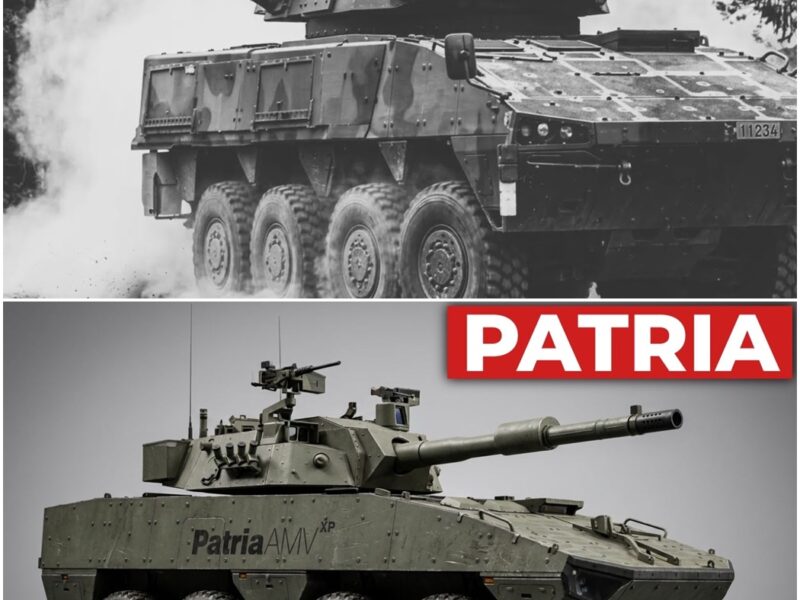
Why This ‘Strange’ Finnish 8×8 Made 9 Nations Trust It With Their Soldiers’ Lives D
2004. The Patria vehicles factory, Hemliner, central Finland, 90 km north of Helsinki. Deep inside a country most people associate with sauners, forests, and silence. Not armored warfare. A vehicle rolls off the production line. Eight wheels, 26 tons of welded steel and aluminium, a hull so flat and angular it looks more like a shipping container bolted onto tires than a machine designed to carry soldiers into combat. The proportions seem wrong.
The country seems wrong. Finland, a nation of 5 and a half million people with no colonial ambitions, no expeditionary tradition, and no history whatsoever of exporting armored vehicles, has just started serial production of what it claims is the most advanced modular wheeled carrier on Earth. It looks strange.
It looked like an outsers’s guess at what a military vehicle should be. It would go on to be ordered by nine nations across three continents, built under license in five countries, deployed into active combat in Afghanistan, Yemen, and Ukraine, survive direct hits from rocket propelled grenades that should have killed everyone inside, and earn a nickname from the Taliban that translated as the Green Devil.
More than 1,600 have been contracted. Production lines are still running in Finland, Poland, Slovakia, and Japan. The order books are still growing. Its designation is the Patria AMV, the armored modular vehicle, and it is the most commercially successful Western 8 by8 of the 21st century. To understand why the AMV exists, you need to understand the problem Finland faced in the mid 1990s. The Cold War was over.
The Soviet Union, Finland’s enormous eastern neighbor, had collapsed into the Russian Federation. But geography had not changed. Finland still shared a 1300 km border with Russia, still operated in Arctic conditions where winter temperatures dropped to -40° C, and still needed to move infantry across frozen terrain, through boreal forests, and across rivers that froze solid in December and flooded violently in spring.
The vehicle Finland relied on was the Sissu XA180, a 6×6 armored personnel carrier designed in the 1980s. It had served well, but it was reaching the limits of what its chassis could accept. It could not carry the weight of modern composite add-on armor. It could not accommodate the new generation of remote weapon stations, digital battle management systems, and countered equipment that every NATO partner was now demanding.
And crucially, it could not be reconfigured quickly for the dozen different battlefield roles, from heavy mortar carrier to ambulance to anti-tank platform that a small army with a limited defense budget needed from a single vehicle family. In 1995, Finnish army headquarters launched a formal investigation into next generation armored vehicle concepts.
Patriot Vehicles, the Hemliner based subsidiary that traced its industrial lineage back to the wartime truck works founded in 1943, began internal concept work the following year. The conclusion was decisive. Only an 8×8 wheel configuration offered the payload capacity, internal volume, and mine protection mass that the Finnish defense forces required, while still preserving the strategic mobility to use Finland’s narrow roads and lightweight bridges without destroying them.
The vehicle had to be modular from the ground up, one common hull, dozens of possible configurations, every turret, sensor package, communication suite, and mission kit swappable between variants without cutting steel. A full concept study was ordered in 1999 and completed in 2000. The first prototype was ready for testing in November 2001.
Serial production began in 2004. Finland ordered 62 armored personnel carriers fitted with Kongsburg Protector remote weapon stations plus 24 vehicles armed with the extraordinary Amos twin barrel 120 mm automatic mortar, a weapon system unique to Finnish and Swedish service. The vehicle itself was a masterclass in practical engineering.
Designed for the worst operating conditions on Earth, the baseline AMV measured 7.7 meters long and 2.8 m wide. Power came from a Scania DI12 inline six-cylinder diesel engine producing 480 horsepower, driving all eight wheels through a ZF 7-speed automatic transmission. Top road speed exceeded 100 kmh.
Operational range stretched beyond 800 km on a single tank of diesel. Every wheel sat on fully independent hydronneumatic suspension. a feature that gave the AMV a ride quality across broken ground that crews from other nations would later describe as transformative compared to their own vehicles.
The drive line included a central tire inflation system, run flat inserts on every wheel, hydraulic disc brakes with ABS, and steering on all four front wheels, and the vehicle was fully amphibious out of the factory, propelled through water by twin shrouded propellers at speeds up to 10 kmh. No preparation kits, no flotation screens.
Drive to the riverbank, drive in, drive out the other side. Yeah, protection was the key to everything. The baseline hull offered ballistic resistance to 7.62 mm fire. Modular add-on armor kits could scale that protection upward to defeat 14.5 mm heavy machine gun rounds across the frontal arc.
Mine protection beneath the V-shaped belly withtood up to 10 kg of TNT equivalent. And because the chassis had been designed from the first sketch to accept additional weight, the armament options that could be mounted on it spanned the entire NATO weapons catalog. Remote weapon stations with 50 caliber heavy machine guns for the basic APC variant.
The Italian Oto Malara hitfist 30P turret with a 30 mm Bushmaster chain gun for the infantry fighting vehicle. The Patriot designed Nemo singlebarrel 120 mm turreted mortar for fire support. even Russian BMP3 turrets mounting a 100 mm main gun for customers with unusual requirements. One chassis, 16 proven configurations, three continents, and climbing.
Now, before we get into where the AMV actually fought and how it performed under fire, if you are enjoying this deep dive into Finnish armored vehicle engineering, hit subscribe. It takes a second, costs nothing, and helps the channel grow. The AMV’s first and most consequential export customer was Poland.
In December 2002, Warsaw selected the Patria design over the Swiss Piranha and the Austrian Panda to replace its fleet of aging Soviet era BTR carriers. Poland did not simply buy the vehicle. Poland built it. A licensed production agreement established a dedicated factory at Vskov’s Aquad Manniche in Smovva Schlones upper Cellesia and the Polish variant received a new name KTO Rosomak the Wolverine.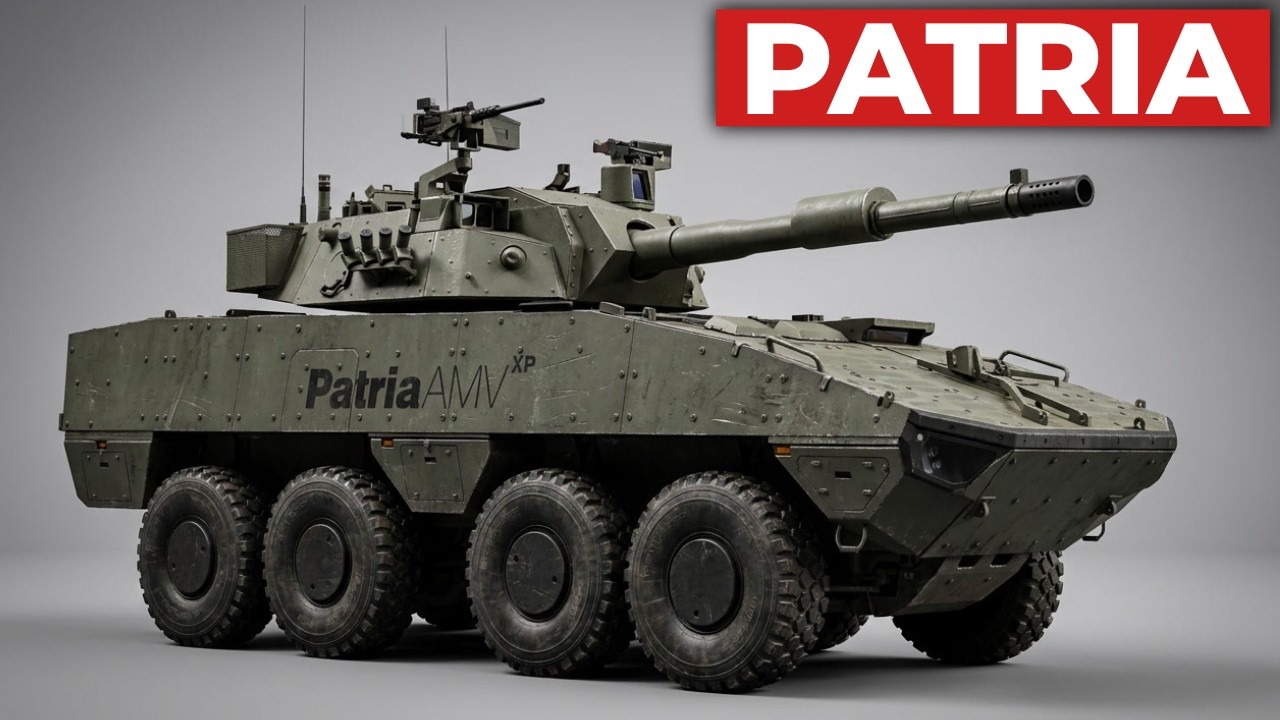
Initial orders called for 690 vehicles. The number kept climbing. By 2017, Polish domestic content in each Rosomarmac had risen from 21% to over 94%. By 2025, more than 1,090 vehicles had been delivered or placed on order in 16 different configurations. Poland had turned a finished design into the absolute backbone of its entire mechanized infantry force.
Then came Afghanistan. From 2007 onward, Poland deployed Rosamax under Task Force White Eagle in Gazny Province, one of the most violent regions in the entire International Security Assistance Force area of operations. Over 100 vehicles rotated through the theater. The first serious test came quickly.
In early 2008, an uparmored Rosamac operating near Gazny City was struck by two RPG7 rockets in a single engagement. The shaped charge warheads detonated against the composite add-on armor panels. The crew felt the concussion the hull held. The vehicle returned fire with its turret-mounted 30mm cannon, completed its patrol, and drove back to its forward operating base under its own power.
Every soldier inside walked away alive. The Taliban noticed, according to multiple defense media sources, insurgent fighters in Gazny province gave the vehicle a nickname. The Polish Green Devil, theater specific upgrades followed rapidly. The Rosomac M1 variant received steel and composite applique armor, wire cutters mounted above the hull, rearward-f facing cameras, and an acoustic gunshot detection system that could identify the direction of incoming fire within seconds.
The M1M added anti- RPG slat cages manufactured by Chineti Q, electronic counter, IED jammers, and American Blue Force tracker terminals. The extra mass eliminated the vehicle’s amphibious capability entirely, but in the mountains and bone dry valleys of Gazny, nobody needed to swim. Not every encounter ended without loss.
On December 19, 2009, an improvised explosive device detonated beneath an M3 variant, rolling the vehicle violently and killing the gunner who had been standing exposed in the open weapon station. On October 23, 2011, Sergeant Marius Depura of the 15th Kajjika Mechanized Brigade was killed during a combat patrol when an IED struck his Rosac in Gazny province.
The helport at his forward operating base was subsequently named in his honor by Brigadier General Pota Buazosh. Depurua left behind a wife and a young daughter. Over the full course of Poland’s Afghan deployment, eight Rosamacs were permanently destroyed. 44 Polish soldiers were killed in total across all vehicle types.
But the Rosamax survival rate under fire cemented its reputation among every NATO nation watching. The Hull held when it was supposed to hold. Crews survived hits that would have killed them in older vehicles. Beyond Afghanistan, the AMV saw combat in Yemen with the United Arab Emirates. From 2015 onward, Emirati forces deployed AMVs fitted with slat armor and remote weapon stations along the Yemen West Coast during offensives against Houthi forces.
Some of these vehicles carried the unusual Russian BMP3 turret, mounting a 100 mm gun and a coaxial 30 mm cannon on a Finnish hull. According to army recognition, the AMV proved its combat credentials in Yemen under harsh desert conditions that bore no resemblance to the Finnish Arctic it was designed for.
Then came Ukraine. In April 2023, Poland ordered 100 Rosamax for delivery to Ukrainian forces fighting Russia’s full-scale invasion. The first vehicles reached Ukraine’s 21st mechanized brigade by July of that year. Ukrainian crews reportedly praised the vehicle’s cross-country mobility and the survivability of its hull against artillery splinters and Lancet kamicazi drone strikes.
As of mid 2026, open- source intelligence trackers have documented seven Rosac losses in Ukrainian service. In a war that has consumed thousands of armored vehicles on both sides, seven losses from an active combat fleet is an extraordinary survival rate. On paper, rivals look formidable. The American Striker is battleproven across two decades of operations in Iraq and Afghanistan, but it weighs 17 tons, carries only 350 horsepower, and has never been amphibious.
The German Dutch boxer is heavier still at 38 12 tons. And while its modular mission module system is genuinely innovative, its multinational production consortium makes license deals far more difficult to negotiate. The Swiss Piranha 5 is a direct commercial rival, but General Dynamics controls its export rights, and its amphibious capability has been eliminated in the current variant.
The AMV undercuts them all on the single metric that matters most to army shopping for an 8×8 payload to weight ratio. The AMVXP, the current production standard announced at DSEI in 2013, carries 15 tons of usable payload on a 32-tonon gross chassis. That means armor, turrets, sensors, communications equipment, and active protection systems can be added, removed, and reconfigured without fundamentally rebalancing the vehicle.
No other Western 8×8 offers that engineering margin. The export record is the proof. Croatia took 126 assembled under license at Jurrojakovich. Sweden ordered 113. Slovakia signed a €447 million euro contract in 2022 for 76 vehicles with the Slovakmade Tur 30 turret. And in December 2022, Japan selected the AMVXP to replace its aging Kamatsu Type 96 carriers.
Japan Steel Works began local production at its Moruran plant in September 2025, making Japan the ninth operator nation. The story is not without its shadows. Finnish courts convicted Patria executives of aggravated bribery connected to the Croatian deal. The Slovenian contract became entangled in a political scandal that saw former Prime Minister Janis Janser convicted, then acquitted on appeal with the original 135 vehicle order slashed to just 30.
South Africa’s project Hufistister, which was supposed to produce 264 AMV-based Badger infantry fighting vehicles, became one of the most catastrophic defense procurement failures in modern African history. 18 years and billions of rand spent with zero production vehicles delivered. These cases are the price of building a vehicle good enough that everyone wants it, but selling it through channels not everyone can keep clean.
2004, the Patria factory, Hem Lina, Finland. An angular eight-W wheeled vehicle rolls off a production line in a country with no tradition of armored vehicle exports. Built by a company most of the world has never heard of. Designed for a war Finland hoped would never come. It was not the cheapest option on the market.
It was not the most heavily armored out of the box. It came from a nation of 5 12 million people squeezed between Scandinavia and Russia with no empire, no expeditionary doctrine, and no reason whatsoever for anyone to expect that its armored vehicle would dominate the global export market. And yet it worked.
In the mountains of Gazny province, where RPG warheads detonated against its hull and the crew walked away. In the deserts of Yemen, where it fought in heat it was never designed for. On the battlefields of eastern Ukraine where it carries soldiers into a war that will define European security for a generation.
In the procurement offices of Warsaw, Stockholm, Bratislava, Zagreb, Ljubljana, Abu Dhabi, and Tokyo, where generals and politicians chose it over American, German, and Swiss alternatives. again and again and again. Nine nations bought it. Five countries built it under license. Soldiers in 16 configurations have trusted their lives to it on three continents.
That is not luck and it is not marketing. That is Finnish engineering designed for the Arctic, tested by war, and proven by the only metric that has ever mattered, survival.