Why This ‘Stubborn’ British Scout Car Outlived Every Tank Built To Replace It D
March 25th, 2025. Nadia, Luhansk region, Eastern Ukraine. A British armored car rolls down a shell-pocked track, framed in drone camera footage that would circle the world within hours. Its hull is wrapped in steel cage armor. Its radio mast bristles with electronic warfare jammers tuned against Russian first-person view drones.
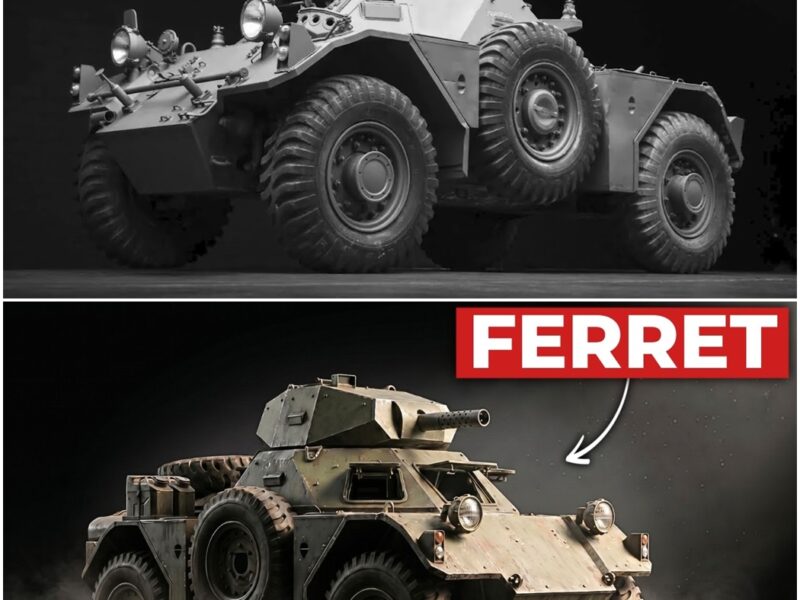
The vehicle is a Daimler Ferret Mark 1. It was built in Coventry before the Cuban Missile Crisis. It is 73 years old, the oldest British armored car firing in anger 21st century is the same type of vehicle that patrolled Belfast in 1972. Climbed the mountains of Radfan in 1967 and led the Queen’s Royal Irish Hussars through the breach into Kuwait in 1991.
Every Cold War armored vehicle designed to replace it has long since gone to the scrapyard. The Ferret has outlasted them all. This is how that happened. The story begins in October 1948 at the Daimler Fighting Vehicle Drawing Office in Coventry. The War Office had issued a requirement for a new light armored scout car to replace the Dingo.
The little pre-war Daimler that had carried reconnaissance troops across the Western Desert and through Normandy. The man put in charge of the design was named Sid Shellard. Described in company records as the brains behind the Fighting Vehicle Office. His understudy, Ted Wilday, was a Dingo and Daimler armored car veteran.
They were not starting from a blank sheet. They were refining something that already worked. The problem was specific. The British Empire was shrinking, but the small wars were multiplying. Malayan jungle, Cypriot mountains, Kenyan bush, Arabian wadis, urban streets in a dozen restless colonies. What was needed was not a tank.
It was a tiny, tough, reliable vehicle that two men could drive almost anywhere, maintain with hand tools, and trust with their lives. The Dingo had done this job in one war. Its successor would have to do it for every war that followed. The first prototype was delivered for trials in June 1950. By mid-1952, the first production vehicles were rolling off the Coventry line.
Production would continue until 1971. By the time the last Ferret left the factory, 4,409 had been built across roughly 16 subvariants. A figure cross-referenced between Wikipedia, Think Defense, Tank Encyclopedia, and the Daimler Ferret Project Archive. The Ferret family is sprawling, but the combat story belongs overwhelmingly to one member of it, the Mark 2/3. Quick moment here.
If you’re finding this deep dive into British engineering worthwhile, a subscribe genuinely helps the channel keep making them. Now, back to the design that carried this vehicle into history. The Mark 2/3 was the standard British Army combat Ferret. Every armored regiment fielded a reconnaissance troop of 12 of them, plus two per squadron headquarters. It weighed 4.
4 tons combat loaded. It was 3.835 m long, 1.905 m wide, 1.879 m tall. A crew of two sat inside, commander and gunner in the turret, driver in front. The armor was welded steel, 6 mm at the rear, 16 mm on the hull front and turret face. That was enough for small arms and shell splinters. It was never enough for mines, rocket-propelled grenades, or heavy machine gun fire.
Anyone who rode in a Ferret understood what it could and could not stop. The heart of the vehicle was a Rolls-Royce B60 Mark 6A inline six-cylinder petrol engine. 4.26 L, 129 brake horsepower at 3,750 revolutions per minute. The same engine family powered the Saladin armored car, the Saracen personnel carrier, and the Champ utility vehicle.
One engine, one spares pool, one set of trained mechanics across half the British fleet. This was logistical thinking, not just engineering. The transmission was a Daimler five-speed preselector epicyclic gearbox driving through a fluid flywheel. There was no conventional clutch.
All five gears were available in reverse, meaning a Ferret could retreat as fast as it could advance, a capability that would save crews in Belfast ambushes two decades later. The driveline was H-form with permanent four-wheel drive and tractor constant velocity joints. Each wheel had independent coil suspension with 406 mm of travel.
That travel figure is remarkable for the era. It is what let the Ferret climb things a Jeep could not. One myth deserves correction here. The Ferret did not have four-wheel steering. Only the front wheels turned through a recirculating ball mechanism, 3.2 turns lock to lock, 12.2 m turning circle.
Four-wheel steering had been a feature of the original Dingo Mark 1. It was deleted because drivers could not manage it. That lesson stuck. Top speed on road was 93 km/h, around 58 mph. Range was 300 km. The tires were 9 by 16 run flat, letting the vehicle limp 80 km after being shot through. Armament on the Mark 2/3 was a single .
30 caliber M1919 Browning machine gun in a one-man manually traversed turret, later replaced by the 7.62 mm general-purpose machine gun. Six smoke grenade dischargers pointed forward. The Mark 4 and Mark 5 added bigger wheels, disc brakes, and in the case of the Mark 5, a wide flat aluminum turret mounting four British Aircraft Corporation Swingfire anti-tank guided missiles.
Roughly 30 to 50 Mark 5s were built, the exact figure disputed between sources, but these were specialists. The Mark 2/3 was the everyman Ferret. And the everyman Ferret is the one that fought. Combat started almost immediately. In November 1956 during Operation Musketeer at Suez, the 6th Royal Tank Regiment landed at Port Said with Ferrets accompanying the airborne and armored car elements.
Through the late 1950s, the 1st King’s Dragoon Guards patrolled the Mantin Pass in Malaya in Mark 1/2s, the three-crew variant built specifically for jungle operations. Cyprus, Kenya, Oman. By the early 1960s, there was barely a corner of Britain’s contracting empire without a Ferret somewhere on patrol.
Then came Aden. June 20th, 1967. The Arab Armed Police mutiny in Crater District. Major Brian Malcolm’s patrol from the Royal Northumberland Fusiliers was caught in the open and cut down. A relief column was ordered in. Second Lieutenant John Shaw rode forward in a Humber armored personnel carrier supported by a Saladin and a Ferret of the Queen’s Dragoon Guards.
According to contemporary accounts collected by Britain’s Small Wars, the fire was so intense that the paint began flaking off the inside of the armor. Arriving at the ambush site, the column found eight dead and two burning Land Rovers. The Saladin commander requested permission to use his 76 mm gun. Permission was refused.
In the Radfan Mountains, Ferrets of the 1st Royal Tank Regiment and the 4th/7th Royal Dragoon Guards fought in ambushes that never made the London papers. One soldier who rode in a Mark 2 described the vehicle in words that stuck. It was very sturdy in both urban and mountainous terrain, he said, and could destroy a terrorist’s car when used as a ram. That was the Ferret.
A battering ram with a machine gun, small enough to fit down a crater alley, tough enough to survive getting there. Rod Blencarn, a reconnaissance platoon non-commissioned officer with the 1st Battalion Lancashire Regiment, was wounded in the turret of a Ferret when, as he put it, a sniper squeezed a round through the open flap he was peering out of. The Ferret was not invulnerable.
It was survivable. There is a difference. While Aden was burning, another Ferret campaign was being fought in the swamps of Borneo. From October 1962, the Queen’s Royal Irish Hussars deployed Ferrets on jungle operations in Brunei and Sarawak against Indonesian insurgents during Confrontation. The Mark 1/2 variant with its extra crewman and its fixed low-profile superstructure had been built for exactly this.
Dense canopy, narrow tracks, poor visibility, ambushes at 15 m. The Ferret was one of the few armored vehicles small enough to operate there at all, but the longest combat deployment of the Ferret’s career was not in any colony. It was in a part of the United Kingdom itself. Northern Ireland, 1969 to roughly the mid-1990s, Operation Banner.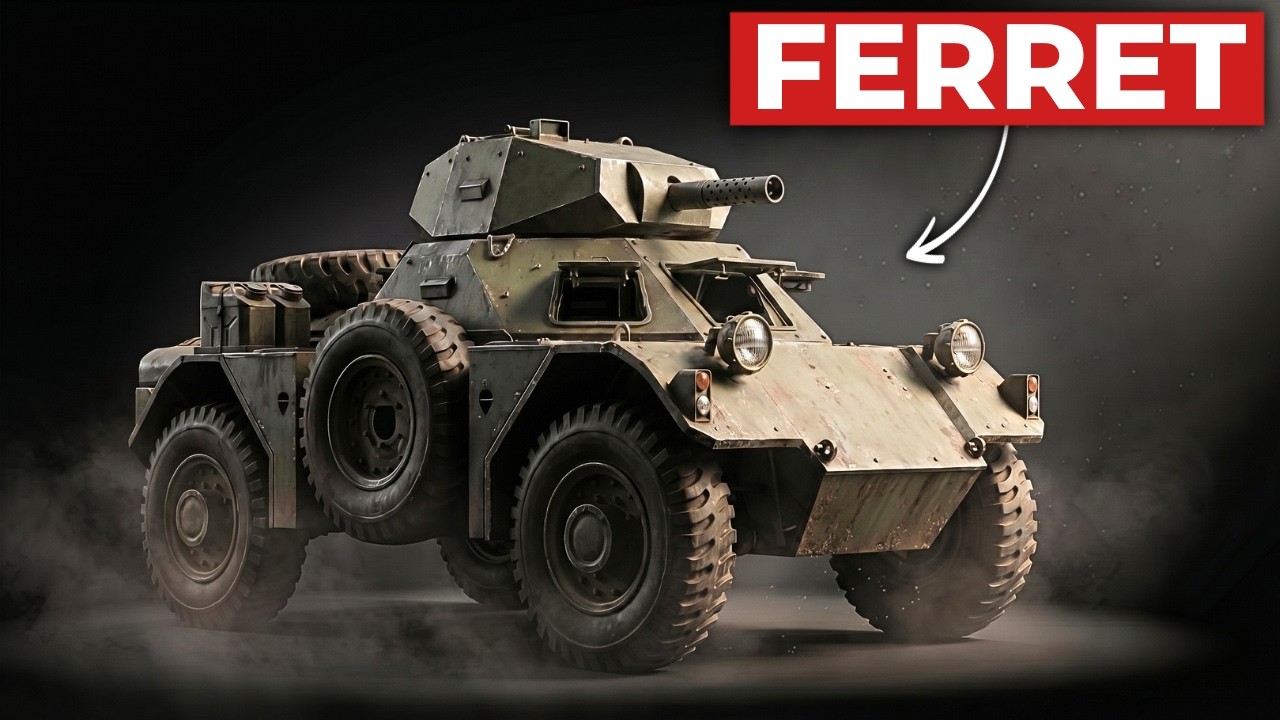
The vehicle was called the Dalek by Belfast residents. According to the National Army Museum’s collection records, the turret, the thin hull, the menacing silhouette at the end of a terrorist street, the Browning machine gun barrel pointing out. From 1973, the Ferret was pulled from routine urban street patrols as too provocative.
It moved to the rural border areas, to South Armagh, to Fermanagh, to the places the army called bandit country. There it was welded with mesh headlight guards, and beside the turret, an improvised vertical angle iron blade known as the cable cutter. Local crews described it as designed to sever wires stretched across country lanes to decapitate a vehicle commander.
The incidents accumulated. May 12th, 1971. A remote-controlled improvised explosive device detonated at the junction of Glen Road and Monaro Road in Belfast. According to the Hansard parliamentary record of May 18th that year, the target is thought to have been a Ferret scout car which was passing at the time.
No damage, no arrests. August 1971, Cullyhanna, South Armagh. Corporal Peter Webb of the 14th/20th King’s Hussars was commanding a Ferret approaching the customs post when his vehicle was hit by a Claymore mine and automatic fire. According to the Horsepower Museum regimental record, with a half-inch bolt driven into his jaw, he calmly returned fire and gave his driver the order to reverse out of trouble.
Webb was awarded the Military Medal and invested at Buckingham Palace in 1973. July 1972, Lena Doone, Belfast. Second Lieutenant Robert Williams, winner of the 14th/20th King’s Hussars, was shot dead by a Provisional Irish Republican Army sniper while commanding a Ferret patrol. His driver, Trooper Brian Hansel, wounded in the shoulder, drove his dying officer to Musgrave Park Hospital and was mentioned in dispatches, August 1972, South Armagh.
A Ferret was destroyed by a landmine of approximately 600 lb of explosive. One soldier was killed. That incident is widely cited in regimental histories and in Toby Harnden’s book Bandit Country, though the specific casualty’s identity remains unconfirmed in the open sources we could verify. The units cycled through 14th/20th King’s Hussars, 5th Royal Inniskilling Dragoon Guards, 4th Royal Tank Regiment, Queen’s Own Hussars, Household Cavalry, 17th/21st Lancers.
For more than 20 years, the Ferret was the armored face of a counterinsurgency that nobody wanted to call a war. Now, here we need to correct something. There is a popular story that during the Iraqi invasion of Kuwait on August 2nd, 1990, Kuwaiti Ferrets fought Iraqi T-72 tanks at the Battle of the Bridges at Jahra.
It makes for a dramatic story. It is not what happened. According to Global Security’s inventory records, Kuwait owned around 90 Ferret Mark IIs in 1990, but they were explicitly listed as in storage. The 9-to-10-hour delaying action at Jahra was fought by Colonel Salem Masoud Al-Sarraf’s 35th Armored Brigade using 36 Chieftain Mark V 2K tanks, supported by BMP-2 infantry fighting vehicles, M113 armored personnel carriers, M109 A2 self-propelled howitzers, and M901 antitank vehicles. This is the order of battle confirmed in the United States Army Armor Magazine reconstruction from September-October 1995, in the Institute for Defense Analyses Iraqi Perspective Study from 2008, and in Reuters’ interviews with Colonel Salem himself. What Colonel Salem said about his men at Jahra deserves to be remembered regardless. “We fought,” he told Reuters, “because we thought we were all going to die anyway, and in such
situations you fight tooth and nail.” Those Chieftains held the Iraqi 3rd Armored Division long enough to let the Kuwaiti royal family escape south. That is the real Battle of the Bridges. The Kuwaiti Ferret’s actual combat record was earlier and quieter. After the Yom Kippur War of 1973, Kuwait sent a task group known as Al Jahra Force to Syria, equipped with Vickers main battle tanks, Saracens, and Ferrets.
They held positions on the Golan front until September 1974. Documented detail is sparse, but they were there. The Ferret’s own war with the Iraqi army did come. It just came later and on the other side. February 1991, Operation Granby. A single Ferret, a Mark 1+1 nicknamed Talliard, deployed with the Queen’s Royal Irish Hussars Battle Group of the 7th Armored Brigade for the liberation of Kuwait.
By this point, the vehicle was 39 years old as a design. The Queen’s Royal Irish Hussars Museum describes its role directly. Talliard was used to marshal all Irish Hussar Battle Group vehicles by leading them into the correct column in preparation for their move through the breach. During the next phases, the FSC along with three others became affectionately known as Ferret Force, providing close protection to regimental headquarters as the advance to contact continued.
During one incident when RHQ came under friendly machine gun fire, the benefit of having a Mark with the turret soon became evident. 39 years after Sid Shellard’s drawing office prototype rolled out of Coventry, a Ferret was riding in the spearhead battle group of the last great maneuver war of the 20th century. Then it just kept going.
Compare what the rest of the world had built to replace it. The American M114 armored command and reconnaissance carrier entered service in 1961. General Creighton Abrams called it a failure in 1973. Only around 615 were built before the program was killed. The Soviet BRDM-2, fielded in 1962, was larger at 7 tons, amphibious, and armed with a 14.5 mm heavy machine gun.
7,200 were built. It was a more capable combat vehicle in raw firepower, but it was never sold to any operator outside the Warsaw Pact sphere. The French Panhard AML 90. Panhard’s engineers, having reportedly studied the Ferret closely before designing it, mounted a 90 mm rifled gun and outsold the Ferret on the export market after the mid-1960s because customers wanted a scout that could actually fight tanks.
4,800 of those were built. The German Spähpanzer Luchs, entering service in 1975, weighed 21 tons on eight wheels, a completely different class of vehicle. Against the M114, the verdict is unambiguous. The Ferret did everything the M114 was supposed to do, and it did it for 40 years in British service rather than 12.
Against the BRDM-2, the Ferret is outgunned and outprotected, but it is smaller, quieter, more reliable, and it was bought by dozens of nations the Soviets could never reach. Against the AML, the Ferret lost the export race on firepower, but won the longevity race on simplicity.
And longevity is where the story becomes extraordinary. The International Institute for Strategic Studies Military Balance for 2024 still lists active Ferret inventories in roughly 11 nations. Cameroon holds around 15, Central African Republic around eight, Indonesia around 55, Kenya around 12, Uganda around six, Zimbabwe around 15.
Malaysia’s Royal Malaysia Police still runs them. Burkina Faso, Malawi, Nepal is the headline. 40 Mark IV Ferrets delivered in 1981 and 1995, according to Stockholm International Peace Research Institute transfer records, remain on Nepali’s army strength per the 2024 Military Balance. Parade footage from Kathmandu confirms running vehicles.
Nepal is almost certainly the last army in the world operating the Ferret as a formed element rather than as a museum piece. Ukraine is the other great longevity story. At least one Mark purchased in the United Kingdom and shipped through volunteer channels appeared with Ukrainian forces in August 2022.
That second Mark the one with the anti-drone cage and the multi-frequency jammers, was filmed near Nadia in March 2025 conducting counter-unmanned aerial vehicle work. The reason this is possible at all traces back to something Sid Shellard’s team got right in Coventry in 1950, mechanical simplicity, sealed electrics, a body that can be welded, bolted, and modified by any competent workshop.
A vehicle that does not need a manufacturer to stay alive. A project Ferret today can be bought in the civilian market for around 4,000 lb. A runner, 15 to 30,000 lb. A concours example, 40 to 60,000 lb. The Military Vehicle Trust in Britain has 7,000 members. Tank Museum Bovington holds multiple examples, including a cutaway and a former Australian Mark Swingfire Carrier.
The Ontario Regiment Museum in Oshawa keeps the largest operational Canadian fleet running. Return to that Ukrainian track, March 2025. The Ferret is not the best armored car Britain ever built. The Saladin had more firepower. The Fox had more modern sensors. The Scorpion had more speed. The Ferret was the right armored car for every small war Britain actually fought.
From the mountains of Radfan to the streets of Belfast to the breach line at Kuwait, it was simple enough to be maintained with hand tools. It was small enough to fit down a crater alley. It was tough enough that its users never quite got round to retiring it. 73 years and counting, the Ferret has outlasted the empire it was designed for, outlasted the Cold War it was built to fight, and outlasted every contemporary that was supposed to replace it.
On a Ukrainian track in 2025, Sid Shellard’s little Coventry scout car is still doing the job. Nobody planned that. That is British engineering.