Why This ‘Tiny’ British Patrol Vehicle Built With F1 Technology Replaced The Army’s Mobile Coffins D
June 28th, 2004. Basra, Southern Iraq. A British Army Land Rover turned off a dusty road at the end of a routine patrol. Inside sat Fusilier Gordon Gentle, 19 years old from Pollok in Glasgow, 6 weeks in country. A roadside bomb detonated beneath the vehicle. Gordon Gentle was killed instantly. His mother, Rose, answered the knock at her door the next morning.
He would become the first of 37. 37 British soldiers killed in a vehicle that troops on the ground had already begun calling the mobile coffin. A Land Rover designed in the 1990s to stop thrown bricks and pistol rounds in Northern Ireland. A flat belly, no V-shaped hull, no underbody blast protection. And the Ministry of Defense kept sending it into Iraq, then Afghanistan, then everywhere the insurgents had learned to bury explosives under the road.
For 10 years the families fought. When the vehicle that finally replaced the Snatch Land Rover arrived in Helmand Province, it did not come from the traditional British defense giants. It came from a 6 Workshop that it working week building engines for McLaren. The Snatch Land Rover was never meant for this war.
It was a derivative of the Land Rover Defender 110, developed in the early 1990s for internal security work in the streets of Belfast and Derry. Its composite armor was optimized for low-velocity pistol rounds, thrown bricks and petrol bombs. Its belly was flat. Its ground clearance was poor. Its seats sat directly above the chassis rails with no blast geometry beneath them. None of this mattered in Ulster.
All of it mattered in Iraq from 2004 onwards. Shia militia groups in Southern Iraq began receiving explosively formed penetrators, weapons that according to British and American intelligence assessments were supplied through networks originating in Iran. These were not ordinary roadside bombs. They fired a molten copper slug that could punch through the side armor of an American Abrams tank.
Against a Snatch Land Rover, they were catastrophic. In Afghanistan, the threat evolved differently. Taliban bomb makers buried pressure plate mines under tracks and culverts using low metallic content to defeat standard detection equipment. Some contained up to 20 kg of homemade explosive.
A Snatch struck by a device of that size did not simply fail. It was torn apart around its crew. July 16, 2005. Alamara, Iraq. Second Lieutenant Richard Shearer, Private Leon Spicer, and Private Philip Hewitt of the 1st Battalion Staffordshire Regiment were killed by a roadside bomb in their Snatch. Hewitt was 21. His mother, Susan Smith, would later reveal, according to a statement released by the family solicitors at Hodge Jones and Allen, that her son had lied to her about which vehicle he was driving. He told her he was in a Warrior armored fighting vehicle so that she would not worry. June 17th, 2008. East of Lashkar Gah, Afghanistan. Corporal Sarah Bryant, the first British servicewoman killed in Afghanistan, died with Corporal Shaun Reeve, Lance Corporal Richard Larkin, and Trooper Paul Stout when their Snatch was struck by an improvised explosive device. Four dead in a single vehicle. Rose Gentle founded Military Families Against the
War. Susan Smith became the lead claimant in a legal campaign that would take nearly a decade. In 2013, the UK Supreme Court ruled in Smith and others versus Ministry of Defense that the families could sue the MOD for negligence, and unanimously that British soldiers serving abroad remained within UK jurisdiction for human rights purposes.
The solicitor representing the families, Jocelyn Cockburn, stated on the record that the Snatches had been known to be inadequate for years, and that troops had nicknamed them mobile coffins. In July 2016, the Chilcot Iraq Inquiry formally identified the failure to replace the Snatch as one of the principal equipment failings of the war.
Defense Secretary Sir Michael Fallon wrote personally to Sue Smith and the other bereaved families, accepting that decisions taken at the time had delayed the arrival of alternative protected vehicles that could have saved lives. By then, the replacement had already been in Afghanistan for 5 years.
The company that designed it is called Ricardo. It was founded in 1915 at Shoreham-by-Sea by Sir Harry Ricardo, the engineer who designed the power plant for the first British tank. Over the following century, Ricardo became one of the most respected engineering houses in Britain with a specific reputation in high-performance powertrain work.
The Bugatti Veyron gearbox was built at Shoreham. The McLaren supercar engine is manufactured at Shoreham. Ricardo runs transmission programs for multiple Formula 1 teams. In the company’s own published materials, it states plainly that it employs many ex-Formula 1 engineers within its defense team. In 2009, the Ministry of Defense opened the light protected patrol vehicle competition.
The requirement was specific. The new vehicle had to be small enough to drive through the gateway of an Afghan walled compound, light enough to be slung beneath a single Chinook helicopter, tough enough to survive the blast of the improvised explosive devices that were killing soldiers in Snatches every month. No vehicle in British service met all three requirements.
No vehicle in American service did either. Force Protection Europe, the British arm of an American mine protection specialist, approached Ricardo to co-develop a clean sheet design. The technical lead was Paul Tarry, director of special vehicles at Ricardo. According to his later interview with Forces News, the team started the vehicle in 2009 and delivered the first prototype in 2011.
The biggest automotive challenge, Tarry said, was protecting every single driveline component inside a V-shaped blast hull, when conventionally those components would sit on a standard ladder frame truck chassis. The solution was lifted directly from Formula 1 practice. A composite survival pod, manufactured using glass reinforced plastic and the same layup techniques used for F1 monocoque tubs, housed all six crew.
This pod bolted to a separate armored steel chassis containing the engine, transmission, fuel tank, and driveline. Ricardo engineers called it the skateboard. The whole architecture was modular. The pod could be unbolted and lifted clear of the chassis within hours for major battle damage repair.
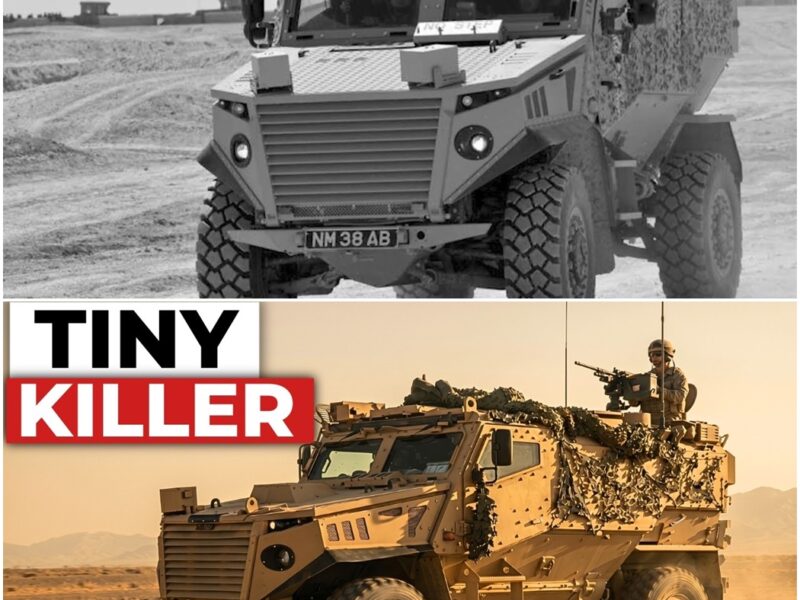
The engine and gearbox could be swapped as a complete power pack in 30 minutes. The specification confirmed the rest. A Steyr M16 monoblock 3.2 L inline six turbo diesel, a ZF six-speed automatic transmission, permanent four-wheel drive with four-wheel steering, run-flat tires, 7.5 tons combat weight, 5.
32 m long, a turning circle of 12 m, top speed 70 mph, range 600 km, baseline ballistic protection to STANAG 4569 level two, upgradeable with add-on armor kits. And if a wheel station was destroyed by a blast, the wheel was designed to detach cleanly, and the remaining three wheels could drive the crew out of the ambush.
The official Ministry of Defense press release confirmed this last capability in writing. Because Ricardo had a production team at Shoreham already building McLaren road car engines, that same team was put onto the new defense build. Stewart Cooper, Ricardo’s head of motorsport, explained the philosophy in a later company publication.
The most transferable aspect of motorsport to defense, he said, was data collection. The more data captured, the more performance could be extracted. The vehicle went from a blank sheet of paper to full production in less than 2 years. 40 months from contract signature to first operational deployment in Afghanistan.
A defense vehicle program would normally take 10 to 15 years. In September 2010, the Ministry of Defense selected the Ocelot, as it was then called, over the rival Supacat SPV400. The name came from the small South American wildcat the design team had chosen as a code word during development, reflecting the vehicle they were building.
Small, quick, hard to catch. On November 30, 2010, an urgent operational requirement contract was signed. 180 million pounds, 200 vehicles. The Shoreham production line would run through the night for the next 2 years with ex-Formula 1 assembly staff working defense shifts alongside the McLaren engine build.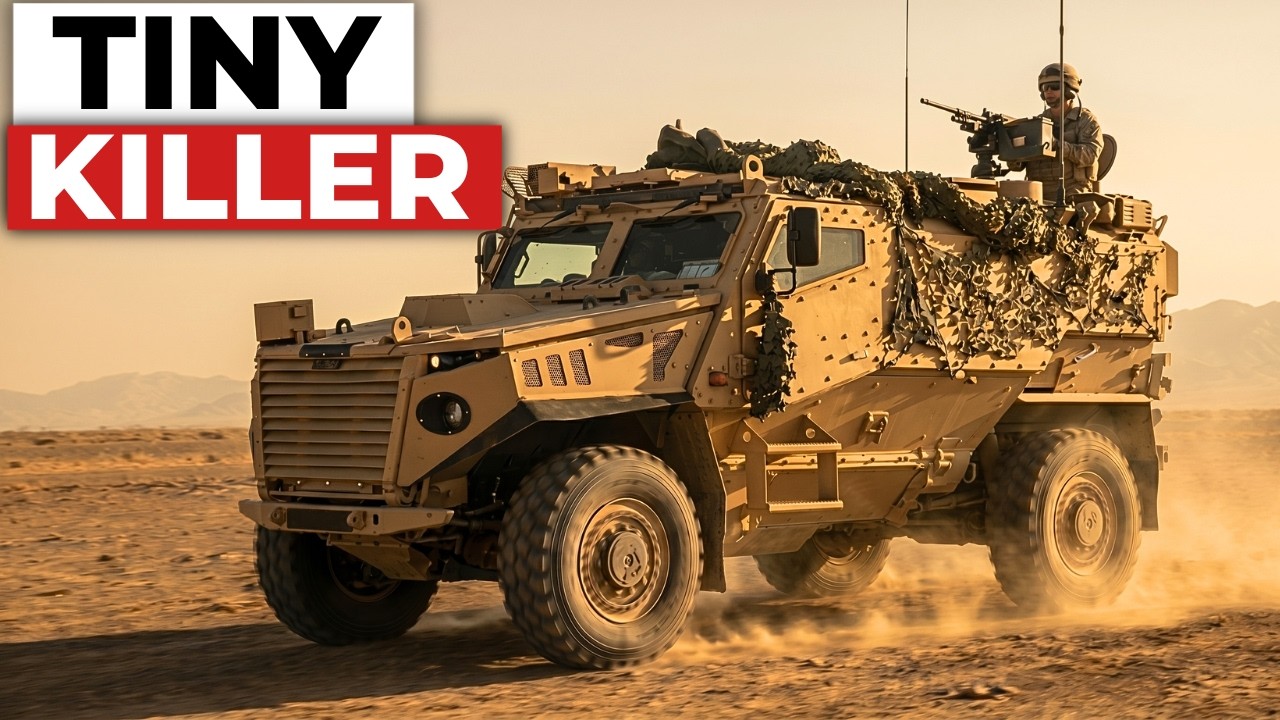
The Army renamed it Foxhound, following the canine convention applied to its protected patrol fleet. Mastiff, wolfhound, ridgeback, husky, jackal, Helmand, if you’re finding this useful, hit subscribe. It costs you nothing, and it genuinely helps this channel keep producing deep dives on British military engineering. Now, the combat record.
June 2012. Camp Bastion, Helmand Province. The first Foxhounds arrived by C-17 from RAF Brize Norton. The operational introduction was led by number five force protection wing of the RAF Regiment, which used the vehicle for airfield security. By October of the same year, Foxhounds were deployed on Operation Herrick 17 with 4th Mechanized Brigade, the formation that would begin the British drawdown from Helmand.
General Sir Peter Wall, then Chief of the General Staff, stated in the Ministry of Defense press release of that summer that Foxhound gave the British Army the latest level of protection available on operations and would play a key role in the army of the future. The vehicle’s combat performance is best measured by what did not happen.
In the public record, no British fatality inside a Foxhound has been identified during the Afghanistan campaign or any subsequent deployment. This is not the same as saying no Foxhound was ever struck. According to crew accounts reported through the defense press, the vehicle was hit on multiple occasions by buried bombs in Helmand and later in Kabul during Operation Herrick.
The V-hull deflected the blast outward. The wheel station detached as designed. The composite pod remained intact. The crew walked out. Compare this to the Snatch record. Forces News reported, citing published casualty data, that between July 2004 and July 2006, nearly half of all British fatalities from hostile action in Iraq and Afghanistan were personnel traveling in Snatch Land Rovers.
Against a similar threat, in similar terrain, with broadly similar operational tempo, Foxhound’s casualty profile was transformed. The comparison with foreign equivalents is just as telling. The American Oshkosh MATV, the workhorse mine resistant vehicle of United States forces in Afghanistan, weighs approximately 12 and 1/2 tons combat loaded.
The Australian Thales Bushmaster weighs 12 and 1/2 tons empty and approaches 15 tons fully laden. The German ATF Dingo 2 weighs a similar 12 and 1/2 tons. Foxhound in its baseline patrol configuration weighs 7.5 tons, almost half. This weight differential mattered enormously in Helmand. A Chinook can sling a Foxhound under its belly. It cannot lift an MATV.
A Foxhound fits through the gate of an Afghan walled compound. An MATV physically does not. A Foxhound can cross the narrow culvert bridges of Helmand’s irrigation system. An MATV falls through them. The trade-off is armor mass. Foxhound’s baseline ballistic protection sits below that of the heavier American and German vehicles, but the design philosophy was deliberate.
The British Army had learned through years of counterinsurgency in Helmand that a vehicle which could not access the population it was meant to protect was militarily useless. Foxhound solved a tactical problem that heavier American vehicles could not. The vehicle is not without its critics. In 2017, a BBC News investigation reported that Foxhounds deployed to Iraq on the counter-Islamic state training mission suffered overheating and breakdowns in desert summer conditions.
An army sergeant responsible for maintaining a small fleet told the BBC on record that the vehicles were a massive waste of money and could not handle the heat. The Ministry of Defense acknowledged the demanding operating environment, but maintained the vehicle was keeping soldiers safe.
Whether this reflected a genuine design limitation or the stress of a tiny fleet being overtasked well outside its intended theater remains disputed among defense analysts. The story is worth telling honestly. The Foxhound is not a flawless vehicle. Over the following decade, the fleet accumulated more than 1 million kilometers of operational mileage.
Legend within the protected community holds that one crew in Helmand survived two buried bomb strikes in the same vehicle in the same month and drove it back to camp on three wheels the second time. This is unverified and may well be apocryphal. It is the kind of story crews tell about a vehicle they have come to trust.
The Ministry of Defense placed follow-on orders across 2012 and 2013. By September 2013, the fleet had grown to 400 vehicles at a cumulative cost of 371 million pounds. That works out at roughly 900,000 pounds per vehicle, broadly comparable to the Dingo 2 and cheaper than the French Serval. Ricardo manufactured 376 of the 400 at Shoreham using the same skilled workforce that built McLaren engines during the day shifts. No export customers followed.
The Ocelot design lost the Australian Land 121 competition to the Thales Hawkei. It was offered to Canada in 2015 and not bought. The British Army remains the sole operator of the type. After Afghanistan, the Foxhound was retained on Operation Toral in Kabul from 2015 to 2021, deployed to Bosnia as a public order variant and exercised across NATO Eastern flank deployments.
The 1st Battalion Royal Irish Regiment took Foxhounds to Norway on Exercise Trident Juncture in 2018 operating at minus 20° C in Arctic conditions the original Afghan specification had never anticipated. No. One Squadron RAF Regiment ran the vehicle through desert heat on Exercise Saif Sareea in Oman the same year.
In November 2023, a 19.76 million pound contract upgraded 50 vehicles to a command variant configuration. Six British infantry battalions were designated as light protected mobility units specifically to operate the fleet. The legacy question is the important one. British protected mobility doctrine before Foxhound assumed that a vehicle was either a Snatch sized patrol Land Rover or a Mastiff sized armored truck.
There was nothing in between. Foxhound created the middle class. It proved that a 7 and 1/2 ton vehicle, designed properly, could deliver mine protection comparable to vehicles twice its weight. General Dynamics United Kingdom is now working on a Mark 2 command and control variant with first examples delivered to the British Army in September 2024.
The fleet has no scheduled out of service date. More than a decade after its first operational deployment, it is still the vehicle British infantry use when the task is too dangerous for a Land Rover and too delicate for a Mastiff. Rose Gentle is still alive. She still lives in Pollok.
She still speaks publicly about Gordon when she’s asked and she did not stop when the legal fight ended. Sue Smith received the letter from Sir Michael Fallon in July 2017 and kept a framed copy. She told the British press at the time that her son had not died for nothing. Neither woman ever rode in a Foxhound. Neither ever met Paul Terry or Stuart Cooper or any of the engineers at Shoreham, but the connection between the Al-Amara bomb and the Ricardo production line is not coincidence.
The Foxhound exists because the Snatch killed people. The composite survival pod exists because the flat Defender floor did not protect the soldier sitting above it. The sacrificial wheel station exists because too many crews had been trapped in burning wreckage with no way out. The 40-month procurement timeline exists because the normal decade and a half defense industry process had already cost 37 British lives.
Every major design decision in the Foxhound is a negative image of a Snatch failure. The Formula 1 engineering was not a marketing story. It was an industrial reality. When the British defense establishment found itself unable to produce a vehicle fast enough to save the soldiers still serving, the work was handed to a Sussex motorsport firm that could.
They delivered in 40 months what the defense industry had not delivered in 15 years. The lesson is not that Formula 1 saves lives. The lesson is that British engineering excellence was available all along. It simply was not in the places the Ministry of Defense had been looking.