“None Of Them Came Back” — How Australian Troops Stopped Taking Japanese Prisoners
“None Of Them Came Back” — How Australian Troops Stopped Taking Japanese Prisoners
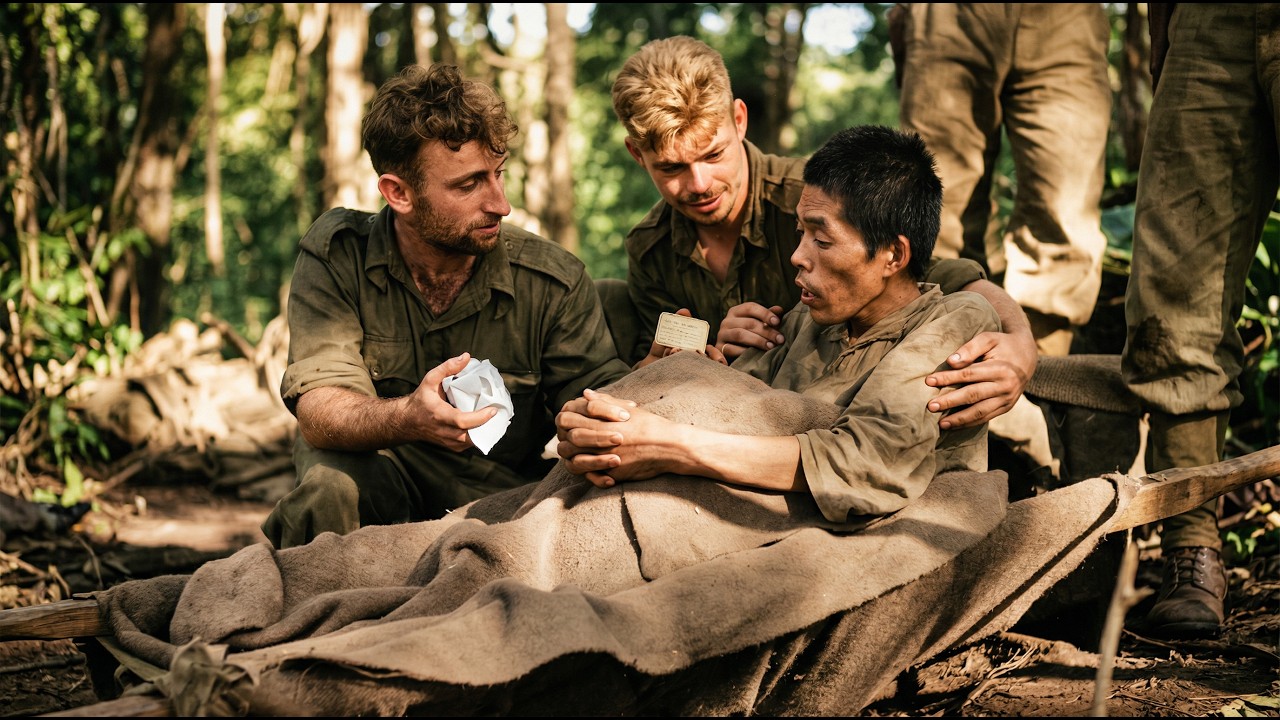
Milne Bay, Papua, September 1942. Australian patrols moved through swamp and churned mud and found the bodies first. Bayonet wounds, torture marks, silence where prisoners should have been. Later reports would record a detail that men in the ranks never forgot. None of the 36 Australians taken alive there survived.
And from that moment, a darker question began to stalk the Pacific war. What happens to an army when it learns that surrender might not save you at all? The air already smelled wrong in New Guinea. Wet earth, fuel, rot. Sweat trapped in uniforms that never really dried. The jungle pressed in so tightly that men could hear a twig break and still not know where death was standing.
Then came stories that were worse than combat. Stories from Ambon, from New Britain, from camps the Japanese had overrun. These stories of men marched away and never seen again. Stories of prisoners beaten, starved, worked to collapse, then killed anyway. Some of it arrived as rumor, some of it as intelligence, some of it as missing names that never came back.
And if you stay with this story, you’ll see why the answer wasn’t a single order. It wasn’t one speech, one massacre, or one moment of rage. It was slower than that and more dangerous because armies do not usually wake up one morning and decide to stop taking prisoners. They harden one patrol at a time, one burial at a time, one discovery too many.
At the beginning, Australian soldiers had gone to war with older assumptions still hanging in the air. Prisoners were supposed to be disarmed, searched, moved to the rear. That was the language of rules, of armies that still imagined war had edges. But the Pacific had no edges. It was fought in kunai grass and mangrove swamp, on ridgelines where wounded man could still pull a grenade pin, in jungle so steep and thick that carrying your own injured was almost impossible, let alone escorting enemy prisoners through miles of mud under fire.
And there was another problem. The Japanese rarely surrendered. That fact mattered more than it sounds. Australian troops were not fighting an enemy shaped by the same battlefield logic they had seen in the Middle East or Europe. Surrender for many Japanese soldiers was shame. Capture was disgrace. Some fought to the last round.
Some feigned death. Some crawled close enough to kill after appearing finished. Some chose suicide over capture. So, from the first battles in Papua and New Guinea, each every approach toward a fallen enemy carried its own private terror. Is he wounded or waiting? Is that hand reaching for help or for a grenade? That uncertainty changed everything.
And yet fear alone does not explain what happened next. Because the Australian hatred of the Japanese in the Pacific was not born only from combat. It was fed by discovery, by evidence, by the growing realization that men who fell into Japanese hands were entering a world governed by cruelty, humiliation, starvation, disease, and death.
More than 22,000 Australian servicemen would become prisoners of the Japanese during the war. Roughly 8,000 would die in captivity. That number sat behind everything. Not as a statistic back then. Not neatly. Not all at once. Men in the front line did not receive history in finished paragraphs.
They received fragments, whispers, a rumor from a signalman, a grim detail from a chaplain, an intelligence briefing, a camp survivor’s stare, but fragments can be enough, especially when every fragment points in the same direction. The fall of Singapore had already shaken Australia to its core. Thousands of Australians vanished into Japanese prison systems across Asia.
Families at home waited through silence. Units in the field heard the first hints of what was happening in places like Changi, on Hainan, in Burma, in New Guinea, in Borneo. Then, there was Ambon. After the Japanese captured the airfield at Laha in February 1942, around 200 Australian and Dutch prisoners were summarily executed and buried in mass graves.
The full fate of those men was not known immediately in every trench and platoon, but the shadow of it spread. It lingered in letters, in intelligence, in post-war confirmation that only deepened the horror. The message was simple enough even before every detail was confirmed. Taken alive did not mean safe.
Then came the stories from Tal Plantation in New Britain. The murder of prisoners there, the shooting of Australian nurses on Bangka Island after the sinking of the Vyner Brooke, the beatings, the bayonet killings, the camps, the disease, the casualness of it all. And beneath all of it was a brutal, creeping realization that captivity under Japan was not a pause in war.
It was another battlefield, except you entered it unarmed. For Australian troops still fighting in the jungle, that knowledge seeped into the bloodstream of the campaign. It changed how they saw the enemy. It changed what mercy began to cost. Not every soldier reacted the same way. That is important.
Some Australians did take prisoners. Some followed orders. Some forced themselves to remember that a surrendering man, even an enemy, was no longer supposed to be a target. Commanders still needed prisoners for intelligence. They wanted maps, unit identifications, plans, locations, strengths. Men were sometimes specifically ordered to bring Japanese back alive.
But those orders often collided with something harder than discipline, memory and rage. By 1942 and 1943, the fighting in New Guinea was not merely exhausting. It was intimate in the worst way. Men killed at breath distance. They lived in slime. They watched malaria hollow out their mates. They heard wounded enemy soldiers calling from the dark, not always knowing whether those cries were bait.
They found mutilated civilians. They found comrades dead in ways that felt personal. At Milne Bay, Australian troops found evidence that Japanese forces had committed atrocities not only against Australian servicemen, but also against Papuan civilians. At least 59 civilians were killed there. Some were tortured.
And the Australians knew it. That mattered. Because now this was not simply an enemy trying to kill them in battle. This was an enemy that seemed to erase the line between combat and cruelty. The line soldiers rely on to remain soldiers themselves. Once that line goes, something else enters. Not courage, not exactly. Permission.
Not official permission. Something more intimate than that. The permission men give themselves when they believe the rules have already been torn up by the other side. The kind born from the sentence soldiers say in every brutal war, after what they did, why should we? That sentence has ended human beings for centuries.
And in the Pacific, it grew stronger every month. There were speeches, too. Language that helped men step over a moral edge. Senior officers and public rhetoric often described the Japanese in ways meant to strip away sympathy, to make hatred easier, cleaner, even patriotic. The enemy became vermin, beast, not a soldier across the line, but something less than human.
Once a man believes that, the act becomes easier. Not easy, easier. That difference is where war does some of its worst work. And still, the mystery remains. Was it revenge? Was it fear? Was it logistics? Was it racism? Was it simple battlefield survival? The most honest answer is the one people usually dislike. It was all of them.
In battle after battle, the Australians were fighting an enemy that often refused to surrender. An environment that made prisoner handling dangerous, and a war increasingly framed by atrocity. Each factor reinforced the others. Every time a wounded Japanese soldier was suspected of pretending. Every time a patrol found bodies.
Every time a rumor about a prison camp proved true. Every time a mate failed to come back. The emotional math got simpler. Too simple. If we take him prisoner, he may kill one of us. If they capture us, we may die anyway. But if they showed no mercy, why should we? That is how the slide begins. Not with a monster, with a thought.
There is a photograph that hardened something in many Australian hearts even further. In 1944, American troops found an image on a dead Japanese soldier. It showed the final seconds of Sergeant Len Siffleet, an Australian special operations soldier captured in New Guinea. Kneeling on Aitape beach in October 1943, blindfolded with a sword raised behind him, Siffleet was photographed just before he was beheaded.
The picture spread. Men stared at it. They saw not an abstract atrocity, but the face of one of their own in the last instant of his life. Haggard, helpless, about to be butchered before crowd. Photographs do something rumors cannot. They remove doubt. And when doubt dies, restraint can die with it. Dig veterans would later insist that the Siffleet image, once it circulated through the ranks, stripped away what little compassion remained for many.
Whether that happened everywhere is impossible to measure, but the emotional truth of it is hard to miss. A battlefield rumor can be argued with. A photograph cannot. By then, Australian troops in the Pacific often needed to be pushed, coaxed, or directly ordered to take Japanese prisoners at all. Not because every soldier had become lawless.
Not because there was a standing policy of execution, there was not. But because in too many places, too many men had come to believe that mercy was either suicidal or undeserved. And sometimes, the evidence of what followed survived in Australia’s own records. One of the most unsettling examples is not enemy propaganda, not a hostile accusation, but an Australian work of art.
The official war artist, Ivor Hele, produced a drawing titled Shooting Wounded Japanese Timbered Knoll, depicting Australians calmly executing wounded Japanese in New Guinea in 1943. That matters because it forces us to confront something uncomfortable. This was seen. This was known. This was part of the war.
Not the whole of it, but part of it. And once we admit that, the title of this story becomes less like a slogan and more like a warning. Australian troops did not simply wake up and stop taking prisoners as though a single bugle call changed everything overnight. What happened was uglier, more human, and more believable.
In some sectors, in some periods, especially in the jungle fighting of New Guinea, many Japanese soldiers who might have been captured were instead shot, bayoneted, or left to die. Some of that was murder. Some of it happened in the heat of combat where was unclear or believed to be a trick. Some of it was revenge dressed as necessity.
And some of it was necessity already poisoned by revenge. That is the part history resists because it denies everyone the comfort of being pure. The Australians were not wrong about Japanese brutality toward prisoners. The record is overwhelming. Captured Australians were beaten, starved, enslaved, and massacred. On the Burma Thailand Railway, thousands died.
At Sandakan, one of the worst atrocities suffered by Australian soldiers anywhere in the war, unfolded in stages of starvation, forced marching, shooting, and bayoneting. Of roughly 2,500 Australian and British prisoners caught up in Sandakan and the death marches that followed, only six Australians survived. Six. That number feels less like history than accusation.
Imagine hearing even part of that while still in uniform. Imagine carrying a rifle through dripping jungle, knowing your own side’s prisoners were dying like that if captured. Imagine then seeing a wounded Japanese soldier raise his hands. What would the law say? What would your officer say? What would the dead say? Those were not always the same answer.
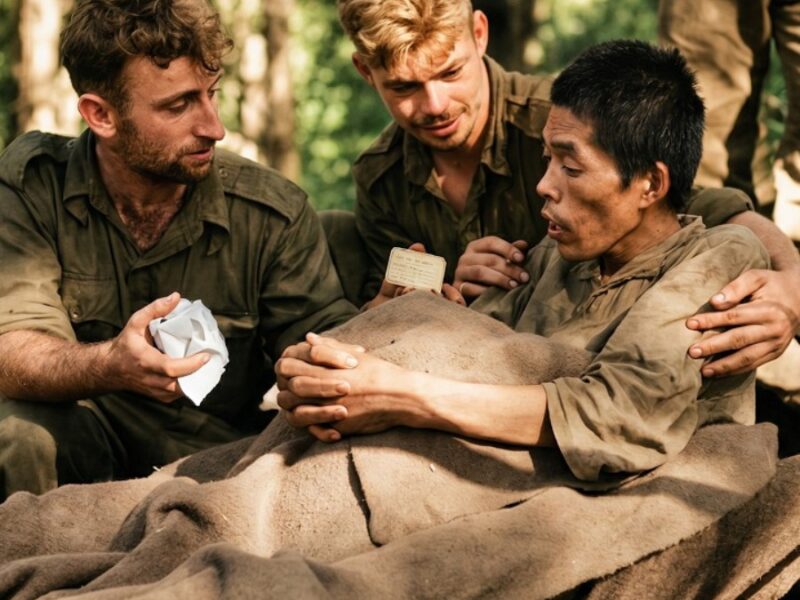
And this is where the story becomes even more tense, because the Australians were still capable of formal humanity, even after years of hatred. Japanese prisoners did exist in Australian custody. Some were moved to compounds. Some were interrogated, fed, guarded, processed. On places like Nome 4, Japanese prisoners of war were photographed resting in barbed wire compounds in 1944.
The official rules had not vanished, but the front line was not a courtroom. It was a fever dream of mud, fear, and memory. The same army could care for a prisoner in one place and kill a wounded man in another. The same platoon could take one enemy alive for intelligence and shoot the next because the jungle, the timing, the mood, the recent dead, or the smell in the air felt different.
That inconsistency is not a flaw in the story. It is the story. By 1945, Australian troops were still fighting bitter campaigns in places many thought no longer strategically necessary. Balikpapan in Borneo was one of the last major Australian battles of the war, and it was costly. Men were still dying in a campaign some believed should never have been fought at all.
Resentment simmered. Fatigue deepened. No one wanted to be the last man killed before the end. Then they began uncovering even more evidence of Japanese atrocities against local civilians. Bodies mutilated. Villagers murdered. Fresh reminders that the enemy they had fought for years had brought terror not only to soldiers, but to everyone under its reach.
When the campaign ended, only 63 Japanese had allowed themselves to be taken prisoner. Think about that. After all the firepower, after all the casualties, after all the jungle warfare and collapsing empire and certain defeat, only 63. That number tells you something about Japanese resistance, but it also hints at something else.
How small the space for surrender had become. Even after the war formally ended, the bitterness did not vanish. At Banjarmasin in September 1945, Lieutenant Colonel Murray Robson accepted the surrender of Japanese forces with barely concealed fury. He had spent years fighting a savage war. And he had seen his men killed in campaigns whose purpose many now doubted.
He had seen the evidence of what the Japanese had done. When he addressed the surrendered commander, he made one thing plain. You will be treated humanely, but disobedience will be met without mercy. That line is revealing. Humanity was still present, but it now stood beside fury, not innocence. By the end, Australian troops were learning the full scale of what had happened across Japanese captivity.
The prison camps, the death marches, the executions, the nurses, the missing, the survivors coming home with bodies so damaged they barely looked alive. And suddenly the war’s emotional ledger seemed complete. Now they knew. Now the rumors had names. Now the silence had evidence. So did Australian troops stop taking Japanese prisoners after discovering what happened to POWs? In some places, yes.
Not by formal decree, not always, not universally. But in the psychological truth of the Pacific battlefield, many did. They stopped because the jungle taught them to fear hesitation. They stopped because surrender could look like a trap. They stopped because the Japanese military system had shown such contempt for captive life that mercy began to feel like a one-sided bargain.
They stopped because atrocity corrodes restraint and because revenge is most seductive when it can disguise itself as survival. That does not excuse what happened. It explains it. And history needs that distinction more than ever. Because if we turn this into a simple tale of good men forced to do bad things, we miss the real danger.
The danger is not that Australians were uniquely cruel. The danger is that ordinary soldiers under pressure, after enough grief, with enough evidence of enemy brutality, they can begin to feel morally entitled to cross lines they once thought sacred. War does that. It turns outrage into permission. It turns memory into a trigger.
It turns dead friends into arguments. And then, one day, the prisoner in front of you is no longer a prisoner. He is a symbol. And symbols rarely survive war. That is the hardest lesson in this story. Japanese atrocities against Australian POWs were real, systemic, and devastating. Thousands suffered and died under a regime of starvation, forced labor, disease, and murder.
That truth must never be softened, but another truth sits beside it. Some Australian troops, shaped by that brutality and by the savage conditions of the Pacific war, killed Japanese who were wounded, surrendering, or already defeated. That truth should not be softened, either. Because once we hide either half, we stop learning from both.
And the final irony is this. The more a war convinces each side that the other is beyond mercy, the more both sides begin to prove it. That is how captivity becomes a death sentence. That is how soldiers stop seeing prisoners. That is how secret wars stay secret. If you want more untold military stories like this, subscribe to Australia’s secret wars.