“They’re Not Real Soldiers” — How Australians Proved A US General Completely Wrong in Vietnam
“They’re Not Real Soldiers” — How Australians Proved A US General Completely Wrong in Vietnam
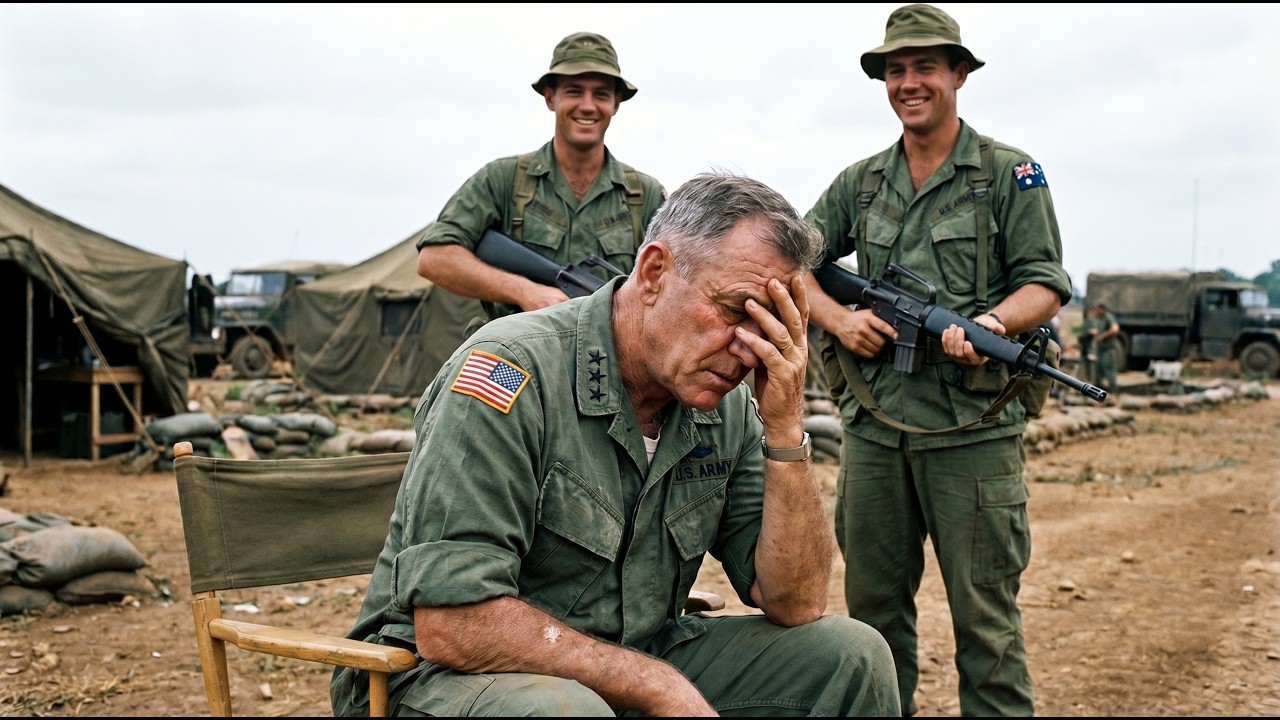
On the afternoon of August 18th, 1966, in a rubber plantation near Long Tan, 108 Australian and New Zealand soldiers walked into a monsoon storm, and then into something far worse. Within hours, official battle records would say they were facing at least 1,000 enemy in direct contact, maybe far more.
And by nightfall, the question was no longer whether they could win, but whether any of them would come out alive. Because this story is not just about a battle. It is about a judgment. A judgment made in the biggest war machine on Earth, where men in pressed uniforms measured success by helicopters, artillery, and body counts, and looked at Australians in slouch hats moving slowly through the bush and saw something unimpressive.
Too quiet, too cautious, too small. Not the kind of soldiers who were supposed to matter in Vietnam, but the jungle was about to deliver its own verdict. And it would not be polite. If you think you already know the Vietnam War, stay with this one because hidden inside it is a much darker question. What if one of America’s closest allies understood the war better than America’s own generals did? By 1965, the Americans had turned Vietnam into a furnace.
Tens of thousands of troops were pouring in. Helicopters thumped over the tree line. Bombs rolled across the countryside. Search and destroy became the language of the war, and body counts became its scoreboard. It was loud, fast, violent, and to men in Washington and Saigon, it looked like modern war. Australia entered that world with a battalion that was respected, but also expected to fit in.
The 1st Battalion, Royal Australian Regiment, arrived in 1965 and served with the US 173rd Airborne Brigade around Bien Hoa. They fought hard. They earned praise. But very quickly, Australian commanders felt something was wrong. The Americans wanted to draw the enemy out and smash him with superior firepower. The Australians had learned something different in the jungles of Malaya.
Patrol more, speak less, move lightly, set ambushes, separate guerrillas from the people, use violence carefully, not constantly. That difference sounds technical. It was not. It was a completely different philosophy of war. One side believed you could break an insurgency by killing enough fighters. The other believed that if you did not control the ground, the villages, the movement, the fear, and the loyalty of the people, then killing fighters solved almost nothing. And that was dangerous.
Because once you start fighting a different war from your ally, you are also gambling that your ally might be wrong. Australia pushed for its own area of operations. In 1966, the first Australian Task Force was established in Phuoc Tuy province, southeast of Saigon, with its base at Nui Dat. More than just a military relocation, it was a quiet act of defiance.
It meant the Australians wanted room to fight their war, not simply help America fight its own. To American eyes, that did not always look impressive. No giant air cavalry theatrics, no obsession with piling up enemy dead, no appetite for charging blindly into the jungle just to prove aggression. Instead, there were long foot patrols in suffocating heat, boots rotting in the wet, leeches clinging to skin, shirts pasted to the body with sweat, and a kind of discipline that looked almost old-fashioned.
Men walked until their legs shook. They listened more than they fired. They stared into bamboo and silence and tried to feel the enemy before they saw him. It did not look heroic. It looked slow, and in war, slow is often mistaken for weakness. But Phuoc Tuy was not empty ground waiting to be tidied up.
It was contested, layered, alive with danger. Viet Cong units knew the province. They knew the tracks, the villages, the tree lines, the escape routes. They could vanish at dawn and come back by dusk. Every plantation row could become a firing lane. Every peasant cart might be watching.
Every smile could be measuring distance. The Australians were not entering a battlefield. They were stepping into a nervous system, and almost immediately the province started probing them. It on the 16th and 17th of August, 1966, Nui Dat was hit by mortar and recoilless rifle fire. Not a major catastrophe. Not yet. But it was enough to tell the Australians something important.
The enemy was close. Closer than the base wanted to admit. So, on August 18th, D Company, 6th Battalion, Royal Australian Regiment moved out. 105 Australians. Three New Zealand gunners attached. A patrol into the rubber. At first it was routine. Heavy air, damp earth, the strange neat geometry of plantation rows. Men moving with that nervous calm soldiers learn when they know something is wrong, but do not yet know how wrong.
Then, at around 3:00 in the afternoon, they made contact. Not much, just enough. Just enough to let them keep walking. That is one of the oldest tricks in war. A glimpse. A few shots. A shape in the trees. Something small enough to draw you forward and deep enough that turning back begins to feel cowardly. Then, at 4:08 p.m.
, everything detonated. 11 Platoon advanced and was hit with heavy fire. Men dropped almost immediately. The air filled with snapping rounds and splintering bark. Visibility collapsed under a torrential monsoon. The plantation, so orderly a moment before, turned into a maze of black trunks, smoke, mud, and noise.
This is where theories die. Not in conferences, not in memoirs, in wet soil with someone screaming for a medic while your radio hisses and your mouth tastes like metal. Second Lieutenant Gordon Sharp, the 11 Platoon Commander, was killed. Sergeant Bob Buick took over. Around them, the enemy was not breaking.
He was closing, and this mattered. Because if the American theory of Vietnam was that the enemy could be found, fixed, and overwhelmed by firepower, then Long Tan was the moment that theory ran into its own nightmare. The Australians had found the enemy, yes. But now, the enemy was trying to swallow them whole at close range in weather that stripped away visibility, air support, and certainty.
The firefight became intimate. Not battlefield intimate, animal intimate. Men soaked to the bone. Rifles slick in the hands. Ammunition counted not by crate, but by instinct. The wounded lying in mud that kept rising. Voices harder to hear over rain and shell bursts. Every tree line looking like the one from which death would come next.
And still, the enemy pressed. 10 Platoon tried to move. 12 Platoon tried to support. Each movement collided with more fire. The Australians were being broken into pieces, and that is how annihilation begins in the jungle. Not with a dramatic collapse, but with separation. A section here, a platoon there. Radios strained, distances distorted.
Command becoming less a system than a chain of desperate human decisions. Then the artillery started saving lives. New Zealand gunners from 161 battery, along with Australian and American batteries, had began dropping shells so close to the Australian positions that the line between support and catastrophe almost disappeared.
Sergeant Buick reportedly brought fire in almost on top of his own trapped men. That was the margin now. Not comfort, not safety, arithmetic. And yet even artillery could not answer the worst question. How long could they keep shooting back? By evening, D company was running out of ammunition.
That is the detail people remember too late. Not courage, not grit, ammunition. War often comes down to a number getting smaller in your hands. Somewhere inside that storm, men were checking magazines, passing rounds, calculating whether the next burst was worth the risk. And through the rain and enemy fire, two RAAF helicopters flew in at treetop height and dropped ammunition boxes to the men below.
Think about that. A storm so bad the battlefield was half blind, an enemy force closing in, and helicopters descending anyway because if they did not, a company of Australians would likely disappear into that plantation forever. Then came the part that still sounds unreal. At around 6:35 p.m.
, the enemy launched what battle accounts describe as a human wave assault. Out of the darkening plantation they came in force, driving against the Australian perimeter with the kind of confidence that only comes when you believe the men in front of you are finished. Maybe that is what some American officers had believed, too. That Australians were too few, too cautious, too irregular in their methods, too unlike the image of modern military power to matter when the real pressure came.
But under that rain, with 18 men dead by the end and 24 wounded, E D Company did not collapse. They held until reinforcements and armored personnel carriers arrived, and at last light the enemy broke contact and withdrew. The next morning, 245 enemy bodies were found on the battlefield with evidence many more had been carried away.
Long Tan became famous because it was dramatic, but that is not why it mattered. It mattered because it exposed something deeper. The Australians had not won by acting like a miniature American force. They had won by staying disciplined under impossible pressure, by trusting patrol craft, small unit leadership, artillery coordination, and a kind of field composure that bigger armies often confuse with passivity.
And that was the insult hidden inside the victory. Because Long Tan suggested that the men who looked old-fashioned might actually understand this war better than the men writing the grand strategy. Still, one battle does not settle an argument. That is the trap of war history. A single victory can become a legend, and legends are comfortable.
But Vietnam was not a legend. It was a long, dirty, political war, and the bigger question remained unanswered. Was the Australian way actually working? In Phuoc Tuy, the answer seemed, at least for a time, to be yes. The Australians kept patrolling, kept ambushing, kept trying to deny the insurgents freedom of movement, kept focusing on the province rather than chasing grand illusions.
Their methods were never perfect. They made mistakes, some costly and some tragic. They were not superhuman, and yet, over time, they did erode insurgent strength in parts of the province. That is the part most people miss, because the loudest war was the American war. The Australian war was quieter, and quiet wars leave fewer myths.
By late 1967, American commander General William Westmoreland was still talking publicly about seeing the light at the end of the tunnel. That phrase would become one of the most haunting lines of the war, because it captured not confidence, but misreading. He was looking at attrition charts and body counts.
He was measuring pressure, but pressure is not the same as control. Then came Tet. In early 1968, communist forces struck across South Vietnam on a scale that shocked the world. The political effect was devastating. In America, the illusion of imminent victory began to crack, and in Australia’s own area, the war suddenly shifted again, forcing Australian troops into brutal fighting around Baria and beyond.
This is where the story sharpens, because the Australians were not immune from chaos. They were not watching from some clean, superior distance. They were in it, fighting house-to-house in places they had not trained for, adapting again, bleeding again, proving again that the enemy was not a problem to be statistically reduced, but a force that could survive punishment and still seize initiative.
And that is what made the Australian experience so uncomfortable for the American high command. Not because Australia won Vietnam, it did not. Not because Australia discovered a magic formula, it did not. But because Australian operations in Phuoc Tuy suggested that limited local success came from things America’s broader strategy often undervalued.
Patience, restraint, village security, persistence, and understanding that guerrilla war is political before it is mathematical. Years later, even Westmoreland himself would offer a striking judgment. He wrote that the Australian army was small in numbers and well-trained, particularly in anti-guerrilla warfare, and was much like the post-Versailles German army, in which even men in the ranks might have been leaders in some less capable force.
That is not a small compliment, it is a confession. Not a total confession, but enough. Yes, because buried inside those words is an admission that the Australians were not second-string auxiliaries, not decorative allies, not soldiers who merely tagged along behind American power. They were highly trained anti-guerrilla troops whose methods deserved respect in exactly the kind of war America had turned into an industrial contest.
And yet, here is the sting in the story. Even being more right did not make Australia victorious. A major academic study of pacification in Phuoc Tuy argues that Australian and allied efforts did weaken the insurgency and change local conditions, but ultimately could not overcome the deeper political weaknesses of the South Vietnamese state.
In other words, the Australians may have understood the fight in their province better, but they were still trapped inside a war whose foundations were cracking. That is the part no triumphant version of this story can ignore. The Australians proved something real, but they could not prove enough to save the whole project.
That is what makes this history so gripping and so bleak. The men at Long Tan and later across Phuoc Tuy did not simply prove bravery. Plenty of armies are brave. They proved professional judgment. They proved that in a counterinsurgency, small unit skill, local control, and disciplined patrolling could outperform brute force spectacle.
But war is merciless to partial truths. You can be tactically sound and still strategically trapped. You can be better at fighting the war in front of you and still lose the war above you. You can even force a powerful ally to quietly admit you were right about key parts of the battlefield and then still watch the entire enterprise collapse a few years later.
Maybe that is why this story still has power because it is not really about national pride. It is about the arrogance of scale, about what happens when a superpower believes that more firepower means more understanding. About how easy it is in coalition warfare for the smaller ally to be patronized right up until the moment the shooting starts.
And about how often the jungle punishes vanity first. Imagine the smell at Long Tan when the rain hit hot earth and cordite together. Imagine the sound of artillery walking closer and closer until the men under it had to trust mathematics more than instinct. Imagine the silence afterward. The kind of silence that follows survival when nobody feels victorious yet because they are still counting who is missing.
That silence is where the myth ends and the truth begins. The truth is that Australians in Vietnam were not magical bush warriors floating above the mistakes of the age. They were human. They got things wrong. They suffered. They carried fear, fatigue, and doubt like everyone else. But, they also carried a professional culture that, in crucial ways, saw the war more clearly than the dominant American model did.
And that is why the phrase matters. They’re not real soldiers. Whether spoken exactly like that or felt in quieter ways, the prejudice was real. Against the slouch hats, against the slow patrols, against men who did not worship firepower the same way, against an ally that looked too small to teach anything to the United States Army.
Vietnam taught otherwise. Long Tan taught otherwise. Phuoc Tuy taught otherwise. The final lesson is brutal. A general can be wrong not because he lacks courage and not even because he lacks intelligence, but because he asks the wrong question. Westmoreland’s war kept asking how many enemy had been killed.
The Australians, at their best, were asking who controlled the ground, who moved at night, who listened better, who could stay alive longer, and who understood that fear and loyalty were as decisive as bullets. That difference did not win the whole war, but it revealed the war for what it was. And sometimes, in military history, exposing the truth is its own kind of victory.
If you want more untold military stories like this, subscribe to Australia’s secret wars.