Why Historians Still Question Charles II’s Official Death
Why Historians Still Question Charles II’s Official Death
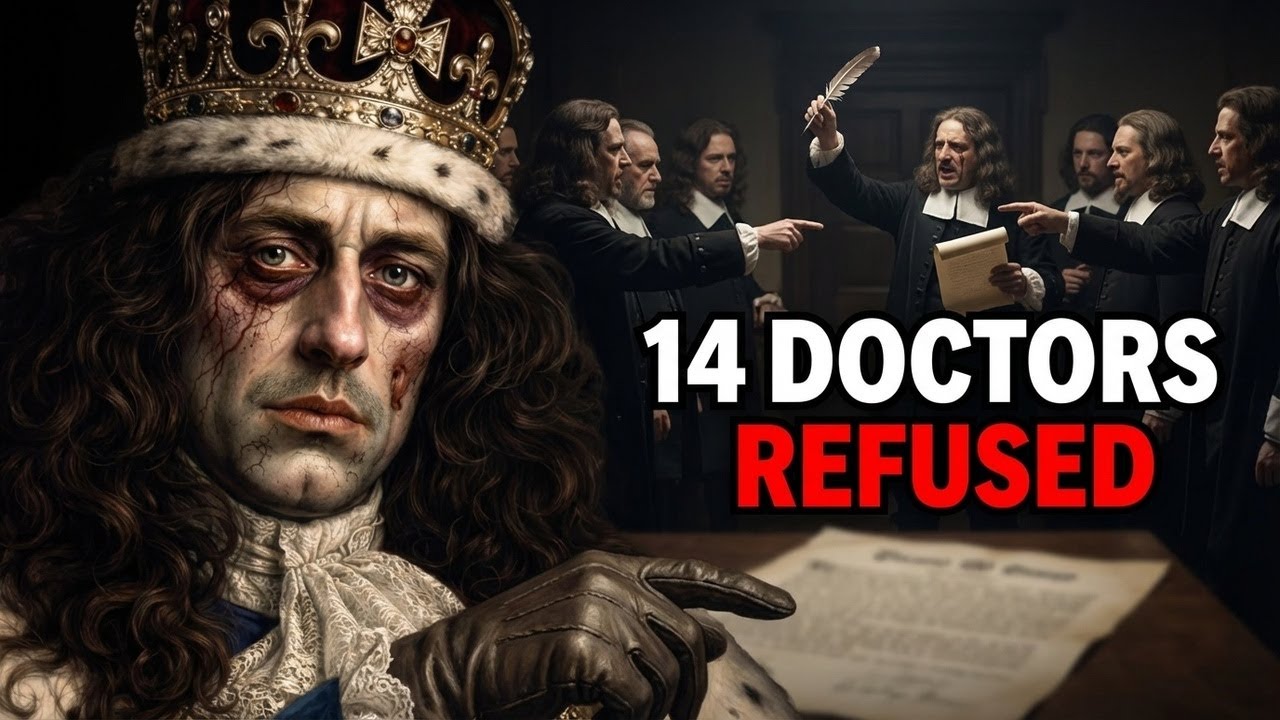
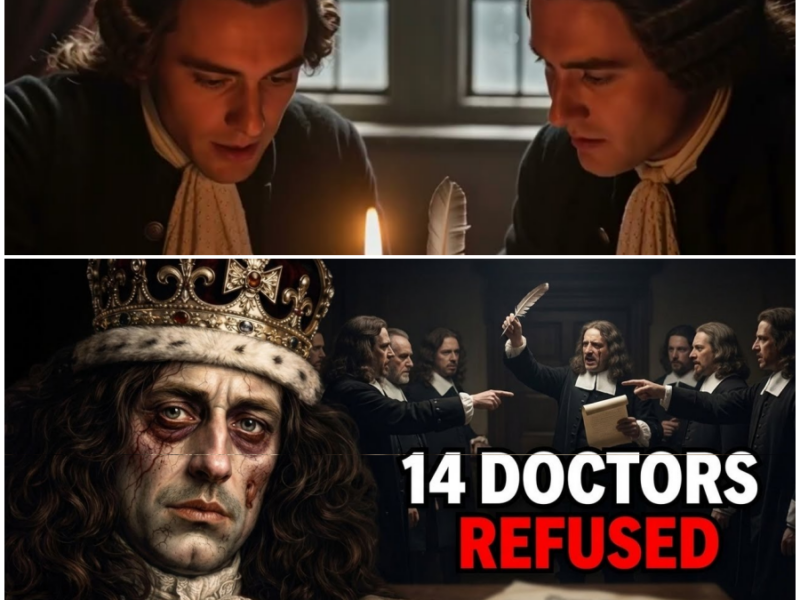
Why did the 14 most educated men in England refuse to sign a death certificate, not one of them? Think about what that actually means. 14 of the finest medical minds in England, led by the King’s personal physician, Sir Charles Scarburgh, stood over the body of the most powerful man in the country. And not one could produce a cause of death they were willing to put their name to.
That fact alone should have triggered an inquiry. It didn’t. Instead, it triggered something else, not answers, just silence. What happened in that room didn’t really look like treatment anymore. And it started the moment Charles collapsed, his tongue is was blackened. His speech was lost in a violent convulsion.
He fell from his chair mid-shave and could not be roused. What happened next was almost as alarming as the collapse itself. Dr. Edmund King, one of the attending physicians, performed an emergency bloodletting on the spot without authorization, without the Privy Council’s permission, which was legally required.
He opened the King’s veins before anyone with authority had been informed because he believed waiting would mean watching the King die. It may also have accelerated it. After that first unauthorized cut, the 14 physicians descended in full. They bled him from the arms repeatedly, removing quantities that would weaken any man.
They administered enemas containing substances we now know were toxic. They forced him to swallow mixtures of powdered chalk, dissolved pearls, and ground human skull. A preparation Charles had actually invented himself, known as the King’s drops, which he kept in his private laboratory and considered a cure for almost everything.
They applied scalding cups to his skin to draw out what they believed were poisonous vapors trapped beneath the surface. Through all of it, Charles drifted in and out of awareness. He was lucid enough at one point to apologize to the men in the room for taking so long to die. He asked that his mistresses be provided for.
He said, “Don’t let poor Nelly starve.” A reference to Nell Gwyn, his most famous companion. A small, a human moment. Inside an increasingly inhuman situation. After 4 days, after every method available to 17th century medicine had been thrown at a dying man with ruthless enthusiasm, Charles II stopped breathing.
The official record states apoplexy, a stroke, a sudden failure of the brain, clean, simple, acceptable. But the official record was written by men whose careers depended on the next king’s favor, and the next king needed a clean death. He needed it desperately. So, the question isn’t just how Charles died, it’s why no one in that room could explain it.
And that’s when one possibility starts to explain why no one said anything. Historians still disagree on this point. They have for over 300 years. But before you form your own opinion, you need to understand the world Charles lived in. This was a country that had already executed one king. Charles I, his own father, had been marched to a scaffold in front of a public crowd and beheaded by order of Parliament.
That was not ancient history. That was living memory. Half the men at court could remember where they stood when the axe fell. Charles II knew exactly how fragile his throne really was. He had spent over a decade in exile after his father’s execution, begging foreign courts for money, watching loyalists be hunted down and killed, learning one lesson above all others.
The English will remove a king they find inconvenient. And they will do it without hesitation. When he was finally restored to the throne in 1660, he came back not as a conqueror, but as a performer. The Merry Monarch, the king who loved theater, mistresses, spaniels, and spectacle. He made England laugh again after a decade of Puritan severity.
And he did it deliberately. Because making people laugh made him easier to accept, easier to trust. But Charles wasn’t just a performer. He was, by any reasonable definition, a French asset. In 1670, he signed the secret Treaty of Dover, a private arrangement with Louis XIV that was hidden from his own parliament.
Under its terms, Charles agreed to support French military ambitions and, when the moment was right, publicly convert to Catholicism. In return, Louis paid him 200,000 pounds a year. Money kept coming for the rest of his reign. He played Catholic and Protestant factions against each other with the patience of a man who understood that survival, not victory, was the real game.
For 25 years long, I he held power through charm, misdirection, and a near perfect instinct for knowing when to act and when to wait. And then, something happened that doesn’t fit the rest of his life at all. Five days, that’s all it took. On Saturday, February 1st, 1685, Charles was in good spirits.
He walked freely through Whitehall Palace. Multiple witnesses described him as healthy, sharp, and entirely himself. Nothing obvious suggested a man about to die. Within days, on Monday morning, his tongue was blackened. His speech was gone, and he was on the floor. The official record skips one detail that changes everything, and we’ll get to it in the next section.
From full health to a sealed coffin in under a week, and 14 physicians who wrote down everything except the one thing that actually mattered. What killed him? That gap in the record is not an oversight. It is the story. Most people will hear this and forget it within minutes. That’s exactly how stories like this stay buried.
Not through conspiracy, but through indifference. Subscribe because what comes next hasn’t been properly examined in over 300 years. And there is a reason for that. Up to this point, you can still believe this was natural. And honestly, that’s what most people still believe. But the next detail makes that explanation much harder to defend.
The primary medical account comes from Sir Charles Scarburgh. His report is meticulous. Every treatment, every dosage, every physical response recorded with the precision of a man determined to prove that he and his colleagues did everything in their power to save their patient. But there is something Scarburgh never does.
He never offers a diagnosis. He describes convulsions. He describes renal failure. He describes a body shutting down in stages. But at no point does he connect these symptoms to a cause. For a physician compiling the official medical record of a king’s death, that absence is extraordinary. It is the equivalent of a detective describing a crime scene in exhaustive detail.
The position of the body, the temperature of the room, the pattern of blood, and never once mentioning the weapon. Historians still debate whether that omission reflects genuine medical uncertainty or something more deliberate. What we know for certain is that Scarborough was one of the most accomplished medical minds in England.
He knew how to draw conclusions. He chose not to. Now, compare Scarborough’s account with what others recorded privately. John Evelyn, the diarist and courtier, was at Whitehall during the final days. Evelyn was a cautious writer. He understood that diaries could become evidence, but he notes one detail that deserves far more attention than it has received.
In the weeks before the collapse, Charles had been spending an unusual amount of time in his private laboratory, specifically the king’s laboratory at Whitehall, a dedicated room inside the palace where Charles conducted his chemical experiments. This is well documented. He was fascinated by alche- and experimental chemistry.
He handled mercury regularly. He handled compounds containing arsenic. He conducted experiments that exposed him over years to substances that modern science classifies as cumulative poisons. Substances that uh that build in the body slowly, producing no visible symptoms until the damage reaches a threshold. And then the collapse comes all at once.
The symptoms match. Mercury poisoning damages the kidneys first, then the nervous system, then the brain. The victim experiences periods of apparent stability followed by sudden catastrophic decline. Intervals of lucidity between episodes of violent deterioration. That is precisely what Scarborough documented. But this is where the story fractures into two very different paths.
The first path is the simple one. Charles poisoned himself over years through his own laboratory work. His death was self-inflicted, accidental, and unremarkable. The physicians either didn’t recognize chronic mercury exposure, a diagnosis genuinely beyond 17th century medicine, or they recognized it and chose silence because documenting a king’s death by his own chemical recklessness would humiliate the monarchy.
One interpretation, clean. No conspiracy required. The second path is harder. In 1999, researchers examining surviving records of the medicines administered to Charles during his final days found something troubling. Several of the treatments contained mercury in concentrations that exceeded anything recognizable as therapeutic.
Though whether that reflects desperation, incompetence, or something more deliberate, no one has ever been able to say for certain. Were the physicians trying to save him or making sure he didn’t survive? There’s no direct evidence of intent, but the pattern raises questions that have never been satisfactorily answered.
Consider who controlled access to the bedchamber, not the physicians. The physicians were summoned and directed by members of the Privy Council. The same political operators who understood with perfect clarity what the king’s death would mean. And what his recovery might prevent. They decided who entered the room.
They determined which treatments were administered. They controlled the flow of information in and out. And there was one man in that room with the most to gain if Charles died, James, Duke of York, the king’s brother, Catholic, ambitious, next in line for a throne he had spent years fighting to secure and which Parliament had spent years trying to keep from him.
Here is the piece most histories skip over. If Charles had survived another month, he almost certainly would have been forced to call a new Parliament. The Exclusion Crisis, the multi-year campaign to legally bar a Catholic from the succession, was not finished. It had merely been suspended. A reconvened Parliament would have revived the Exclusion Bill and this time with broader support, it might have passed.
James would have been legally barred from the throne, possibly arrested. With Charles dead suddenly before opposition could mobilize, the crown transferred immediately. No debate, no parliamentary challenge, no time for Protestant lords to act. James was proclaimed king before the body was cold. The official record skips 1 hour on the night before Charles died.
The hour Father John Huddleston spent behind a locked door with a dying king. Huddleston, the same priest who had helped a young Charles escape after the Battle of Worcester decades earlier, was brought through the backstairs of the Queen’s apartments, a hidden route, a passage that officially did not exist.
He administered last rites in secret. Charles II, the Protestant king of England, died a Catholic. The men in that room understood exactly what that meant. If England discovered that their king had been secretly Catholic or had converted on his deathbed, it would validate every paranoid accusation the Protestant establishment had spent 25 years trying to suppress.
It would mean the French money, the secret treaty with Dover, the quiet political maneuvering, all of it was serving a hidden agenda that was real. And it would mean that James had not simply inherited the crown by accident of birth. He had been positioned there. Witnesses at the deathbed later recalled James hovering close to the physicians, whispering instructions, monitoring which treatments were being prepared.
At the time, um it was attributed to brotherly concern. In the context of everything else, it looks like something else. That gap in the record is not an oversight. It is the story. Right now, you are further into this than most people will ever go. The version in the textbooks stops long before this point. Subscribe because the conclusion changes how you understand everything that came next.
Let us assemble what we have. A king who handled mercury and arsenic daily in the King’s laboratory at Whitehall. A collapse that 14 physicians documented in exhaustive detail but could not or would not diagnose. Treatments containing concentrations of heavy metals that exceed anything recognizable as medicine. A brother who controlled the deathbed and stood to inherit everything.
A French ambassador whose timeline contradicts the English record. And a dying man who appeared to have been settling his affairs for weeks. Before a supposedly sudden collapse. No single piece of this evidence convicts anyone. That’s not a flaw in the evidence. That near is the evidence. Political killing in the 17th century was not designed to be provable.
It was designed to be deniable. Poisoning was not dramatic. A vial in a goblet. A single traceable moment. It was slow. It was layered. And it was structured so that no individual action could ever be identified as the killing blow. Some modern researchers argue that Charles II died of chronic mercury poisoning.
Compounded by acute renal failure. Accelerated catastrophically by the treatments administered during his final days. Whether the mercury entered his body through his own experiments, through deliberate contamination, or through some combination of both. This is the line that divides researchers. And it may never be fully resolved.
But here is where many agree. The official explanation doesn’t account for the symptoms. And the men who wrote the official record almost certainly knew that when they committed it to paper. Consider the position of the 14 physicians. Their careers, their reputations, and potentially their safety depended on the goodwill of whoever sat on the throne next.
Charles was dead. James, Catholic, intolerant of dissent, and acutely aware of who had opposed him during the Exclusion Crisis, was now king. If the physicians concluded Charles had been poisoned, the consequences would be immediate and uncontrollable. An investigation, accusations against people close to the new king, a political crisis at the precise moment James needed stability to consolidate power.
If they concluded Charles had killed himself through years of reckless experimentation, the damage would be different, but nearly as severe. A king destroyed by his own laboratory was not a dignified predecessor. He was a liability. And the restored monarchy, still haunted by civil war, still fragile, still dependent on public confidence, could not absorb that humiliation.
So, the physicians chose the only safe option. They described symptoms. They documented their efforts. And they left the cause of death as a void. An empty space that official historians would later fill with the word apoplexy, a term so imprecise it explained nothing. And more importantly, accused no one. And it worked.
That’s the uncomfortable part. It held for 300 years. The reason it began to unravel is straightforward. Science caught up with politics. When modern researchers examined Scarborough’s clinical descriptions with the benefit of toxicology that did not exist in 1685, the symptoms stopped being mysterious. They became a recognizable pattern.
And here is the bitter irony of it. Scarborough’s report was so precise, so methodical, so obsessively detailed, that he essentially left a trail of breadcrumbs for future historians to follow directly. To the poison. He was trying to protect himself by documenting everything. Instead, he preserved the evidence.
Paul Barillon, the French ambassador, wrote in his dispatches to Louis XIV that Charles had shown signs of declining health for weeks before the public collapse. Signs that were deliberately minimized by the people closest to him. If Barillon is accurate, the official timeline is a construction. The narrative of a king struck down without warning becomes the story of a slow deterioration that was hidden from view until concealment was no longer possible.
That changes how the entire story is understood. A sudden collapse suggests misfortune. A concealed sub gradual decline suggests that someone close to the king knew what was happening and allowed it to continue. In the weeks before his death, Charles made a series of decisions that break the pattern of his entire reign.
He settled debts he had ignored for years. He made private financial provisions for his illegitimate children. He held a series of unusually long private conversations with James. Conversations whose contents were never recorded by anyone present. These are not the actions of a man who expects to live. He apologized for taking so long to die.
He made a joke about Nell Gwyn. He performed to the end the role of a man surprised by his own mortality. But every piece of evidence we have suggests he had seen it coming for weeks. The deathbed confession is the final locked door. When Father Huddleston came through the back stairs of the Queen’s apartments, Charles made a full confession detailed, according to Huddleston’s subsequent account, and not a word of it was ever written down.
In a room where everything was documented, every medicine, every symptom, every word Charles spoke in delirium, this was the one thing no one recorded. James, who arranged the priest’s visit, never disclosed what was said. Huddleston, bound by the seal of confession, could not. The handful of witnesses present understood that repeating those words would be political destruction aimed at a throne passing to a new and unforgiving king.
The Stuart dynasty died in that room. Not because of a stroke, but because of a laboratory and a secret conversion. Within 3 years of taking the throne, James II had provoked a national crisis severe enough that Parliament invited a foreign army to invade. He fled the country. The Stuart line was, for all meaningful purposes, finished.
If Charles was murdered, the conspirators achieved the precise opposite of what they intended. James’s reign destroyed the Catholic cause more thoroughly than decades of Protestant opposition ever could. If Charles poisoned himself through his own obsession, then a man who had survived every political threat for 25 years was destroyed not by his enemies, but by his own hands in a room inside his own palace filled with equipment he had chosen himself.
And if he knew, if he understood what was happening, and chose not to fight it, then his death was not an accident or a murder. It was a decision. Scarborough’s notes survive. His original Latin medical report, meticulous, precise, conspicuously silent on the question of cause, is a document that tried to hide something in plain sight, and instead preserved it for anyone willing to look closely enough, which is exactly what we just did. Subscribe.
Because next, we’re going somewhere even darker, and the cover-up makes this one look straightforward.