“Why Won’t They Salute?” — How Australian Soldiers Defied a U.S. General
“Why Won’t They Salute?” — How Australian Soldiers Defied a U.S. General
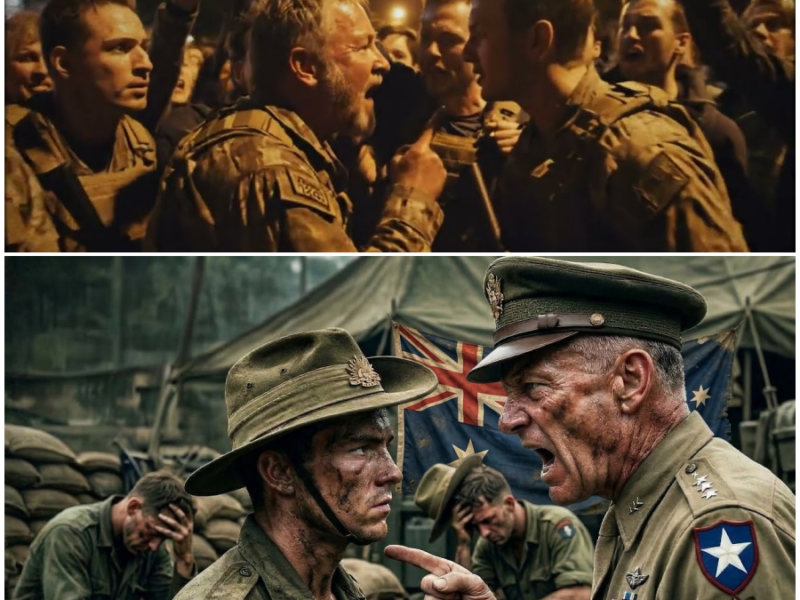
Brisbane, November 27th, 1942. Outside the building tied to General Douglas MacArthur’s command, Australian soldiers and civilians were shouting into the dark, throwing abuse at the American high command, while the city still reeled from the night before when one Australian serviceman had been shot dead in the chaos.
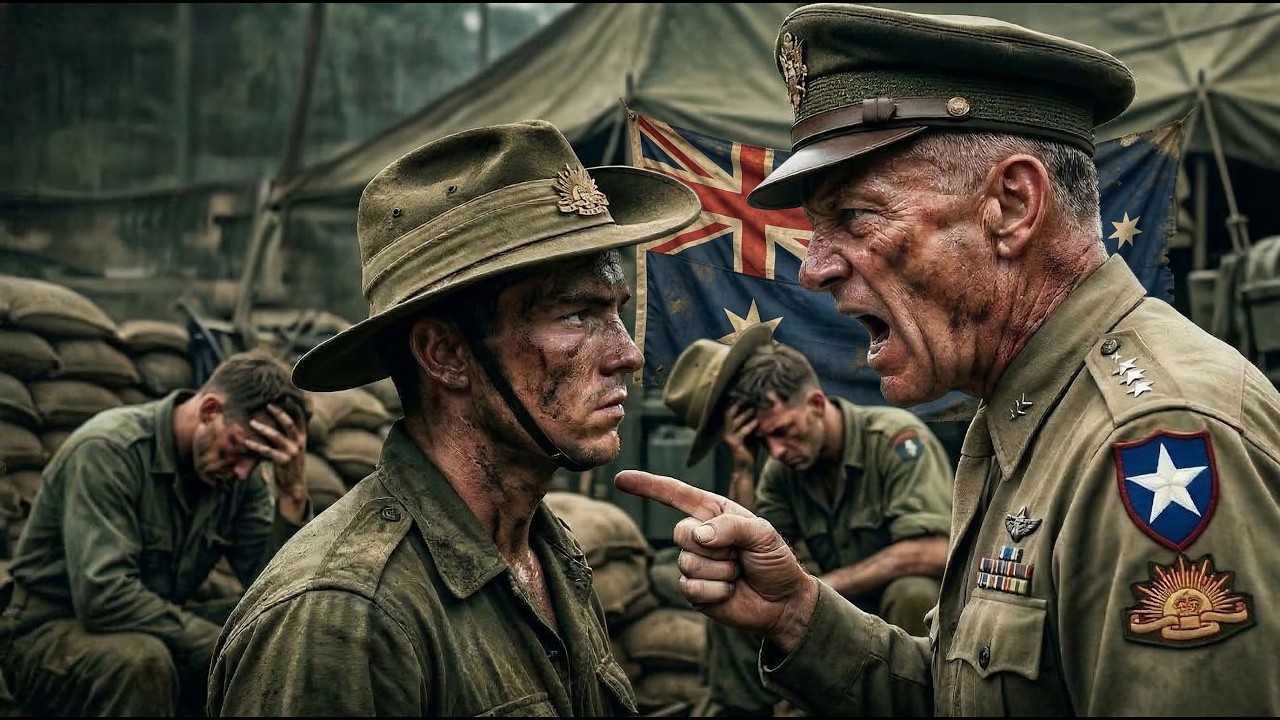
Behind that violence was a smaller insult, almost ridiculous on the surface, but powerful enough to poison an alliance. Why wouldn’t they salute? Later, retellings would shrink the whole affair into one American general, one order, one punishment, one moment of Australian defiance. But the truth is more dangerous than the legend.
Because this was never just about one man’s rank. It was about two armies that looked at the same war and saw two completely different meanings of discipline. And once that clash began, it spread everywhere. It spread through the camps in Queensland, where the heat came off the ground like breath from an oven and the dust clung to skin, webbing, and teeth.
It spread through Brisbane, where American troops arrived with better pay, sharper uniforms, better food, more cigarettes, more access to women, and a confidence that could look to Australian eyes a lot like swagger. And it spread through the rank structure itself. Because by the time the Americans poured into Australia, many Australian soldiers already had their own answer to authority.
It had been hammered into them at Gallipoli, hardened in the desert, and soaked into them under shellfire at Tbrook. They did not automatically worship badges, stars, or polished boots. They respected men who could carry weight, keep calm, and not get their mates killed. That difference sounds small. It wasn’t. Veterans remembered it very clearly.
One Australian recalled that they wouldn’t salute American officers and barely saluted their own. Another said, “Australians did not salute much at all. And if an Australian did salute you, it meant something. Not ritual, respect, earned respect.” And that one detail unlocks the whole mystery. Because once you understand that, the anger starts to make sense.
to an American regular officer, especially one raised inside a rigid hierarchy. The salute was not decoration. It was the visible shape of command. It told everyone who was above, who was below, and how the machine stayed in motion. Remove that gesture and what do you have left? To many Australians, the answer was simple. You had the real thing left.
You had matesship. You had competence. You had the private judgment of men who had already seen too much death to be impressed by ceremony. They did not think they were lesser men because someone else wore insignia. And that attitude in peace time could look insolent. In war, it could become explosive, especially when the Americans arrived in force.
By mid 1943, there were roughly 150,000 American troops in Australia, heavily concentrated around places like Brisbane, Rockampton, and Townsville. They brought money, equipment, scale, and the overwhelming force Australia desperately needed. They also brought habits, their own food, their own military police, their own social rules, their own assumptions about who saluted whom, and they brought MacArthur.
MacArthur was not the cause of every grievance, but he became the symbol of many of them. He towered over the alliance, admired, resented, needed, and distrusted all at once. In the ranks, that resentment could feel personal. Australian soldiers already believed some American commanders looked down on them.
And once a soldier believes a superior officer does not respect him, every tiny act begins to matter. A salute becomes a test. Who yields first? Who belongs above whom? Who gets to define what a soldier is? That was the real battlefield beneath the smiles and photographs. At first the friction seemed almost petty. Australians noticed the pay gap.
American enlisted men often earned around twice as much. They noticed the PX privileges, the better rations, the ice cream, the stockings, the access to luxuries ordinary Australians could barely imagine in wartime. They noticed the American MPs. They noticed the way some Americans talked to them and the way some American officers expected space to open around them.
The Australians did not open it. Not naturally. And this is where the legend of the angry American general starts to make sense, even if later storytellers embroidered it into something cleaner than the archives can prove because the atmosphere was already there. The ingredients were real. The refusal was real.
The contempt for empty formality was real. So when stories spread of some visiting American brass demanding salutes and getting either cold silence or mocking over compliance, people believed them instantly. They believed them because they fit perfectly. An Australian private in that war was far more likely to judge an officer by where he slept, what he carried, and how he behaved when shells started landing than by how much braid sat on his shoulders.
If an officer ate separately, talked down, clung to privilege, or hid behind ceremony, that smell of weakness traveled fast through a battalion, and once it traveled, it stuck. At Tbrook, that culture had been forged under near constant shelling and bombing for months. Men lived filthy, exhausted, and close to death.
In those conditions, no one cared about elegance. They cared about whether the officer in front of them could endure the same fear, the same flies, the same hunger, the same incoming fire. Respect was not issued. It was tested. That memory came home with them. So imagine the collision. A dustb blown Queensland camp. Sweat running down the spine under coarse khaki. Flies at the eyes.
Vehicles grinding through red dirt. Men carrying ammunition, cleaning rifles, smoking in scraps of shade, and talking in the loose, rough language of soldiers who had already paid their dues. Then an American officer arrives expecting the clean grammar of deference. He expects the hand to rise.
Instead, he gets a nod or nothing. Maybe a getday, maybe a glance, maybe a stare that says very quietly, “You haven’t earned a thing from me yet.” That was the insult. And that was the mystery that kept deepening. Because from the American point of view, how could an army function if rank was treated so casually? How could orders move? How could discipline survive? Were these men unreliable? Were they sloppy? Were they dangerous? The answer, which would take time for many Americans to understand, was almost the opposite. The Australian
style could look loose on the surface because it demanded something harder underneath, mutual trust. A private was expected to think. A sergeant was expected to speak plainly. An officer was expected to know his job so well that he did not need to hide behind ritual. In jungle warfare, where visibility vanished, control frayed, and units broke into fragments of sound and instinct, that mattered a lot.
One veteran later explained that strict discipline in the Australian army was often self-imposed. Men did certain things because of their mates, not because some distant figure barked it through the chain. And in the jungle, he said, that mattered even more because an officer’s direct control could be very limited.
Men had to use their own heads. That is not in discipline. That is a different doctrine of survival. But doctrines don’t just sit in books. They rub against one another in mess lines, checkpoints, city streets, and camps. They produce looks, complaints, small humiliations, letters, threats, warnings, smirks, drunken arguments, fists, and before long, nobody is really fighting over the original issue. do anymore.
They are fighting over dignity. That is what happened in Brisbane. The battle of Brisbane did not erupt because one side suddenly snapped for no reason. It erupted because tension had been building for months. Better pay, better uniforms, competition over women, race tensions, different military police cultures, different ideas of class, different assumptions about authority.
The American presence was huge. To some Australians, it felt less like reinforcement than occupation. Then came the spark. On the evening of November 26th, 1942, an altercation involving a US military policeman spiraled into mass violence. Australians believed one of their own had stepped in when an American soldier was being harassed.
Crowds gathered, bottles flew, batons came out, the streets filled, and in the confusion, an Australian serviceman, Edward Webster, was killed when a shotgun discharged during the melee. Now the insult had blood on it. And this is the point where the salute question stops sounding trivial. Because when men already believe they are being looked down on, policed differently, and treated as inferiors inside their own country, every forced courtesy becomes fuel.
Every demand to stand straighter, step aside, or perform military respect on someone else’s terms becomes one more reminder that the alliance is unequal. That is why the second night mattered. Crowds gathered again. Abuse was hurled toward MacArthur’s headquarters. He was not even there. It didn’t matter. The building had become a target because the command itself had become a symbol.
At the top, Australian and American leaders were tense with each other. In the streets, ordinary soldiers translated that tension into rage. One dead man was enough to prove how far it had gone. But here is the darker question. Why were the Australians so unwilling to bend? Because it wasn’t just pride, it was memory.
Australian soldiers had long carried an egalitarian streak that unsettled more rigid military systems. One veteran put it bluntly. The English thought they were superior, but the average Australian thought everyone was the same. That was not just social attitude or attitude. It shaped command. It shaped who God obeyed and why.
It shaped how quickly a man could lose the respect of those under him. And once that respect was gone, no salute could restore it. That is why later camp legends matter, even when details blur. Stories circulated of American officers or generals demanding strict saluting only to discover that Australians could turn compliance into mockery.
Not open mutiny, something smarter, exaggerated formality, dead pan insolence, too much obedience, the kind that makes a rule look stupid by following it so literally that everyone sees the emptiness. It is exactly the kind of thing Australian soldiers would do, and it is exactly the kind of thing a rigid officer would hate.
Could every detail of those later stories be proven line by line? No, the archival trail is not as tidy as the legend. It does not hand us a neat villain with a perfect memorandum and a courtroom ending. But the wider truth is solid enough to be more unsettling. The Australians really did resist automatic deference.
They really did refuse the ritual more often than other armies. And American officers really did collide with that culture in camps, streets, and command relationships across wartime Australia. The legend survived because it felt true, because in a deeper sense it was. And there was one more reason saluting carried such poison in active theaters.
In frontline conditions, conspicuous gestures toward officers could be dangerous. Men in combat zones knew what visible hierarchy could do. Mark the officer too clearly, and you helped the enemy. Even where that wasn’t the direct issue, the instinct remained. Salutes belonged to the parade ground. Survival belonged to something else.
The Americans did not all miss this. Many enlisted Americans serving alongside Australians noticed the difference quickly. They saw officers who mixed more easily with their men. They saw a rougher kind of equality. They saw informality that instead of destroying effectiveness, sometimes sharpened it. Not every American admired it, but plenty noticed that these Australians, lacks in appearance by some standards, could fight very hard indeed.
That was the contradiction. Loose but lethal, casual, but reliable. Disrespectful in form, disciplined in action. It is hard for bureaucracies to absorb a contradiction like that. Institutions like clean logic. Salutes mean order. Order means obedience. Obedience means effectiveness. But war keeps humiliating systems that confuse appearance with function.
Again and again, what looks untidy survives because it is adaptive. Australians had been adapting for a long time by the desert, by the bush, by distance, by being a smaller force that could not afford too many foolish officers or too much dead weight in its chain of command. If the man in charge was incompetent, the consequences arrived fast.
So, Australian military culture, for all its roughness, evolved a brutal filter. Lead well or lose the room. No wonder some American officers found it infuriating. No wonder some Australian soldiers found American formality theatrical. And now we come back to the supposed punishment. Because in a way, punishment did happen. Not always as some dramatic official sentence, not always as a neat order barked by one furious general.
The punishment was broader than that. Complaints rose. Relations soured. MPS cracked heads in the streets. Mutual suspicion thickened. Australians were made to feel lesser in their own rear areas. Americans were made to feel mocked by an ally they expected to be more differential. The alliance punished both sides for not understanding each other.
And yet the Australians paid in a particular way. They paid in reputation. To rigid observers refusing to salute looked like sloppiness, insolence, bad breeding, even unreliability. But that judgment missed the central fact. These were not men rejecting discipline. They were rejecting a certain performance of discipline. They were saying in the roughest possible military language that a badge does not make a man worth following.
Only character does. Only competence. Only courage under pressure. That is why the story still bites because it asks a question larger than history. What does a soldier really owe rank? The gesture or the trust behind the gesture? If an officer receives perfect salutes from men who would never follow him into fire, what exactly has he earned? And if another officer gets nothing but a muttered mate from his battalion, yet those same men would die for him without hesitation.
Who is actually commanding? That is the heart of it, not etiquette, not manners. Command. The Australians had their own answer, and they had paid for it in blood long before the Americans arrived. At Gallipoli in the desert in New Guinea, the lesson kept repeating. When everything collapses, men do not cling to symbols. They cling to each other.
The officer survives in their minds not because of privilege, but because he was seen sharing risk, because he was there, because he was solid. So when some American officers saw a missing salute and concluded there was no discipline, they were reading the room backward. The discipline was there.
It was simply hidden in places harder to measure, in restraint, in initiative, in battlefield honesty, in the confidence to tell a superior when something was wrong, in the refusal to pretend that starch and posture could substitute for judgment. And that difference saved lives. Not every time, not perfectly. No military culture is pure.
Australians could be reckless, disorderly, infuriating, and chaotic. But the underlying principle held. They expected officers to be more than symbols. They expected them to be men, good men, reliable men, men who could be trusted when the map was wrong, the jungle was closing in and the wounded were crying somewhere in the blackness just beyond the next ridge.
That is what the salute question was really measuring. Trust. And trust cannot be demanded at pistol point. It cannot be bought with better rations. It cannot be enforced by an MP’s baton in a city street. It cannot be conjured by a general stars. It can only be earned slowly under pressure in front of witnesses who know exactly what fear smells like.
Sweat, cordite, wet canvas, dust after trucks, beer on hot pavement, jungle rot, blood in a bandage, tobacco in a shaken hand. The Australians knew that smell. So the next time you hear the old story about the US general who punished Australian soldiers for ignoring his rank, remember this. The reason the story endured was not that every detail was preserved.
It endured because thousands of men instantly recognized the deeper truth inside it. A foreign military culture arrived in Australia expecting ritual deference. It found an army that believed respect had to be deserved, and that army would not fake it. Not for British class, not for American glamour, not for anyone.
In the end, that is why the mystery of the missing salute still matters. It exposes the fault line between authority and legitimacy, between being obeyed and being followed, between having rank and having moral weight. One can be stitched to a collar, the other has to survive contact with frightened men. Only one lasts. And in wartime Australia, under the pressure of invasion fear, Allied dependency, and bruised national pride, that difference became impossible to hide. It surfaced in camps.
It surfaced in interviews decades later. It surfaced in Brisbane with a body on the street. It surfaced in every veteran memory that said in one way or another, we did not salute much. Not because we were less disciplined, because we meant it when we did. That is the real lesson. An army can force the hand upward.
It cannot force the heart behind it. If you want more untold military stories like this, subscribe to Australia’s Secret Wars.