Nazi doctor who beat pregnant women, broke legs with a hammer & amputated limbs without anesthesia
The Beast in the White Coat: Herta Oberheuser and the Nightmarish Experiments at Ravensbruck
What happens when the person entrusted with your life decides to become your executioner? In the hellish landscape of Ravensbruck, the women who were selected for medical experiments called themselves rabbits because they were treated exactly like lab animals. At the center of this web of unimaginable abuse was Herta Oberheuser, a Nazi doctor whose legacy is defined by the blood of those she was supposed to care for.
Witnesses describe her beating pregnant women until they miscarried, injecting defenseless prisoners with lethal cocktails of petroleum and phenol, and watching with cold indifference as they died in agony over the course of several minutes. Even after the war, when she stood before the tribunal at Nuremberg, she attempted to mask her brutality with excuses of duty and nationalism, claiming she was helping the German war effort.
But the testimonies of the survivors tell a different story—one of a woman who found twisted pleasure in the torment of others. She was sentenced to prison, but her story does not end there; the life she led after her release is a haunting reminder of how easily the past can be buried if we are not vigilant. Discover the shocking details of the crimes committed by one of history’s most infamous female war criminals. Click the link below to read the full, gut-wrenching article and ensure this dark chapter is never forgotten.
History often presents us with figures of such profound moral depravity that our minds struggle to comprehend the reality of their actions. Among the most chilling of these is Herta Oberheuser, a woman whose medical training became a weapon of war, and whose presence at the Ravensbruck concentration camp remains a stark, haunting reminder of how the structures of a radicalized state can transform a healer into a monster. To understand Oberheuser, one must understand the environment that birthed her—a Germany swept up in the fervent, exclusionary zeal of National Socialism, where medicine was no longer a profession of compassion, but an instrument of racial hygiene and state-sanctioned cruelty.
Born in 1911, Oberheuser was a product of her time, an ambitious woman navigating the complexities of the German Empire’s transition into the Third Reich. Her journey into the medical field was marked by struggle and financial necessity, but her ascent into the Nazi party in 1937 was a deliberate choice. Driven by a desire for career advancement and a belief in the regime’s twisted racial doctrines, she transitioned from a promising assistant physician in dermatology to a cog in the machine of the SS. In December 1940, at the age of 29, she took a position that would forever stain her legacy: she became the doctor for the women’s concentration camp at Ravensbruck.

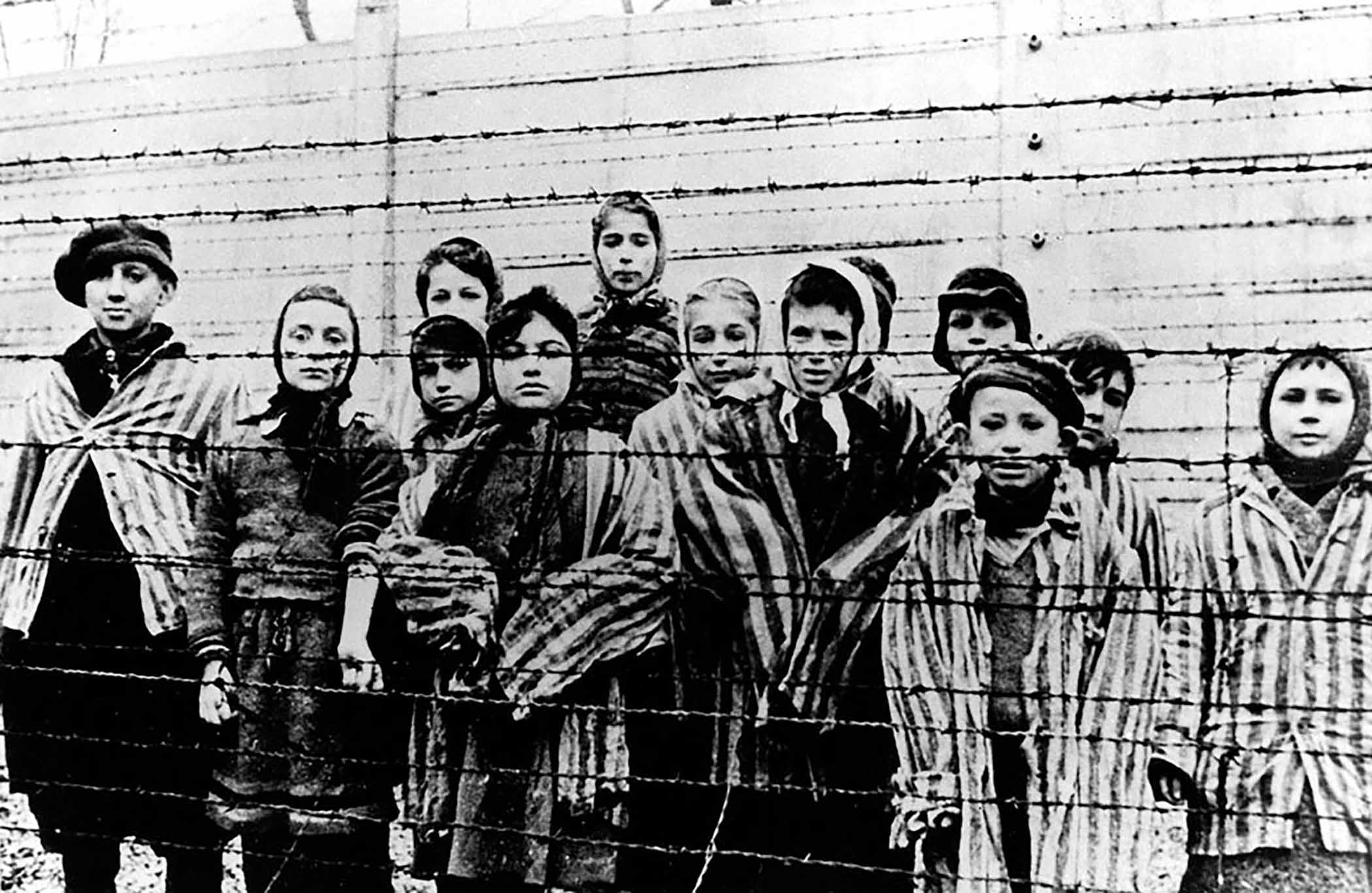
Ravensbruck was not merely a prison; it was a sprawling, horrific laboratory for the implementation of Nazi racial policies. By the time Oberheuser arrived, the camp held thousands of women from across Europe—Poles, Russians, Jews, and Romany people—all reduced to numbers in the camp’s ledger. While the camp was overseen by high-ranking SS officials, Oberheuser’s role became increasingly central to the day-to-day horrors of the facility. She operated under the leadership of site physicians like Walter Sonntag and Gerhard Schidlowski, but as the war dragged on and the ethical boundaries of her colleagues frayed, Oberheuser stood out for her unwavering, often sadistic, commitment to the regime’s “research.”
The experiments conducted at Ravensbruck were, by any modern definition, crimes against humanity. They included the testing of sulfonamide drugs on prisoners who had been intentionally wounded, with their legs often broken by hammers to simulate battlefield trauma. Oberheuser, alongside figures like Karl Gebhardt and Fritz Fischer, oversaw these procedures. The victims—often called “rabbits” by the prisoners—were subjected to these horrors without anesthesia. They were left to suffer in squalid conditions, their wounds intentionally infected with bacteria to test the efficacy of drugs that would never be used to help them, but rather to justify the failures of Nazi military doctors on the front lines.
The testimonies of survivors such as Wanda Poltawska provide a harrowing glimpse into the reality of Oberheuser’s “medical care.” Survivors described her as callous, cruel, and entirely indifferent to the suffering of her patients. She was known to deny them water, sometimes offering it mixed with vinegar to heighten their distress. She denied pain relief, mocked those who complained of agony, and, in the ultimate betrayal of her Hippocratic oath, she actively participated in the murder of those she deemed no longer useful.
Oberheuser’s role in the “liquidation” of the camp’s population was systematic. She would inject vulnerable women with lethal doses of phenol or petroleum, a process that took several agonizing minutes. She later attempted to frame these murders as a “humanitarian act,” a twisted justification that only further underscored her total detachment from the value of human life. She was also deeply involved in the forced abortions of women who were in the late stages of pregnancy, as well as the murder of newborns—actions that she viewed as necessary components of the Nazi mission to eliminate “useless eaters.”
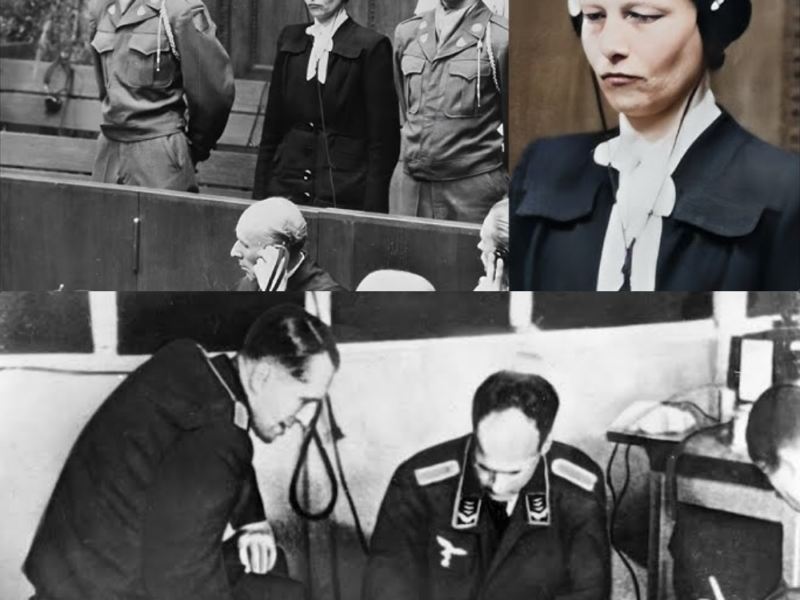
The trial at Nuremberg, which began in 1946, served as the theater where Oberheuser’s facade finally began to crumble. She was the only female defendant in the Doctors’ Trial, and throughout the proceedings, she maintained a posture of indignant denial, attempting to leverage her femininity and her status as a “good National Socialist” to excuse her crimes. She argued that her actions were legitimate orders from the highest levels of the party and that she was merely serving the German state. Yet, the testimonies of the survivors were irrefutable. She was found guilty of war crimes and crimes against humanity and was sentenced to 20 years in prison.
The justice served, however, was fleeting. Through a series of commutations and a culture of silence in post-war West Germany, Oberheuser was released in 1952, less than five years after her conviction. She attempted to return to a normal life, becoming a family doctor in the quiet town of Stocksee. It was only by a stroke of fate—when a survivor recognized her in 1958—that her past caught up with her. The subsequent public outcry and the intervention of the minister of the interior of Schleswig-Holstein led to the revocation of her medical license. Her career as a doctor was finally, and rightly, extinguished.
The story of Herta Oberheuser is more than just a historical anecdote; it is a profound warning. It reminds us of the fragility of medical ethics when they are subordinated to political ideology. It challenges us to look closely at the individuals who hold power and to recognize the signs of moral decay long before they manifest in such grotesque displays of cruelty. The suffering of the “rabbits” of Ravensbruck remains a debt that the world can never fully repay, but by remembering their names and the atrocities committed against them, we ensure that the lessons of the Holocaust remain a central part of our collective consciousness.
Oberheuser’s life, from her days as a young doctor in Dusseldorf to her final years in a nursing home in Linz, was a long, slow descent from a position of trust to a place of infamy. She died in 1978, at the age of 66, largely unrepentant and forgotten by the society that had once encouraged her worst impulses. But for the survivors of Ravensbruck and their descendants, she remains a figure of enduring horror—a testament to what happens when we abandon our commitment to empathy, to humanity, and to the sanctity of life.
As we reflect on her story, we must ask ourselves how we can prevent the recurrence of such monstrous behavior. The answer lies in constant vigilance, in the protection of our institutions from the corrupting influence of hatred, and in our unwavering support for the truth, even when it is difficult to face. The victims of Ravensbruck deserve nothing less than our continued attention and our commitment to justice. Their endurance through the darkness is the light that guides us, a light that we must guard and pass on to future generations to ensure that such horrors are truly, and finally, confined to the pages of history.
In the final assessment, the case of Herta Oberheuser stands as a powerful indictment of the Nazi medical establishment. It exposes the fallacy that expertise, when separated from a foundation of moral integrity, can lead only to destruction. It serves as a reminder that every individual, no matter their position or authority, is responsible for the consequences of their actions. The shadows of Ravensbruck are long, but they are illuminated by the courage of the survivors who spoke the truth, and by our collective resolve to never look away from the realities of the past.
Let us continue to honor the memories of those whose lives were shattered by the “beast in the white coat.” Let us continue to advocate for the principles of human rights and dignity, and let us use the lessons of history to build a world where the Hippocratic oath is always honored, and where the values of empathy and compassion are the bedrock of our society. This is the only way we can truly fulfill the promise of “never again.”
The story of Ravensbruck is a dark page, but it is one that we must read to the end. It is a story of how an ordinary person can commit extraordinary evil, and it is a mirror that asks us to consider our own moral choices. We must be the keepers of this history, ensuring that the legacy of those who suffered at the hands of Herta Oberheuser is not lost to time. We must keep their stories alive, for they are the witnesses to a nightmare that we must always strive to understand.
Ultimately, the life of Herta Oberheuser is a lesson in the dangers of moral complacency. It is a cautionary tale that echoes through the decades, demanding that we remain alert to the encroachment of dehumanizing ideologies. It asks us to be better, to be more compassionate, and to be profoundly aware of the power we hold to make choices that either build up or tear down the world around us. In the end, we are all stewards of our collective humanity, and the choices we make today will shape the world of tomorrow.
Let us learn from the tragedies of the past and build a future rooted in justice, compassion, and the unwavering defense of human dignity. The story of Oberheuser is a grim starting point, but it is a necessary one. By understanding the depths to which she sank, we can more clearly see the heights to which we must strive. We must never forget, and we must always hold those who violate the sanctity of human life accountable. That is the least we can do for the 132,000 women who passed through the gates of Ravensbruck, and for all those who strive for a world free from the reach of such darkness.
In conclusion, the history of the Holocaust is a vast and painful ocean of stories, and Herta Oberheuser’s account is one of the most unsettling. Yet, it is through the exploration of these dark narratives that we find the strength to advocate for a more just world. May we never shy away from the truth, no matter how uncomfortable it may be, and may we continue to honor the memories of those who perished by ensuring their experiences serve as a beacon for the preservation of humanity. The pursuit of truth is a lifelong commitment, and it is one that we must all embrace with courage and conviction.