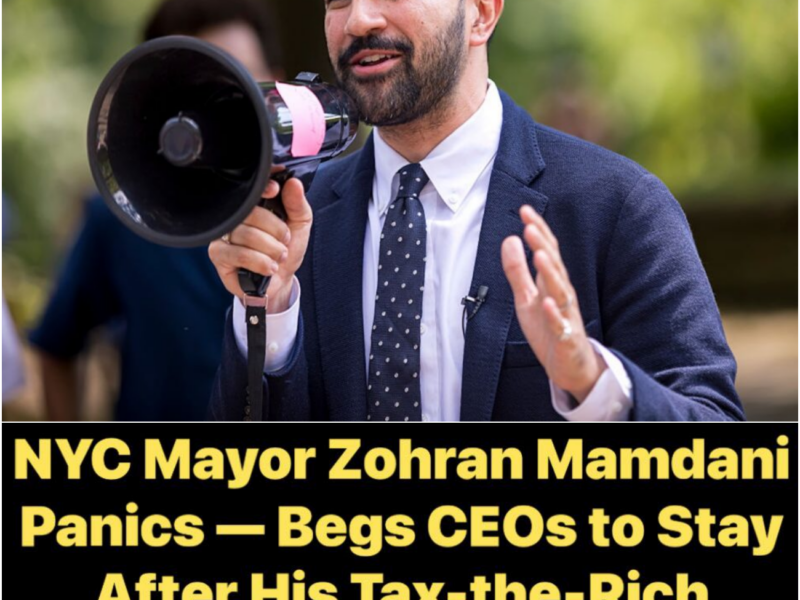
NYC Mayor Zohran Mamdani Faces Business Backlash as “Tax-the-Rich” Push Sparks CEO Exit Concerns and Urgent Calls to Retain Investment
NYC Mayor Zohran Mamdani Faces Business Backlash as “Tax-the-Rich” Push Sparks CEO Exit Concerns and Urgent Calls to Retain Investment
The Narrative of “Exodus”: Fact, Politics, and the Debate Over Tax Policy in New York City

A viral political narrative has recently circulated online claiming that “NYC Mayor Zohran Mamdani” is facing a crisis of business flight after implementing “tax-the-rich” policies, allegedly prompting emergency meetings with CEOs and urgent appeals for companies to remain in the city.
The story is dramatic: executives supposedly fleeing in large numbers, city leadership scrambling to respond, and a progressive mayor reversing course under pressure. But beneath the headline language lies a more complicated reality—one that blends misinformation, real policy debates, and long-running tensions over taxation, inequality, and urban competitiveness in the United States.
The key factual issue appears at the outset: Zohran Mamdani is not the Mayor of New York City. He is a state legislator in the New York State Assembly and a member of the Democratic Socialists of America, known for progressive policy advocacy rather than executive city governance.
The city itself—New York City—is governed by a separate municipal administration. As of the latest public record, the claim that Mamdani holds the mayoral office or is conducting executive negotiations with corporate CEOs is not supported by factual reporting.
That distinction matters, because it reveals how quickly political narratives can detach from institutional reality and evolve into viral stories shaped more by ideological framing than verifiable events.
How a Viral Story Takes Shape
The claim of a “mass exodus” of companies and emergency meetings with CEOs fits into a familiar genre of American political storytelling: the clash between progressive taxation policies and corporate mobility.
In this version of the narrative, progressive lawmakers raise taxes on high earners or corporations, businesses respond by leaving, and political leaders scramble to repair the damage. It is a storyline that has appeared in various forms in debates about California, Illinois, and New York for decades.
What makes the current iteration notable is its personalization. Instead of focusing on institutional policy debates, it centers on a specific political figure—Zohran Mamdani—and attributes to him executive-level authority he does not hold.
This personalization amplifies emotional impact, transforming abstract policy disagreements into a dramatic leadership crisis narrative.
However, no credible evidence supports claims that New York City has experienced a sudden corporate collapse triggered by a new “tax-the-rich” policy under his leadership, nor that CEOs are currently engaged in emergency negotiations with him in any official capacity.
Zohran Mamdani: Political Identity and Policy Positioning
To understand why Mamdani’s name appears in such narratives, it is important to examine his actual political profile.
Zohran Mamdani is a progressive lawmaker representing parts of Queens in the New York State Assembly. He is affiliated with the Democratic Socialists of America and has advocated for policies such as housing reform, public transit accessibility, and higher taxation on wealthy individuals to fund social services.
His policy positions place him within a broader ideological movement in American urban politics that emphasizes redistribution, expanded public services, and structural responses to inequality.
In public discourse, politicians with these views are often central figures in debates about taxation and business competitiveness—even when they are not directly responsible for citywide fiscal policy or executive governance.
This makes them frequent subjects of political messaging that extends beyond their actual institutional authority.
The Real Debate: Taxes, Mobility, and Business Decisions
While the viral claim lacks factual grounding, the broader issues it references are real and long-debated.
In New York City, discussions about taxation and business competitiveness are perennial. The city is one of the world’s largest financial and commercial hubs, home to industries ranging from finance and media to technology and real estate.
Policy proposals that involve increasing taxes on high-income earners or corporations often generate debate about whether such measures could encourage businesses or individuals to relocate to lower-tax jurisdictions.

Economists studying this question typically note several key factors:
Business relocation is complex: Companies consider taxes, but also infrastructure, talent pools, market access, and regulatory environments.
High-income migration exists but is not uniform: Some individuals relocate for tax reasons, but many remain due to career networks, lifestyle, and industry concentration.
Urban economies are resilient: Cities like New York retain strong economic gravity even amid policy shifts due to scale and global connectivity.
Thus, while tax policy can influence decisions at the margins, the idea of sudden “mass exodus” events triggered solely by tax changes is not supported by most empirical economic research.
The Myth of Sudden Corporate Flight
The phrase “companies fleeing New York” has become a recurring feature of political rhetoric, but its real-world meaning is often more limited than the language suggests.
Corporate relocation tends to occur gradually and selectively. Some firms may move headquarters, open satellite offices elsewhere, or adopt hybrid models with distributed operations. However, large-scale abandonment of a global city like New York is rare due to the concentration of financial services, media institutions, legal infrastructure, and human capital.
Even during periods of heightened tax debate, New York City continues to attract startups, international firms, and high-skilled labor due to its unmatched economic ecosystem.
This does not mean businesses ignore tax policy entirely. Rather, tax considerations are weighed alongside a much larger set of operational factors.
Political Messaging and the Amplification of Economic Anxiety
The viral framing of “exodus” narratives often reflects broader political messaging strategies rather than measurable economic trends.
Claims that a political figure is “begging CEOs to stay” evoke emotional images of instability and urgency. However, without documented evidence of such meetings or statements, these narratives function more as rhetorical devices than factual reporting.

In the case of Zohran Mamdani, there is no verified record of him holding emergency negotiations with corporate leaders regarding mass departures from New York City.
Instead, what does exist is an ongoing ideological debate about how cities should balance progressive taxation with economic competitiveness.
Historical Context: New York and Tax Debates
New York’s tax policy debates are not new. For decades, policymakers have grappled with how to fund public services while maintaining a favorable environment for business investment.
Key historical dynamics include:
Periodic increases in top marginal tax rates
Corporate incentives aimed at retaining financial firms
Real estate market pressures shaping migration patterns
Federal-state tax interactions influencing high-income mobility
Despite these fluctuations, New York has remained one of the most economically powerful cities in the world.
This resilience suggests that while tax policy is politically sensitive, it has not historically produced the kind of abrupt economic collapse sometimes suggested in viral political narratives.
Media Ecosystems and the Speed of Political Claims
The spread of the “mass exodus” story also reflects how digital media ecosystems amplify emotionally charged political content.
Headlines that combine figures like taxes, CEOs, and migration tap into existing public anxieties about inequality, affordability, and economic uncertainty. When attached to recognizable cities like New York, these narratives gain further traction.
However, the speed at which such claims circulate often exceeds the speed of verification. As a result, misleading or unverified assertions can appear widely accepted before they are fact-checked or contextualized.
In this case, the mischaracterization of Zohran Mamdani as “NYC Mayor” is a foundational factual error that significantly alters the meaning of the narrative.
Economic Reality vs. Political Framing

A careful distinction must be made between economic trends and political framing.
Economic reality involves measurable data: business formation rates, tax revenue, employment statistics, and migration patterns. Political framing, by contrast, often simplifies these dynamics into stories of winners and losers, attraction and flight, success and failure.
In the case of New York City, available evidence continues to show a complex but stable economic environment with ongoing business activity and international investment interest.
This does not mean that policy debates are without consequence. Tax rates and regulatory environments do influence long-term planning decisions. But the leap from policy disagreement to claims of sudden corporate abandonment is not supported by available data.
The Role of Progressive Politics in the Debate
Figures like Zohran Mamdani often become symbolic representatives in broader ideological debates about urban governance.
Progressive policy proposals—such as increased taxation on high earners or expanded public services—are frequently debated in terms of their economic impact. Supporters argue these policies address inequality and fund essential services. Critics argue they risk discouraging investment or driving away businesses.
This tension is not unique to New York. It is part of a broader national conversation about the role of taxation in addressing inequality in large metropolitan economies.
Conclusion: A Story About Narratives, Not Events
The claim that “NYC Mayor Zohran Mamdani is begging CEOs to stay after tax policies trigger a mass exodus” does not align with verifiable political or administrative facts. Zohran Mamdani is not the mayor of New York City, and there is no confirmed evidence of the described crisis meetings or corporate flight on the scale suggested.
What does exist, however, is a real and ongoing debate about taxation, economic competitiveness, and urban policy in New York City. That debate is often emotionally charged and easily shaped into simplified narratives that travel quickly online.
The episode illustrates a broader phenomenon in modern political communication: the transformation of complex policy discussions into viral stories that prioritize drama over accuracy. In doing so, they can obscure the actual mechanics of governance and economic decision-making.
Ultimately, the challenge for readers is not only to evaluate whether such stories are plausible, but to separate political symbolism from institutional reality—and to recognize how easily the two can become blurred in the digital age.