A Nightmare for “Tigers”? The Truth About the Super Pershing Armacor D
The tank that arrived at the front just a month and a half before the end of the war, contrary to common sense, managed to become the main and most controversial legend of late war Europe. Friends, meet the famous Super Pershing. How did a raw prototype with an unbalanced gun turn into the main opponent of the German Tigers? Why did the Americans hastily weld tons of someone else’s armor onto it right in field workshops, overloading the vehicle suspension? Today, we will analyze archival facts that remained in the shadow of official chronicles for a long time. There are too many uncomfortable questions in the history of this unique monster. Watch the video to the end. You will find out who the only combat-tested Super Pershing actually destroyed in the legendary Battle of Dessau, and why this project was hastily shut down immediately after the victory. Let us begin. Late 1944, Europe has been burning from two sides for a year and a half. The Allies broke through Normandy, crossed France, bumped into the German border, and stopped. The front line
froze in place. Not because of a lack of men, not because of a lack of ammunition, but because vehicles had appeared on the roads of Belgium and Germany against which standard American weaponry performed poorly. This was no secret. It was a problem everyone knew about, from the rank-and-file tanker to the command in Washington.
And while politicians discussed strategy, engineers were already bending over drawing boards. The main American tank at that moment remained the Sherman, the M4. Reliable, mass-produced, easy to maintain. More than 50,000 of them were produced. It won the war in North Africa, landed in Italy, and went through Normandy.
But by the end of 1944, it had one serious problem, the gun. The standard 75-mm gun on most Shermans could confidently work against most German vehicles, but not against the heaviest ones. And it was the heavy vehicles that now stood on the way to Berlin. The American command understood this, and starting in 1943, work was underway on a new tank, the Pershing, officially designated the T26E3, a vehicle of a fundamentally different class, heavier, better protected, with a new 90-mm M3 gun.
Not perfect, but it was a different kind of conversation with the enemy. There was only one problem, time. While the designers were refining the Pershing, while the military was coordinating production, and while the factories were retooling, the war did not wait. By January 1945, 40 T26E3 vehicles had been produced.
40 for the entire army fighting from the North Sea to the Alps. 20 of them went for testing at Fort Knox, Kentucky. This is the training and testing center of the American armored forces, a place where tanks are run on proving grounds, fired at special ranges, and every breakdown is recorded.
A standard procedure for new equipment. But the other 20 did not go to a proving ground. They were loaded onto ships and sent to Belgium, straight to the front, without a full cycle of testing, without established instructions for the crews, with a minimal supply of spare parts. This operation was code-named Zebra.
The name sounds neutral, almost boring, but behind it lay a simple decision, to test the new tank not on a proving ground, but in real combat. Because a proving ground is a proving ground, and war is war, and they are different things. The 20 vehicles were divided between two divisions, the 3rd Armored Division and the 9th Armored Division, 10 for each.
The crews received vehicles they were seeing for the first time. The mechanics received equipment for which there was no established repair practice yet. But even as these 20 vehicles were unloading in the Belgian port, Washington already understood that this was not enough. Because the Pershing had the same problem as the Sherman, only different.
The Sherman lacked protection and penetration. The Pershing’s protection became better, but the gun, the 90 mm M3, still fell short of what the command wanted, especially when it came to the heaviest German vehicles of the end of the war. And so, engineers started thinking not about a new tank, but about a new gun.
The task was stated briefly. A 90 mm system was needed that would approach the best German weapon of that period in performance, the long 88 mm gun. Not to copy, not to duplicate, but to approach using their own solutions and their own ammunition. On paper, this looked like the next logical step.
In practice, it turned out to be much more complicated than it seemed. To understand why a new gun was needed in the first place, you first need to understand one simple principle. A tank is a compromise, always, between weight and speed, between protection and maneuverability, between the power of the gun and how much that gun weighs.
Engineers do not choose the best solution, they choose the least bad balance. And in 1944, the main issue of this balance was the gun. To put it very simply, a tank gun must penetrate the enemy’s armor before the enemy’s armor stops its shell. This is not poetry, it is physics. And this physics at the end of World War II became a real headache for American engineers.
The Americans had a 90 mm M3 gun on the new Pershing. A good weapon, noticeably better than what was on most Shermans. At a distance of about 900 m, it penetrated about 120 mm of armor, provided the shell hit it a right angle. This is an important caveat that we will return to. Now, the German side. By then, the Germans had a long 88 mm gun on their heavy vehicles, called the KwK 43.
The number 88 is the caliber, meaning the inner diameter of the barrel in millimeters, 2 mm less than the American M3. It would seem that smaller means weaker, but this is a trap. The power of a gun is determined not only by the diameter of the shell. It is determined by muzzle velocity, the speed at which the shell exits the barrel.
The faster the shell flies, the more energy it carries. The more energy, the deeper it penetrates armor. The German KwK 43 accelerated its shell to about 1,000 m per second. For comparison, sound travels through air at about 340 m per second. This meant the shell of this gun flew almost three times the speed of sound.
The result? At a distance of about 1,000 m, the KwK 43 penetrated around 180 mm of armor at a right angle of impact. That is 60 mm more than the American M3. 60 mm of difference is no small matter. It is roughly the thickness of the frontal armor of a standard medium tank of that period. This meant that where the American M3 gun already stopped, the German KwK 43 kept going right through.
This very difference became the goal for American engineers, not to surpass, but to approach. To reduce the gap to an acceptable level. To do this, they took on a new 90-mm system, which received the designation T15. The logic was direct. Take the already familiar 90-mm caliber, cruiser trained, ammunition production is established, but make the barrel longer, much longer.
The barrel length is directly related to the muzzle velocity of the shell. The longer the barrel, the longer the powder gases push the shell inside it, and the higher the speed at the exit. This is basic physics, known to artillerymen for several centuries. The standard M3 gun on the Pershing had a barrel length of about 50 calibers, meaning the barrel length was about 50 times the diameter of the shell, or about 4.5 m.
The new T15 gun received a barrel length of 73 calibers, almost 6.6 m. The difference was more than 2 m of pure steel, which now protruded forward from the turret. The result on paper was convincing. The new T15 gun accelerated an armor-piercing shell to a velocity of about 1,021 m per second. This was very close to the German KwK 43.
Armor penetration at a distance of about 1,000 m was around 170 mm at a right angle. The gap with the German gun was reduced from 60 mm to 10. Task completed. The figures aligned. But here was the problem. When the engineers took this long gun and tried to mount it on the turret of an existing Pershing, it turned out that the victory in numbers turned into a set of new, very specific, and highly uncomfortable tasks.
And the first of them was the most obvious. The gun did not fit the way it was supposed to. Not physically, it went in, but its weight changed everything. There’s a simple experiment familiar to anyone who has ever held a long tool, a shovel, a fishing rod, or a broom. If you hold it in the middle, it is easy to hold.
If you move your hand to one end, the other end immediately starts pulling down. The weight has not changed, but the distribution of weight has changed completely. This is exactly what happened to the Pershing turret when the new long T15 gun was installed in it. A tank turret is not just a box with a gun.
It is a complex design that must rotate smoothly and predictably. To do this, its weight must be balanced relative to the axis of rotation, the point around which the turret spins. When the balance is correct, the turret turns equally easily in any direction. The gunner can work precisely with the weapon.
On the standard Pershing with the M3 gun, this balance was calculated and verified. Everything worked as intended. The new T15 gun was significantly longer and heavier in the front. The long barrel, almost 6.6 m, now heavily outweighed the front of the turret. The turret became like scales with the heavyweight on one pan while the other was empty.
It pulled forward and down. This was not just an inconvenience. It was a direct problem for combat. An unbalanced turret turns heavily. The gunner cannot keep the sight precise. The stabilization mechanisms operate under overload. At a critical moment, when every second counts, such a turret becomes a serious obstacle.
The engineers needed to compensate for this imbalance. And they did so by adding counterweights to the rear of the turret. Special weights that balance the heavy barrel in front. In photos of the T26E4, these elements are clearly visible. Massive protruding parts in the rear area of the turret that immediately catch the eye of anyone who knows the standard Pershing.
The balance was restored. But this solution added weight. The turret became heavier, which meant it reacted more slowly to the gunner’s commands. This was the first problem, but not the last. The second came from where it was least expected, from the shell itself. The new T15 gun was designed for a powerful ammunition round.
The more powerful the shot, the larger the powder charge. The larger the charge, the longer the cartridge case. It was all logical. But when the engineers put these numbers together, a troublesome picture emerged. The single-piece round for the T15 gun, meaning the shell and the cartridge case with powder joined into one piece, turned out to be very long.
So long that the loader in the cramped Pershing turret physically could not work with it the same way as with ordinary ammunition. In a standard tank, the loader takes the unitary round as a whole, rams it into the gun breech in one motion, and closes the breech block. Fast, practiced, one person, one movement. This did not work with the new long round.
The space inside the turret simply did not allow such a long structure to be turned for loading. A solution was found, but it changed the crew’s work fundamentally. They switched to separate loading ammunition. The shell and the cartridge case with the powder charge were loaded separately, sequentially. First, the loader rammed the shell, then the cartridge case with powder.
Two movements instead of one. It sounds like a trifle, but in reality, it is a completely different pace of work. In a normal tank, an experienced crew fires a shot every 8 to 10 seconds. With separate loading, this cycle lengthens. The loader works in a cramped space in a moving vehicle under physical load, in conditions where every extra second is costly.
And this happens in a turret that already has a heavier mechanism, where counterweights been added, where everything is a bit tighter and a bit more complicated. The crew of the T26E4 worked in conditions that were noticeably harder than those of their colleagues in the standard Pershing. Not critical, not impossible, but tangible.
This is what wartime compromise is like in reality. Not a pretty diagram on paper, but a human being in a cramped metal space who emits noise and shaking must perform two sequential movements precisely and quickly, again and again. The engineers solved the balance problem. They solved the loading problem.
The tank worked on paper, but there remained another problem that could not be solved with blueprints and calculations. It could only be solved right on the spot using whatever was at hand, without regard for factory standards. There is a difference between how a piece of machinery looks on a factory blueprint and how it looks after several weeks at the front.
On a drawing, there are clean lines, precise angles, verified tolerances. At the front, it is a different story. Things not in the design are added. Things that get in the way are removed. Things that seem necessary are welded on. And not because the engineers made mistakes, but because the people fighting in this machinery see the task differently than those who designed it.
This is exactly what happened with the T26E4. The basic armor of the Pershing was already a significant step forward compared to the Sherman. The frontal armor of the hull was about 102 mm in the most protected areas compared to about 63 mm on a standard Sherman M4. The turret received even better protection at the front.
But this was still considered insufficient. And here begins the part of the T26E4’s history that distinguishes it from any other American tank of that period. The additional armor was not added to this vehicle at the factory. Not according to an approved design. Not according to standard documentation.
It was installed in field conditions with their own hands from whatever was at hand. In surviving photographs of the T26E4, additional armor plates are clearly visible on the front of the turret and on the frontal plate of the hull. They do not look like factory parts and that is because they aren’t.
The edges are uneven. The mountings are crude. The thickness and shape do not correspond to factory standards, but they are there and that is what matters. Where they got the material is a separate story. Part of the additional armor plates was taken from American spare parts depots and repair bases.
It was standard armor steel simply cut and welded where the mechanics decided. Without precise calculations of the slope angle, without testing on a rig, by eye and experience. But there is a detail that makes the story of this vehicle even more interesting. Part of the armor on the T26E4 was captured, literally stripped from knocked-out German vehicles.
This is not conjecture or legend. On the surviving specimen in the First Infantry Division Museum in Cantigny, Illinois, researchers identified armor plates that matched German armor steel in composition and characteristics. German vehicles on the battlefield were a source of material, and this material was put to use.
Think about this for a second. The armor protecting the American tank was partly the very same armor against which this tank was built to fight. A war in metal in the most literal sense. How effective this field armor was is a question with no simple answer. On one hand, any additional layer of metal increases protection.
It is physics. A shell has to overcome more material. Even an uneven steel sheet welded at a sub-optimal angle creates additional resistance. On the other hand, factory armor is not just metal. It is specially treated steel with specific hardness and toughness characteristics. Factory armor plates undergo thermal treatment that makes them simultaneously hard on the outside and tough enough on the inside not to shatter upon impact.
Field-applied plates did not undergo such treatment. But the people who fought in this vehicle did not have time for metallurgical debates. They had a specific task, to make the tank better protected right now with whatever was available, and they did it. The result turned out to be visually very distinctive.
The T26E4, with its long barrel, turret counterweights, and added field armor plates, looked completely different from a factory-fresh Pershing. It looked like a machine that had been heavily modified by people who knew exactly what it was meant for. This was field engineering in its true form.
Not beautiful, not perfect, but honest. By the spring of 1945, the Americans had a tank with the most powerful 90-mm gun they managed to mount on a production platform. With additional protection added by those who would fight in it, with a crew that knew the features of their vehicle. The final question remained, how and when to send it where it was needed.
And this is where that part of the story begins, which explains why the T26E4 had such a short combat biography. January 1945, the front line runs through eastern Belgium and Luxembourg. The Ardenne Offensive, the German attack that American historiography calls the Battle of the Bulge, had just ended.
German troops struck through the Ardenne Forest in mid-December 1944, broke through the American defense, and created a deep bulge in the front line, hence the name. It took the Allies more than a month to cut this bulge and regain the lost positions. This operation was costly, and it demonstrated very clearly to command what was already theoretically known.
Standard American tanks were operating in difficult conditions against well-protected German armor. It was against this backdrop that Washington finally approved the decision to accelerate the dispatch of the new Pershings to Europe, not to wait for a full testing cycle, not to wait until there were enough vehicles to fully equip at least one unit according to the table of organization, to send what was available and test it in real conditions.
The operation was named Zebra. Officially, it was a program for combat testing of new equipment under real employment conditions. In essence, it was a very pragmatic decision dictated by a shortage of time. 20 T26E3 tanks were the entire available stock of vehicles that could be sent to Europe at that time, not because the rest were under repair or in storage, but because no more existed in finished form.
Only 40 vehicles had left the factory by then, and half of them had already gone to Fort Knox for testing. 20 vehicles for an army numbering hundreds of thousands of men and thousands of armored vehicles. To understand the scale, the Third Armored Division alone, which received 10 of these vehicles, had hundreds of Sherman tanks of various modifications on its roster at any given time.
10 Pershings against this number was not rearmament. It was an experiment. The ships with the tanks arrived in Antwerp, a large port city in Belgium, which by then had been in Allied hands for several months and served as the main gateway for supplying the European campaign. From there, the vehicles traveled under their own power and on transporters to their destinations.
The Third Armored Division at that moment was located near the Belgian-German border, preparing to advance deep into Germany. It was one of the most experienced American armored divisions in Europe, having fought since the Normandy landings in June 1944 and gone through France, Belgium, and the first battles on German soil.
The choice of this specific division to receive the new vehicles was not accidental. Experienced personnel, proven logistics, commanders with real combat experience. If you are going to test a new tank in battle, it is best to do so with people who know what they are doing. The crews received their vehicles and a minimal briefing.
There was no time for lengthy preparation. The front was not standing still. The division’s mechanics looked for the first time at equipment they would have to work on in field conditions, without a full set of spare parts, and without established repair procedures. The official logic of Operation Zebra sounded reasonable.
The new tank had to be tested in real conditions because proving ground tests cannot reproduce all the diversity of a combat situation. This is true. A proving ground is a controlled environment. War is not. But there was another reason that was talked about less. By early 1945, the American command understood well that the war in Europe was drawing to a close.
The pace of the advance was accelerating. Germany was retreating. And if the new tank did not reach the front now, it might not get there at all before the end of hostilities. And that would mean that the entire Pershing development and production program would have concluded without a single real combat episode in Europe.
This mattered not only for history, it mattered for the future. Combat experience, even minimal, is data. It is an understanding of how a vehicle works in real conditions, where it is good and where it requires refinement. Without this data, the next development program starts from scratch. While 20 ordinary Pershings were joining two divisions and beginning combat work, the single T26E4 had not yet reached Europe. Its journey took more time.
The vehicle was an experimental prototype, one of a kind, and sending it required separate preparation. On March 15th, 1945, this wait ended. March 15th, 1945 is not a random date on the calendar. Two weeks before that, on March 7th, 1945, American forces crossed the Rhine near the town of Remagen. This was one of the key moments of the entire Western European campaign.
The Rhine was the main water obstacle on the way to the heart of Germany. The German command expected to hold it as the last serious line of defense in the west. They failed to hold it. Soldiers of the 9th Armored Division discovered that the Ludendorff Bridge at Remagen was still standing.
The Germans had not managed to blow it up in time. American units crossed it to the east bank of the Rhine before the enemy could organize serious resistance. The bridgehead was captured. This event changed the pace of the entire campaign. The allies secured a crossing where no one expected one. The German command was forced to redeploy forces to eliminate the bridgehead, weakening other sectors.
Over the following weeks, the allies organized several additional crossings of the Rhine north and south of Remagen. It was into this environment that the single T26E4 arrived. The vehicle was delivered by sea to a port in Northwestern Europe. According to available data, the route went through Antwerp, which by then was the main supply port for Allied forces in Western Europe.
From there, the tank traveled under its own power and on a transporter to the location of the 3rd Armored Division. In mid-March 1945, the 3rd Armored Division was in Western Germany in the area between the Rhine and the next major river, the Weser. The division already had combat experience working with ordinary Pershings.
The 10 vehicles that had arrived via Operation Zebra in January had managed to fight for several weeks by then. When the T26E4 appeared in the division’s disposition, it immediately attracted attention. This was not a vehicle people had seen before. Even compared to an ordinary Pershing, and most soldiers in the division already had an idea of what a Pershing looked like, the T26E4 stood out immediately.
A long barrel, noticeably longer than on the standard vehicle. It projected forward at a distance that visually seemed almost implausible for a tank gun. Behind the turret were massive counterweights that were not present on any other American tank. On the front of the turret and hull were additional armor plates, clearly not a factory origin.
The mechanics of the 3rd Armored, who were used to the Sherman and were just starting to master the ordinary Pershing, looked at this machine with understandable interest. Unfamiliar equipment at the front always evokes two feelings simultaneously, curiosity and caution. What can it do? Where does it break? How does it behave in movement and in battle? There were few answers to these questions.
Documentation for the experimental vehicle was minimal. This is logical. The T26E4 existed as a single prototype. The program was just beginning and a complete technical manual simply did not exist in the form it does for production vehicles. The crew received the vehicle with a basic set of instructions and an understanding of its main feature, the powerful long-barreled gun and the specifics of separate loading.
In essence, the instructions boiled down to a few key points. How to work with separate loading, how to take the barrel length into account when moving in confined conditions, through forests, through streets of populated areas, under bridges, and how to maintain the turret balancing mechanisms. The crew had to find out everything else themselves.
In the process, this was normal for that time and that situation. The war did not offer ideal training conditions. People learned on the go in both the literal and figurative senses. The crew that took over the vehicle found themselves in a rare situation. They were operating a piece of equipment of which no other combat-ready copy existed anywhere else in the world.
One tank, one crew, one gun of this type in the entire Western European theater of operations. It was March 1945. Germany was retreating along the entire front. The Allies were advancing eastward. The distance to Berlin was shrinking every day. The T26E4 had very little time left to write its page in this history.
And this page would be written on April 21st, 1945, near the city of Dessau, under circumstances that historians have not been able to fully clarify to this day. Dessau is an industrial city in central Germany on the Mulde River, about 130 km southwest of Berlin. In April 1945, it lay in the zone of advance of American troops.
By then, the Third Armored Division had passed through Western Germany, crossed the Weser River, traversed the Harz, a mountainous region in Central Germany, and continued its movement eastward. The pace was high. German resistance in most sectors no longer had the density and organization it had at the beginning of the year.
But not everywhere. April 21st, 1945, the Dessau area. It was here that the battle took place, which became the central episode in the history of the T26E4. It was here, according to available accounts, that the only super Pershing engaged a German armored vehicle. And this is where that part of the history begins, where facts end and questions begin.
Let us break down what is known for sure. The 3rd Armored Division operated in the Dessau area in late April 1945. This is confirmed by division documents and post-war research. The T26E4 was part of the division and participated in combat operations during this period. This also leaves no room for doubt.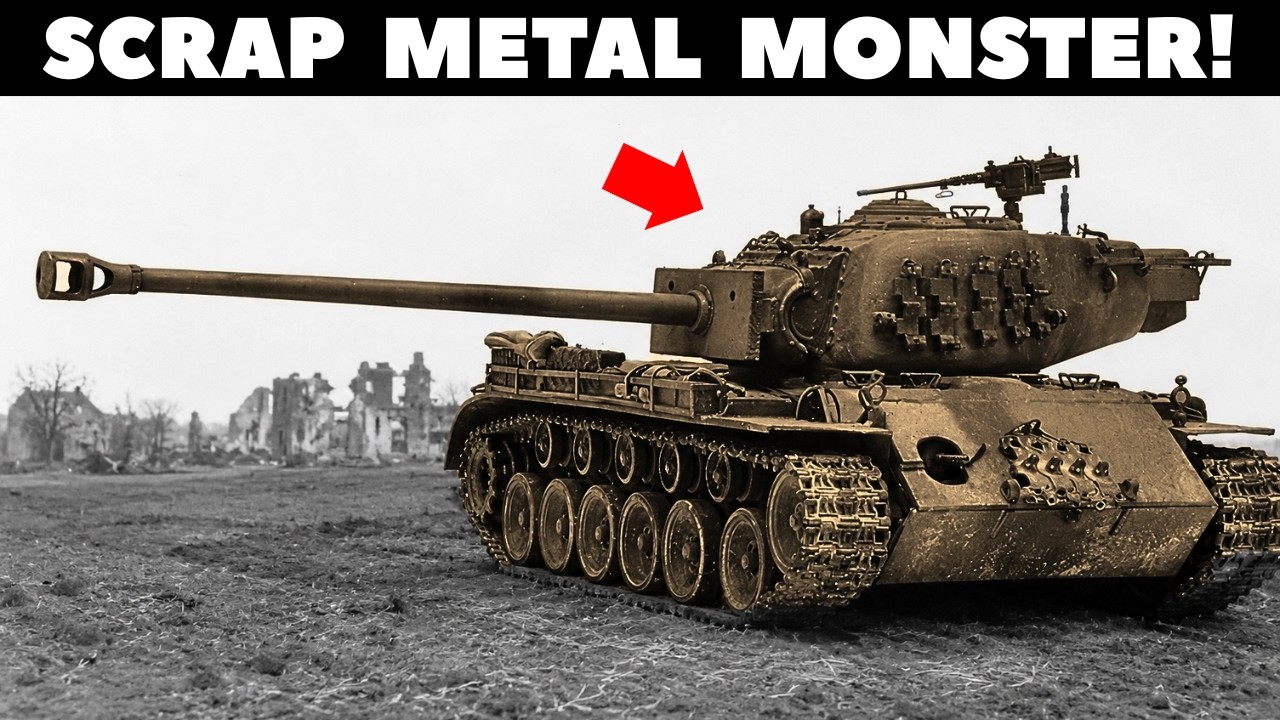
According to accounts recorded after the end of hostilities, the crew of the T26E4 engaged a German armored vehicle in the Dessau area. During this battle, the German vehicle was put out of action by fire from the 90-mm T15 gun. The T26E4 itself sustained hits, but remained operational. This is what is in the accounts.
Now, where the questions begin. The main question. What exactly stood on the opposing side? In most popular accounts of this battle, the German heavy tank Tiger II figures. The official German designation Panzerkampfwagen VI Ausführung B, also known as the Königstiger or King Tiger. This was the heaviest mass-produced German tank of that period.
Weight around 68 tons. Frontal hull armor was 150 mm, sloped. Frontal turret armor in the most protected area was 180 mm. If the opponent was indeed a Tiger II, this makes the battle highly significant from a technical point of view. Because it was precisely against such vehicles that the T-15 gun was created.
This would be direct confirmation that the program had achieved its goal. But this is where the problem arises. Researchers who investigated and documented this episode discovered a discrepancy. The nearest German units equipped with the Tiger II in late April 1945 were located a considerable distance from the Dessau area.
German armored unit documents from that period, those that survived, do not contain records of losing a Tiger II in that specific area on that date. This does not prove that a Tiger II was not there. Documentation of German units in the final weeks of the war was extremely incomplete. Headquarters moved, communications worked intermittently, and records were kept irregularly or not at all.
The absence of a record of a vehicle lost does not mean no loss occurred. But it casts doubt on the certainty with which this version is repeated. There is also a second factor that is important to understand. At the end of the war, American soldiers and commanders often called German vehicles Tigers when they were not.
This is not a deliberate exaggeration. It is a feature of the combat environment. A German tank encountered in battle was identified by its appearance, often inaccurately. The Panzer IV, the Panther, various modifications of assault guns, all of these sometimes turned into Tigers in the post-war accounts of participants.
This is a well-documented phenomenon. Historians working with sources from that period take it into account as a standard correction factor. What alternative versions exist? Some researchers suggest that the opponent could have been a Panzer IV, a lighter German tank that made up a significant portion of the remaining German armored forces by then.
Another version is one of the variants of assault guns. A third is that it was a Panther, a medium tank with good frontal protection, but far more common than the Tiger II in the final months of the war. And here’s a detail missed by almost everyone who writes about this battle. Regardless of what exactly stood on the opposing side, the technical significance of the battle itself does not change fundamentally.
The T26E4 engaged an armed German vehicle, sustained hits, and remained operational. The opponent was put out of action. This is a real combat episode of a real vehicle in real conditions, and it happened. The question of what exactly stood on the other side is important for the accuracy of the historical record, but it does not negate the fact of combat use and its result.
Here it is important to pause and state clearly, we do not know the exact answer. Available sources do not provide definitive certainty regarding the type of vehicle knocked out near Dessau. Anyone who asserts otherwise with absolute confidence is either relying on sources that are themselves inaccurate or engaging in wishful thinking.
The story of the T26E4 is more honest and interesting because this question remains open. Because uncertainty is also a historical fact. And it says more about the reality of war than any neat legend. After Dessau, the T26E4 had less than 3 weeks of active combat operations left. On May 8th, 1945, Germany signed the instrument of surrender.
The combat career of the only Super Pershing in Europe came to an end, and almost immediately, a process began that nearly erased this vehicle from history entirely. When a war ends, equipment becomes a problem. Not in a figurative sense, but in the most literal one. Thousands of armored vehicles scattered across Europe required a decision.
What to do with them next? Shipping them home was expensive and time-consuming. Leaving them to allies was politically complicated. Selling them required time and negotiations. Scrapping them on site was fast and cheap. Scrapping was precisely the fate of most American tanks that remained in Europe after May 1945.
This applied to Shermans, ordinary Pershings, and almost without exception the T26E4. But let us start with what preceded this. By the time combat operations in Europe ended, the T26E4 program was in a state that can be described in one word, incompleteness. The original plans called for the production of a thousand vehicles.
A thousand T26E4s is no longer an experimental program. It is a full-scale rearmament capable of changing the composition of armored forces. With such numbers, entire divisions could be equipped, specialized units created, and tactics built around the capabilities of the long-barreled 90-mm gun. This did not happen.
By May 1945, the actual production stood at 25 vehicles. 25 instead of a thousand. That is 2.5% of the planned volume. The reason is simple and requires no complex explanations. The war in Europe ended before production could scale up. Factories switched to other tasks or stopped production altogether.
The need for new heavy tanks for the European theater disappeared along with the theater itself. 25 vehicles. Where did they end up? The exact fate of most of them has not been established. This is a telling fact in itself. Experimental vehicles, unique specimens of technology of which fewer than three dozen were built, and most of them simply vanished from the documentary record.
Some were scrapped in Europe immediately after the end of hostilities. Some returned to the United States for continued testing. The T26E4 program was not formally closed immediately. And some work continued. Some ended up in army depots and storage bases where they were gradually dismantled or scrapped in subsequent years. Photographs of most of these vehicles have not survived.
Detailed documents about their fate haven’t either. They simply ceased to exist, leaving no trace proportional to their uniqueness. This is a normal story for experimental military equipment. Not heroic, not dramatic, simply the logistical reality of the post-war world. But one tank survived. And here begins the part of the story that distinguishes this specimen from the other 24.
The surviving T26E4 is now in the First Infantry Division Museum located in Cantigny, Illinois about 60 km west of Chicago. The museum is named after the Battle of Cantigny in France in May 1918, the first major offensive battle of the American Army in World War I. The First Infantry Division fought that battle and kept the name as part of its history.
Exactly how this specific specimen of the T26E4 was preserved is a question that is difficult to answer fully. Museum collections of military equipment were formed in the post-war years through various channels, army transfers, private donations, purchases from storage bases. The documentation of these processes was preserved unevenly.
What is known for certain, the vehicle was preserved, underwent museum conservation, and became the only physically existing representative of its type in the world. It was on this specimen that researchers were able to conduct a detailed study of the design features of the T26E4, including that study of the additional armor material mentioned earlier.
Without this vehicle, many details of the program would have remained only on paper in those documents that survived at all. On this tank, everything discussed in the previous sections is clearly visible. The long barrel of the T15 gun projecting far forward, the massive counterweights in the rear of the turret, the additional armor plates on the front of the turret and hull, uneven edges, crude mounts, traces of field work rather than factory production.
This is not a reconstruction or a mock-up. It is a real vehicle that was actually built, actually moved under its own power, and actually participated in combat operations in April 1945. 24 others disappeared. This one remained. It is hard to say whether this was a conscious effort to preserve a unique specimen or a coincidence that simply saved one specific vehicle from the fate of the others.
Probably the latter is closer to the truth. Post-war sorting of equipment was not a process guided by historical value considerations. But the result is this. There is one tank. It stands in a museum hall in Illinois, and it is the only material witness to the entire T26E4 program. A program that planned a thousand vehicles produced 25.
25 produced one survivor. One survivor yielded everything we know about the vehicle today. This is the true story of disappearance. But by itself, it does not explain why the T26E4 still sparks debates, articles, discussions, and videos 80 years after its combat career ended in a matter of weeks. For this, one needs to understand something else.
Exactly how a legend about military hardware is born and why it often lives longer and brighter than real facts. There is an interesting point in the history of military technology that repeats itself again and again. A machine is created with a specific technical purpose, undergoes tests, and participates in battles, sometimes successfully, sometimes not, and most often differently in different situations.
Then the war ends. The machine goes into archives and museums, and a few decades later, it turns out that the popular memory of this machine has very little in common with what it actually was. With the T26E4, this happened very clearly. Let us look at what the vehicle was in fact. An experimental version of the already existing Pershing tank.
Created in early 1945 with one specific goal, to mount a longer and more powerful 90-mm gun on an already finished platform. Produced in a quantity of 25 units. One specimen made it to Europe. Arrived on March 15th, 1945. Participated in combat operations for several weeks. The program was canceled after the end of combat operations in Europe.
This is the machine. Now let us look at what it became in popular perception. A secret American super weapon. A vehicle specifically created to counter the Tiger II. A tank that could single-handedly stand against the heaviest German vehicles. The hero of the final act of the war, who arrived at the last moment and proved its superiority.
This is the legend. How does this transition from machine to legend occur? It is not malicious intent or deliberate distortion. It is a natural process that has several understandable mechanisms. The first mechanism is rarity. The T26E4 was a rare machine in life and became even rarer after. A single specimen in the entire Western European theater of operations naturally creates an aura of exclusivity.
When something exists in the singular, people automatically attribute special significance to it. Rarity is perceived as evidence of value, though in reality, it is often simply a consequence of circumstances. The second mechanism is appearance. The T26E4 looks unusual. A long barrel, crude field armor, massive counterweights.
All this creates a visual image of a vehicle that was clearly modified with a serious purpose. Its appearance says, “This is not an ordinary tank.” And that is true, it was not ordinary. But visual unusualness easily turns in people’s perception into secrecy and superiority, even though by itself it simply reflects engineering compromises.
The third mechanism is the Battle of Dessau. A single documented combat episode with unclear details is the perfect breeding ground for a legend. Uncertainty does not stop storytellers. On the contrary, it gives them room. Where sources say, “Possibly a Tiger II.” The retelling turns it into, “Definitely a Tiger II.
” Where sources say, “The vehicle was put out of action.” The retelling adds details that are not in the sources. Each new generation of storytellers builds on the story a little, and gradually it becomes something else. The fourth mechanism is the name. Super Pershing is not an official military designation.
Officially, the vehicle was the T26E4. Super Pershing is a nickname that appeared later and took hold in popular literature and discussions. But the word super itself already shapes the frame of perception. By calling the vehicle the Super Pershing, we inform the listener in advance that it is superior to the ordinary Pershing, that it is better, that it is special.
And this is true again, it really was more powerful in terms of its gun. But super in the popular imagination means something more than just with a longer barrel. It means superiority in general. And gradually, the T26E4 transitions in people’s minds from a Pershing with an upgraded gun to the American answer to the heaviest German vehicles that defeated them all.
Here it is important to say something that might sound unexpected. The legend of the T26E4 does not make the vehicle itself less interesting. On the contrary, the real story of the T26E4 is the story of engineers working under the pressure of time and creating a working solution. The story of a crew that accepted an unfamiliar vehicle and fought in it in the final weeks of a great war.
The story of a program that planned a thousand vehicles, produced 25, and left one surviving specimen. The story of a battle whose details have still not been conclusively established. This is richer and more complex than the super tank that defeated the Tigers. And here is what is interesting.
It is precisely such stories with uncertain details, with engineering compromises, with people doing what they could under difficult circumstances, that more accurately convey the reality of what war was on both its technical and human sides. Neat legends about invincible machines are convenient stories, but they are flat.
They lack the detail about separate loading in a cramped turret. They lack the field armor plates stripped from knocked-out German vehicles. They lack the question of what exactly stood at Dessau, which remained without a definitive answer. The real story of a vehicle is always more interesting than its legend.
It is simply harder to tell. And this is perhaps the main thing the T26E4 tells us. Not about tanks, but about how we remember technology and the people who fought in it. One final question remains, either technical nor historical. What exactly did this tank leave behind? The single specimen of which now stands in a museum hall in Illinois, in a broader sense.
What does it tell us about wartime engineering, and why does it matter today? Cantigny, Illinois, the museum hall. The tank stands quietly as any museum exhibit stands, motionless in artificial light behind a barrier. The long barrel looks forward. The field armor plates in the front of the turret still bear the traces of the work done by the hands of mechanics somewhere in Western Germany in the spring of 1945.
The massive counterweights on the rear of the turret remind us that you cannot trick physics. The long barrel required compensation, and they found it. This is the only such vehicle in the world. Not the only survivor of many thousands, like the Sherman, of which hundreds stand around the world.
The only one, period. No more of them exist anywhere. It is worth stopping for a second and thinking about what exactly we see when we look at this tank. We see the result of the work of people who, in late 1944, were given a task to take an existing tank and mount a gun on it that would approach the capabilities of the best German weapon of that period.
Not to develop a new tank from scratch. Not to wait for ideal conditions. To take what is available and make it better. Quickly, because there is no time. They managed the task. The T15 gun achieved characteristics close to the set goal. The problem of turret imbalance was solved with counterweights.
The problem of the long ammunition round was solved with separate loading. The problem of insufficient protection was solved right in the field with available materials, including captured metal. None of these solutions were perfect. All of them were workable. This is wartime engineering in its true form.
Not the search for perfection, but the search for sufficiency. Not the best possible solution, but the best available solution in the given conditions in the given time. The T26E4 fits into a long line of American tanks, each of which was a step in one direction, from light and fast to better protected and more heavily armed. The Sherman was a compromise between maneuverability and firepower.
The ordinary Pershing shifted this compromise toward protection and a more powerful gun. The T26E4 shifted it even further toward maximum firepower within an already existing platform. The next step in this direction was the M26 tank, which after the end of combat operations in Europe was adopted as the standard American medium tank.
Then came the M46, then the M47 and M48, then the M60. This is a continuous line of development and the T26E4 stands in it not as a dead end but as one of the experiments that showed where the limit of possibility on this platform lay. 25 vehicles, one combat specimen in Europe, a few weeks at the front, one surviving tank.
By the standards of military programs, this is almost nothing. By the standards of what this program managed to do and what it managed to teach, it is enough. Now, about the crew. We have talked about the gun, the turret, the armor, the balance, but behind all this stood people. Those who accepted the vehicle in March 1945, who mastered separate loading not on a proving ground but in real conditions, who drove it through Western Germany in the final weeks of the war.
Their names did not become as famous as the name of their vehicle. This is a common story. Machinery is often remembered better than the people who worked on it. The vehicle stands in a museum. It can be photographed, measured, studied. People remain in archives and memories, which become less accessible with each passing year.
But it was they who made the T26E4 what it became. Not the designers in Detroit, not the commanders in Washington, though their role was also real. But the people who got into this vehicle, figured out its features, and drove where they were ordered to go. This is worth remembering when looking at a museum exhibit.
The T26E4 appeared too late to change the course of the war. This is a fact. The war was already drawing to a close when it reached Europe. The program was shut down before it could expand. Most of the vehicles disappeared without a trace, but this does not make its story less significant. Because significance in this case is determined not by the number of vehicles and not by the length of the combat path.
It is determined by how honestly the story shows how engineering works under pressure. How decisions are made under time constraints. How legends about technology are born and live. And how a single surviving specimen can tell more than thousands of words and archival documents. One tank. One month at the front.
And the questions it raised still remain open. What exactly stood at Dessau on April 21st, 1945? We will probably never know with absolute accuracy. The documents are incomplete. The witnesses are gone. Time has done its work. But the tank stands. The long barrel looks forward. The field armor plates keep the traces of other hands.
The counterweights on the turret remind us of the physics that cannot be cheated. And in the silence of the museum hall, there is something very precise. A machine that arrived late to a major war. Of which 25 units were produced instead of a thousand. Which left behind one combat episode with unestablished details.
And a legend that lives far longer and brighter than the real facts. This is an honest story. Without victory fanfares and without tragedy. Simply the history of one machine and the people who fought in it. Thank you for watching. See you.