Australia’s “Ugly” Gun That Proved Deadlier Than Any Allied Weapon in the Jungle D
Wulingong, New South Wales, 1939. The sea wind carried the scent of iron and salt into the small industrial town. In a modest weatherboard house behind the Ilawa escarment, a 24year-old man sat alone beneath the pale glow of a single bulb. His name was Evelyn Owen, and the rhythmic clatter from his father’s old lathe mixed with the hum of night insects outside.
Australia was not yet at war, but the headlines made it clear. Europe was burning and the Pacific trembled with tension. While politicians debated and soldiers drilled on distant parade grounds, Owen tinkered with discarded metal in his parents’ garage. He wasn’t a soldier or an engineer, merely a factory worker with an obsession for how things worked, how a spring returned, how a bolt locked, how a trigger released.
The floor around him was littered with shell casings, sketches, and parts scavenged from scrapyards. Amid the noise of turning steel, a crude shape began to emerge, his own homemade submachine gun. The prototype looked nothing like the polished rifles admired by army officers. It was clunky, stitched together from scrap steel, its chamber cut for the small 22 caliber round, and its trigger operated by the thumb instead of the finger.
Owen’s design included a top-mounted drum magazine, odd to the trained eye, but he saw in it an answer to the age-old problem of feeding ammunition smoothly. He worked with a childlike persistence, driven less by ambition and more by curiosity, that irresistible need to see if the impossible could function.
When his neighbors asked what he was building, he simply said, “Something that won’t jam.” In a nation still importing much of its weaponry from Britain, the idea that an untrained young man could outdes professional ordinance engineers bordered on absurd. Owen sent letters to army procurement offices across the country.
Each one neatly typed and hopeful, describing his weapon and asking for a demonstration. The replies came back weeks later, always polite, but final. His invention was impractical, unproven, unsuitable for adoption. The rejections might have crushed another man, but Owen continued. To him, the machine wasn’t just a weapon.
It was a question, and he intended to find its answer. By late 1939, Australia had entered the war. Factories that once produced farm tools began turning out munitions. Yet even as the nation mobilized, Owen remained an outsider, working alone in his cluttered garage, oil stained and half deaf from the constant rasp of metal on metal.
His family tolerated his obsession, his father occasionally shaking his head as he passed the doorway. But Owen wasn’t dreaming. He was engineering something the official system could not imagine. a gun that could survive the filth, the rain, and the chaos that he suspected would define the coming war in the jungles to the north.
Unbeknownst to him, a few towns away in Port Kembla, a local industrialist named Vincent Wardell, director of Lysite’s works, would soon become the missing link between his idea and the army that rejected it. Wardell, known for spotting potential in unlikely places, was shown Owen’s gun by chance when the young inventor brought it to the factory, hoping someone with influence might take interest.
He noticed something not refinement, but resilience. The design looked crude, yet it functioned with an almost primitive reliability. At that time, Australia relied heavily on imported weapons, particularly from Britain and the United States. When shipments slowed or failed to meet demand, soldiers were forced to improvise.
Local manufacturing capacity was limited and innovation came mostly from necessity. Wardell saw in Owen’s simple blowback mechanism a rare opportunity, a firearm that could be produced domestically, cheaply, and quickly. Still, the army was skeptical. Officials argued that Australian industry lacked the precision to mass-produce automatic weapons.
The Thompson submachine gun from America was considered the gold standard, and bureaucrats saw no reason to gamble on a garage invention. Letters exchanged between departments in 1940 show an undercurrent of dismissal, describing Owen’s weapon as the product of enthusiasm rather than engineering. Yet, the world was changing faster than paperwork could keep up.
The fall of France, the bombing of London, and Japan’s march into China convinced many that the next war zone would not be Europe cities, but the dense, humid jungles of Southeast Asia, places where mud, sweat, and rain ruled more than tactics or technology. In that environment, the finely tuned mechanisms of foreign guns, beautiful but delicate, were beginning to look less like assets and more like liabilities.
Meanwhile, Owen refined his weapon. He replaced parts, adjusted tolerances, and experimented with new ammunition. His notes, later recovered, reveal a surprising grasp of mechanical logic for someone without formal training. He wrote about separating the dirty parts from the clean ones, an early concept that would later define the gun’s famed resistance to jamming.
He tested his prototypes in his backyard, firing into sandbanks and old tins, each shot echoing off the quiet hills behind Woolong. Neighbors complained, but Owen smiled. He was proving something not yet to the army, but to himself. By 1941, the situation in the Pacific grew dire. The Japanese advanced toward Malaya, and Singapore sent shock waves through Australia.
The government began to consider weapons that could be produced without reliance on foreign factories. In this desperate climate, Vincent Wardell convinced military officials to give the young man’s weapon a chance. A test was arranged at the Long Bay Rifle Range near Enogera.
In December of that same year, officers from several branches of the Australian Army were invited to witness the trials. For the first time, the rough Garageorn prototype would face comparison with two icons of the modern arsenal. The British Sten gun and the American Thompson. As soldiers unpacked the weapons on the range table, no one expected much from Owen’s design.
It looked ungainainely beside the polished imports. A patchwork of welded seams and odd angles with that peculiar top-mounted magazine. Some officers chuckled under their breath. One reportedly muttered, “Let’s see if the boy’s toy can even fire.” Mud was shoveled into the guns. Sand poured into open actions.
Buckets of water drenched the chambers. The air was thick with tension and disbelief. When the first test began, the Thompson spat a few rounds before choking. Its crude frame rattled, spat, and kept firing one burst, then another, refusing to stop, even as sludge oozed from its receiver. In that moment, something shifted. The laughter stopped.
Officers leaned forward, watching in silence as the gun completed every test flawlessly. The myth of the backyard tinkerer began to dissolve, replaced by the dawning realization that Australia might have just stumbled upon the perfect jungle weapon. By the time the smoke cleared, the gun that no one wanted, had proven itself against the world’s best.
And for the first time, Evelyn Owen, the quiet man from Wulingong, was no longer seen as a dreamer. He was an inventor on the verge of rewriting Australia’s place in the war. The following morning, the officers at Long Bay were still talking about the previous day’s trials. What had begun as an informal comparison had turned into something closer to revelation.
Reports were drafted immediately, stamped confidential, and circulated up the chain of command. Every line spoke of the same thing. The Owen gun continued to function flawlessly under conditions that disabled both the Sten and the Thompson. For a military establishment that had treated local invention as a curiosity, the results were embarrassing.
If a factory worker from Wulingong could outdo the combined resources of Britain and America, what did that say about the army’s procurement system? Senior officials preferred caution, recommending further evaluation, but Vincent Wardell, stubborn as ever, refused to let the matter fade into paperwork.
He took the muddy, battle tested prototype directly to CRA, personally demonstrating its mechanism to anyone who would listen. By January of 1942, with Japanese forces advancing through the Pacific, urgency overruled hesitation. Orders were placed for mass production at the Lysite factory in Port Kembl.
For Owen, it was the end of 3 years of rejection and the beginning of a new, far greater challenge. In those early production months, the design underwent refinement, but never lost its original logic. The engineers at Lysites made small adjustments to simplify manufacturing. But the heart of Owen’s system, the top-mounted magazine and dualchamber receiver, remained untouched.
Military officials who had once scoffed at the backyard gun, now demanded delivery schedules and field manuals. The guns unconventional. top-mounted magazine quickly became its most distinctive feature. While most submachine guns fed ammunition from below, Owen’s idea of letting gravity assist the process gave it a natural advantage.
In the choking humidity of jungle warfare, where soldiers often fired from awkward positions or while crawling through muck, that design kept the weapon reliable when others failed. rounds dropped cleanly into the chamber, even if the shooter was lying prone or firing upward into trees common in Pacific fighting, where visibility was limited and ambushes constant.
Owen had divided the mechanism internally, separating the moving parts from the charging handle with a wall that acted as a filter. Any dirt or sand entering one side could not travel to the bolt or firing mechanism. Every time a casing was ejected, debris was flung downward, self-cleaning the gun as it fired.
The simplicity of the system meant fewer parts to jam, fewer tools to repair, and almost no chance of failure. That simplicity became a quiet miracle on the assembly lines. Workers with little prior experience in firearms could learn to build and service the Owen within days.
The components were robust, requiring no delicate machining or foreign materials. In an era when wartime shipping routes were under constant threat, this independence from imported parts was revolutionary. To the soldiers who first received the weapon in early 1942, it looked odd. The magazine sticking up like a periscope, the stock, plain and utilitarian.
Yet once they fired it, skepticism vanished. Men who had fought with the heavier temperamental Thompson or the unreliable Sten began to speak of the Owen as if it were a living thing. Military archives from that year record glowing field reports from training ranges in Queensland and New Guinea. The weapon performs excellently in all conditions, one instructor wrote.
Another described deliberately burying the gun in wet sand for an hour before firing a full magazine without stoppage. Word spread quickly through the ranks. It just won’t jam. The story of its creation became legend almost overnight. Newspapers caught wind of the Australianmade weapon and hailed it as proof of local ingenuity.
Garage to battlefield. One headline proclaimed, “The press loved the idea of a humble inventor whose persistence had outlasted bureaucracy. But within the army, the tone was more subdued. Officers now faced the delicate task of explaining how such a weapon had been overlooked for years. Despite production success, obstacles remained.
Australia’s industrial capacity was stretched thin and every raw material was rationed to meet demand. Lysites ran its machines around the clock. workers, many of them, women replacing men who had gone to fight, assembled components by hand, inspecting bolts and springs under the dim glow of factory lamps.
The clang of steel echoed through the nights at Port Kembler, and outside the plant gates, the Pacific War crept closer each day. By mid1942, the first batch of Owen guns reached frontline units in Papua New Guinea. The soldiers there were fighting a new kind of war. Not in cities or deserts, but in jungles where heat and rot consumed everything.
Weapons that worked in Europe simply could not survive the monsoon. Rifles jammed with mud, cartridges swelled in humidity, and fine mechanisms corroded overnight. Its sealed design and simple blowback system proved immune to the jungle’s worst conditions. In those early clashes along the Cakakota track, soldiers learned that while their boots might rot and radios fail, the Owen would still fire.
Wardell and his engineers back home read the field reports with pride, but they also knew the stakes had changed. The gun’s success meant responsibility. Every defect could cost lives. Weekly telegrams from the front requested minor adjustments, a better safety catch, a sturdier sling, an improved barrel shroud to prevent burns. Each request was answered with rapid redesign, reflecting a rare collaboration between factory floor and battlefield.
Meanwhile, Evelyn Owen, the man whose name was now stamped on each weapon, had enlisted in the army himself. Officers viewed him as both a hero and an oddity, an inventor out of place among soldiers. But Owen didn’t seek rank or reward. In interviews later, he would recall only one thought. I wanted to build something the men could trust.
By the close of 1942, the Owen gun had transformed from rejected experiment to national symbol. It embodied a kind of rugged self-reliance that Australians began to associate with their own identity during the war. Practical, unpolished, but unbreakable. As the first units prepared for deployment to the steaming jungles of Gona and Bruna, the weapon faced its final and most brutal test.
Not in laboratories or rifle ranges, but in the mud, rain, and blood of real combat. There, far from the factory lights of Port Kemler, the Owen would prove not only its worth, but its legend. The Owen gun looked almost comical at first glance, with its magazine perched awkwardly on top and its matte green paint that chipped under salt air.
It hardly carried the sleek menace of the Thompson or the compact appeal of the Sten. Yet inside that odd shape was the simplest and most brilliant mechanical logic the Australian army would ever see. Its operation was pure blowback, a principle as old as automatic weapons themselves, but refined to an art in Owen’s hands. There were no gas pistons, rotating bolts, or fragile extractors to complicate the mechanism.
When a round fired, the energy pushed the bolt backward, ejected the casing, and returned forward again, ready to fire the next shot. It was not elegant in the aesthetic sense, but it was unkillable. The secret, however, lay not in simplicity alone, but in the way Owen organized the weapon’s anatomy. He divided its receiver into two distinct chambers, one dirty, one clean.
The charging handle, which soldiers constantly touched with muddy hands, was sealed off from the bolt and firing components. That meant dirt entering through one side could never reach the vital heart of the gun. Imagine the difference. The Sten gun with its open slot for the bolt handle acted like a funnel for mud.
The Thompson, though well-built, had intricate springs that jammed easily under tropical humidity. But the Owen, it shrugged off abuse as if designed by nature for chaos itself. Every spent cartridge expelled debris downward. Each burst of fire cleansed the system. Patent diagrams from 1943 preserved in the National Archives show the precision of the layout.
This design eliminated the need for complex feed ramps or delicate magazine lips. Common failure points in other weapons. When soldiers tilted the gun at odd angles or fired while crawling, gravity still did its work. Ammunition fed true. The blowback spring, housed neatly behind the bolt, required no special tools for removal. Maintenance took minutes.
A soldier could knock out a single cross pin, lift the barrel free, and clean it with a rag. Field manuals described the process in three lines: tap, wipe, replace. In conditions where seconds could separate survival from death, such ease became sacred that simplicity also made mass production practical.
Unlike foreign weapons requiring precise machining, the Owen could be built in basic Australian workshops using local materials. Even during resource shortages, parts could be stamped or mil with forgiving tolerances. Each gun was nearly identical, but none were fragile. a dented casing, a nicked bolt, even a cracked stock, it would still fire.
To the soldiers, it wasn’t just a tool. It was a companion. Men began naming their Owens like they did pets or trucks. Old Betsy, Mud Jane, the green bastard. In oral histories recorded decades later, veterans still record the sound. It made a steady chop, chop chop, distinct from any other weapon.
One described it as a kind of heartbeat that meant you’d live another minute. Owen’s design also addressed the human element of warfare. The gun’s center of balance was forward, reducing muzzle climb and recoil. Even inexperienced soldiers could control bursts accurately, making it deadly at close range, the range that defined jungle combat.
The trigger pull was smooth, the cyclic rate moderate, and the barrel shroud protected hands from burns. It was a gun made for movement, not parade ground precision. As production continued, small variations appeared. The early 32 caliber prototypes gave way to the 9 mm Parabellum, matching Allied ammunition supplies. Barrels were rifled locally.
Wooden stocks shaped by carpenters more used to furniture than firearms. Each detail bore the mark of human hands, the smell of oil, the warmth of wood, the faint imperfections that made the weapon personal. Yet, even as the Owen became standard issue, some officers remained skeptical.
British ordinance experts dismissed it as peculiar colonial engineering. They preferred their own designs, citing tradition and appearance over function. But the men who actually fought didn’t care for elegance. In the thick green silence of the New Guinea jungle, they only cared about what fired when they pulled the trigger.
Historians later compared the Owen’s design to the evolution of the AK-47, which followed years later with a similar philosophy. Few moving parts, loose tolerances, and field reliability over precision. In that sense, Evelyn Owen had anticipated the future of small arms by nearly a decade.
Inside the Lysite factory, engineers conducted endless torture tests. They mixed mud from the factory yard with water, poured it into the receiver, and fired until the barrels glowed red. The gun refused to quit. Workers grew fond of calling it the digger’s mate, a term born from respect. The army’s confidence grew.
By mid 1943, thousands of Owens had been shipped north. Still, Evelyn Owen himself remained oddly distant from fame. The war had swept him into service, and he spent his days not as a celebrated inventor, but as a soldier in training camps. He never built another weapon. Letters from colleagues show a man modest to the point of discomfort, uneasy with praise.
One officer recalled him saying, “The gun works because it’s simple. I just made what needed to exist.” That sentiment captured the essence of the Owen gun. It wasn’t a masterpiece of art or theory. It was a creature of necessity born from a garage, forged by mud, perfected by hardship. Its shape came not from aesthetics, but from empathy, an understanding of what a soldier truly needed when everything else failed.
And as the gun’s legend spread through the Pacific, that empathy turned into survival. For in the swamps and rainforests of New Guinea, where disease and exhaustion killed as often as bullets, the one thing a man could depend on was the cold steel in his hands, stamped with the name E. Owen. Next came the moment of truth.
The battlefields of Goner and Buuna, where weapons rusted in hours, and human endurance reached its limit. There, amid monsoon downpours and suffocating heat, the Owen gun would face its ultimate test, not of design, but of faith. Because in war, reliability was more than engineering. It was the line between chaos and control.
And the Owen had already shown which side it belonged to. Papua New Guinea, late 1942. The air hung thick with the scent of rot, gunpowder, and rain. The jungles around Gona and Buuna were not merely battlefields. They were living, breathing traps. Every vine seemed alive. Every puddle, a grave in disguise.
The Australian soldiers who fought there learned quickly that this war was unlike any before. It was not about trenches or grand maneuvers, but survival in the mud, and the rain never stopped. It fell in curtains, turning the ground into soup, coating rifles in slime, and filling foxholes faster than men could dig them.
Boots disintegrated within weeks. Rations rotted. The enemy, the Japanese, held the high ground and the bunkers. Yet, it wasn’t always bullets that broke men. It was the jungle itself. And then, in this chaos, a small, awkward-looking weapon earned its legend. At first, many had been skeptical. The weapon didn’t look like the sleek American Thompson or the British Sten.
Its top-mounted magazine seemed backward, and its green paint chipped easily. Some joked it looked like a plumbers’s project. But when the fighting began, jokes turned to reverence. Corporal Ralph Ormsby of the Second 14th Battalion wrote in his diary, “I dropped the Owen in the swamp twice today.
Wiped it with my sleeve, pulled the trigger, still fired true. That’s all that matters.” Another soldier, Sergeant Kevin Gibson of the Second 16th, told a similar story years later. “You could drown the thing in the river and it would still go off. No cleaning, no tricks, it just worked.” Those were not isolated accounts.
In the thick, suffocating jungles of the Buunagona campaign, rifles jammed daily, pistols rusted before dawn, and the few Thompsons left overheated after short bursts. But the Owens painted olive and stamped with Australian steel fired again and again. The weapon’s unique construction made it almost immune to the jungle’s cruelty.
The dualchamber receiver separated the dirty external parts from the clean firing system, while the top-mounted magazine let gravity feed each round flawlessly. Even when the shooter crawled through the muck, dirt that slipped into the weapon simply fell out with each ejected casing. It wasn’t just engineering. It was survival by design.
Soldiers learned to trust their Owens like they trusted their mates. It was common to see the gun cradled even while men slept. Its barrel covered with an old sock or cloth to keep leeches from crawling inside. During night patrols, the steady rhythm of its short bursts chop chop chop became a kind of heartbeat across the jungle.
It was the sound of reliability, the sound of life continuing another hour. The conditions at Buuna and Gona bordered on the inhuman. Temperatures soared. Humidity choked the air and every wound risked infection. Japanese positions were dug into coconut groves and swamp lines fortified with logs. Advancing a few meters could take an entire day.
Mud rose past the knees and sometimes higher. Many soldiers threw away boots altogether, choosing bare feet over the constant sucking weight of wet leather. Every weapon carried by the Australians had to endure this same punishment, and nearly all failed, except one, officers wrote home in disbelief.
“Our rifles rust within a week. Our machine guns jam hourly. Yet the Owen continues, “Reports sent back to CRA during the campaign painted the weapon as almost supernatural. Some claimed it had fired after being buried overnight. Others said it worked even after being filled with river sand. While these stories stretched the truth, they reflected one simple reality.
The Owen had become a symbol of trust in a place where everything else betrayed you. Australian war correspondent Chester Wilmont, covering the campaign, later described it in his field notes. In this country of mud and heat, the men have little faith in anything mechanical. Radios fail, trucks bog, even compasses corrode.
But their Owens, strange and homely things, keep firing. They talk about the gun as if it breathes. That human bond between soldier and machine changed the morale of entire units. In a war where despair was as deadly as bullets, confidence in one’s weapon meant everything. The men who carried Owens fought with a kind of grim certainty.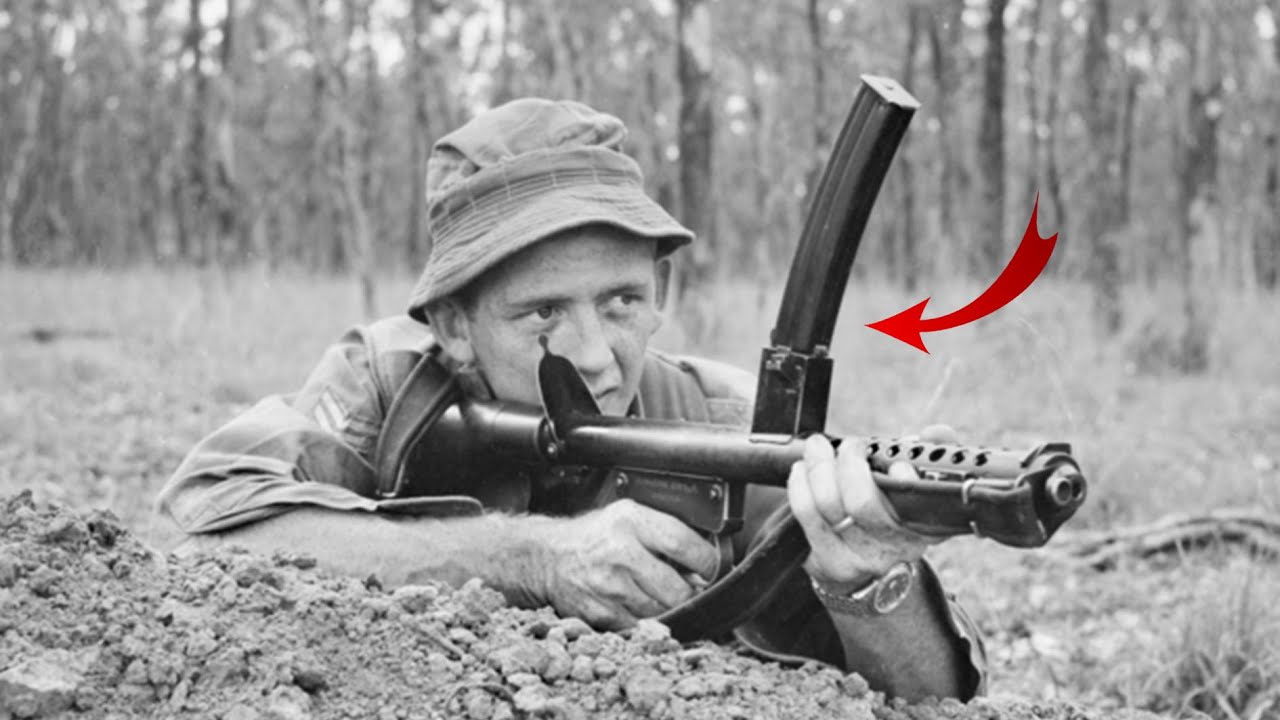
Whatever else failed, their gun would not. When the fighting intensified in December of 1942, Australian troops closed in on Japanese bunkers around Buuna Mission. Rain hammered the palm leaves above. Bullets hissed through the wet air. The ground had turned into black glue, swallowing men up to their thighs.
In that hellish proximity, the Owen’s short, balanced frame and moderate rate of fire made it perfect. The gun’s recoil barely kicked. It stayed steady even in panicked bursts. Soldiers fired from the hip, from behind trees, through slits in bunkers. The sound was constant, not chaotic, but rhythmic, deliberate, confident.
Field diaries later revealed that many Japanese soldiers after the battle were found still clutching rifles jammed with mud and rust. While the Australians Owens remained functional, the weapon had become both tool and talisman. But even myths are built from real sweat. Behind the gun’s reliability lay the relentless effort of workers.
Back in Port Kemler, Lysite’s factory ran around the clock. Its workers, men too old or women too young for the front machining, cleaning and inspecting every part. Telegrams from the front asked for small improvements. A stronger barrel guard, a smoother magazine latch, a better safety catch.
Each change was implemented within days. That collaboration between soldier and worker made the Owen not just a weapon of war, but a living link between the home front and the battlefield. By the time the campaign ended in early 1943, the Owen gun had earned a reputation that spread far beyond Australia. American officers who witnessed its performance sent reports praising its reliability, suggesting the US Army study its design.
British officials, previously dismissive, now requested samples. The same people who had once called it a colonial curiosity now wanted to know how it had outlasted their own designs. The battle of Bunagona had been brutal. Thousands of Australians were killed or wounded.
Entire companies were reduced to handfuls of survivors. The victory when it came was hollow and exhausted. Yet in every report, amid the grief and statistics, one constant appeared, the Owen gun performed excellently under all conditions. In letters home, soldiers rarely spoke of medals or strategy. They wrote instead about the mud, the leeches, the fever, and the gun that saw them through it.
If not for the Owen, one wrote, “Half of us wouldn’t be here.” By mid 1943, the weapons legend was sealed. It was no longer a rejected prototype from a garage. It was a national symbol. The army, once skeptical, now referred to it as standard issue for all close combat operations. Photographs from the period show soldiers resting in the mud, their faces hollow, but their Owens clutched firmly in hand.
The weapon had earned not just respect, but affection. Evelyn Owen himself never set foot on those battlefields. Yet his creation fought for him and for every soldier who trusted it with his life. In that sense, his invention transcended its steel and screws. It became an idea that even in the harshest conditions, something simple, honest, and well-made could endure.
As the war continued northward into New Guinea and beyond, the Owen gun became part of the Australian soldiers identity. It was not beautiful, but it was beloved a product of necessity, born from stubbornness, perfected by mud, and in the steaming jungles of the Pacific, where the rain drowned everything but courage.
When the war finally ended, the story of the Owen gun began to shift from battlefield reality to legend. Soldiers returned home with mud, still clinging to their memories. And in their retelling, the little green submachine gun grew larger than life. It had become more than a weapon. It was a companion, a savior, and to some, a miracle of engineering that seemed blessed by the jungle itself.
Yet behind that myth was a quieter, more grounded truth. In dusty storooms and army depots across Australia, armorers sorted through the surviving Owens, cleaning and cataloging them. The maintenance logs they kept, some written in careful cursive, others scrolled hastily on field paper, tell a more precise story.
The gun that soldiers said never jammed did, in fact, jam on occasion. But those failures were few and always, for understandable reasons. A dented magazine lip, a worn spring, ammunition swollen by humidity. Almost every malfunction ended the same way. A quick fix, a new part, and the weapon was ready again.
These official records, preserved in the archives of the Australian War Memorial, reveal the discipline behind the myth. Far from being invincible by magic, the Owen succeeded because it was built for imperfection. Its loose tolerances allowed mud and sand to move through without seizing the action. Its weight and balance kept it steady, even when soaked in rain.
What soldiers described as luck was in fact the result of meticulous engineering married to human practicality. Still to the men who carried it through Gona Buuna and Saninandanda that distinction hardly mattered for them. The gun’s reliability had taken on a sacred dimension. In the jungle faith in one’s weapon meant faith in survival.
And so in letters home and reunion talks years later, the story changed shape. The Owen became the gun that would fire underwater, the gun that never stopped, or the one thing in the war that didn’t give up. By the time these stories reached newspaper editors and postwar journalists, the line between truth and legend had blurred completely.
Newspapers across Australia printed features with titles like from garage to glory and the weapon that won the jungle. The myth had escaped into popular imagination growing taller with every retelling. Meanwhile, in factories like lysites at Port Kembl, the workers who had built those guns smiled quietly at the praise.
They knew the weapons power came not from magic, but from sweat. They remembered the endless nights spent polishing bolts, testing springs, and inspecting each barrel under dim light. Some of those factory workers, mostly women who had replaced men, sent to the front, later said that they treated each gun as if it might save someone’s son or brother.
That devotion to craftsmanship was, in truth, the unseen backbone of the Owens reputation. The army might have written orders and the soldiers might have fired it, but it was the factory floor, the human touch that made the weapon trustworthy. Each piece was handled, fitted, and tested by people who understood its purpose intimately.
Their quiet labor turned a crude invention into a national symbol. After the war, Evelyn Owen returned to civilian life, but peace did not bring him fame or fortune. He was only in his early 30s, but years of work and war had drained him. Friends described him as gentle and humble, often uncomfortable when people called him a hero.
He gave few interviews, and in those he did, he deflected credit, saying, “He tried his hand at other inventions, designing a few experimental firearms during the late 1940s, but none reached production. The war had been both his triumph and his exhaustion. In 1949, at only 33 years old, he died quietly, gone before the weapon that bore his name reached its full historical significance.
In the years that followed, the Australian army continued to rely on the Owen gun. It served through the Korean War where soldiers once again praised its ability to function in snow and sleet and later in the Malayan Emergency where it proved just as reliable in tropical rain as it had been in New Guinea to the young recruits of those later wars.
The Owen was already a legend, a relic of their father’s time, but still the weapon they trusted most. Even as newer firearms appeared, none matched its reputation for reliability. The British Sterling, the American M3 grease gun, and even later Australian prototypes all struggled under the same conditions the Owen seemed to thrive in.
Historians often remarked that it had been born perfect for the wrong war since its design heavy, slow firing, and built for close-range endurance fit the jungle better than the urban battlefields of the future. By the early 1960s, modernization came calling. The phone submachine gun, a sleeker and lighter model, replaced the Owen as standard issue.
On paper, the phone was the logical successor, easier to produce, simpler to maintain, and compatible with NATO ammunition standards. But among veterans, the change was met with resistance. Many soldiers called the new gun soulless. They missed the weight, the feel, the stubborn dependability of the Owen.
One veteran of Malaya wrote in a letter to the Sydney Morning Herald that year. You can polish the new guns as much as you like, but they don’t have the same heart. The Owen had heart. It was an odd word to use for a machine heart, but in a way it fit perfectly. The Owen’s story was never just mechanical.
It was human from beginning to end. A young man’s persistence, a facto’s collective effort, and an army’s desperate need had fused into something far greater than any blueprint. The weapons myth grew alongside its history. Military historians began to compare it to the Russian AK-47. Both weapons born from necessity, designed with simplicity, and carried by soldiers who trusted them completely.
But while the Kalashnikov became a global icon, the Owen remained a local legend. its fame confined mostly to Australia and the Pacific that suited its story. Though the Owen had never sought attention, it had simply done its job better than anyone expected. In the archives, an old inspection report dated 1945 captures that spirit perfectly.
In neat typewritten lines, it reads, “The Owen submachine gun remains the most dependable firearm in service. Reports of failure are statistically insignificant. Its maintenance is straightforward. Its operation foolproof, its performance exemplary. That report, like the weapon itself, was understated and exact devoid of poetry, yet somehow deeply moving in its simplicity.
By the end of the 1950s, as Australia’s attention turned toward the atomic age and jet aircraft, the Owen gun was quietly retired from glory. Many were melted down for scrap. Others ended up in museums or private collections. But among the men who had carried it through the jungles, its memory stayed vivid.
Even decades later at veteran reunions, old diggers would bring photographs of themselves, young faces smeared with mud. They’d tap the images with trembling fingers and say, “That gun saved my life.” No one argued. For them, the Owen gun was not a relic of war, but a reminder of endurance of what could be achieved with persistence, humility, and faith in one’s own creation.
It stood as proof that genius could come from a backyard, that courage could take the form of craftsmanship, and that sometimes the greatest weapon a soldier carries is not made of steel, but of trust. And in that trust, the legend of Evelyn Owen, the quiet man from Wingong, lives on. The war was over.
But the legend of the Owen gun did not fade with the silence that followed. It lingered in veterans memories, in factory yards, and in the stories told to young recruits who never saw New Guiney’s mud, but still knew the name Owen. What had begun as a lonely experiment in a Wingong garage had become one of the most respected weapons ever made in Australia.
In the immediate postwar years, the Australian Army kept the Owen in frontline service, even as other nations replaced their wartime firearms with newer, flashier designs. It was used in the Korean War beginning in 1950 and ending in 1953 and again during the Malayan emergency that spanned from 1948 to 1960. There, Australian and Commonwealth troops fought communist guerillas in dense tropical jungles that echoed the very conditions of Papua.
The gun that had conquered mud and monsoon two decades earlier did the same again, almost unchanged. Field reports from Malaya read like echoes from New Guinea. Patrols deep in the rainforest praised the weapon’s balance, reliability, and steady rhythm. The Owen has no fear of the jungle. One officer wrote, “If it jams, it means the man is dead before the gun is.
” In those years, young soldiers heard tales of veterans who swore their Owens could fire after being buried, and they treated the weapon with the same reverence their fathers had. Meanwhile, engineers and historians began studying why it had worked so well. Universities and ordinance departments dissected the Owens design in search of its secret.
What they found was not advanced technology, but a series of clever, almost humble decisions, each made with the soldier in mind. The top-mounted magazine was not just a quirk. It made reloading easier while lying prone. The internal divider that kept dirt away from the bolt wasn’t overengineering. It was common sense applied with precision.
The gun’s heavy build, often criticized, absorbed recoil, and made bursts more controllable. In essence, the Owen succeeded because it was honest, designed for real war, not imagined one. It did not pretend to be elegant or modern. It simply worked. By the early 1960s, however, military fashion shifted. Nations sought lighter, higher capacity weapons for new types of warfare.
The phone submachine gun, also Australianmade, replaced the Owen as the army’s standard issue. The phone borrowed from Owen’s lessons, but lacked its soul. Many soldiers quietly resented the change, saying the phone was too clean, too cold. In the jungles of Vietnam, some troops managed to keep their old Owens smuggled or unofficially issued, trusting them more than the newer model.
The last Owens were retired in the 1970s. Many were melted down or scrapped, though a few survived in museums and private collections. The Australian War Memorial in CRA preserves several examples. Their olive green paint faded, their metal pitted by age. To the untrained eye, they look crude relics from a distant past.
But to those who know their story, every dent and scratch carries meaning. The mark of invention born from isolation and endurance born from necessity. Evelyn Owen never lived to see this legacy. His early death in 1949 robbed him of recognition, though his name lived on in every stamped receiver and every whispered story of survival.
Historians later pieced together his life from fragments, letters to the army, sketches, and the recollections of co-workers who remembered his quiet intensity. He was, by all accounts, a man uninterested in fame, more comfortable with tools than medals. Yet his work had given his country something more valuable than pride, self-reliance.
In the decades since, the Owen gun has been studied not only as a weapon, but as a cultural artifact. Scholars see in it a reflection of Australia itself during the Second World War. Practical, unpolished, determined to solve problems in its own way. It embodied a national confidence that emerged from hardship.
The belief that ingenuity could thrive far from the world’s industrial centers. Even modern firearms designers continue to cite the Owen in discussions of field reliability. The concept of separating clean and dirty chambers, the emphasis on gravity-fed efficiency, and the commitment to simplicity remain guiding principles for small arms engineers.
In military museums across the Commonwealth, next to sleek assault rifles and polymer pistols, the old Green Owen still demands quiet respect. But perhaps its greatest legacy lives not in steel or engineering diagrams, but in the stories of the men who carried it. Veterans who fought in New Guinea, Korea, and Malaya often described the same ritual.
After cleaning the gun, they would pat the stock almost like thanking a comrade. For many, that gesture outlived the war itself. They could forget the faces of some officers, even the details of certain battles, but never the feel of that weapon in their hands. The legend of the Owen also changed how Australia viewed its own potential.
Before the war, the nation had been seen largely as a dependent outpost of the British Empire. It showed that ingenuity could grow in the most modest of places, a backyard, a garage, a nation underestimated. In 2004, when the last surviving production engineers were interviewed, one of them then in his 80s said softly, “We didn’t build it for glory.
We built it so our boys could come home. That single line captures the spirit behind the Owen better than any technical manual. Today, the weapon stands in museums not as a symbol of war, but as a testament to creativity under pressure. Its green frame sits beneath glass, the barrel angled slightly upward, as if still ready for use.
Visitors pause, read the plaque, and move on. But those who know linger, tracing with their eyes the rough welds that once meant survival. The Owen Gun’s endurance was never just mechanical. It was emotional. It was a reminder that innovation does not need vast laboratories or government funding.
It needs someone stubborn enough to keep going when everyone else says no. Evelyn Owen’s garage became a birthplace of history because one young man refused to stop tinkering. And so the Owen remains more than a footnote in military history. It is a quiet challenge whispered to every generation that follows.
Build something that works when nothing else will. For the men who once marched through jungles with its weight against their chest, that whisper still echoes. They remember the mud, the rain, the smell of gun oil, and the staccato rhythm that meant survival. And somewhere in the memory of every man who carried it, the Owen gun still fires, steady, stubborn, and unbroken.