British Engineers Cut Open Damaged Tanks and Created Something the Germans Had Never Seen D
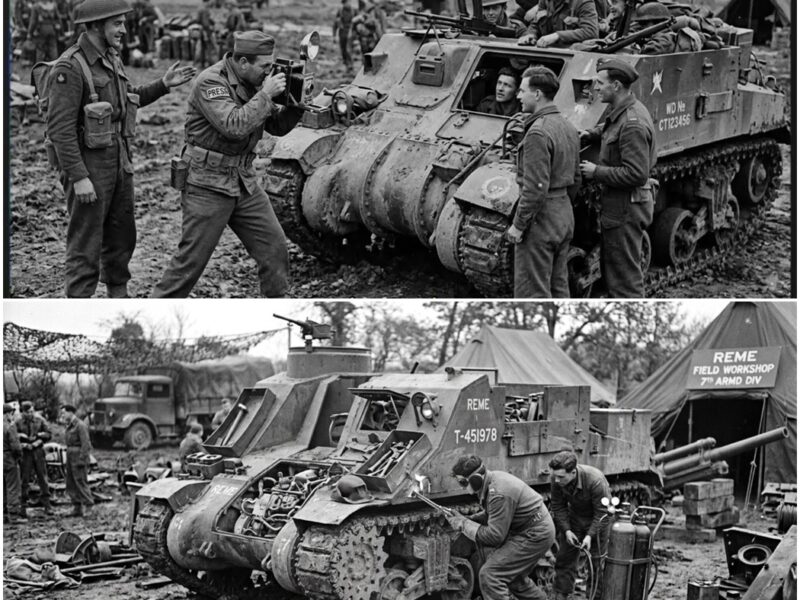
Normandy, 6th of August, 1944. Behind the lines near Caen, a workshop crew from the Royal Canadian Electrical and Mechanical Engineers stood over a row of Priest self-propelled guns, oxyacetylene torches hissing in the summer heat. These were not vehicles awaiting repair. They were perfectly serviceable American-built M7 Priests mounting 105 mm howitzers, and the crews had orders to cut the guns clean out of them.
On paper, this was an act of vandalism, the deliberate destruction of usable artillery on the eve of a major offensive. Yet, by the following morning, 76 of these gutted hulls would carry the infantry of the 51st Highland Division across 2 mi of open, fire-swept ground during Operation Totalize at a fraction of the casualties anyone had dared to predict. The vehicle had no name yet.
Soldiers would soon give it one, the Kangaroo. What looked like sabotage was, in fact, the birth of the armored personnel carrier as the British Army would fight the rest of the war with it. And the disadvantage everyone saw, an unarmed box of steel with no gun, would turn out to be exactly the point.
Standard military thinking in 1944 held that infantry crossed open ground on foot behind a creeping barrage, or they rode in unarmed trucks and half-tracks well back from the objective before dismounting. Doctrine on both sides of the line assumed that a fighting vehicle needed a weapon, and that a vehicle without one had no place near the front.
Critics within the Canadian and British staffs argued that stripping a 105 mm howitzer out of a functioning Priest wasted a scarce artillery piece to build something that could not shoot back. They were right that the Kangaroo could not fight. They were wrong about what that meant on the battlefield of Normandy in August 1944.
By early August, First Canadian Army under Lieutenant General Guy Simonds faced a specific tactical nightmare. The country south of Caen, the Verrières Ridge sector, was open, gently rolling farmland dotted with small orchards and stone-walled villages, ideal for the long-range fire of German 88 mm anti-tank guns and Panther tanks dug into hold-down positions on on reverse slopes.
Previous attacks at Verrieres Ridge in late July had shown what happened when infantry walked across that ground. The Black Watch of Canada lost 315 of 325 men in a single frontal assault on 25th of July, cut down by machine gun fire and mortar bursts before they had covered a thousand yards. Standard military thinking said the answer was more artillery preparation, more smoke, more armor escorting the infantry forward on foot at the pace of the slowest man.
Simonds looked at the casualty figures and concluded that the infantry themselves were the vulnerable element, soft, slow, exposed for every one of those two miles. And that the problem was not a lack of firepower, but the sheer length of time spent walking through it. While staff officers elsewhere continued to argue for heavier bombardments and denser smoke screens, Simonds asked a more basic question.
How does a man cross open, observed ground without being seen and hit before he ever reaches the objective? Trucks and half-tracks offered speed, but no protection worth the name. A single burst of machine gun fire through canvas sides could wipe out a section. Walking offered nothing at all. What Normandy demanded, and what no existing British or Canadian vehicle provided, was something that combined a tank’s armor with a lorry’s capacity, minus the weight and complexity of a turret and gun that the job did not require. That gap in the inventory, not any grand design brief, was what sent the REME workshops looking at the Priests parked in the depots behind the line. The secret was in recognizing that the Kangaroo did not need to fight. It needed to survive the journey. A Priest hull was built on the M4 Sherman chassis, with armor up to 42 mm at the front glacis, and roughly 25 mm on the sides. Thin by tank standards, but sufficient to stop rifle caliber fire, shell splinters, and the machine gun fire that killed infantry crossing open ground in the old way. Workshops removed the howitzer, the
recoil mechanism, and the ammunition racks, welded steel plate over the resulting gap in the superstructure, and fitted simple bench seating. Each Kangaroo could carry eight to 10 fully equipped infantrymen sealed inside armor moving at up to 24 mph far faster than a man could run let alone advance under fire.
What actually mattered was not what the vehicle could do to the enemy but what the enemy could no longer do to the men inside it. Operation Totalize opened at 2300 hours on 7th August 1944 at night a decision itself born of the same philosophy. Minimize exposure by any means available including darkness.
The first and second Canadian infantry divisions alongside the British 51st Highland Division advanced with infantry riding in the newly formed kangaroos of the first Canadian armored personnel carrier regiment the first unit of its kind in any army. Columns of kangaroos guided by tracer fire artificial moonlight bounced off low cloud and radio beams drove directly across ground that had cost the Black Watch nearly its entire strength two weeks earlier.
After action reports from the operation recorded infantry casualties during the approach March at a small fraction of those from July’s dismounted attacks. One Canadian officer writing in the regimental war diary noted that his company reached its start line with boots barely muddied and not a man lost to the approach.
A sentence that would have been unthinkable for infantry crossing the same fields on foot three weeks before. German prisoners taken during the operation reported confusion at engaging what their own reports described as unidentified armored transporters vehicles that did not match any known Allied tank silhouette and that did not stop to return fire when engaged by small arms or splinters.
German anti-tank gunners trained to prioritize targets by gun caliber and turret shape found themselves facing squat turretless boxes that simply kept moving. The vehicles that did fall to German 88 mm fire did so as tanks did through direct anti-tank rounds not through the machine gun and mortar fire that had shredded the Black Watch.
That was the entire point. The kangaroo was never meant to survive a direct anti-tank hit. It was built to survive everything short of one which was the overwhelming majority of what killed infantry in the open. The advance itself was organized with the same attention to minimizing exposure that had inspired the vehicle in the first place.
Columns moved in tight formation behind a rolling barrage, navigating by compass bearing, and by searchlight beams bounced off the cloud base, a technique the British had already nicknamed artificial moonlight. Dust and smoke reduced visibility to a few dozen yards in places, which for infantry on foot would have meant disaster, men scattering and losing contact with their units under fire.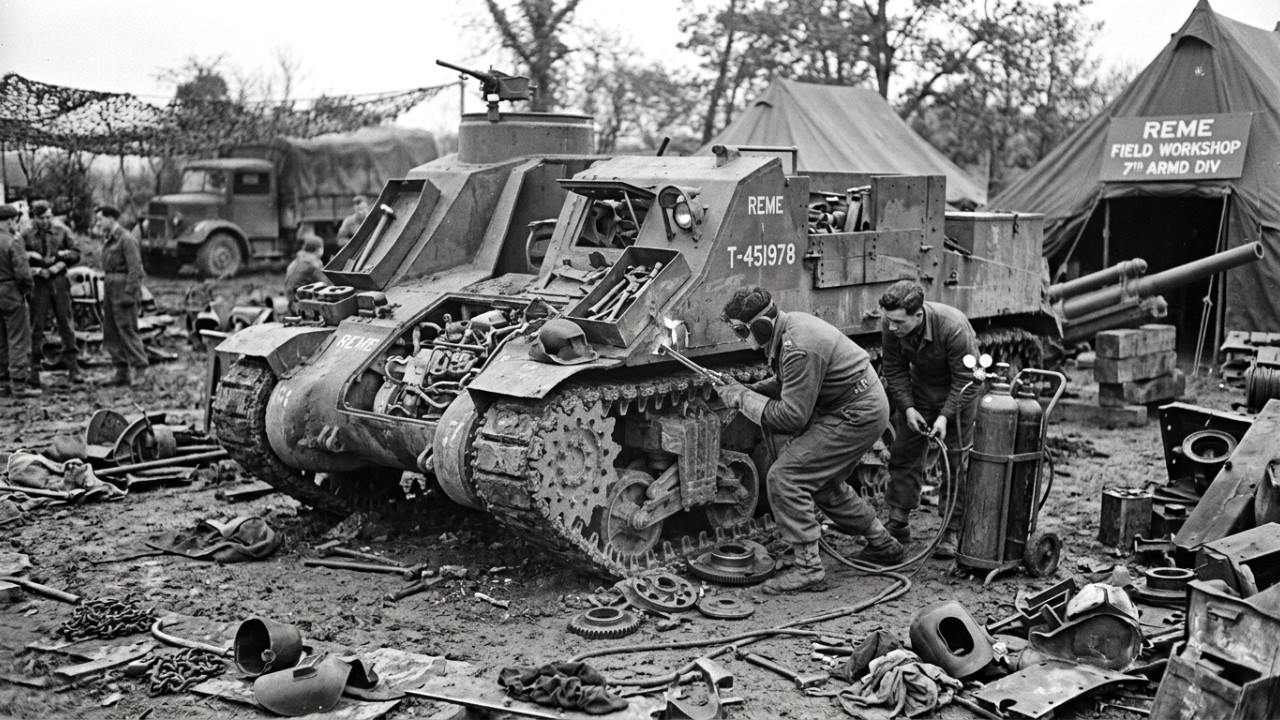
For men sealed inside a Kangaroo’s hull, the same dust and confusion mattered far less. The driver held his bearing, the column held its shape, and the infantry inside simply waited for the ramp down order. A signals officer traveling with the column later described the difference in blunt terms.
Soldiers who had crossed similar ground on foot in July arrived at Totalizer’s start line talking, joking, checking their kit, rather than shaking with the anticipation of a barrage they would have to walk through. That psychological dimension mattered as much as the physical one. Infantry who arrived composed fought better in the minutes that followed than infantry who arrived exhausted and shocked by casualties suffered on the approach.
This was not accidental improvisation dressed up afterwards as doctrine. Simons had specifically requested unfrocked priests, the term used in signals traffic at the time, borrowed cheekily from the defrocking of a clergyman, because he had already identified that the shortage was not in guns, but in protected transport.
Standard supply had plenty of towed and self-propelled artillery. It had almost no way to move infantry under armor across open ground quickly. Commanders were not clinging to the idea that every armored vehicle needed a weapon. They understood that the Normandy battlefield of August 1944 was killing infantry with shell splinters, small arms fire, and mortar bursts during the approach, not in the final assault.
Removing the gun did not create a weaker vehicle. It created the right vehicle for a problem that had nothing to do with firepower. What made the Kangaroo work was not any single technical feature, not the armor thickness, not the seating capacity, not the speed. What made it work was that it addressed the actual mechanism of infantry casualties in this specific kind of terrain, rather than the mechanism the existing doctrine assumed.
Textbook thinking held that infantry needed fire support to advance. The Kangaroo instead removed the need for the infantry to be exposed at all until the moment of the assault itself. Testing establishments back in Britain evaluating armored vehicles against standard criteria of armament and armor protection would have scored the Kangaroo poorly.
No main gun, modest armor, no offensive capability whatsoever. In the chaos of an actual night assault across the Verrières Ridge corridor with tracer arcing overhead and 88 mm rounds probing for targets, those criteria were irrelevant. What mattered was whether man arrived at his start line alive and able to fight.
And by that measure, the Kangaroo outperformed every existing method of infantry transport used by either side in Normandy. Word of the Kangaroo’s performance at Totalize moved quickly through Second Army as a whole. By the autumn of 1944, the workshops of 21st Army Group had converted further RAM tanks, the Canadian-built Cruiser tank that had already been declared obsolete as a gun tank owing to its weak 2-pounder and later 6-pounder armament, into dedicated Kangaroo carriers.
This time, by removing the turret entirely rather than converting a self-propelled gun. The RAM Kangaroo became the definitive version and the First Canadian Armoured Personnel Carrier Regiment, soon redesignated First Armoured Personnel Carrier Squadron, carried infantry of multiple divisions through subsequent operations including the clearing of the Scheldt Estuary in October and November 1944.
Fighting conducted across flooded polder country where dismounted infantry faced exactly the same exposure problem Totalize had solved. German assessments captured later in the campaign continued to register surprise at the concept. The Wehrmacht anti-tank doctrine built around identifying and prioritizing armored threats by their offensive capability had no established category for an armored vehicle whose entire purpose was defensive transport.
Standard German tactical manuals emphasized destroying tanks and self-propelled guns first, softer targets second. A hierarchy that assumed every armored vehicle on the battlefield carried a weapon worth fearing. The Kangaroo exploited exactly that blind spot. Gunners conditioned to identify threats by turret and barrel found themselves looking at vehicles that presented neither.
And by the time they recognized the danger, infantry pouring out of the hull at close range, the assault had already closed to grenade distance. The lesson British and Canadian engineers drew from the Kangaroo was not really about tanks at all. It was about matching the vehicle to the specific mechanism of harm on a specific battlefield, rather than to an abstract standard of what a fighting vehicle should be.
Verrières Ridge had already proven in blood that the killer of infantry in that terrain was sustained indirect and small arms fire during a slow approach, not the absence of allied firepower. Once that diagnosis was accepted, removing the gun from a Priest was not a downgrade. It was a precise engineering response to a precisely identified problem, achieved not in a design bureau, but in a field workshop with cutting torches, in a matter of days, using vehicles that were already sitting in the depot.
This was the pattern that ran through British engineering solutions across the Normandy campaign more broadly. The funnies of the 79th Armoured Division, the flail tanks, the bridge layers, the flame-throwing crocodiles, all shared the same underlying philosophy of building a specific answer to a specific killing mechanism, rather than a generalist vehicle scored well against a theoretical checklist.
The Kangaroo, born from cut-open Priests on a Normandy roadside, was perhaps the purest expression of that philosophy. A tank stripped of the very thing that made it a tank, because the men inside it needed to arrive alive far more than they needed a gun that, riding inside an armored box, they would never have fired anyway.
Critics who called it a wasted artillery piece were counting the wrong casualties. The infantry who rode across the Verrières-Falaise corridor with boots un-muddied counted differently, and theirs was the count that mattered. Long after Normandy, the concept the REME workshops improvised with cutting torches in a matter of days would outlive the war itself.
The armored personnel carrier became a permanent fixture of post-war armies. And every APC that followed, the American M113, the British FV432, inherited the same basic wager first proven on that Normandy roadside, that a vehicle built to protect the man riding inside it could matter more than a vehicle built to fight.
Nobody in a design office had specified that trade-off in advance. It was arrived at by engineers standing over damaged and spare tanks with torches in their hands, solving the problem in front of them, rather than the problem the textbooks described. And in doing so, building something the Germans had genuinely never seen coming.