Diana Picked Sarah Chatto to Be Harry’s Godmother — For a Reason Nobody Names D
On the morning of the 21st of December, 1984, at St. George’s Chapel, Windsor Castle, a 3-month-old boy was held over a font, and the Archbishop of Canterbury poured water on his forehead and gave him four names. Henry, Charles, Albert, David. The boy’s mother was 23 years old. Her name was Diana, Princess of Wales.
The boy was her second son. He would, before he was 40, walk away from the family he was being christened into that morning. And the world would spend the next two decades arguing about what had been done to him. His mother was already arguing about it inside her own marriage. Robert Runcie had officiated at Diana’s wedding 3 years earlier at St.
Paul’s Cathedral. He had heard the vows. Now he was recording the next document in the sequence. The christening of the second child on the 21st of December, the week before Christmas, at Windsor. Princess Anne didn’t attend. Six people had been chosen as godparents. The press reported all six names the following morning.
Five of those names are immediately legible to anyone who knew the Wales household in 1984. The sixth has been published in every list of Harry’s godparents for more than 40 years, and nobody in 40 years has been asked to read it carefully. The sixth name is Lady Sarah Armstrong-Jones, Princess Margaret’s daughter, 20 years old that December.
Diana picked her on purpose. Go back 3 years. The 29th of July, 1981, St. Paul’s Cathedral, London. Diana Spencer is marrying Charles, Prince of Wales, in front of a television audience estimated at 750 million. Her dress, designed by David and Elizabeth Emanuel, has a 25-ft train. Five bridesmaids walked behind it.
UPI archives carried the bridesmaid announcement on the 9th of April, 1981, 3 months before the wedding. The wire copy was direct. The oldest bridesmaid at 17 is Lady Sarah Armstrong-Jones, daughter of Princess Margaret and Lord Snowdon. Sarah shared the train-carrying duties with 13-year-old India Hicks.
Three younger girls completed the party. Sarah Jane Gaselee, Catherine Cameron, and 5-year-old Clementine Hambro at the front. Press photographers from every major agency in Britain captured her that day. She is individually named in the captioned archive photographs. The Getty Images collection contains multiple images from the ceremony in which she appears by name.
A 17-year-old with a 25-ft train and a composed expression doing a job inside an institution she had known since birth. This is the first piece of public documentary record that places Sarah Armstrong-Jones directly in Diana’s orbit. It isn’t the last. Sarah Frances Elizabeth Armstrong-Jones was born on the 1st of May, 1964, at Kensington Palace, London.
She was the second child and only daughter of Princess Margaret and Antony Armstrong-Jones, the 1st Earl of Snowdon. At birth, she was seventh in line to the British throne. She grew up in apartment 10 of Kensington Palace, the same building complex where Diana moved after her marriage in 1981. When Diana arrived, she arrived, in the broadest sense, next door to a woman who had been navigating the same institution since childhood.
Sarah and her brother David were raised there with a nanny called Verona Sumner. Though their father was known to be engaged in ways unusual for aristocratic households of the era, teaching the children to build things, to work creatively with their hands. Holidays went to Sandringham and Balmoral, where Sarah spent much of her time doing landscape painting, which is what she does for a living today.
Anne de Courcy, who wrote the authoritative biography of Lord Snowdon, noted that by the time Sarah was born in 1964, problems in the marriage had already begun to show. Her parents formally separated when she was 12. The divorce was finalized on the 11th of July, 1978, when she was 14 years old. She had spent her entire childhood watching what the institution did to a woman it couldn’t accommodate on her own terms.
When Diana arrived at Kensington Palace after the 1981 wedding, Princess Margaret made a genuine effort to help her settle. Andrew Morton’s sourcing for his 1992 biography was Diana herself, taped interviews recorded in private in 1991 and 1992. 18,000 words of primary testimony subsequently published in full.
Two women in the same palace, both of them navigating the same institution from the inside. The proximity meant Sarah and Diana were in each other’s orbit from 1981 forward. The relationship continued between the two formal occasions the public record tends to reach for. After leaving Bedales School in Hampshire with a single A level in art, Sarah enrolled at Camberwell School of Art for a foundation course, then at the Royal Academy Schools for postgraduate fine art training.
She would win the Winsor & Newton Prize in 1988 and the Creswick Landscape Prize in 1990. Her work has been exhibited at the Redfern Gallery in London since 1995 under the name Sarah Armstrong Jones, her maiden name, not her married one. The Redferns’ most recent solo show of her new paintings saw over three quarters of the pieces sold.
She isn’t and has never been a working royal. The Tatler calls her creative, loyal, and famously low-key. Town and Country, covering her appearances at Queen Elizabeth II’s centenary commemorations in April 2026, described those appearances explicitly as rare public appearances. She attends jubilees, funerals, the Sandringham Christmas service.
She comes without fanfare. She leaves without statement. In December 1984, she was 20 years old at art school, building a life that kept her close to the family without being consumed by it. She had never entered a program of royal engagements in the first place, and so had never had to decline one.
The press barely noticed. Diana noticed. The six godparents chosen for Henry Charles Albert David divide themselves clearly when you set them out in sequence. Prince Andrew, Duke of York, was Harry’s paternal uncle, the most straightforward possible family appointment. No explanation required. Lady Celia Vestey was connected to the Wales household through the equestrian world that surrounded both the Prince of Wales and the royal estates.
Vanity Fair, covering her death in November 2020 at the age of 71, noted that her connection to the royals came through her love for horses. A social pick rooted in the Gloucestershire country house world where Charles spent much of his private time. Bryan Organ was the painter commissioned by the National Portrait Gallery in February 1981 to mark Diana’s engagement.
The portrait, acrylic on canvas, NPG accession number 5408, currently on display in room 28 on floor two, was seen by an estimated 100,000 visitors in the gap between its unveiling and the wedding 3 days later. Organ had spent considerable time with Diana at Buckingham Palace during the portrait sittings.
He knew her at the charged moment of her engagement to the institution. The portrait was slashed by a 20-year-old man as a political protest that same summer. The painting was restored. Organ and Diana remained close. His selection as Godfather was a personal pick, born directly of that proximity. Gerald Ward was described across multiple royal biographies as a soldier, stockbroker, and sportsman, and an old friend of Prince Charles.
The Times identified him as a confidant of the Prince of Wales. He died while playing golf at Sunningdale. Harry attended his memorial service at St. Mary’s Church, Chilton Foliat, in October 2008. Ward belonged to Charles’s world, not Diana’s. Carolyn Bartholomew, née Carolyn Pride, was Diana’s closest pre-royal friend.
One of three flatmates who had shared 60 Coleherne Court in Earl’s Court from approximately 1979 until early 1981. English Heritage’s blue plaque for that address names Diana as having lived there with her old school friend Carolyn Pride, later Bartholomew. She was there before the engagement, before the wedding, before any of it began.
Andrew Morton’s book, drawing directly on Diana’s tape testimony, characterized the Coleherne Court women as the bedrock of Diana’s support before the institution had its full effect. Carolyn Bartholomew was the most legible pick of all five. She knew who Diana had been before. Five names, a paternal uncle, an equestrian social connection, a portrait painter, a confidant of Charles, a pre-royal friend.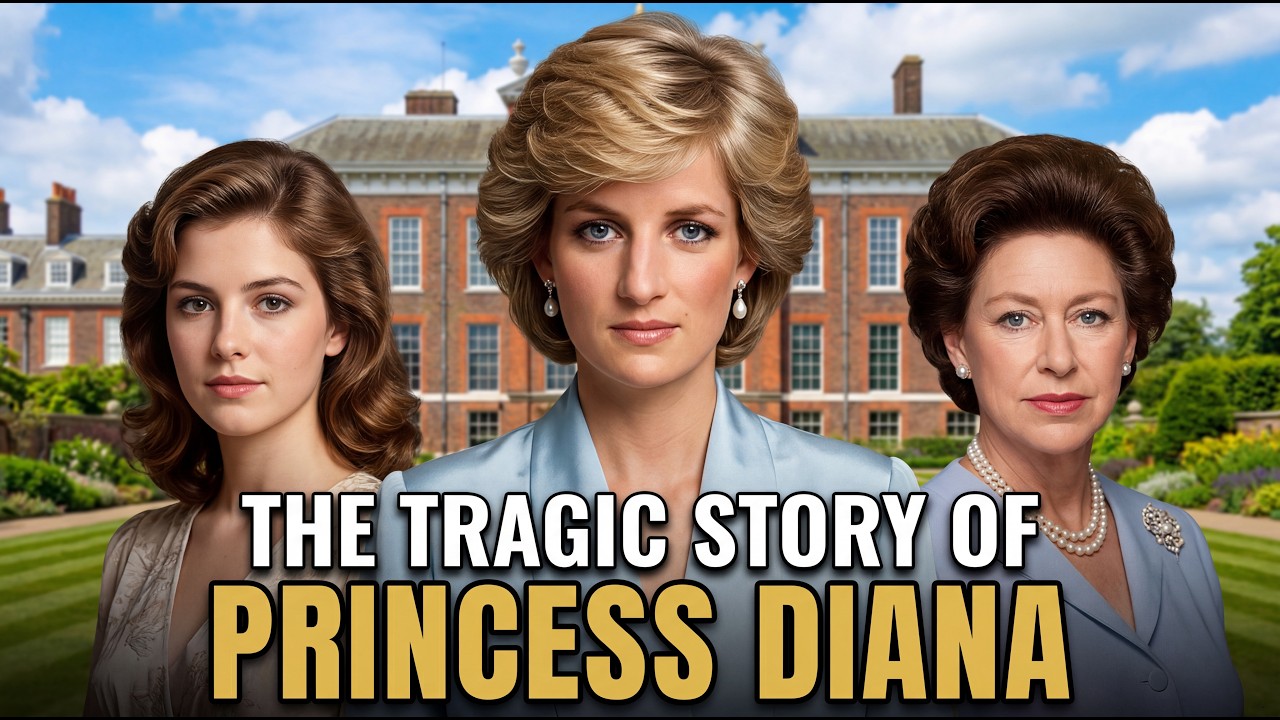
The selection logic for each one is visible, sensible, and immediately understood. Then, there is the sixth name. Sarah Armstrong-Jones isn’t family in the paternal way that Andrew is. She isn’t a pre-royal intimate in the Coleherne court sense. She didn’t paint Diana. She wasn’t part of Charles’s country house world.
She was the 20-year-old daughter of Princess Margaret. Which means she was the young woman who had watched the firm from the inside for her entire life, grown up with its costs as domestic fact, and had already, in the quiet way that doesn’t produce headlines, begun to live differently. No tape has been located in which Diana explains this choice in her own words.
Morton’s 18,000 words of Diana’s testimony cover the christening, the godparents’ names, the early Wales household in detail. What those words don’t contain, in any passage found in the available record, is Diana’s stated reasoning for selecting Sarah specifically. Any claim to omniscient access to her thinking in autumn 1984 would be false.
This script won’t make one. What can be said with full confidence is what the list shows. Five names are immediately legible. The sixth requires explanation. And the explanation, when you look at who Sarah Armstrong-Jones was in December 1984, and who she has been in the 42 years since, becomes the kind of explanation that resolves itself clearly once you place it in context.
The context is her mother. Princess Margaret had paid a precise price. In October 1955, after years of a documented romance with Group Captain Peter Townsend, she issued a public statement in the exact language the institution required. “I would like it to be known that I have decided not to marry Group Captain Peter Townsend, mindful of the church’s teaching that Christian marriage is indissoluble, and conscious of my duty to the Commonwealth.
” She gave the institution what it asked for. The marriage to Anthony Armstrong Jones that followed in May 1960 at Westminster Abbey, the first royal wedding to be televised, was initially celebrated. 24 years later, in December 1984, the divorce had been finalized for 6 years. The years of public separation before the divorce had been documented across the entire British press, and Princess Margaret was 54 years old, still performing royal duties, still present in the household.
What she had sacrificed to remain there had been the two significant romantic relationships of her adult life, plus two decades of her private self conducted in public view. Her daughter had watched this from the nursery, from the royal estates, from the schools and art programs and film sets in India that took her physically away from the palace without ever fully removing her from its obligations.
Sarah Armstrong Jones chose, at no specific dramatic moment, simply not to be consumed. She never accepted the framing that would have required her to decline it. She built her work. She found Daniel Chatto on a film set while her father was photographing A Passage to India. She got married in a City of London church on a Thursday afternoon in July 1994 with 200 guests.
A dress designed by Jasper Conran, and no carriage procession. She came to family occasions, and she left without statements. That is the life Diana appears to have been reading in her in 1984, when Sarah was 20 years old, and the institution had not yet finished deciding what to make of her. The 42 years of public record after the christening read as the confirmation of that reading.
On the 14th of July, 1994, Sarah married Daniel Chatto at St. Stephen Wallbrook, officiated by the Reverend Chad Varah, founder of the Samaritans. Princess Diana attended, documented, photographed, part of the archive. She arrived separately from Charles. Both of them came to the church on a Thursday in July to watch a young woman from their shared family marry on her own terms.
Harry was 9 years old. On the 9th of February, 2002, Princess Margaret died. Her funeral was at St. George’s Chapel. The royal watchers documentation of those present records it directly. Viscount Linley and Viscountess Linley, Lady Sarah and Daniel Chatto, the Queen and Duke of Edinburgh, the Queen Mother making her last public appearance before her own death 7 weeks later, the Prince of Wales, Prince William, and Prince Harry.
Sarah and Harry were in the same family party at the service for her mother. Harry was 17. Harry married Meghan Markle at St. George’s Chapel in May 2018. Multiple sources covering the guest list include Sarah Chatto among those present. She attended the coronation of King Charles III in May 2023. The official guest list records Lady Sarah and Daniel Chatto, the King’s maternal first cousin and her husband.
In April 2026, at events marking what would have been Queen Elizabeth II’s 100th birthday, both Hola and Tatler described Sarah’s participation as specifically notable because of its rarity. Two of Harry’s six godparents are dead. Gerald Ward, gone at Sunningdale. Lady Celia Vestey, dead in November 2020, described by her family as having gone suddenly but peacefully at 71.
Of the godparents who remain, there is no press interview in the accessible record in which Sarah Chatto has commented publicly on her godson, on the departure of January 2020, on the Netflix documentary, on the memoir, on any of it. Every recent profile of her uses the same language, discreet, low-key, rare in public, present at the occasions that matter.
What she has said to Harry in private isn’t part of the public record. This script can’t report it and won’t speculate about it. What the record does contain is 42 years of presence and silence. Not the silence of distance, the silence of someone who understood from the beginning that presence and commentary are two separate things and that the more lasting of the two does not require a microphone.
She was 20 years old in the December of 1984 and her own mother, Princess Margaret of England, was by then already the cautionary tale the Wales marriage was beginning to need. The Princess of Wales walked into St. George’s Chapel on the 21st of December with her 3-month-old son and the Archbishop of Canterbury opened the register and Diana looked down the list of six names the household and the firm had agreed on and she stood by one of them.
Lady Sarah Armstrong Jones, the young cousin who had watched the institution at close range for 20 years, who had grown up in the nursery at Kensington Palace while her mother’s marriage absorbed two decades of sacrifice and ultimately public failure, who had never entered a program of royal duties in the first place, who was already quietly building a life made of paint and canvas and a marriage she would conduct on her own terms in a borrowed Christopher Wren building in the city. The case for this reading can’t be made omniscient. Diana left no tape on this specific question. The register records the name. It does not record the reasoning. What can be said is what 42 years of public record shows. The woman Diana wrote into that register has been consistently present, consistently quiet, and consistently unwilling to turn the relationship into public property.
Five names on the list are immediately legible. The sixth has been publicly available since December 1984. It has appeared in print thousands of times. In a comment thread on a video about the royal family, someone wrote, “Sarah is Prince Harry’s godmother. She was one of Diana’s bridesmaids.” Three likes.
Load-bearing fact. The audience already knew the data. Nobody had laid the two pieces flat on the table and asked them to read it together out loud as a single document. Diana was 23. She had been doing the work for 3 years. She already knew. She picked the woman who would tell her son by the example of her whole adult life what could be done about it.
Sarah has done it for 42 years through every marriage and every funeral and every year in which the rest of the world has been arguing about what the firm did to the boy who was christened at Windsor on the 21st of December, 1984, she hasn’t spoken. The audience reads the register. The audience writes the verdict.
Diana picked Sarah Chatto for the same reason the Queen picked Sarah Chatto. She was the only royal of her generation the firm had not managed to break. Subscribe for more stories like this.