Edward V: England’s Darkest Royal Mystery D
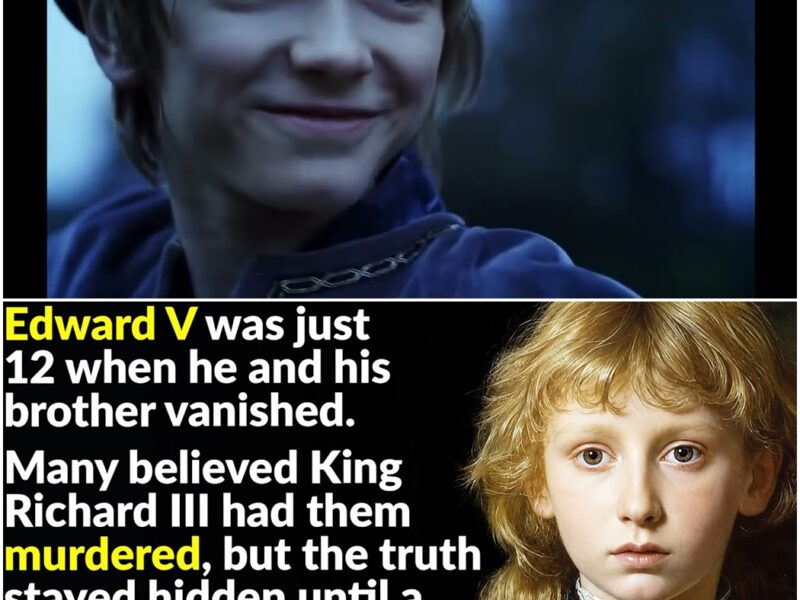
Edward V was only 12 years old when he and his brother disappeared. Many believe they were murdered by their uncle, King Richard III. The truth, however, remained a mystery. It wasn’t until 1789 that restorations at St. George’s Chapel unearthed the wildest twist of all. Edward V is most noted in history as one of the princes in the tower who disappeared without a trace along with his younger brother, Prince Richard of Shrewsbury.
While most historians think they know what happened, the mystery still hasn’t truly been solved. At the time Edward’s mother gave birth to him on November 2nd, 1470, she was seeking refuge from a bitter dynastic conflict that had deposed her husband, the king. Not long after his birth, Edward V’s father, King Edward IV, reclaimed the crown and with it a small measure of safety and security.
By June 1471, young Edward became Prince of Wales. As his father’s eldest son, he had to prepare to one day wear the crown himself. With his father busy trying to secure power, Edward’s education fell to his uncle, Anthony Woodville, Earl Rivers. Rivers was his mother’s brother and had developed a reputation as an exemplary scholar of his era.
Under his careful eye, the young prince prepared for a life of good governance and courtliness. Every morning, lessons followed Edward’s breakfast. His father had specifically instructed that his tutelage should focus on virtuous learning, not idle amusement. Edward IV demanded moral purity within his son’s household, banning anyone from reading stories that should move or stir him to vice.
As per his father’s instructions, Edward’s afternoons included physical activity befitting a prince followed by an early supper that had to be served no later than 4:00 in the afternoon. By 8:00, Edward’s servants had to draw the curtains closed so that the tuckered out if pampered prince could get a good night’s sleep and do it all over again.
In keeping with his practice of controlling every aspect of his son’s life, Edward IV arranged the prince’s marriage. As soon as they were old enough, the king had arranged for Edward to marry Anne, the heiress to Francis II, Duke of Brittany. As per the agreement, their eldest son would inherit the throne of England while their next son would inherit the Duchy of Brittany.
It was all a perfect plan until one fateful day. At just 12 years old, Edward V found out that his life was going to change. On April 14th, 1483, news reached Ludlow Castle where Edward was staying that his father, King Edward IV, had died suddenly 5 days earlier. From that moment on, every step he took would carry the unbearable weight of a crown that he was not yet ready to wear.
Edward IV had planned for exactly this possibility. Until Edward was ready to assume the throne on his own, his uncle, Richard, Duke of Gloucester, would serve as protector. The Duke of Gloucester was Edward IV’s trusted brother, but power has a way of corrupting even the best people. When Richard learned the news of his brother’s death, he didn’t waste a minute.
He rushed to York Minster where he swore his loyalty to his new king. The gesture was reassuring, but perhaps a calculated manipulation. Edward V, now technically king of England, departed from Ludlow on April 24th heading towards London to claim his crown. Richard left York a day earlier intending to escort his nephew into the kingdom’s capital.
Their parties converged at Stony Stratford 5 days later and already the Duke of Gloucester’s behavior raised eyebrows. That evening Richard dined with Edward V’s guardians including Earl Rivers and Richard Grey, a half-brother of the new king. By morning, however, Richard had set a devious plan into motion.
He took Earl Rivers, Grey, and another one of Edward’s guardians into custody and sent them up north away from London. Two months later, he ordered the men to be executed. Despite his age, Edward recognized the gravity of his situation. Reportedly, the new king protested when his uncle clapped his guardians in irons.
However, his objections did nothing. Gloucester dismissed the rest of Edward’s household and personally escorted the boy king to London. Edward entered London beside his uncle as the presumptive monarch and for a time it seemed like his uncle was actually serving as his protector. Plans for Edward’s coronation moved forward, but not without a curious delay.
Without explanation, the coronation was moved from May 4th to June 25th, the same day that Gloucester had Rivers and the others executed. Slowly, Edward saw what his uncle was doing. In mid-May, Edward moved into the Tower of London as was the custom for monarchs before their coronation. Then, a little less than a month later, on June the 16th, his younger brother Richard of Shrewsbury joined him.
However, what was once a regal residence quickly became a gilded cage, and Edward’s uncle was the only one with the key. The Privy Council initially pushed for a swift coronation, wanting to avoid the protracted regencies that had defined the kingships of Richard the second and Henry the sixth before.
However, despite their push for a speedy transition, nothing materialized. Working quietly in the background, Gloucester managed to have Edward’s coronation postponed indefinitely. By late June, anti-Edward propaganda kicked into high gear. An influential preacher, Dr.
Ralph Shaw, stood on the pulpit at St. Paul’s Cross and made a scandalous claim. Edward the fourth, he said, had been promised in marriage to Lady Eleanor Butler before marrying Elizabeth Woodville. Shaw then concluded that Edward the fifth was an illegitimate heir. After removing Edward and his cousins from the line of succession, an assembly named Richard the rightful heir to the throne.
Parliament’s signing of the Titulus Regius the next day made it official. The Duke of Gloucester was now King Richard the third. An Italian monk named Dominic Mancini was visiting England during this time and kept a diary of what he observed. He couldn’t help but notice that Edward and his brother seemed to be kept deliberately out of sight.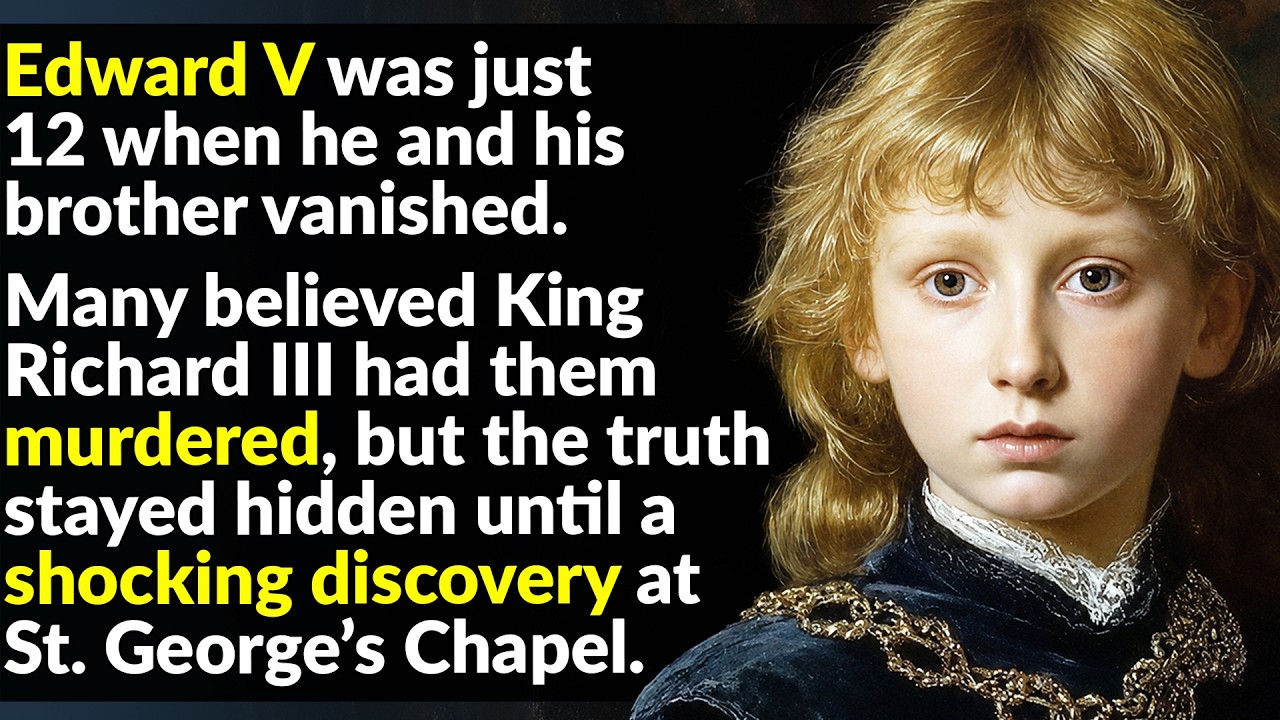
He noted that someone had moved the two princes into the tower’s inner apartments, where few courtiers, far less the public, could see them. Then, by autumn that year, the boys all but ceased making public appearances. Some accounts from the time make mention of two boys, presumably princes, playing within the grounds of the Tower of London.
Most have assumed that these sightings were of Edward V and his brother as they occurred shortly after Shrewsbury had arrived. However, by the end of the summer, no such sightings were ever recorded. What seemed to be happening inside those walls was terrifying. According to Mancini, Edward was having routine visits from a physician who had troubling news to report.
The doctor said that Edward was like a victim prepared for sacrifice, confessing and seeking penance because he believed that death was facing him. Historian Morris Keen argues that early opposition to Richard III’s rule sought to rescue Edward and his brother from the Tower. However, as the power struggle waged on outside the Tower of London, Edward’s supporters began to lose hope.
They feared the worst, that Edward and his brother were already dead. The 19th century English writer Clements Markham put forth a likely date for Edward’s demise, suggesting that he and his brother lived until July 1484. The theologian St. Thomas More was the first to record what most people believe happened to Edward V.
In his writings, More claimed that Edward and his younger brother suffocated in their beds, smothered by pillows. More’s account entered popular culture as the inspiration for Shakespeare’s Richard III, becoming the widely accepted truth. More went beyond simply naming the deed. He pointed fingers.
He identified Sir James Tyrrell as the agent behind the operation, aided by Miles Forest and John Dighton who held the pillows over the boys’ faces. Years later, Sir James Tyrrell fell into Henry VII’s hands after backing yet another Yorkist challenger. According to Thomas More, Tyrrell spoke before his execution, admitting, under some questionable treatment, that he had in fact carried out the terrible deed of smothering Edward V, and moreover, that he had acted on Richard III’s command.
News of Edward’s ultimate fate spread across the English Channel. In January 1484, Guillaume de Rochefort addressed France’s Estates General, urging them to take warning from the boys’ fate. Their own king, Charles VIII, was only 13 himself. Even at the time, there was little doubt in anyone’s mind that Richard III had ultimately been the one to orchestrate Edward’s demise.
Nearly two centuries later, builders remodeling the tower made a shocking discovery when they unearthed a wooden box beneath a staircase. Inside lay two small skeletons. In 1678, the presumed remains of Edward V and his brother Richard of Shrewsbury finally received the proper care their status warranted.
What was left of the princes in the tower was sealed in an urn and placed in Westminster Abbey by order of Charles II, granting Edward a royal resting place at last. But, was it actually him? In 1933, experts reopened the urn that contained the presumed remains of Edward and his brother. Scientists studied the bones carefully and concluded that they had belonged to two children of roughly the same ages as the brothers.
However, there were some troubling inconsistencies. The presumed bones of Edward and Richard were mixed in with animal remains and rusty nails. Further, the skeletons were incomplete and showed damage from the original excavation. Critics later challenged the 1933 inquiry, arguing that it had assumed too much from the outset to be a reliable source of truth.
Investigators, the critics claimed, had focused narrowly on signs of suffocation and never even confirmed whether the bones belonged to males or females. However, trying to conduct a better examination would prove even harder. Despite centuries of mystery, intrigue, and debate, no modern scientific testing has been carried out on the bones resting in Westminster Abbey.
No fresh examinations, no forensic upgrades, not even a serious attempt at DNA analysis, assuming usable material still exists. Edward V’s true identity and ultimate fate remains a mystery. Even before the end of the 15th century, during Henry VII’s reign, the mystery of Edward V’s fate had gripped public imagination.
First, a boy named Lambert Simnel emerged as if from nowhere and claimed to be the long-lost Edward V. He was even crowned King Edward in Dublin and was called Edward Plantagenet, the 17th Earl of Warwick, by those who believed him. But he wasn’t the only princely pretender. Sometime later, Perkin Warbeck appeared in Ireland claiming to be Edward V’s younger brother, Richard of Shrewsbury.
Warbeck styled himself as King Richard IV and even had powerful figures like Margaret of York and James IV of Scotland back his claims. Putting his words into action, Warbeck launched an invasion, but it failed miserably. Having fallen into English custody, he withdrew his claims before his sentence of execution was carried out.
Most historians now agree that he was just a princely poser whose backers had their own interests at heart. Researchers from the Missing Princes Project made a startling proposal in 2021. What if Edward V had managed to escape from the Tower of London? The researchers pointed to a man named John Evans who simply appeared in Coldridge, Devon around 1484 and received the prestigious title of Lord of the Manor.
Nearly 200 years later, King Charles II sought to finally lay Edward V and his brother to rest for good. He ordered their presumed remains to be sealed in a white marble sarcophagus. To this day, the sarcophagus sits close to Elizabeth I’s final resting place in Westminster Abbey.
But, a discovery a century later cast doubt on the whole thing. In 1789, restorations at Windsor Castle unearthed the greatest twist in Edward V’s disappearance. By chance, workmen mistakenly opened Edward IV’s vault and found something unexpected. Beside Edward IV’s tomb, there was another enclosure housing two small coffins. The tomb named two children, George and Mary, two of Edward IV’s children.
However, later excavations found that both George and Mary lay elsewhere in the chapel, leaving the identity of the coffins’ true occupants unknown. Thanks for watching History Xposé. If you love uncovering the best stories in history, hit like and subscribe to keep exploring with us.
If you enjoyed this video, check out the others on screen for more amazing history content.