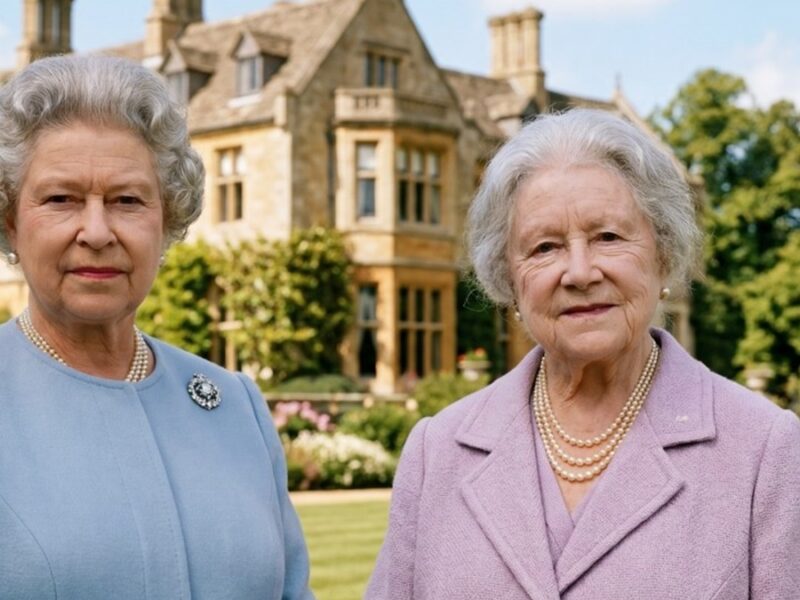
Elizabeth II Became the Real Queen the Day the Queen Mother Died D
On 9 April 2002, the tenor bell of Westminster Abbey rang 101 times, once for each year of a life. 200,000 people had filed past her coffin during the four days it lay in Westminster Hall, twice the number officials had prepared for, so far beyond expectation that staff had to extend the planned opening times.
The queue stretched more than a mile along the River Thames and over Lambeth Bridge. People waited for hours in the April cold. Nobody ordered them to. Outside Buckingham Palace and other royal residences, flowers accumulated in mounds. Around 30,000 messages of condolence were submitted through the palace’s memorial website.
The Irish national flag flew at half-mast on state buildings in Dublin. Flags at Volgograd, a Russian city of which the Queen Mother had been an honorary citizen, flew at half-mast until the day of her funeral. The scale of public feeling wasn’t manufactured. It was immediate, instinctive, and enormous. That was the public grief.
The private one was harder to read. Somewhere inside that same year, British newspapers began printing something that didn’t quite match the weight of the morning. The Times ran the headline, “Queen finally free after death of Queen Mother.” The Evening Standard went with, “Queen finally kicks up her heels.
” The Daily Telegraph observed that the Queen was acting out happiest days of her reign. These weren’t tabloid provocations. These were established, serious papers writing about the same woman who had stood at her mother’s bedside as she died, who 8 days after the funeral released an official statement using the word beloved.
Queen Elizabeth II’s own words, dated 8 April 2002, “Ever since my beloved mother died over a week ago, I have been deeply moved by the outpouring of affection which has accompanied her death.” Beloved, that is the emotional baseline. The paradox sits between that word and those headlines. A woman in genuine grief, described by serious journalists as somehow lighter.
For 50 years, Elizabeth II had been the most powerful person in Britain, the head of state of 15 Commonwealth realms, served by 15 prime ministers, holder of every formal prerogative the constitution could grant. And for 50 of those years, there was still one person in the world who could make her feel like a daughter who needed to answer to someone.
Understanding how both things, grief and the observation of lightness, can coexist, requires understanding what the Queen Mother actually was within the family she outlived. And what it costs to be sovereign in every room in the country except the one that contains your mother. Before anything else, the timeline, because this audience will notice if it’s wrong.
The year 2002 dealt Elizabeth two bereavements, not one, and they arrived in sequence, not simultaneously. The first death was Princess Margaret’s. Margaret died at approximately 6:30 in the morning on 9 February 2002 at King Edward VII’s Hospital in London. She was 71. Her two children, Lord Linley and Lady Sarah Chatto, were at her bedside.
The official palace statement described it precisely. She had suffered another stroke on the Friday afternoon, developed cardiac complications during the night, and been taken from Kensington Palace to the hospital. By early morning, she was gone. The cause was a final stroke in a series that had been eroding her health since 1998, compounded by a history of heavy smoking, a partial lung removal in 1985, and about of pneumonia in 1993.
Her health had been declining for years, and by early 2002, the end wasn’t entirely unexpected, even if it arrived with a sudden finality that death always manages. The Queen Mother at this point was still alive. She was 101 years old and had spent most of January and February bedridden at Sandringham with a persistent cold caught over Christmas.
She had missed several engagements, the annual luncheon of the Women’s Institutes on 23 January, the 100th birthday celebrations of Princess Alice, Duchess of Gloucester, in December 2001. But for Princess Margaret’s funeral, she made the journey. On 13 February, she slipped in her sitting room at Sandringham, a fall that caused considerable concern among the family.
She was helped up, and the following day she traveled to Windsor by helicopter. On 15 February, she attended her daughter’s funeral at St. George’s Chapel, arriving in a people carrier with blacked-out windows, specifically chosen so that no photographs could be taken of her in a wheelchair. She attended the service, then she returned to Royal Lodge, Windsor.
She never really left it again. Her health deteriorated through the final weeks of March. She watched the Cheltenham races on television on 5 March and attended a lunch with the Eton Beagles that same day. Then she retreated for the last time. On 30 March 2002 at 3:15 in the afternoon, she died in her sleep at Royal Lodge.
Queen Elizabeth II was at her side. From 9 February to 30 March, 49 days, 7 weeks. Both deaths fell on a Saturday. The gap is sometimes described as 3 weeks, which is wrong. It was 7 weeks, and the distinction matters because those 7 weeks weren’t a hiatus. They were the period in which Elizabeth absorbed the death of her sister, arranged the funeral, and watched her mother move through the last stage of a life that had already lasted a century.
The sequence ran Margaret first, then 49 days later, the Queen Mother. 2002 was also the Golden Jubilee year, the 50th anniversary of Elizabeth’s succession. She would mark it while in formal mourning, proceeding with the Jubilee program because the program was the obligation, and the obligation didn’t pause for grief.
To understand the weight of what ended that spring, you have to understand what it had been since the spring of 1952. On 6 February 1952, King George VI died in his sleep at Sandringham. He was 56. His daughter, Princess Elizabeth, was 25 and on a Commonwealth tour. She and Philip had spent the previous night at Treetops Hotel in Kenya watching wildlife from an observation platform built above a waterhole, lights trained on the salt lick below as animals moved in and out of the dark.
They returned the next morning to their residence at Sagana Lodge when word arrived. Philip was the one who told her. She had been Princess Elizabeth when she went to bed. She was Queen Elizabeth II when she was told. She flew home. Her mother, Elizabeth Bowes-Lyon, became a widow at 51 and became something else simultaneously, something for which no established protocol existed.
The new queen’s name was Elizabeth. Her mother’s name was also Elizabeth. Both women had held the style Queen Elizabeth. The palace had to invent a solution. Within weeks of the accession, the title Queen Elizabeth the Queen Mother was formalized, specifically to prevent confusion between the two. It wasn’t a historic title with centuries of precedent.
It was an administrative necessity created for a specific situation. A widowed queen consort whose daughter had just become Queen Regent bearing the same first name. That administrative awkwardness masks something more significant. When George VI died, the Queen Mother wasn’t simply a private citizen stepping aside.
She was the most publicly beloved member of the royal family. More beloved at that moment than the 25-year-old who had just inherited the crown. She had spent 15 years as Queen Consort. She had toured Canada and the United States with George VI in 1939, building the transatlantic relationship before the war, charming both Franklin Roosevelt and the Canadian public to a degree that the tour’s own organizers hadn’t anticipated.
She had refused to leave London during the Blitz. She had dressed in Norman Hartnell pastels and visited the East End, walking through rubble in inappropriate shoes, smiling. When Buckingham Palace itself was hit, she said she was glad. It meant, she said, that she could look the East End in the face.
Adolf Hitler reportedly called her the most dangerous woman in Europe, which may be apocryphal, but is at minimum instructive. He meant it because she was compelling, because her presence during the worst period of the war had done something that no military operation could accomplish. She had made ordinary Britons feel accompanied by the monarchy rather than merely governed by it.
By 1952, she was 51 years old and had been a recognizable public figure for nearly 30 years. Her daughter had been a public figure for approximately six. The emotional ledger between them wasn’t equal and it wasn’t designed to be. Formidable mothers of daughters who inherit great responsibility are rarely content to disappear quietly into the background.
And the Queen Mother had no intention of disappearing at all. She moved into Clarence House, the London residence she and Philip had briefly occupied before Elizabeth’s succession, and made it her own. She retained Royal Lodge in Windsor Great Park as her country home, living there for the remaining 50 years of her life and dying in it.
In the autumn of 1952, she visited Caithness on a private trip, traveled along the Pentland Firth, and noticed the Castle of May, a near derelict 16th-century tower house whose owners were prepared to abandon it entirely. She bought it, restoring it over several years at considerable personal expense.
She would travel there in late summer each year for the rest of her life, spending several weeks on a remote Scottish headland where the sea wind came off the Firth and her kitchen garden had to be fought against the salt and the cold. The castle’s garden, which she maintained obsessively, became a matter of considerable personal pride.
Castle of Mey wasn’t a residence she inherited or was assigned. It was one she chose, funded, and refused to give up. Between Clarence House, Royal Lodge, Birkhall near Balmoral, and Castle of Mey, the Queen Mother maintained four separate residences after her husband died. Four houses, each with its own staff, its own seasonal calendar, its own particular character.
The Queen subsidized this establishment. After the Queen Mother’s death in 2002, it was widely reported, sourced in part to accounts cited by the Financial Times, that Elizabeth had paid off a reported overdraft her mother held at Coutts Bank. The precise figure is disputed. Some accounts cited 4 million pounds, others significantly more.
And no single authoritative figure has been confirmed. But the substance is documented. The sovereign was financially underwriting her mother’s independent establishment across the full duration of the reign. Whatever the exact number, the structure of that arrangement is itself informative.
It says something about the direction in which deference ran within this family. A daughter who has been subsidizing her mother for 50 years isn’t experiencing her mother as a historical footnote. The Queen Mother was also institutionally present in ways that mere widowhood does not typically entail. Royal.
uk records over 40 official overseas visits after 1952. She remained a central figure at Trooping the Colour and Remembrance Sunday year after year. The 1953 Regency Act named her a counselor of state, a limited but real constitutional designation, allowing her to perform specific duties when the sovereign was incapacitated or abroad.
She held patronages, attended ceremonies, opened buildings, accepted honorary degrees. She was still conducting her final public engagement, attending the recommissioning of HMS Ark Royal, on 22nd of November, 2001, 4 months before she died. She wasn’t retired. She wasn’t fading. She was a living institution within the institution, with her own court, her own household identity, her own financial gravity.
Stephen Tennant, a figure who knew her well enough to observe without protective deference, described her with unusual precision. She looked everything that she wasn’t. Gentle, gullible, tenderness mingled with dispassionate serenity, cool, well-bred, remote. Behind this veil, she schemed and vacillated, hard as nails.
That is a portrait of someone who understood the precise distance between her public image and her private operation. Harold Nicolson, one of the sharpest political observers of the 20th century, called her the greatest queen since Cleopatra. The gap between Tennant’s assessment and Nicolson’s is the gap between the person and the performance, and she had maintained both with remarkable discipline across a century.
The objection will come, and it deserves a direct answer. Elizabeth was close to her mother. She genuinely loved her. Sally Bedell Smith, whose 2023 biography of the George VI marriage, draws on extensive family sources, describes the mother-daughter relationship as one that enjoyed an open and trusting relationship.
William Shawcross, chosen by Queen Elizabeth II herself to write the authorized biography of the Queen Mother, meaning his access carried the family’s explicit sanction, describes the Queen Mother as having instilled in her children an ethos in which duty always came first. That instruction wasn’t a memorandum.
It was the air that Elizabeth breathed as she grew up in a particular household, shaped by particular crises. On Sunday mornings, according to accounts of palace routines, the Queen would invariably call on the Queen Mother at Royal Lodge. Every Sunday. For decades, across the full length of the reign.
That isn’t the behavior of a woman straining against an unwanted obligation. That is the behavior of a devoted daughter, maintaining a rhythm of filial love sustained over 50 years. All of that is true, and it does not contradict the argument. Love and burden aren’t opposites. A relationship can be genuinely warm, deeply cherished, and still carry weight.
The relevant question isn’t whether Elizabeth loved her mother. She clearly did. The record is unambiguous. But whether the presence of a living, active, formidable parent changes something in the way you inhabit your own authority. For that question, the biographical record does offer specific evidence, even if no single biographer has assembled it into exactly this argument.
The surnames controversy of 1952 provides one clear example. Within weeks of the accession, a serious argument erupted over whether the royal house would become Mountbatten. Philip, as the husband of the Queen and father of the heir, wanted his name to pass to the dynasty. A reasonable instinct with obvious historical precedent.
The Queen Mother, aligned with Prime Minister Winston Churchill and the broader royal establishment, supported retaining Windsor. Elizabeth agreed to retain Windsor. Philip’s frustration wasn’t subtle. He later said with considerable bitterness that he was the only man in the country not allowed to give his name to his own children.
The decision was Elizabeth’s to make, and she made it. But she made it in an environment where her mother’s institutional weight fell decisively on one side. In 1952, in the opening weeks of a new reign, under maximum pressure from every direction at once, the direction of familial influence ran one way.
The Peter Townsend affair is more complex, and it would be a distortion to present the Queen Mother as the decisive authority in an outcome that involved multiple parties. In late 1952 and into 1953, Princess Margaret told her sister she wished to marry Group Captain Peter Townsend, decorated, charming, widely respected, and divorced with two sons from his previous marriage.
The structural awkwardness was extreme. Townsend had served as equerry to George the VI and had been appointed comptroller of the Queen Mother’s own household after the King’s death. The man Margaret wanted to marry was, in the most literal sense, her mother’s employee. The Church of England’s position on divorce made the marriage constitutionally complicated.
Parliament’s likely response would have required Margaret to renounce her succession rights. Multiple parties shaped the eventual outcome: the Queen, the government, Parliament, the Church. The Queen Mother’s stated private position, documented in Shawcross’s authorized account, was that she hoped, given time, the affair would simply peter out.
That isn’t a formal veto. It’s a strategy of delay, which is itself a form of influence, particularly when it comes from a figure whose approval carries the weight it carried in this family. She waited, and she communicated her waiting through the channels that family hierarchies make available. Through presents, through expectations, through the particular gravity that accumulates in a parent whose standards have shaped every major decision of your life.
Margaret announced in October 1955 that she wouldn’t marry Townsend. She married Anthony Armstrong-Jones in 1960, divorced him in 1978, and didn’t remarry. The connection between the Queen Mother’s preferred strategy and the outcome of 1955 isn’t direct causation. It’s the influence of atmosphere, of the values she had embedded in the family, of the standards she represented and never stopped representing.
The pattern that emerges from both episodes is the same: not tyranny, not manipulation, but the quiet and durable authority of being the person whose values originated the family culture. The Queen Mother’s preferences didn’t need to be enforced to be felt. They were the water in which everyone swam.
The corrective is necessary here, because the argument will fail if it allows a misreading to take root. Elizabeth was the power. From the moment she returned from Kenya in February 1952, from the moment the words of accession placed the crown on her inheritance, she held every formal authority the British constitution could confer.
All formal acts of state were performed in her name. She held the royal prerogative, the appointment of prime ministers, the opening of parliament, the granting of royal assent to legislation, the formal machinery of sovereignty in its entirety. Royal.uk is explicit. The prime minister is officially appointed by the sovereign in person.
This remains one of the few personal prerogatives of the sovereign. In 1963, when the complex internal politics of the conservative party produced the Earl of Home as prime minister, he went to the palace at Elizabeth’s invitation and kissed hands on her authority alone. She served 15 prime ministers across 70 years and navigated every one of those relationships from a position of constitutional primacy, advising and being advised, encouraging or warning as the constitution permitted, but never as a subordinate.
Philip’s role has been consistently misread by observers who assume that a husband must be the real authority in any household. Philip was the Queen’s consort. He was never king. He held no executive power of any kind. He was given the title Prince of the United Kingdom by letters patent in 1957, five years into the reign at Elizabeth’s own initiative.
Lord Simon confirmed at the time that even the title Prince consort would have lacked any constitutional significance. Philip performed his supporting role with enormous energy and commitment for 69 years, completing more than 22,000 solo engagements before his retirement. But, he didn’t govern. The constitutional distinction is absolute.
The Queen Mother’s formal position after 1952 was similarly clear. She held no governing authority. The Regency Act named her a counselor of state in limited specific circumstances of incapacity or absence. She couldn’t create peers. She couldn’t dissolve Parliament. She couldn’t direct policy. In constitutional terms, she was a private subject of the crown her daughter wore.
The irony at the center of this story is precise. The only people who could make Elizabeth feel something other than completely sovereign weren’t constitutional rivals. They were family. The constitution offered no mechanism for managing the weight of a formidable parent.
No statute defined what happens when the holder of the royal prerogative is also a devoted daughter who has spent 50 years driving to Royal Lodge on Sunday mornings. That gap between what the law could address and what the family relationship created is where the interesting argument lives. The Queen Mother had built her authority during the most consequential possible period.
The abdication crisis of 1936, which destabilized the entire institution. The wartime years, which rebuilt it through her public refusal to leave London. The immediate post-war reconstruction of the monarchy’s image, which she managed alongside a husband whose health was in serious decline as early as 1948. By the time George VI died in 1952, she had been the central figure in a decades-long project of institutional repair and public reconstruction.
She wasn’t handing that over at 51. She was stepping to the side, but staying in the building for 50 more years. The values she had shaped in Elizabeth weren’t incidental. Shawcross, in the authorized biography, describes the Queen Mother as having instilled in her children the principle that duty always came first.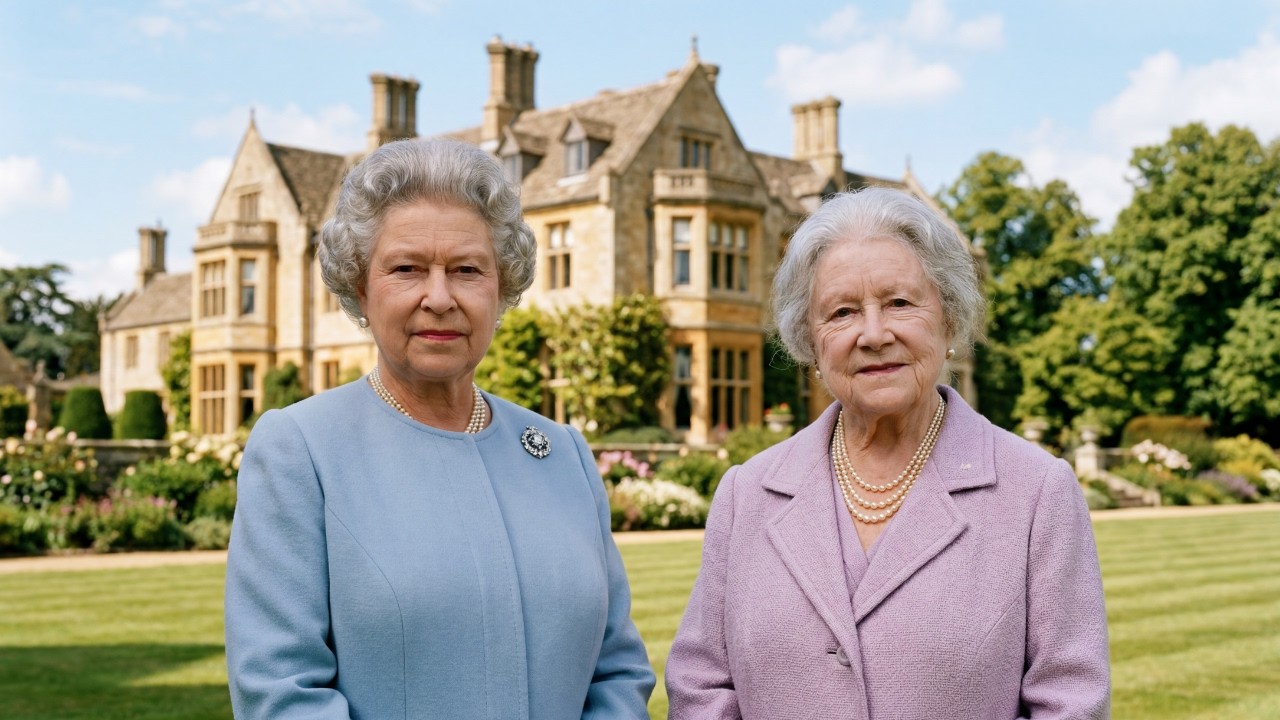
A principle that sounds obvious until you remember that it was forged against a specific counterexample. The abdication had happened because Edward VIII chose personal happiness over constitutional duty. The lesson embedded in the family culture by the woman who had watched that happen from the inside, who had been forced by it into a life she had not chosen, was that the choice had to go the other way.
Duty over self, always. Elizabeth absorbed that instruction so thoroughly that by the time she became queen, it wasn’t an external rule she followed. It was who she was. When you are the author of someone’s foundational value system, you are something more than a parent in the ordinary sense. You are the voice running underneath every major decision, the standard against which every choice is implicitly measured.
Elizabeth’s duty-first ethos, universally identified by biographers as the defining characteristic of her reign, was genuinely hers. It wasn’t imposed on her from outside in any coercive way. But it originated in a family culture that her mother had created, sustained through crises, and embodied for 50 years after George VI died.
That is a specific kind of authority. Not control, not tyranny. Something quieter and more durable. The authority of origination. When the originator is present, still walking the grounds at Royal Lodge, still expressing opinions, still maintaining a household and a calendar, and a set of expectations.
The authority is still alive. When the originator is gone, something changes in the structure of the air, even if the crown itself is unaltered. On the morning of 30th March, 2002, Queen Elizabeth II was at Royal Lodge, Windsor, at her mother’s bedside. The Queen Mother had been declining since Princess Margaret’s funeral in February.
She had continued to receive visitors and to take some pleasure in the small rituals of her days through early March. Lunch with the Eton Beagles, television racing, the ordinary business of a life still trying to maintain its rhythms. Then she had retreated for the last time. At 3:15 in the afternoon, in the Windsor house she had lived in for 50 years, she died peacefully in her sleep.
The formal machinery of Operation Taybridge, the long-prepared plan for managing the Queen Mother’s death, activated immediately. Prince Charles and Prince Andrew, on holiday in Switzerland and Barbados, respectively, flew home. Her body was placed at the altar of the Royal Chapel of All Saints, near Royal Lodge, where the Queen and the Royal Family attended an Evensong the following day.
On 5th April, the coffin was brought to London, carried with an escort of 1,600 troops, and placed in Westminster Hall for four days of lying in state. The queue that formed wasn’t what anyone had anticipated. 200,000 people. The line stretched over Lambeth Bridge, along the Thames Embankment, for more than a mile.
Officials extended the planned opening times as the numbers kept arriving. People came from across Britain and beyond, some having traveled overnight. All of them joining a procession that moved at the pace of collective grief. At one point during the vigil, the Queen Mother’s four grandsons, the Prince of Wales, the Duke of York, the Earl of Wessex, and Viscount Linley, mounted the guard simultaneously around her coffin.
An honor echoing the vigil of the princes performed at George the fifth’s lying in state in 1936. The parallel wasn’t accidental. It bound her death into the longer ceremonial history she had helped create. The funeral at Westminster Abbey on 9th April 2002 began at 9:48 in the morning when the tenor bell rang those 101 times.
The procession to the Abbey included 1,700 military personnel, a massed pipe band of 192 musicians drawn from 13 British and Commonwealth regiments. And her coffin draped in her personal standard with her crown resting on a cushion at its center. The Queen left Buckingham Palace at 11:12 a.m.
and arrived at the Abbey’s Great West Door 4 minutes later. The funeral service lasted approximately 50 minutes. After it, the cortege traveled by road to Windsor, 50 minutes through central London, crowds lining the entire route. The Queen Mother was interred in the King George the VI Memorial Chapel at St.
George’s Chapel, Windsor, beside the husband she had outlived by 50 years. At the same private service, Princess Margaret’s ashes were placed there, too. The two women who had died 49 days apart together in the same chapel on the same afternoon. What was left after all of that ceremony was the ordinary continuation of a reign that had now shed its last significant private anchor.
The newspaper headlines appeared during the Golden Jubilee celebrations that June, and the timing is the key ambiguity. The Jubilee of 2002 had not been expected to be straightforwardly celebratory. A 2004 academic analysis of press coverage noted that it had initially been viewed as a risk for Queen II, meaning the warm public reception wasn’t a foregone conclusion.
The 1990s had been a genuinely brutal decade for the institution. The annus horribilis of 1992, when the Wales, York, and Kent marriages all collapsed in public, the fire at Windsor Castle, the constitutional embarrassment of the Diana years, and the near catastrophic mishandling of the days between the Paris crash in August 1997, and the palace’s eventual public response.
By the end of the decade, the monarchy was navigating questions about its own relevance that it hadn’t faced in this form since the abdication. Then, June 2002 arrived, and the public showed up in numbers that surprised observers who had expected residual coolness. On the evening of the Jubilee concert at Buckingham Palace, crowds stretched from the gates through Green Park.
The Queen, at walkabouts and public events throughout the Jubilee weekend, was visibly animated. Correspondents who had covered the monarchy for decades reached for a word, and the word that kept appearing was delight. The Times headline, the Evening Standard headline, the Daily Telegraph piece on the happiest days of her reign, these appeared in this context.
They weren’t stand-alone observations about the Queen Mother’s death. They were written within the charged atmosphere of a Jubilee that had exceeded expectations, filtered through the recent double bereavement, and emerging as the interpretation of experienced royal journalists trying to account for a quality in the Queen’s public engagement that struck them as new, or at least newly visible.
The honest accounting requires separating what the evidence will support from what it won’t. Three named national newspapers in the same calendar year independently reached for the same image. Liberation, ease, a burden lifted. That is a journalistic cluster with enough consistency to deserve serious attention.
Robert Hardman, who has written more about the latter years of Elizabeth’s reign than almost any other biographer, has said explicitly that the older she got, the stronger she became. That characterizes a continuous arc, not a single turning point. He does not, in the available record, identify March 2002 as a specific pivot.
He describes a queen who grew in confidence and strength across seven decades, not one who was suddenly unencumbered in a particular spring. No named biographer, not Shawcross, not Hugo Vickers, not Hardman, not Bedell Smith, has been found in the available record to have explicitly stated that Elizabeth appeared more relaxed or freer specifically because of her mother’s death.
The lighter perception is a journalistic interpretation, recorded at a specific moment with an alternative explanation immediately available, the Jubilee reception. After the turbulent 1990s, an unexpectedly warm public response to the 50th anniversary of her reign is sufficient on its own to explain why the Queen appeared to be having some of the best days of it.
What can be said with confidence is structural, not psychological. After 30 March 2002, there was no longer anyone in Elizabeth’s life who had been Queen before her. No one whose approval carried the specific weight of a parent’s endorsement. No one whose views on the proper conduct of the dynasty still constituted a living cultural presence within the household the Queen occupied.
The Queen Mother had been the embodiment of an older version of the monarchy. Someone who could still remember from personal experience George VI’s coronation in 1937 and the abdication crisis that had made it necessary. When she died, that living connection to the pre-Elizabethan monarchy died with her.
There is a distinction between constitutional sovereignty and what might be called the emotional architecture of sovereignty. The private, familial, deeply human context in which a Queen is also someone’s daughter. Someone who has spent 50 years managing a relationship that carries weight no constitutional document addresses.
That architecture changed in the spring of 2002. Whether the change felt like liberation or like grief or like both at once is something Elizabeth didn’t record for our benefit. She wasn’t in the habit of recording it. By the end of 2002, Elizabeth was 76 years old. The turbulent decade of the 1990s was behind her.
Diana had been gone since 1997, Margaret since February, the Queen Mother since March. The Jubilee had returned a measure of public warmth that the institution had genuinely needed. Whatever the relative weights of those factors, the texture of the rain had changed. She continued going to Royal Lodge, the Windsor house her mother had lived in for 50 years, but by 2003, it had passed to Prince Andrew.
The rhythm of the Sunday visits, maintained across a lifetime, was simply gone. Not suspended, gone. The house was still there. Her mother wasn’t. Robert Hardman’s formulation, the older she got, the stronger she became, remains the best summary the biographical record offers. A continuous strengthening across the whole career, not a rupture at a specific moment.
What the record also shows is that after 2002, the principal sources of private complication that had defined the turbulent middle of the reign were all resolved. Not pleasantly, not without grief, but resolved. The monarchy that Elizabeth now led was constitutionally identical to the one she had led in 1952.
Nothing in the law had changed. The crown was the same. The powers were the same. The obligations were the same. But the family structure in which the crown was embedded had altered in a way that no legal document could measure. Elizabeth was, for the first time in her adult life, the oldest living member of the immediate Windsor family.
There was no one left who remembered her as a child. No one left for whom she had ever been anything other than the queen. The family hierarchy had simplified to its most essential form. Just Elizabeth and the institution she had embodied for half a century. Elizabeth died on 8 September 2022 at Balmoral Castle, aged 96.
Her cause of death was listed as old age. Her reign lasted 70 years and 214 days, the longest in British history, the second longest of any sovereign in recorded history. She outlived the Queen Mother by 20 years. She outlived Philip, who died at Windsor Castle in April 2021 at 99. She outlived Margaret by 20 years.
In the final decade of her life, she was the last person alive who had experienced the very beginning of her own story from inside the family. The abdication that made her father king, the Blitz, the Kenya morning when Philip told her she was queen. Everyone who had witnessed those moments from inside was gone.
The Queen Mother’s death didn’t make Elizabeth II more powerful. She had been the power since February 1952. Every formal prerogative, every constitutional authority, every appointment and ascent. These were hers from the morning she landed at Heathrow and walked down the steps of the plane to find Churchill and Eden waiting on the tarmac.
Philip held no executive authority. The Queen Mother held no executive authority. The constitutional position had always been exactly what it appeared to be. What ended on 30 March 2002 was something the constitution had never addressed and could never have addressed, the private structure of accountability that surrounded the crown.
The Queen Mother had not competed with Elizabeth for authority. She had been the author of Elizabeth’s understanding of what authority meant and what it required. When she died, Elizabeth stopped being the second Queen Elizabeth in a family that still contained the first and became simply the queen, unchallenged, with no prior occupant of feminine royal significance still living in the same household.
No one left for whom the crown was also a continuation of their own story. Love and liberation can arrive in the same terrible moment. Elizabeth didn’t stop being a daughter. She stopped having to be one in the shadow of the crown. The crown itself didn’t change. The emotional architecture around it did. And on the evidence available, that is the most precise and honest thing that can be said about the spring of 2002, and what it cost, and what it ended.
Subscribe for more stories like this.