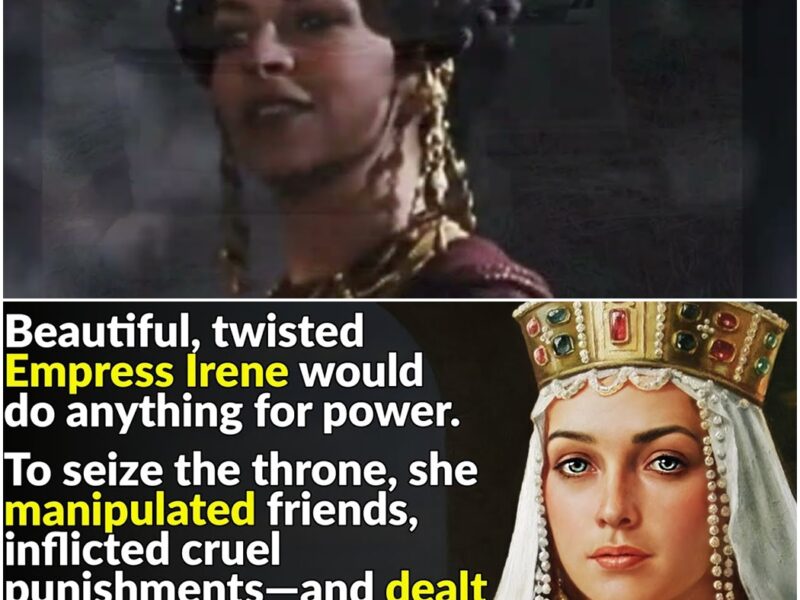
History’s Most Disturbing Empress D
Empress Irene’s exquisite beauty made jaws drop—but no one realized that her elegant face hid a twisted mind. Irene would do anything to gain power. In order to inch closer and closer to the Byzantine throne, she manipulated her loved ones, subjected her enemies to heinous punishments, and, in one occasion, dealt the ultimate betrayal to her own husband. Buckle up: Empress Irene’s story is not for the faint of heart.
Irene’s path to the throne of the Byzantine Empire was a twisted one—but she did have a leg up the beginning. Born in Athens around 750, she was a member of an extremely influential and noble Sarantapechos clan. Only, there was a twist. Irene experienced immense tragedy from a young age, with both of her parents dying when she was a girl. There was, however, one consolation.
Besides her accomplished education, Irene was also exceptionally beautiful…and she was about to put her good looks to great use. When she was still a teenager, the current Emperor Constantine V invited Irene to travel to Constantinople, the center of the Byzantine Empire. Some historians believe that while there, the Emperor put on the first Byzantine “bride show” for his son and heir, Leo.
It is as gross as it sounds: Young women paraded in front of the young man, and he picked the one that he found the most beautiful. Well, guess what happened. At the bride show, Irene’s great beauty helped her blow all the other high-ranking women out of the water. She and Leo married very soon after her arrival in Constantinople, tying the knot in N
ovember 769. It was a fairy tale likely beyond the orphan girl’s wildest dreams…but don’t get too cozy. It soon turned into a total nightmare. The biggest issue was a deep one: While the ruling Byzantines were “iconoclasts” who were against any talismans depicting religious figures, Irene had “iconophile” sympathies and secretly loved images of saints. And sure, this conflict might seem harmless today.
But for Irene and Leo, it was the beginning of one of the most scandalous periods in Byzantine history. Irene was nothing if not dedicated to the crown, and in 771 she gave birth to an heir, a boy they named Constantine after his grandfather. But even this happy news had a suspicious underbelly. Constantine was the only child—and as far as we know, the only pregnancy—that Leo and Irene ever had, indicating that even then their union was on the rocks. But before the kingdom could get too leery, the tides turned again.
As Emperor and Empress, it was crucial that Leo and Irene present a unified front to their kingdom. But they didn’t. While more lenient than his father, Leo was still devoted to the iconoclast cause. Meanwhile, Irene’s rebellious and dangerous love of religious imagery only grew deeper as the years went on. Until the day it all came crashing down.
Irene’s husband had spent the first years of his reign flirting with the idea of some iconography being ok—but in 780, everything got flipped upside down. Leo began persecuting iconophiles like Irene left, right, and center, and he wasn’t nice about it.
He detained his own courtiers, submitting them to whippings and humiliations such as shaving their heads. Clearly, something had gone wrong…and the answer may lie in Irene’s own bedchamber. We’ll never know for sure what set Leo off on his violent rampages of iconophiles, but historians have made a chilling suggestion. Some claim that one day, Emperor Leo lifted up Irene’s pillow, only to discover that his very own wife had hidden two offending, sacrilegious icons underneath it. His next actions were his most ruthless yet.
According to the story, the clever but terrified Empress Irene insisted that she hadn’t known the icons were there, and that some evil iconophile courtiers must have smuggled them in. All too happy to get vengeance, Leo then tracked the courtiers down and had them punished. Even so, he was far from fooled—he just took it out on Irene in an entirely different way.
After finding out about his wife’s secret stash, Emperor Leo was reportedly so disgusted with Irene—despite her denials—that he vowed never to sleep with her again. The trouble is, Leo didn’t have much time to inflict this creative punishment on his wife. Fate was coming for him, and it was going to change Irene’s life forever.
The very same year that Leo went on his rampage of all iconophiles, karma bit the royal family hard. Within months of his purges, the emperor fell seriously ill with a fever. Within days, he was dead, and Irene’s young son Constantine—by then only nine years old—became the new emperor. But that’s when Irene really came into her own…and it was terrifying.
With her husband getting cold in the ground and her son barely old enough to understand he was the new emperor, Irene took advantage of the power vacuum like a boss. Before Leo’s old courtiers could blink, Irene was the official regent over her son, and already ruling the kingdom with an iron fist. But she didn’t stop there. Less than two months after she became regent, Irene’s new courtiers were already chafing under her ambitions.
After all, how could a woman take power? Angry, they plotted her downfall, calling one of Emperor Leo’s half-brothers, Nikephoros, to come pry the throne out of her grasping hands. Oh boy, did they end up wishing they’d stayed obedient. Empress Irene saw this failed conspiracy for opportunity it was. She not only punished the men, she banished them from their former high positions, then replaced them with men who were unfailingly loyal to her and her vision for the empire.
In addition to her punishments for Nikephoros and his allies, Irene also “gifted” them positions as priests at the famous Hagia Sophia in Constantinople. And sure, that seems like a merciful compliment….until you realize the stunning truth. Taking up the cloth barred the wily Nikephoros from ever ruling in the future.
Suddenly, now everyone in the empire knew they were dealing with one smart cookie. But Irene was moving on to even more cunning tactics. In the coming months, Empress Irene solidified her power in a breathtaking way. Elbowing her own son Constantine right to the sidelines, she put her name first and foremost on all coins and documents of the time, positioning herself as his (more powerful) co-ruler, not his regent.
And then she even tried to control him in the bedroom. Nothing says “political genius” in the Byzantine Empire like forging an advantageous marriage, and Irene soon began looking around for a young bride for her son to solidify her—I mean his—power. Her gaze landed on Rotrude, a daughter of Charlemagne.
As always, Irene had chosen well: Charlemagne was then a powerful mover and shaker in the Western Roman Empire, Byzantine’s counterpart. By 787, the still-teenaged Constantine was desperately looking forward to marrying Rotrude, and Charlemagne was all for the new alliance. But Irene now had other ideas.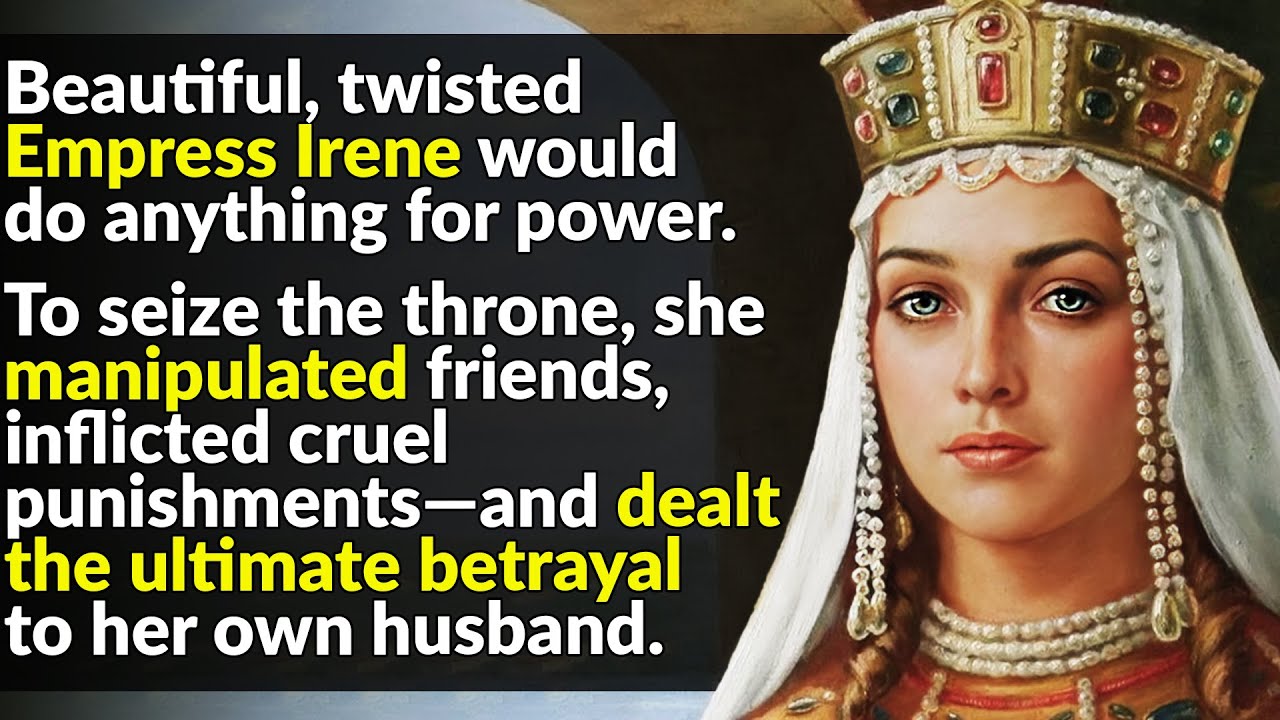
The political tides had shifted and Charlemagne was no longer useful to her, so she cut the engagement off. Looking back, this may have been the beginning of the end of her happy family. Not only did Irene end her son’s engagement to Rotrude, she also still insisted on selecting his next fiancee. Ironically, she chose the prospect, Maria of Amnia, through a bride show—the same unromantic chattel-y way that Irene herself got to be Empress.
Constantine dutifully tied the knot with Maria…but the entire time, he was plotting revenge. As Constantine grew older, he also grew ever more aware that his meddling mother was siphoning off his power. By 790, Constantine was beside himself with frustration and ambition for his throne, and her courtiers were none too happy with her either.
Suddenly, the discontent bubbled up into true rebellion: Soldiers took arms against her, proclaiming Constantine as the true Emperor and Irene as a mere pretender. Worst of all, this time it worked. After a decade of nearly unchallenged power, Irene was humiliated and stripped of her titles. It only made her hit back that much harder. With Irene out of power, everyone thought this “weird’ period of a woman ruling was done for at last. But fate had other plans.
As it turns out, running a kingdom wasn’t as easy as Irene had made it look, and her son Constantine VI failed spectacularly. Within months he was scrambling, barely fending off attacks from his other relatives. In 792, Constantine came crawling right back to his mommy, begging Irene to come back to court and help him clean up the mess he’d made.
To sweeten the deal, he even offered her back the title of “Empress”—not that Irene would have accepted anything less. She agreed, and for a time mother and son reigned as co-rulers once more…until Irene plotted her baby’s dark demise. In the end, the straw that broke the camel’s back was Constantine himself—namely, his scandalous bedroom habits.
Constantine’s marriage to Maria of Amnia had been utterly miserable, and he decided to divorce her in a blaze of infamy and take up with his mistress, Theodote. While the kingdom erupted with outrage, Irene saw her opportunity. And boy, was she vicious. After five years of ruling “beside” her son, Empress Irene put her ruthless plot into action.
She had been quietly gathering allies on her side and, sensing Constantine’s weakness, she now unleashed her supporters on him. Her influence was so far reaching that even when Constantine fled the province in terror, his mother’s friends were there to catch him. Of course, that wasn’t the end of the horror show. It was only the start. Empress Irene was now just about done playing games with her prodigal son.
So she hit him with an utterly brutal punishment. Employing a favorite execution strategy of the Byzantines, Irene had her men gouge out Constantine’s eyes on August 19, 797. Yes, she really did that to her own son, giving new meaning to the term “family feud”. With Constantine VI blinded, heirless, and out of the way for good, there was nothing stopping Irene from ruling not just as regent, but as sole Empress of the Byzantine Empire in her own right. Nothing, that is, except precedent.
Because as she came into power, the Pope and the Western Roman empire started side-eyeing her big time. Since she was a woman, some Western Romans claimed there was a vacant seat in the Eastern empire…and they wanted to fill it with a figure from Irene’s past. In 800, just a few years after she fully grasped the Byzantine throne, Irene’s power faced a chilling threat.
Pope Leo III, going under the whole “a woman doesn’t count” theory, proclaimed her old pal Charlemagne as the Holy Roman Emperor of a unified Roman Empire, essentially diminishing the clout of Irene’s own kingdom. The Byzantine Empire was no place to rest on your laurels, and any Emperor or Empress had to constantly be on their toes for plots against them.
One day, Irene slipped up, and it cost her everything. In 802, yet another faction of rebels plotted to oust her from the throne. This time, they succeeded in replacing her—insultingly enough—with the public finance minister. Given Irene’s ruthless reputation, they did not show mercy. On October 31, Irene was officially no longer the Empress—and after her decades of courtly plotting, no one in the Empire wanted to test out having her stick around the palace as a dowager.
Instead, the victorious rebels exiled her to the remote Greek island of Lesbos, now famous as the poet Sappho’s home. Once Irene got there, her fortune fell even more. Irene had grown up beautiful, took up a position as a fantastically wealthy consort, and plotted her way into absolute power.
In other words, she was not used to poverty, but that’s exactly what she got on Lesbos. Her fate was pitiful. Bereft of her jewels and her influence, the once-mighty Irene had to make ends meet by spinning wool. With this complete reversal of fortunes, it’s perhaps no surprise that the shock was too much for the former Empress, who was now somewhere in her 50s and showing signs of wear from her difficult life.
In the end, Irene only survived a bare year on Lesbos after her humiliating exile, passing on August 9, in 803. There are many theories about just how and why Irene’s late husband Emperor Leo passed. Some other theories blamed his demise on poor health and stress. But perhaps the most scandalous is that Irene saw the tide was turning against her and, to get out of an increasingly uncomfortable situation, she poisoned her husband.
Whatever the truth, Irene definitely had no scruples when it came to getting and keeping power—and her subjects found that out the hard way. If you enjoyed this video, and you’d like to see more content from Factinate, please don’t forget to hit that subscribe button below, and leave a like and comment on the video. Thanks for watching