How a Lone American M10 Wolverine Knocked Out 3 Panzers in Exactly 40 Seconds D
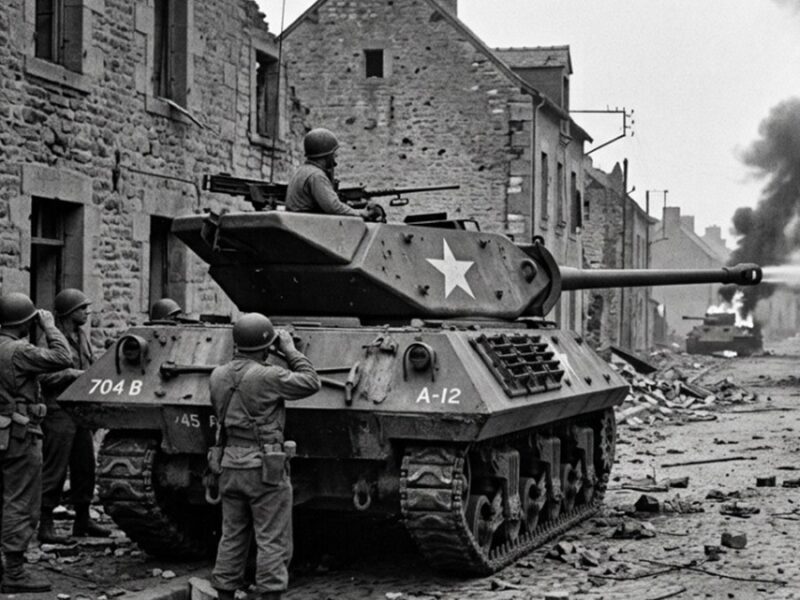
It is just before dawn on December 19th, 1944, and an American tank destroyer sergeant crouches in the open turret of his M10, parked in the shadow of a stone barn on the main road through Rocherath, Belgium. Fog presses against the rooftops. Somewhere out in the murk, tracks grind on cobblestones, closer with every second.
The sergeant cannot see more than 60 yards in any direction. He can hear the Panthers before he can see them. The distinctive whine of their Maybach engines rising and falling as they navigate the narrow street in column, headlights off, confident that darkness and mist will carry them straight through the American line.
His gunner, hunched over the sight of the 3-in gun, has already loaded armor-piercing shot. The sergeant presses his knee against the traverse, easing the turret a few degrees to keep the muzzle trained on the gap between two houses where the road bends. Somewhere behind him, in a cellar window, a bazooka team from the 38th Infantry Regiment watches the same gap.
Nobody speaks above a whisper. The lead Panther’s silhouette emerges first as a smear of gray against gray, then as a shape, then as a tank close enough that the sergeant can hear German being shouted from an open hatch. His gunner does not wait for orders. He fires. What happens in the next 40 seconds on that stretch of road decides, in miniature, the outcome of one of the most desperate nights of the entire Ardennes campaign.
It is not a scene invented for effect. It is drawn from the documented close-range fighting of December 18th and 19th, 1944, when M10 tank destroyers of the 644th Tank Destroyer Battalion dug in alongside Sherman tanks of the 741st Tank Battalion ambushed a column of Panthers from the 12th SS Panzer Division as it drove straight down the main street of Rocherath.
Three tanks under 200 m well under a minute. The kind of engagement tank destroyer crews trained for but rarely got because it demanded that the enemy come to them blind, overconfident, and funneled into a killing ground they could not escape. To understand why an obscure Belgium crossroads became that killing ground, you have to go back four days to the gray snow-heavy hills of the German Eifel where Adolf Hitler had gathered the largest reserve of armor the Wehrmacht had assembled since Kursk.
By December 1944, the German army in the west had been broken twice in six months. First at Falaise, then in the long retreat to the Siegfried Line. Hitler’s answer was a single enormous gamble. 13 infantry divisions and seven armored divisions backed by five more in reserve, over 1,000 tanks and assault guns, and roughly 1,900 artillery pieces were assembled in secrecy along a 70-mi stretch of the Ardennes, the same wooded hilly ground the Germans had exploited in 1940.
The plan, code-named Wacht am Rhein, called for three armies to punch through thinly held American lines, cross the Meuse, and retake the port of Antwerp, splitting the British and American armies and forcing a negotiated peace in the west. Spearheading the northern thrust was 6th Panzer Army under Sepp Dietrich.
Its most dangerous element, a Kampfgruppe of roughly 100 Panzer IVs and Panthers, 40 Tiger IIs and 25 assault guns commanded by Joachim Peiper. To their south, the 12th SS Panzer Division Hitlerjugend, made up largely of teenage conscripts led by hardened veteran officers, was tasked with punching through the villages of Krinkelt and Rocherath and opening the road to Elsenborn Ridge.
Standing in the way were two American infantry divisions that nobody expected to be tested that week. The 99th Infantry Division, activated barely a year earlier, had been stretched across a 22-mile front with no reserve, placed there precisely because commanders believed the sector was quiet. The veteran 2nd Infantry Division was in the middle of its own attack on a road junction called Wahlerscheid when the German offensive opened on the 16th of December, forcing a hurried fighting withdrawal back through Höfenen and into the twin villages of Krinkelt and Rocherath, which sat directly astride the road the Germans needed. If Krinkelt-Rocherath fell quickly, up to 30,000 American soldiers on the Elsenborn front risked
being cut off from the rear. Holding those two villages for as long as it took the infantry divisions to dig in on the ridge behind them became one of the most consequential defensive actions of the entire battle. The tank destroyer force, the 644th battalion belonging to had itself been built a around a specific narrow doctrine.
One of the fighting at Rocherath would both confirm and quietly undermine. American planners of the early war years had decided that tanks should not fight tanks. Instead, fast, lightly armored destroyers with powerful guns would be held in reserve and rushed to wherever German armor broke through, ambushing it from concealed positions rather than trading blows in the open.
The M10, mounting a 3-in gun in an open-topped turret on a Sherman-derived hull, embodied that doctrine well enough in 1942. But by the summer of 1944, it had run into a hard limit. During fighting in Normandy that July, the 899th Tank Destroyer Battalion needed a two-day battle at ranges under 200 m to destroy 12 Panthers near Le Désert because the M10’s gun could not reliably defeat a Panther’s frontal armor at any greater distance.
Eisenhower’s own headquarters asked that same week for M10 battalions to be converted as fast as possible to the heavier-gunned M36. By December, only a fraction of that conversion had happened, which meant the M10 crews waiting in Rocherath’s fog were fighting with a gun already judged inadequate for the tank in front of them unless they could force the engagement onto their own terms at their own range.
The Americans did not hold Crinkle Rocherath with much. Around 20 Shermans of the 741st tank battalion, a company of M10 tank destroyers from the 644th tank destroyer battalion, a second company of destroyers from the 612th, a handful of towed 3-in guns from the 801st, and infantry from the 38th and 9th regiments dug into cellars and behind garden walls.
Against them came Panthers and Panzer 4s, five Tiger IIs, Panzergrenadiers on foot and clinging to hulls, and eventually assault guns firing directly down the main street. The fighting at the Lausdelle crossroads on the night of the 17th of December, where a scratch force of infantry and antitank guns knocked out eight German armored vehicles before being overrun, had already bought the defenders in the villages several critical hours.
By dawn on December 18th, Panthers and Panzer 4 Ausf. H of the Hitler Youth Division were pushing through mist and drizzle toward Rocherath itself. What the German commanders did next handed the Americans their opportunity. Rather than wait for Panzergrenadier support to clear the town house by house, elements of the attacking force drove their Panthers straight down the main road into Rocherath in column, exposed on both flanks with almost no infantry screening them.
It was, by any tank doctrine of the period, a serious tactical error, and the narrow streets of the town turned it into a fatal one. Bazooka teams from the 38th Infantry Regiment had taken up positions in upper story windows and behind rubble, close enough to strike the thinner side and rear armor of the Panthers, rather than trying to punch through the sloped 60 mm glacis plate at the front.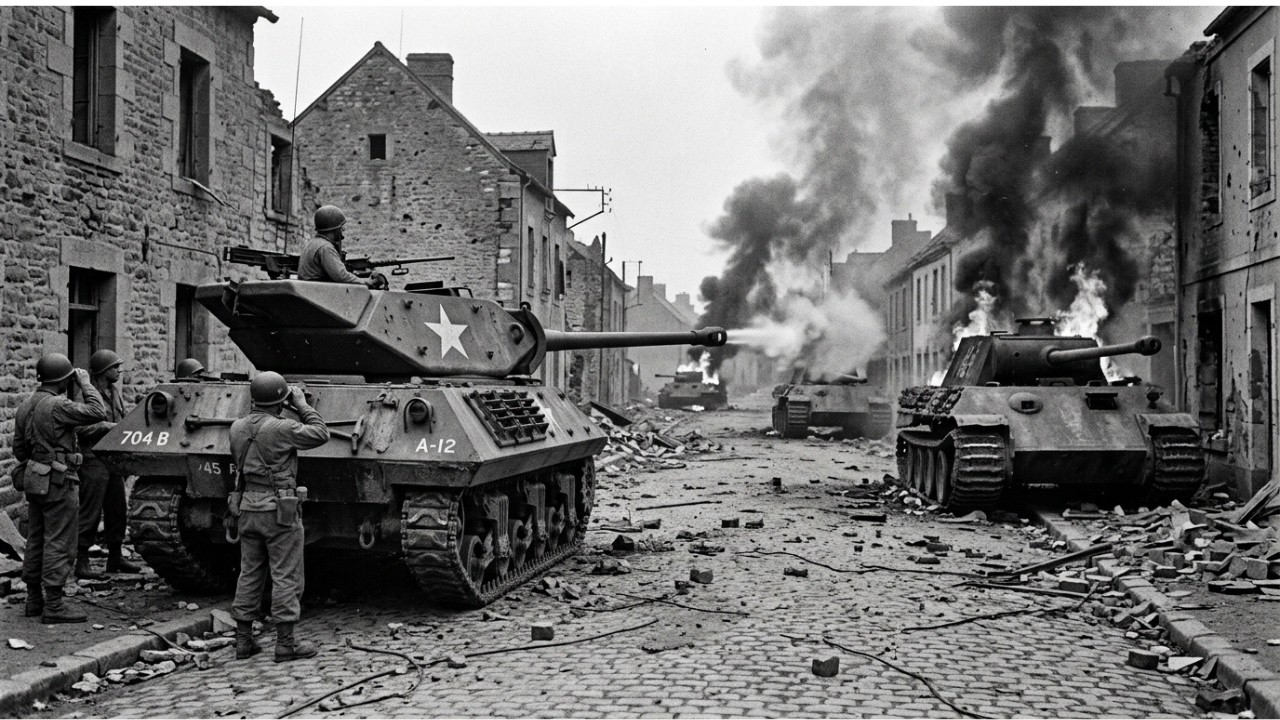
Shermans from the 741st, hidden in alleyways and behind stone barns, waited with engines off. The M10s of the 644th, their open-topped turrets giving commanders a wider field of view in the fog than a closed hatch would allow. Held position at bends in the road where a Panther would have to slow to negotiate the turn.
The first shots came almost simultaneously from several directions. A Sherman crew claimed a hit on the lead tank within moments of it rounding the corner by the church. A bazooka team on a rooftop above put a rocket into a following Panther’s engine deck as it tried to reverse. Further down the column, an M10 crew, sighting along a gap between two houses, fired three rounds of armor-piercing shot in rapid succession into a bunched cluster of Panthers that had nowhere to maneuver.
Each tank blocking the one behind it as the lead vehicles burned. Crews who survived that night described a killing ground barely wide enough for two tanks to pass, lit by burning Panthers, filled with the concussion of proximity-fused artillery airbursts overhead, showering the street with lethal splinters.
Tank destroyer crews reloading by feel because the muzzle flashes had temporarily blinded them. What made the ambush work was not luck, but geometry. Rocherath’s main street bent within the space of a few hundred meters, forcing any column moving through it to slow and momentarily present its flank rather than its front.
American gunners defending the village had days to study exactly where a tank would have to expose its side armor to negotiate that turn, and exactly which cellar windows and barn doorways offered a covered line of fire onto that stretch of road. When the Panthers came through in the mist on the 19th of December, they did so without the close infantry screen that might otherwise have spotted those positions and cleared them house by house first, a decision that historians of the battle have consistently identified as the single greatest tactical error made by the attacking force that morning. It was that misjudgment, more than any weakness in German armor or gunnery, that allowed three tanks bunched nose-to-tail on a narrow road to
be destroyed in barely the time it takes to read this paragraph aloud. If this deep dive into history is interesting to you, consider subscribing. It genuinely helps more than you’d think. By the end of that engagement in Krinkelt and Rocherath, American gun crews, tank destroyers, and bazooka teams together had accounted for a striking toll.
Bazooka teams alone were credited with 21 German armored fighting vehicles destroyed. Anti-tank guns, mines, and tank fire accounted for a further 27, a total of roughly 38 tanks and assault guns lost by the 12th SS Panzer division in and around the two villages. Two Shermans of the 741st Tank Battalion were separately credited with knocking out five Tiger tanks after German armor became trapped on the narrow streets, unable to traverse turrets in the confined space.
Six German tanks were destroyed directly by Sherman fire. Another eight by the towed 57 mm guns, rocket launchers, and mines scattered through the defensive positions. For the M10 crews specifically, the advantage was always going to be brief and close-ranged. The 3-in gun struggled against Panthers’ frontal glacis at distance, a problem serious enough that Eisenhower’s headquarters had already ordered the M10 replaced by the heavier-gunned M36 that July.
What the fog and the narrow streets of Rocherath offered was something the M10 rarely got in open country. Point-blank range, side and rear shots, and a German column that could not maneuver or retreat. The cost to the defenders was real. Three Shermans were lost in the initial German breakthrough before the ambush could be sprung, and infantry casualties in the 38th and 9th regiments mounted through two days of close-quarters fighting in cellars and rubble.
Ammunition ran low enough that some bazooka teams were down to their last rounds by the second night. And crews of the 644th found themselves cannibalizing shot from disabled destroyers to keep the guns still firing supplied. Yet, the arithmetic of the battle had shifted decisively. Every hour the Germans spent fighting through Krinkelt Rocherath was an hour the 2nd and 99th Infantry Divisions used to dig field artillery, anti-tank guns, and reserves into the high ground of Elsenborn Ridge behind them. A position that would hold for the remainder of the Ardennes Offensive and become the northern shoulder the entire German attack broke against. The wreckage left behind told its own story. Photographs taken by American units
moving back through the villages in January show burnt-out Panthers shunted to the roadside to let traffic pass. Their turrets skewed, hulls scorched black around the engine decks where bazooka rockets had found their mark. Of the roughly 250 tanks and assault guns the 12th SS Panzer Division had committed to the Ardennes Offensive, a substantial fraction of its losses in the campaign’s opening week came from the two days of fighting in and around Krinkelt Rocherath alone.
The division that had been expected to punch a clean hole through the American line instead spent itself against a pair of villages most staff maps had barely bothered to label and reached Elsenborn Ridge too depleted and too late to take it. The turning point was not a single dramatic order, but a pattern that repeated itself across the twin villages over two days.
German armor denied the room to maneuver by narrow streets and stone buildings kept choosing to press forward rather than pull back and wait for infantry support. And each time it did so, it walked into prepared fields of fire from tank destroyers, Shermans, and bazooka teams working in concert. By the second day, survivors of the Hitlerjugend divisions tank companies had learned to send infantry ahead of armor house by house, a far slower method that cost the German offensive the one resource it could least afford to lose in the Ardennes, time. General Leonard Gerow, commanding V Corps, had recognized days earlier that a gap in the line south of Losheim Graben left the sector vulnerable. And it was that same instinct for ground
that shaped where American commanders chose to make their stand at Krinkelt Rocherath rather than further back. In the days that followed, the 2nd and 99th Infantry Divisions withdrew in good order from the shattered villages to Elsenborn Ridge, taking their wounded and most of their surviving equipment with them and dug into positions reinforced by four battalions of divisional artillery and additional 155 mm howitzers.
The ridge itself, rising over 2,000 ft and overlooking the approaches from the east, became the one sector of the entire American front during the Battle of the Bulge that German forces never managed to break through. Sepp Dietrich’s Sixth Panzer Army, denied the northern shoulder it needed to widen its breakthrough, was forced to funnel its armor into a narrower corridor further south, one increasingly choked with the wreckage of Krinkelt, Rocherath, and later of Piper’s own overextended column near Stoumont and La Gleize. Between December 19th and the end of January, the average temperature at the Ardennes Front sat barely above freezing. And the cold that had aided the initial
German surprise now worked against a force stretched too thin to hold what it had briefly taken. That crew, along with the rest of the 644th Tank Destroyer Battalion, moved with the withdrawal to Elsenborn Ridge in the days after the fighting in Rocherath, taking up new positions to cover the approaches the Germans would try and fail to break for the next 6 weeks.
The M10 that had fired those three shots in the fog would go on, like most tank destroyers of its type, to be gradually phased out in favor of the heavier M36 as 1945 wore on. But on that road through Rocherath, for the space of less than a minute, three burning Panthers blocked the only route the Hitlerjugend Division had to push west, and the defenders of a village most maps did not bother to name held the line long enough for an entire ridge to become unbreakable.
The gunner reloaded a fourth round out of habit, sighted down an empty smoke-filled street, and found nothing left to shoot at.