How One British Bluff Cost Germany The Mighty Graf Spee D
Dawn breaks flat and gray over the Rio de la Plata on the morning of December 17th, 1939. And by nightfall, a crowd of roughly 20,000 people has gathered along the waterfront of Monte Vidio, drawn there by 3 days of rumor, radio static, and newspaper speculation. All of them expecting to watch something almost nobody alive has ever seen.
a genuine naval battle fought in view of a neutral city between a German capital ship and whatever the British could scrape together to stop her. They have opera glasses. They have brought children. Vendors are selling refreshments along the seaw wall as though this were a regata.
And then a few miles out in the shallow water of the eststerie, with the light failing and the crowd holding its breath, the Admiral Graph speed simply stops moving, and a series of explosions tears through her from bow to stern, and she settles, still burning, onto the mud. No British shell struck her that evening.
No British ship was even in range. the most successful commerce raider Germany had sent to sea in the whole of 1939. A ship that three days earlier had fought three Royal Navy cruisers to a standstill and driven them off, destroyed herself by her own captain’s order in full view of a city that had come to watch her win or lose a fight that never happened.
Sit with that for a second because it is the strangest fact in this entire story and almost nobody talks about it properly. This was not a defeated ship. This was a ship whose captain believed with total sincerity that leaving harbor meant certain annihilation at the hands of a fleet that, as it turned out, did not exist.
He was not wrong because he was foolish. He was wrong because he had been made to be wrong deliberately by people who understood something about war that no amount of German naval engineering could counter. This is the story of how that happened. And it is not in the end a story about who had the bigger guns.
It is a story about who controlled what the other side believed to be true. And it is worth saying plainly right at the start that the ship the British sent to the bottom of the river plate was sunk with radio broadcasts, newspaper rumors, and a piece of maritime law nobody had thought to weaponize before.
That is the real subject here. And everything else, the battle, the guns, the tonnage, is simply the stage on which that idea gets proven. To understand how a bluff could bring down a pocket battleship, you first have to understand what a pocket battleship actually was and why Germany needed to invent one in the first place.
Because the ship herself is the product of a legal loophole and the whole story that follows is in a sense one loophole answering another. After the first world war, the Treaty of Versailles set a hard limit on the size of any new German warship, 10,000 tons. That figure was chosen deliberately.
10,000 tons is enough tonnage for a heavy cruiser. It is nowhere near enough for a battleship. And the men who drafted that clause believed reasonably that they had permanently closed the door on German capital ship construction. German naval architects spent the following decade proving them wrong without technically breaking a single word of the treaty.
The result, unveiled to an unsettled world in 1931, was officially termed a Panzer shift, an armored ship. Though British naval officers coined a more memorable name almost immediately, the pocket battleship, the trick was simple to describe and extraordinarily difficult to execute.
Using all welded construction instead of riveted plate and diesel propulsion instead of conventional steam turbines, German engineers shaved enough weight off the hull to mount six 11-in guns. true battleship caliber weapons on a vessel that displaced barely more than a heavy cruiser.
The diesels did something else, too. Something that would matter enormously three months into the coming war. They gave the ship extraordinary range, close to 10,000 nautical miles without refueling. Enough to cross an ocean, vanish for weeks at a time, and cross it again. Naval historians of the period summarized the entire design philosophy in a phrase that deserves to be remembered.
She was built to outrun what could kill her and outgun what could catch her. Any Royal Navy battleship or battle cruiser, powerful enough to destroy her in a straight fight, was also too slow to catch her. Any cruiser fast enough to run her down lacked the guns to survive the encounter. It was on its own terms a genuinely elegant piece of naval theory, and it produced three ships, Deutseland, Admiral Shear, and the third of the class, launched in 1934.
and named for a legendary admiral of the previous war, the Admiral Graphspe. Her captain from the moment war broke out was Hans Langdorf, a torpedo specialist who had come up through the German Navy in the years after Utland, a professional officer with a reputation even among his enemies for correctness bordering on chivalry.
Langdorf took Graphsp out of German waters two days before Britain and France declared war, slipping into the South Atlantic ahead of the diplomatic collapse. And for the better part of three months, he did exactly what his ship had been designed to do. He hunted merchant shipping across two oceans.
And he did it by every surviving account with a courtesy that startled the crews of the ships he sank. Nine merchant vessels went down under his guns between late September and early December. More than 50,000 tons of Allied cargo shipping. And in every single case, Langdorf took the merchant crews aboard his own ship before scuttling their vessel, fed them, in some accounts allowed them access to reading material and medical care, and eventually transferred them to a captured supply ship or released them at a neutral port. Not one merchant sailor died at his hands in 3 months of raiding. That fact alone made him something close to a folk villain the British public could almost respect. A gentleman raider in an age that badly wanted its villains to at least be interesting. And it is worth holding on to that image of him because it will matter enormously later when the story asks you to judge him. The doctrine behind his mission, the standing orders under which every German raider captain operated was cautious almost to the
point of timidity. And that caution is the single most important fact in understanding everything that follows. German raiders were instructed in writing to avoid engaging enemy warships wherever possible, even warships individually weaker than themselves. Sinking merchant tonnage was the mission.
Surviving to sink more of it was the method. A raider that fought and won a battle against a cruiser had, in the German calculation, still lost because a damaged raider thousands of miles from a friendly port was a raider that had likely signed its own death warrant, regardless of who technically prevailed.
This was not cowardice written into policy. It was arithmetic. Germany had exactly three of these ships. Britain, across a global empire, could build cruisers in numbers Germany could never match. Every one of those three pocket battleships was in effect irreplaceable currency, and Berlin intended to spend it exactly once on tonnage, not on glory.
For 3 months, this worked so well that the Admiral in London had no idea where the threat even was. Ships would simply stop transmitting, and days would pass before anyone realized another vessel had joined the list of the missing. Britain and France, in response, committed an enormous force to the hunt.
something in the order of two dozen warships organized into eight separate hunting groups, each patrolling a slice of ocean on the theory that a raider operating alone across an area that vast would eventually have to surface somewhere within someone’s patrol box. It was an expensive, frustrating way to fight a war.
Dozens of ships burning fuel and steaming thousands of empty miles in pursuit of a target nobody could locate. And it is exactly the trap the pocket battleship doctrine was built to spring. One ship sailing alone had effectively pinned down a fleet. The man who finally closed that trap was not hunting blindly.
Commodore Henry Harwood, commanding the small British Naval Force responsible for the waters of South America, had spent years before the war thinking through precisely this scenario as an academic exercise at the Royal Naval War College. If a German raider ever appeared in the South Atlantic, how would a handful of British cruisers, none individually a match for her, actually fight and beat one? He worked out an answer on paper in peace time and in December 1939 got the chance to test it with live ammunition.
Harwood reasoned that the shipping lanes converging off the mouth of the river plate represented the richest hunting ground on the entire South American station and he judged correctly that a raider hungry for tonnage would eventually be drawn there. He even estimated from patterns in the sinkings roughly when graph speed was likely to arrive. He was right almost to the hour.
What Harwood actually had to work with was not much. Exat, a heavy cruiser mounting six 8-in guns under Captain Frederick Bell, and two light cruisers, Ajax, his own flagship, and Achilles, each carrying eight 6-in guns, and the latter crewed overwhelmingly by New Zealanders defending in a very real sense a homeland on the far side of the planet from where they stood.
Do the arithmetic honestly, because it matters. Graph speeds broadside. Six 11-in guns firing shells weighing roughly 660 pounds a piece dwarfed anything the three British cruisers could answer with individually and even combined the tonnage of shell the British could throw in a single salvo fell well short of hers.
This was on paper not a fair fight. It was barely a fight at all and Harwood’s standing orders to his captains memorized before contact was ever made reduced the entire plan to five words. attack at once, divide the force, split into two groups so that Graphsy’s six big guns would be forced to choose a single target rather than engaging all three ships simultaneously, and let the ship not chosen close the range and pour fire into her from an angle her captain could not easily answer.
At 17 minutes past 6 on the morning of December 13th, with smoke cighted on the horizon and Graphb’s lookouts reporting what Langdorf initially took for a lightly escorted merchant convoy, the plan went into motion exactly as designed. Instead of running from a pocket battleship, as every rule of naval warfare said they should, the three cruisers turned and closed the distance, and Graphsp opened fire on Exat, the heavier of the three targets at ranges under 10 mi.
What followed for Exat over the next hour was close to catastrophic. Two of her three main gun turrets were knocked out in succession. Her bridge was wrecked by a direct hit that killed or wounded most of the men stationed there. And for a period, she was steered not through her damaged wheel, but through a human chain of sailors relaying helm mortars down through the wrecked superructure by voice, deck by deck.
Fires burned along much of her length. 61 of her crew were killed outright, and through all of it, with one turret still functioning, exit kept firing, launched her torpedoes at the raider, and Captain Bell, his bridge gone, prepared, if it came to it, to ram to drive his burning ship directly into GraphB’s hull rather than let her escape untouched.
Whatever else this story is about, it is first about the 61 men who did not survive that morning and about a captain who chose to keep fighting a ship that could no longer meaningfully fight back. If any part of what you are hearing moves you, the smallest thing you can do for men like that is press the like button before you keep listening.
Because a story like this one only reaches more people who have never heard their names if it gets that first small push and it costs you nothing to give it. While Exat absorbed Graphspe’s main battery, Ajax and Achilles closed from the opposite flank and began pouring 6-in fire into the raider at a rate that visibly rattled her crew.
The shells were individually much lighter, but there were far more of them. And Langdorf, watching two light cruisers refuse to break off despite being outgunned in every meaningful respect, made an observation that has survived in the record and become one of the defining lines of the entire battle. that they came at him as though they intended to torpedo him, as though they were small enough and fast enough to behave like destroyers rather than cruisers, throwing themselves at a ship that could on paper have annihilated either of them outright. Captain William Perry of Achilles later admitted he never fully understood why Graphspe had not simply turned her full attention on the two light cruisers the moment Ex was finished and finished her when she had every apparent means to do so. She had the guns. She did not use them that way, and that single hesitation, whatever its cause, cost her the initiative at the exact moment it mattered most. Most of the smaller shells that struck her that
morning, did comparatively little damage. But a handful mattered enormously, and one hit in particular, almost certainly from Exat’s 8-in guns before she was disabled, tore into Graph Speed’s fuel processing system, the plant responsible for cleaning and purifying the diesel oil her engines depended on.
This is the detail the entire rest of the story turns on, and it deserves to be said slowly. Graph speed’s guns were still intact. Her engines could still turn, but she could no longer reliably purify enough fuel to keep them running across an ocean crossing, and her own engineers assessing the damage in the hours after the battle, estimated she had perhaps 16 hours of usable, clean fuel remaining.
16 hours for a ship supposedly built to range across 10,000 nautical miles is not damage. It is a death sentence written in diesel oil, and Langdorf knew it within hours of the guns falling silent. By any conventional scorecard, the morning belonged to Germany. Exat was a wreck, barely capable of limping toward the Falkland Islands for repair.
Ajax had lost two of her own gun turrets to a direct hit. And yet it was Graph Spi, the ship that had inflicted by far the greater damage, that broke off the engagement and ran for the nearest neutral port. Not because she had lost the battle in any tactical sense, but because three smaller ships throwing half her weight of shell, had managed, almost by accident, to hit the one system that mattered more than armor or guns combined.
And her captain understood immediately what that meant for a ship this far from home. Which raises the harder, more interesting question, the one this story is really built around. Why would the Royal Navy risk three cruisers carrying between them roughly half the throw weight of the ship they were attacking in a fight that any sober German staff officer would have called reckless in reverse? No German admiral would have sent three lesser ships into that kind of engagement voluntarily.
The entire raider doctrine existed specifically to avoid exactly this scenario. So why did the British calculate differently and why were they right to? The honest answer has almost nothing to do with courage for its own sake. And it is worth pausing here to be scrupulously fair to the historical record because the popular version of this story tends to inflate the mismatch for dramatic effect and a documentary that wants to be trusted has to say so plainly.
Yes, Graphsy’s individual shells were vastly heavier than anything the British cruisers carried, but between the three of them, the British ships carried 22 guns to her six, and lighter guns cycle and reload far faster than 11in guns can. Measure not the weight of a single simultaneous broadside, but the weight of metal each side could actually put into the air across a full minute of sustained firing, and the gap between the two sides narrows considerably.
And some naval analysts looking at it that way argue it very nearly disappears. The legend of the brave, hopelessly outgunned underdog cruisers facing an unstoppable steel monster is in part a story the Admiral T was happy to let take root in a grim winter that badly needed a victory to tell at home.
The real mismatch was smaller than the legend claims. But Harwood’s captains did not know that for certain on the morning of December 13th. They turned toward those 11-in guns, believing by their own reckoning that they were badly outmatched, and they turned anyway. And whatever the arithmetic actually says in hindsight, the nerve that morning was entirely real.
And underneath that nerve sat something structural, something the pocket battleship doctrine could never have replicated, no matter how many more ships Germany had built. The Royal Navy of 1939 was not, in any meaningful sense, three cruisers off South America. It was the visible tip of a global network built up over three centuries.
Naval bases and coaling and fueling stations scattered across every ocean on Earth. From Simon’s Town at the foot of Africa, to Freetown on the West African coast, to the Falkland Islands, sitting in the empty South Atlantic, almost exactly where this battle was fought. A damaged British cruiser rarely had to survive more than a few days steaming, before reaching somewhere that could repair her.
Exat, torn open and barely afloat, did not need to cross an ocean to find safety. She needed to reach the Falklands a few days away, and she did, and within months, she had been patched, repaired properly at home, and returned to active service. The system simply absorbed the damage and gave the ship back.
There was no equivalent anywhere in the German war machine. A damaged German raider thousands of miles from home had quite literally nowhere to go because there was no German base, no friendly harbor, no fueling station anywhere in that hemisphere waiting to receive her. Germany could design a magnificent ship.
It could not build the empire that ship would have needed underneath her to actually survive being hurt. Layered on top of that physical network was something almost as important and far harder to see, information. British intelligence had tracked Graphspe for months, not through luck, but through the patient accumulation of distress signals from sinking merchant men, radio direction finding, and a slow process of plotting her last known position against where she was likely to strike next.
All of it feeding into a single operational picture maintained in London. Eight separate hunting groups of British and French warships had been organized to cover the oceans she might be operating in. And while most of those groups would spend the entire campaign finding nothing, the system was built on the assumption that most searchers failing was an acceptable cost, so long as whichever one made contact would not be alone for long.
The Germans saw one raider tying down two dozen Allied warships and believed that was their own strategic victory. In a narrower sense, it was. But it was also the British system functioning exactly as intended. flood the ocean with patrols, except that most will find nothing, and make certain the one that succeeds is immediately reinforced.
And beneath even the bases and the intelligence sat something that cannot really be measured in tonnage or nautical miles at all, and it is probably the single most decisive factor in the entire encounter. The Royal Navy’s institutional culture, refined across 300 years of continuous operational history, expected its captains to attack, not to preserve their ships at the first sign of unfavorable odds.
Harwood did not radio London for permission when smoke was cited on the horizon that morning. He signaled his own captain’s two words, “Attack at once.” Germany had built ships engineered, quite literally in their design brief, to avoid battle whenever possible. Britain had built officers who, by temperament and training, found it almost unthinkable to decline one.
Those three captains off the river plate were not being reckless. They were the product of a service that had decided generations before any of them were born that the worst thing a British warship could do in the presence of an enemy was nothing at all. So hold that arithmetic in your head one more time and see what it actually means.
roughly half the throwing weight of Shell by the pessimistic wartime reckoning the British themselves believed at the time and they attacked regardless because the ship in British naval thinking was never really the fundamental unit of power. the system was. And the system could absorb the loss of a single cruiser in a way Germany’s entire raiding strategy could never absorb the loss of one of its three irreplaceable pocket battleships.
Which is exactly the position Hans Langdorf found himself in on the evening of December 13th, steering a damaged ship with 16 hours of clean fuel toward the one neutral harbor within reach, Monte Vidio in Uruguay. And it is here, not on the open sea, that the story stops being about naval gunnery entirely and becomes something closer to a legal and psychological trap, sprung not by an admiral, but by a diplomat.
Graphsby dropped anchor in Monteido Harbor a little after midnight on December 14th. And the moment her anchor touched bottom, she stopped being primarily a warship and became instead a problem of international law, a domain in which the British held every advantage Germany lacked at sea.
Under the Hay Convention rules governing neutral ports, a belligerent warship could remain only for a strictly limited period before she was required either to depart or be interned by the neutral power for the remainder of the war. Langdorf needed time he did not legally have. wounded men aboard requiring treatment, serious battle damage to assess, and where possible, repair, and a fuel system that might not survive an open ocean crossing home, even if she managed to slip past whatever was waiting outside.
He asked Uruguay for 2 weeks. He was granted 72 hours, and it was inside that narrow window that the British minister in Monte Vidio, a diplomat named Eugen Millington Drake, closed a trap that no German staff officer had ever wargamed for. Millington Drake understood something Langdorf apparently had not fully considered.
The same body of neutrality law limiting Graphsy’s stay could be turned into a mechanism for holding her in place indefinitely. Buried inside the Hague rules was an older maritime courtesy originally meant to prevent an ambush just outside a neutral harbor’s limits. When a merchant ship belonging to one belligerent left a neutral port, an enemy warship in that same port was required to wait 24 hours before she herself was permitted to depart.
Precisely so she could not simply pounce on the merchantmen the moment it cleared territorial waters. Look at what that rule actually allows if you apply it deliberately and repeatedly. The British began sending their own merchant vessels out of Monte Vido Harbor one at a time, spaced out with obvious intent. Each departure legally reset Graphsy’s clock by another 24 hours.
As one countdown neared its end, another British ship would sail and the restriction would begin again. Britain was using a courtesy clause originally meant to protect merchant shipping to legally pin a German capital ship to a harbor hour by hour for as long as it took to buy the one thing the Royal Navy in that theater genuinely did not have enough of time for real reinforcements to arrive.
Except here is the part of the story that almost nobody outside serious naval history knows. And it is the detail that turns this from a story about clever lawyering into a story about a genuinely audacious bluff. There were, in practical terms, no meaningful reinforcements coming. Outside the harbor, Harwood had Ajax and Achilles, both already damaged from the battle 3 days earlier, and one fresh heavy cruiser, Cumberland, which had raced up from the Falklands to join them.
That was the entire available British force at the mouth of the River Plate. The ships that could have guaranteed the outright destruction of a pocket battleship in a straight fight, the aircraft carrier Ark Royal and the battle cruiser Renown were not lurking somewhere just over the horizon as Berlin and Langdorf both assumed.
They were roughly 2 and a half thousand nautical miles away days of hard steaming from the river plate and could not conceivably have intervened even if the standoff had dragged on for a week. Britain could not produce an overwhelming fleet. So instead, with real deliberation, it manufactured the belief that one already existed.
The execution of that bluff deserves to be walked through slowly because it is a small masterpiece of applied psychology. British agents arranged for an urgent and very publicly visible order to be placed at a port further up the coast for fuel and supplies of exactly the kind a large fleet carrier like Ark Royal would require and made certain the order was discussed loudly enough in the right circles to reach German ears within hours.
Radio operators transmitted signals on frequencies known to be monitored by German listening posts deliberately structured to suggest heavy units gathering nearby. Out at sea, the cruisers that were actually present were ordered to lay smoke well beyond the 3m territorial limit. Dark columns on the horizon designed to imply far more shipping than genuinely existed.
and the ordinary overheated press of a neutral South American city hungry for a sensational story did the rest of the work entirely on its own, printing speculation as though it were confirmed fact until the whole of Monte Vido believed a British fleet, including a carrier and a battle cruiser, was waiting somewhere just past the horizon to annihilate Graphsp the instant she cleared the harbor mouth.
Put yourself for a moment on that bridge in Langdorf’s position. Your ship is damaged. Your fuel reserves are critically compromised. Your wounded need proper medical care your ship cannot fully provide. Every clock available to you, legal, mechanical, human, is running against you simultaneously.
And every single source of outside information reaching you, the local press, the intercepted radio traffic, even reports filtering back through the German embassy in Monteido is telling you the identical story. An overwhelming British force is waiting just beyond neutral waters to destroy you the moment you emerge.
He believed it completely and understandably, and the surviving German naval records preserve the agony of a careful, methodical officer working his way toward the worst conclusion of his professional life. In signals sent up the chain to Grand Admiral Eric Rder and the German Naval High Command, Langdorf laid out his assessment with total honesty.
There was, in his judgment, no realistic prospect of breaking out into open water and making it back to Germany. He weighed his remaining options like a man doing arithmetic on his own death, fight his way out against a force he genuinely believed to be overwhelming, attempt to slip further up the estie toward Buenosire, allow Uruguayan authorities to intern the ship for the remainder of the war, or destroy her himself on his own authority rather than surrender her intact.
The question went all the way to Berlin and eventually to Hitler personally, and the reply that came back down the chain of command, preserved in the naval war diary, was as cold as the situation itself demanded. Extend the stay in neutral water by every available means. Attempt, if necessary, to fight through toward Buenosire.
under no circumstances allow the ship to be interned by Uruguay. And if none of that proved possible, ensure her effective destruction rather than let her fall into Allied hands intact. Read those instructions carefully because they reveal both the wisdom and the catastrophic blind spot in the entire German position.
Berlin was right to fear internment since a ship interned in a country with strong British commercial and diplomatic ties would almost certainly have been picked apart. her technology and secrets exposed to the very navy she had spent months evading. What nobody in Berlin and nobody aboard graph ever thought seriously to question was the one assumption underlying every calculation they made that the overwhelming fleet reported outside the harbor genuinely existed. It did not.
And the single most consequential fact shaping Germany’s entire decision that week was a fact that had never actually been true. If any part of this story is landing for you, the way it should if you are hearing it right, subscribing costs you nothing, and it tells us there is an audience for more of these, more of the raiders, more of the hunts, more of these strange quiet moments where nerve and information mattered more than steel.
And if you have a family connection to this theater of the war, a grandfather or greatuncle who served in the Royal Navy, the merchant navy, or anywhere in the South Atlantic campaign, leave his name and his ship in the comments below. These stories survive because ordinary people keep typing names into comment sections long after the official histories have gone quiet, and it is worth doing.
On the evening of December 17th, with his 72 hours expired and no further legal delay available to him, Hans Langdorf took Graphsby out of Monte Vido Harbor one final time in front of the 20,000 spectators who had gathered expecting a battle. There was no battle to watch. He had already transferred the overwhelming majority of his crew to safety beforehand aboard a German merchant vessel waiting in the harbor.
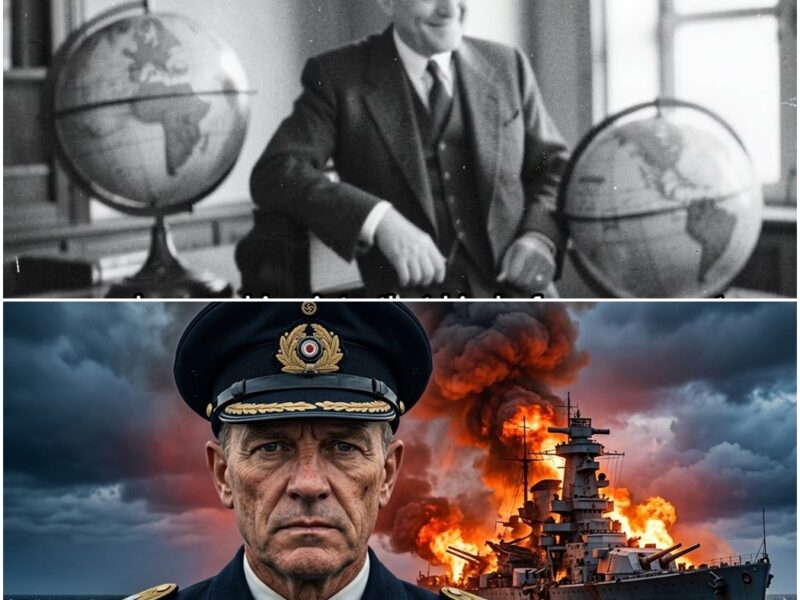
He took the ship only a short distance out into the shallow water of the estie, brought her to a stop, and with a skeleton demolition party aboard, set the scuttling charges himself. In the fading evening light, the most successful commerce raider Germany had put to sea in the opening months of the war, was destroyed by her own crew, her guns still trained outward, still pointed at an enemy force that had never actually been there.
That image deserves to be held on to for a second because it contains the entire paradox this story has been building toward from the opening scene. The Royal Navy never sank the Admiral Graph Spe her own captain did in order to escape a fleet that existed only in radio noise doside rumor and the speculative columns of a neutral city’s newspapers.
Resolve the comparison honestly and it comes out something like this. Germany had built the technically superior ship, heavier guns, longer range, a radar system that on paper outclassed anything sent against her. Britain had built the superior navy in the fullest sense of that word, a global system of bases, a functioning intelligence apparatus, an institutional culture that would not permit its officers to run from a fight, and on this particular occasion, a very wellexecuted lie.
Germany measured naval power in the weight of a single ship’s broadside. Britain measured it in the willingness to attack with roughly half that weight and the imagination to make up the rest of the difference with information rather than steel. Germany’s entire strategy aimed at the ship. Britain’s aimed in the end at the man commanding her.
Back in Britain in the cold and genuinely difficult opening winter of the war, the psychological effect of the news from Monte Vido was immense. Winston Churchill, then First Lord of the Admiral Ty, told the country over the radio that the outcome had been received with real gratitude across the islands, coming as it did after the loss of a fleet carrier and a battleship sunk at anchor earlier that year.
Here finally was a clear victory, and a genuinely clever one, arriving at a moment the country badly needed exactly that kind of story. But the comfort of that version of events should not be allowed to obscure its real costs, and an honest telling has to name them plainly. Harwood’s plan worked, but it worked through the wreck of Exat, and through the 61 men of her crew who never came home from that morning.
The image of hopelessly outgunned little cruisers against an unstoppable steel monster, as the honest arithmetic laid out earlier in this story shows, was polished considerably by an admiral that badly needed a morale victory in a grim winter. And the real mismatch in firepower was almost certainly smaller than the legend that grew up around it.
And the man at the center of the German side of this story was no villain to be cheered against. Hans Langdorf was not a fanatic, was not cruel, had fought an entire three-month campaign without killing a single merchant sailor who fell into his hands, and chose in the end to sacrifice his ship rather than gamble the lives of his remaining crew in a fight he genuinely believed wrongly but sincerely was already lost.
3 days after scuttling his ship in the waters of Buenosaris, having written that responsibility for her loss rested with him alone, Hans Langdorf took his own life. He was buried with representatives of his former enemies in attendance, and merchant sailors whose ships he had sunk remembered him for the rest of their lives with something close to genuine respect.
Henry Harwood, for his part, was promoted directly from commodore to Rear Admiral within days and made a night commander of the Order of the Bath, the officer who had solved the same problem twice. Once on paper years before the war, and once with live shells and a very carefully constructed bluff off the mouth of the River Plate.
Remember all of them then in their proper proportion. The New Zealanders manning Achilles guns in defense of a homeland half the planet away. the crew of Exat who stood to their guns on a burning wrecked deck and prepared if it came to it to ram a pocket battleship rather than let her escape. Henry Harwood who attacked with roughly half the weight of shell his enemy carried because his navy had spent three centuries teaching him the ship was never really the point.
And yes, Hans Langdorf 2, a capable and genuinely decent officer who lost everything to a fleet that was never actually there. undone, not by an 11-in shell, but by a rumor his enemies had built with total precision, and let him believe entirely on his own. That is how one British bluff, built out of maritime law, false radio traffic, and a nervous city’s newspapers brought down the mightiest raider Germany ever sent into the South Atlantic without a single additional shot being fired.
If you want the next one in this series, subscribe because there are more raiders, more hunts, and more of these quiet, unglamorous moments of British nerve waiting to be told properly. And more names on every side of these stories that deserve to stay remembered rather than slip under the water for good.