King Charles II Was Hiding a Nightmare Within D
A few days after his death, King Charles II’s attendants performed an autopsy, and what they found was absolutely bloodcurdling. King Charles II was the last hope of the Spanish Habsburg dynasty, which had ruled an everexpanding Spain for over a century. And he wasn’t much to hope for. a victim of decades of close inbreeding.
From the day he was born, Charles wasn’t expected to live. When his rule did come, it was bitter, brief, and doomed everything it touched. When Charles was born in 1661, his dynasty was already failing. His father, King Philip IVth of Spain, hadn’t managed to have a living son during his first marriage, and his second marriage to Charles’s mother, Mariana of Austria, wasn’t fairing much better.
The Habsburgs were infamous for inbreeding, and his father and mother were actually uncle and niece. While this wasn’t uncommon for the day, the obsessive way the Habsburgs stuck to their own line for generations was potentially because of all the recessive genes. Charles was sickly from the start.
As a young boy, he was bombarded with potentially fatal illnesses, including measles, chickenpox, reubella, and smallpox, all of which he survived against the odds. However, he didn’t escape his infancy entirely unscathed. He also got ricketetts, a weakening of the bones, usually due to a vitamin D deficiency, and had to wear leg braces until he was five.
His most infamous physical ailment, however, was with him all his life. At the time, the Habsburgs were easily identifiable by just one trait, the Habsburg jaw. also called the Austrian lip thanks to its equal prevalence in the Austrian Habsburg line. The Habsburg lower jaw jutted out, giving many people in the family a prominent chin and a crossbite.
This too was likely the result of inbreeding. Although historians have noted this jaw in many of Charles’s relatives portraits, Charles himself seems to have had the most prominent one on record. So prominent in fact that it interfered with his daily life. One of his contemporaries reported that his lower jaw was so distinct from his upper he had difficulty chewing.
His solution reportedly was to just swallow his food whole where possible and he suffered stomach problems as a result. Charles also suffered from an enlarged tongue. It was difficult for him to enunciate and be understood, and there are reports that he couldn’t even speak at all until the age of four and was treated mostly as an infant until at least the age of 10.
It’s no wonder he earned the nickname Eltisado or the bewitched. [Music] In 1665, Charles’s father, King Philip IV, died, leaving him as a toddler king. His mother, Mariana, quickly took over as regent and set about getting the kingdom in order. By the time Charles became king, the Habsburg Kingdom of Spain was both massive and in dire trouble.
The little ice age decades earlier had failed crops and people alike, severely affecting the realm’s economy and rendering it dependent on bigger powers like Britain, France, and the Netherlands. as king. It soon became clear that Charles would not be a glorious solo ruler, likely due in part to his mental and physical disabilities.
His court during this time and for the rest of his life was largely controlled by courtiers, counselors, and even his own mother, grasping for the power he was born into. Many foreign diplomats noted that Charles could be amiable and even generous with his time and resources, but that throughout international talks, he often lacked self-confidence and could fall into shyness.
Sadly, others noted that Charles suffered from bouts of depression. Still, there was one thing everyone agreed Charles was good for, marriage. The year Charles turned 18, one of his ministers brokered a match between him and the 17-year-old Marie Louise of Orleans. The niece of King Louie I 14th and the daughter of the Duke of Orleans, Marie Louise was a crucial link in an alliance with the more powerful France.
Pretty and cultured, Marie Louise was a darling of the French court and her father’s favorite child. More than that, she was in love with her cousin, the Dofan of France. So when the elders in her life told her she was being packed off to marry the deformed Spanish king, the poor girl spent the next weeks weeping her eyes out.
In August of 1679, Marie Louise and Charles married by proxy before officially tying the knot that November, just weeks after Charles’s 18th birthday. According to reports, Charles soon fell deeply in love with his new bride and would remain in love with her to the end of his days. For almost a decade, Charles and Marie Louise tried unsuccessfully to produce an heir who would carry on the Habsburg name.
At the time, most people in court blamed Marie Louise for infertility rather than pointing the finger at Charles. In response, she began a fertility regime full of dangerous substances thought to help her body carry a baby, but which did nothing but give her intestinal issues. In February of 1689, 9 years into her marriage with Charles, Marie Louise was out riding when she experienced a vicious pain in her abdomen, then went through a bout of convulsions and vomiting.
Doctors quickly realized she was on her deathbed and Charles rushed to her side. Reportedly, her last words to him were, “Many women may be with his majesty, but none will love him more than I do.” Yet, it may have been Charles and his court’s expectations that killed her. The Kingdom of Spain had enough enemies and so few heirs that some believed Marie Louise had been poisoned, thus ushering the realm closer to destruction.
Given her symptoms, historians are almost certain that she perished from appendicitis, a condition that her endless fertility treatments may have exacerbated. Her death put the crown into panic mode. Just weeks after his queen’s passing, Charles’s mother selected a new bachelorette for her son, Maria Anna of Noberg.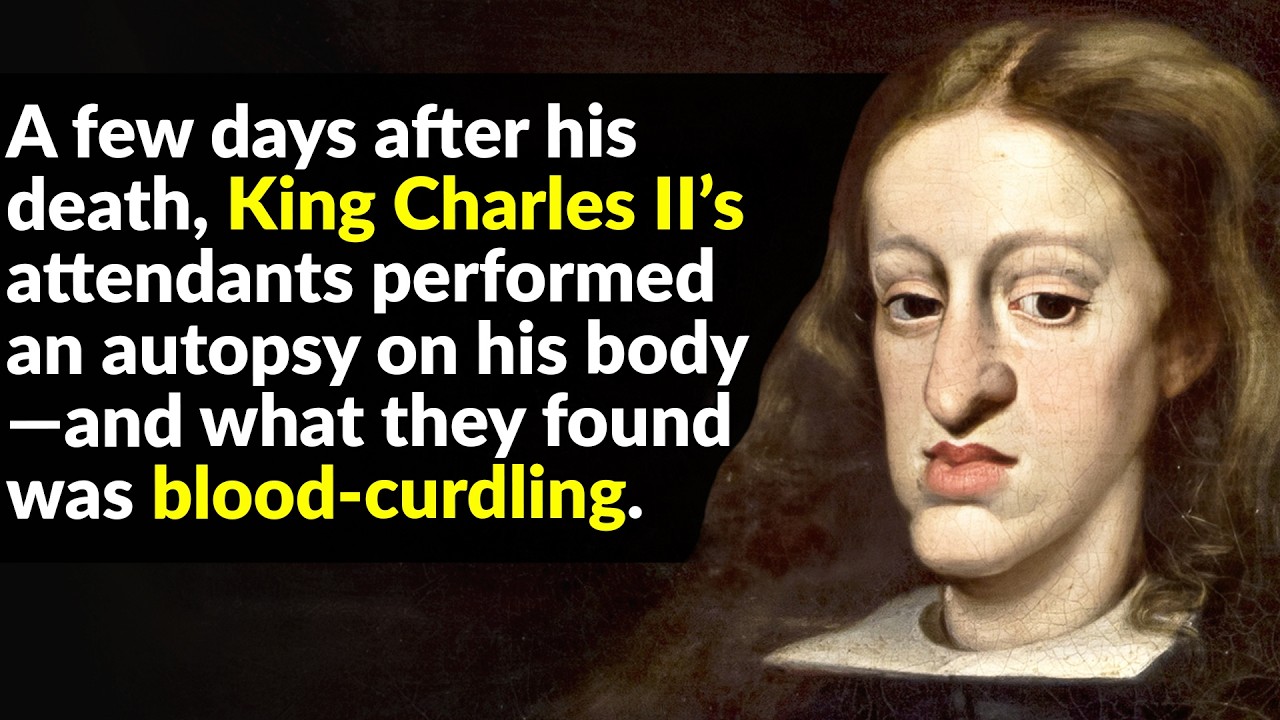
In this choice, she selected from the Austrian side of their alliances and snubbed the French, who had turned into rivals in recent years. Indeed, Maria Anna was chosen for her particular hatred of France. But it wasn’t the only quality she brought with her. By now, Spain was desperate for an heir, and Maria Anna had a secret weapon.
With a mind-boggling 16 siblings to her name, she came from an enormously fertile line. And as she was just 22 years old on the day of their proxy wedding in August of 1689, Maria Anna seemed to not only have the equipment, but also the time to finally provide the Spanish crown with an heir. But they weren’t expecting her to be cunning.
Maria Anna knew she was a Hail Mary and she was also no doubt aware of her poor barren predecessor Maria Louise. So to stave off rumors about her own fertility, Maria Anna frequently and publicly claimed she was pregnant. Even when no child materialized, this nonetheless seemed enough to push more of the blame onto Charles.
As Charles’s childless second marriage went on, more and more problems came for the throne. In 1690, Spain entered the 9 Years War with France and its European allies. Just 2 years in, they had to declare bankruptcy and 4 years later in 1696, they had lost almost all of Catalonia to the French. Part of the reason the 9 years war started in the first place was because of Charles, namely because of his inability to both stay healthy and produce an air.
All the powers in Europe were wound tighter than Springs, knowing that if Charles died without a son to inherit his enormous kingdom, it would throw off the power balance on the continent and spark a succession crisis. In 1696, Charles lost his mother, Mariana. The 61-year-old had likely died from breast cancer, and her passing deprived the Spanish court of one of its stabilizing forces.
She had been a significant figure in Charles’s government since before he could walk without leg braces. In the wake of his mother’s passing, Charles might have stepped up and taken more of his power back. Instead, he stepped aside, and it was his wife, Maria Anna, who rose to prominence in the power vacuum. Soon she was running the court’s political factions just like her mother-in-law had, and she did it with one goal in mind.
Both Charles’s late mother and his second wife were staunch supporters of the Austrian faction in the Spanish court and vehemently opposed the still active French faction. Both sides fought over all manner of influence, but their biggest goal was also the most existential one to control who became Charles’s successor.
an Austrian candidate or a French one. As Charles’s health continued to decline without a son in sight, Maria Anna had to put all her cunning into overdrive. In 1698, 2 years after his mother’s demise, Charles fell terrifyingly ill. Spain went into fierce urgent talks with the rest of the European powers to give Charles an official successor and hopefully avoid all-out conflict when the end finally came.
When the talks ended, Charles was ready to name Joseph Ferdinand of Bavaria as his successor. A coup for both Maria Anna and the Austrian faction at court. In fact, Maria Anna had reason to be very pleased with the result. She and young Joseph were actually from the same noble house. When Charles officially published his will that November, he didn’t just name Joseph Ferdinand as his successor.
He also appointed Maria Anna as regent for the boy should he come to power while still a minor. Charles’s will was supposed to stabilize the Kingdom of Spain, but it only threw it into further turmoil. When Charles’s court heard that he was making his wife regent, their reaction was reportedly complete silence.
In 1699, death brought everything back to the drawing board. And believe it or not, it wasn’t Charles II who perished. That year, Charles’s heir, Joseph Ferdinand, died unexpectedly, throwing most of Europe into frantic treaties for the second time in as many years. The choice of Charles’s next successor gave Queen Maria Anna even more to crow about.
The boy was none other than her nephew, Archduke Charles. Although there was still bickering about just how much of Spain Archduke Charles would get, the Austrian faction at court was overjoyed. But it wouldn’t last. In late 1700, Charles’s health took its last bad turn. After a lifetime suffering stomach issues and having difficulty ingesting food, Charles grew so ill he wasn’t able to eat at all.
And starting that October, he began wasting away in front of everyone’s eyes. There was no more time left, and his disgruntled courtiers now made their checkmate. Many of Charles’s Spanish courtiers, particularly the Castellians, had long despised his wife Maria Anna, and believed that a French successor rather than an Austrian one would allow Spain to keep the greater part of her lands after Charles died.
So they did what any power-hungry courters would do. They approached Charles on his deathbed and pushed their agenda. An archbishop from the French faction successfully convinced the alien king to appoint Philip of Anju, the grandson of King Louis I 14th as his official heir. On the 1st of November 1700, just before his 39th birthday, Charles’s belleaguered body finally gave out.
Philip Avonju was proclaimed king of Spain and Charles’s queen, once one of the biggest inheritors of her husband’s kingdom, was exiled to Toledo. In the end, all the treaties and discussions around Charles’s heir weren’t enough to avert disaster. The War of the Spanish Succession erupted in Europe almost instantly and lasted 13 years.
When the dust settled, Charles’s worst nightmare was reality. Though Philip was still king, Spain had lost much of its former lands, and the Spanish Habsburg dynasty was well and truly gone. In the days following King Charles’s death, attendants performed an autopsy on his remains. From the state of his body, it was a miracle he had lived as long as he did.
His heart was the size of a pepperc corn, his lungs corroded, his intestines rotten and gangrous. They also found that Charles only had a single testicle and that it was black as coal, indicating that it had atrophied long ago. From this information, historians believe that, as his wife, Maria Anna may have suspected, Charles was wholly sterile at the end of his life.
King Charles II of Spain’s story is a centuries old cautionary tale about the horrors of inbreeding, the last gasp of a failing dynasty, and the knife edge balance of European power. [Music] Thanks for watching History Expose. If you love uncovering the best stories in history, hit like and subscribe to keep exploring with us.
Don’t forget to visit our main page, Factate, for more incredible facts about everything.