Marie Antoinette’s Sister’s Revenge Was Absolutely Savage D
When the revolutionaries beheaded her sister, Marie Antoinette, Maria Carolina was as devastated as she was furious. From that moment on, she did everything in her power to get revenge, no matter how bloody. They say that behind every successful man is a strong woman. Well, Maria Carolina of Austria certainly didn’t stand behind anyone, let alone a man.
When her half-wit husband, the King of Naples, didn’t seem up for the job, she rose to the occasion. Her aggressiveness and cunning cost her greatest enemy, Napoleon himself, to call her the only man in Naples. One could say that Maria Carolina’s fighting spirit started as a child. Even though she had more than a dozen siblings, she was only the sixth to survive childhood.
Her parents, Maria Teresa, the Queen of Hungary, and Francis I, the Holy Roman Emperor, had big plans for their lucky little bundle of joy. It’s not surprising that, with all the infant mortality going around, the siblings that did survive became incredibly close. This was certainly true for Maria Carolina and her younger sister, Marie Antoinette.
Yes, that Marie Antoinette. You know, the one who let them eat cake. Maria Carolina was incredibly close to her sister, so much so that their fates seemed intertwined. In 1767, when Maria Carolina was just 15 years old and Marie Antoinette was 12, their mother made a disturbing decision. She separated the ultra-close sisters.
Their mother wasn’t happy with the two girls’ behavior and insisted they grow up apart. It must have been a tearful farewell as the two besties said goodbye. Unfortunately, there was only more sadness in store for her as her parents soon announced their plans to wed her to King Ferdinand IV of Naples.
It didn’t matter how much Maria Carolina complained or begged. Her parents wanted an alliance with Spain, and this wedding was going to happen. Regardless of her protests, the preparations for the wedding continued. There was no doubt that on April 7th, 1768, she would be walking down the aisle and becoming a queen.
As it turned out, Maria Carolina’s groom, Ferdinand IV, couldn’t quite make it for his own wedding ceremony. Maria Carolina was likely walking on cloud nine. Surely the absence of the groom would at least give her a few more months of freedom while they rescheduled the wedding. Unfortunately, rescheduling was out of the question, so they sent in a proxy for the groom, Maria Carolina’s own brother.
After the wedding, Maria Carolina, together with her attending ladies and her brother and his wife, set off for Naples to meet her husband. They took their sweet time as Maria was in no rush. They visited Bologna and Florence along the way. But when she entered the Kingdom of Naples, Maria Carolina had to say farewell to her ladies and finally face her husband more or less on her own.
When she first laid eyes on her husband, Ferdinand, her first impression was brutal, and she didn’t hold back from expressing her harsh opinions. She apparently found him, in her words, very ugly. Later, after getting a little settled and used to him, she wrote, “I love him out of duty.” But what was Ferdinand’s opinion of Maria Carolina? Unfortunately, Ferdinand’s impression of Maria Carolina wasn’t much better.
The two lovebirds did spend the night together, but it didn’t exactly inspire Ferdinand to wax poetic. Instead, his first description of her went something like this, “She sleeps like the dead and sweats like a pig.” While it was certainly not love at first sight, there must have been some kind of spark.
Even though Maria Carolina thought her king was ugly and Ferdinand compared her to a pig, their nights together were quite lusty. Or at least they were lusty enough that they ended up with her getting pregnant, 18 times in total. That’s right. She had 18 deliveries and seven children who survived.
But it wasn’t like they had anything to talk about outside of the bedroom. Maybe the reason Maria Carolina and Ferdinand rolled around in bed so much was that they had no common language. The conversation was pretty limited as Maria Carolina spoke German and some Italian, while her husband spoke no German and not even proper Italian.
It turns out that, even though he was royalty, he preferred to hang out with the local street youth, and he quickly picked up their dialect. Besides lacking a common language, Maria Carolina found that Ferdinand could be just plain common. Maria Carolina’s husband seemed to be constantly at odds with all the privileges his position offered him.
And his rebellion showed itself in disgusting ways. He rudely ate spaghetti while attending the opera and took pleasure in doing his morning bowel movements in front of the servants. He would even ask them to take a look at the result. Remember that Ferdinand was, like Maria Carolina, still a teenager, so these antics weren’t that off-the-wall.
But what kind of a king would this immature creature be? Even though Maria Carolina’s husband was the king, he didn’t really excel at it. In fact, his not-so-great education hadn’t at all prepared him for the task at hand. Instead, Ferdinand relied on his father’s Spanish council to take care of his kingly duties.
At the head of the council was one Bernardo Tanucci. Tanucci probably didn’t think twice about the teenage Maria Carolina, and boy, did that turn into a big mistake. You see, Maria Carolina, under her mother’s strict direction, had a secret plan. She wanted to take over Ferdinand’s power. The first step was to gain her husband’s trust.
But how was she going to do this? Her husband seemed to only have one interest, hunting. Maria Carolina prepared to have an interest in the sport and slowly and calculatingly won over. Once she became her husband’s hunting buddy, Maria Carolina moved swiftly into the Privy Council. She also produced a male heir in 1777, which gave even more power.
Maria Carolina was now able to start throwing her tiny weight around. Her husband had given up, saying that his wife knows everything. Her next step was to get rid of the Spanish council, and she started right at the top, with Tanucci. To remove Tanucci from the council, Maria Carolina complained that he was sending letters with unpopular ideas, signing the king’s name, and making the king look bad.
She pointed this out to her husband, and the writing was on the wall for Tanucci. Ferdinand fired him, and this left a vacancy in the council. A vacancy that Maria Carolina had conspired to fill all along. With Tanucci out of the picture, the now 25-year-old Maria Carolina was free to appoint a new leader to the council, one that wasn’t Spanish.
His name was the Marquis of Sambuca, and he was basically a puppet of Maria Carolina. By removing the Spanish element from the council, Maria had successfully freed Naples from being not much more than a province of Spain. Her first mission was in the bag. Maria Carolina’s next goal was to bring her BFF, Sir John Acton, on board as her assistant.
Acton and Maria Carolina started to give a reboot to the Neapolitan Navy, which Ferdinand and company had sort of forgotten. They commissioned 150 ships and opened four marine colleges. This dynamic duo was doing great work, and it seemed that nothing could stop them. Or maybe I’ve spoken too soon. A woman and a man working so well and so closely together quickly backfired.
The pair soon had tongues wagging about their relationship. What the masses decided was that the two couldn’t be accomplishing so much without being lovers. The rumor started in 1782, even though there was no evidence that it was true. That, however, didn’t stop Maria Carolina’s husband from believing it.
By this time, the king had actually fallen in love with Maria Carolina, and now was pretty sure his wife was having an affair with her close confidant, Acton. Except, he needed proof. He made several attempts at catching them in the act. However, since there was no truth to the rumor, he failed at every attempt.
But this didn’t stop Ferdinand from flying into a rage and threatening both their lives. So, what did Maria Carolina do? Even though she wasn’t cheating, she still wanted to know every move of her husband, just to see what he was doing to trap her and Acton. Just like in a hard-boiled thriller, Maria Carolina hired detectives to trail Ferdinand.
Life in the castle must have been quite comical. Detectives were following Ferdinand as he tried to catch his wife with her non-existent lover. The escapades at the castle were beyond annoying. Eventually, Maria Carolina fired her spies, and Ferdinand resolved to stop being so paranoid. Maybe it was finally sinking in that his wife was actually faithful.
But before Ferdinand agreed to call a complete truce, he had a chilling demand. He wanted Maria Carolina to send Acton away. She accepted his demand and moved Acton into a neighboring town. But all this domestic drama was nothing compared to what was happening elsewhere in Europe. Over in France, where her sister Marie Antoinette was ruling, things for monarchs were going downhill fast.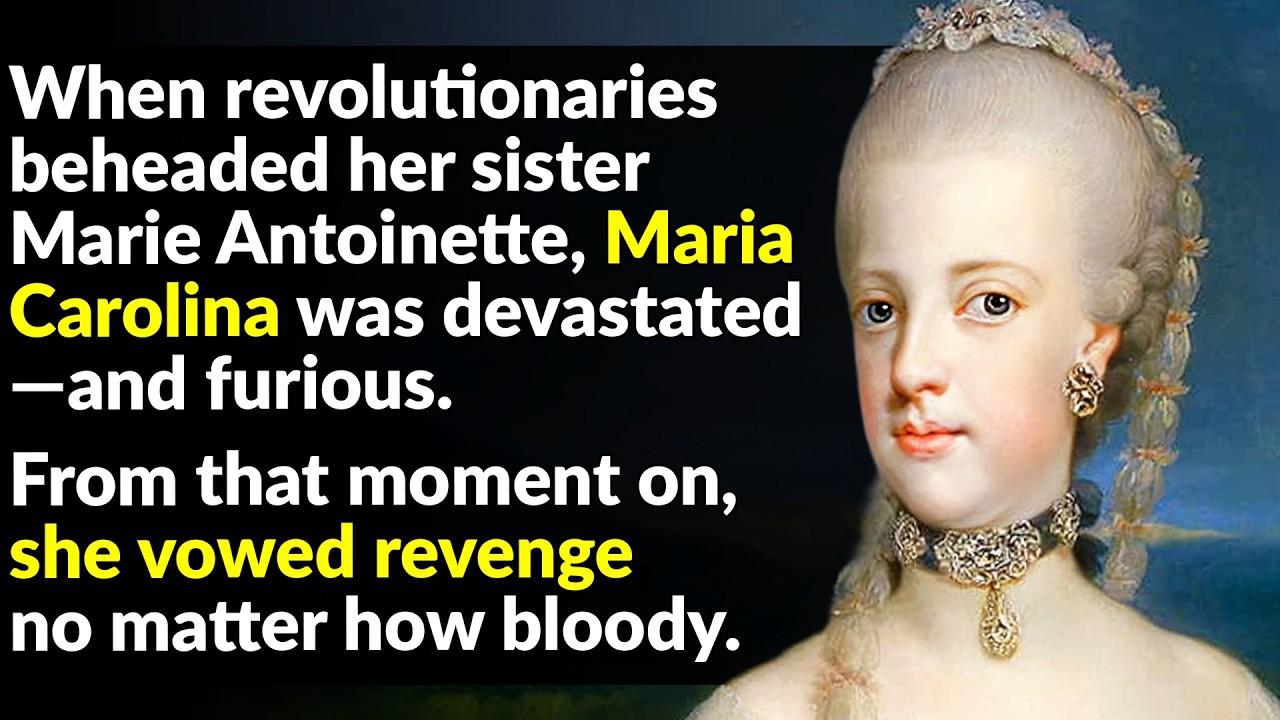
It was the French Revolution and the beginning of a new way of thinking. Maybe monarchs were getting too good of a deal and needed taking down a notch. Maria Carolina took one look at what was happening in France and gave it a big thumbs down. To avoid a similar situation in Naples, Maria Carolina took immediate action.
She divided Naples into wards, 12 to be exact. Maria Carolina took control of universities in an attempt to put a lid on intellectuals who were against her. She also created a secret cadre of law enforcement and even hired spies. Maria Carolina wanted to know what the people were doing and how they felt about her.
Even though she had once been in favor of free thinking, Maria had changed in sinister ways since then. She was now determined to stop it. She scattered her spies among all the different classes in Naples. They collected information about many things, and one of them was whether the people loved Maria Carolina.
The verdict was pretty much unanimous. They hated her across the board. But, as it turned out, her sister Marie Antoinette was in even hotter water. At this time, there were many uprisings against royalty across Europe. Maria Carolina was especially worried about her sister in France. She implored Marie Antoinette to leave France, but sadly, her advice came too late.
On August 10th, 1792, the people of France took Marie Antoinette and her husband, King Louis XVI, into custody. Because of this, Maria Carolina refused to even recognize France as a republic and also didn’t recognize a figure named Armand and his new legislation. Armand was patiently waiting for Maria Carolina to at least recognize the new French Republic, but Maria was in no rush to do so.
The longer she waited, the tenser their relations got. Maria Carolina’s old friend John Acton got in between her and the French official, trying to hold off a full-on battle between Naples and France. Then, he basically blew it. It turns out that Acton, who was now the prime minister of Naples, wasn’t at all an impartial go-between.
Of course, he was acting on behalf of Maria Carolina and trying to double-cross Armand. This all came to light when Armand intercepted a letter written by Acton. He was now seeing red and started making plans for his revenge. When Maria Carolina heard that the French were planning revenge, made up of nine ships no less, she flipped her lid.
She did an astonishing about-face and recognized Armand and his republic immediately. Doing this, Maria Carolina averted a battle against France. Unfortunately, those nine ships had already sailed. On December 17th, 1792, Armand’s nine ships arrived in Naples. Their admiral, Latouche, had a demand. Acton must apologize to him in person, or he would destroy Naples.
Maria Carolina had made a huge mistake, and everything she’d worked for was at risk. She had to decide quickly. Get Acton to apologize, or fight back against the formidable French admiral. Maria Carolina had her own rejuvenated navy, and it was possible she could fight against Latouche and his nine ships.
She met with her admiral and got some shocking news. They hadn’t even mobilized the navy yet. So basically, Maria Carolina had nothing to fight against France with. She had to turn to Acton and get him to apologize. Once Acton said sorry, Armand sent his monarch-hating sailors onto the soil of Naples. These sailors, who were actually Republican agents, had a mission: stir up anti-monarchy sentiment in Naples.
They did this quite easily, and Maria Carolina found herself in trouble. She had to get rid of these radicals who hated her and the king. Luckily, Maria Carolina had a chief of security, Luigi de Medici, who was capable and trustworthy. She quickly dispatched Medici to locate and get rid of the radicals that wanted to end her rule as monarch.
With her chief on the job, Maria Carolina could finally take a breath. But for some reason, Medici wasn’t bringing in any of the radicals. It wasn’t because he was inept, but rather something much more disturbing. As it turns out, Medici wasn’t getting rid of the radicals because he actually was one himself. He tricked the queen and put her in dire danger.
Sensing big trouble, Maria Carolina turned to France’s enemy, Great Britain, for an alliance. Later, in 1793, Maria Carolina joined Naples with the First Coalition. Countries included in this were Great Britain, Austria, Prussia, Russia, Spain, Portugal, and Sardinia. All these countries had one thing in common: a hatred of France.
But France’s next move would make relations even worse. If Maria Carolina loathed France now, what they did next would send her into a deep hatred from which she would never recover. In October 1793, they sheared Marie Antoinette of her hair, shackled her, and led her to the guillotine. She was infamously beheaded for, among other accusations, treason.
Marie Antoinette had been Maria Carolina’s closest sister, which meant this time, it was personal. So what now, Maria Carolina? How could she get back at France for this monstrous deed? Maria had always kept a portrait of Marie in her room. After the beheading, she wrote a promise to herself on it.
“I will avenge my sister.” Her first decision was to simply stop speaking French, which she now called that monstrous language. She also banned the writing of French philosophers, even though she had once liked them quite a bit. It was then that something struck her. Could what had happened to her sister also happen to her? Maria Carolina put the army on constant full alert, which she paid for with an unpopular tax increase, because she was sure her family was in danger.
Then, she went even further and slipped into paranoia. She hired food tasters to make sure her meals contained no poison, and she changed the location of her home daily in order to avoid attacks on it. Maria Carolina’s constant fear of attack was doing a number on her health. She needed a break from all the tension in her life, and a spa day wasn’t going to cut it.
The new French general, Napoleon Bonaparte, was getting dangerously close to Naples, and Maria Carolina just couldn’t handle the pressure. She agreed to pay France an indemnity in exchange for safety. Maria Carolina was always one to be safe, so in addition to the indemnity she paid France, she also married her son off to Austrian royalty.
She quickly joined an alliance with Austria against France, and then joined a second coalition, also against France. Pay out or not, there was no stopping Maria Carolina when it came to getting revenge for her sister’s demise. It was, however, this Second Coalition that brought about Maria Carolina’s own downfall.
Napoleon got wind of it and took it as a sign to act. In January 1799, he took occupation of Naples, and Maria Carolina and her family escaped to Sicily. While there, Maria Carolina organized an attempt to take Naples back. In the summer of 1799, with the help of the English fleet, Maria Carolina managed to do the impossible.
She beat the French and got her homeland back. She traveled back to Naples with her family and entered it triumphantly. Maria Carolina was now in a position to get her revenge, and believe me, she did not hold back. Once she was back in power, Maria finally unleashed the full extent of her fury. She had held onto her need for revenge all this time, and she needed blood to let it go.
She started by trying 1,000 Republicans for treason. Of those 1,000, 100 of them experienced Maria Carolina’s pure wrath. She executed them by either beheading or hanging. She’d finally got her revenge, but her position was far from stable. The people in Naples had been through a lot, and they needed someone to blame it on.
Because they knew that Maria Carolina was calling the shots much more than the simple Ferdinand, they blamed her. Even though King Ferdinand had done virtually nothing, at least he hadn’t brought on so much misfortune. Maria Carolina’s popularity had hit a new low, but there was still more trouble coming her way.
Napoleon once again conquered Naples, and Maria Carolina and her family once again fled to Sicily. Even though she had plans to get Naples back, this time, nothing came of it. She went to Vienna, and on September 8th, 1814, died after a stroke. Though she never got to see Napoleon defeated and her husband restored to the throne of Naples, one thing remains certain.
Throughout her life, Maria Carolina was an absolute force to be reckoned with, wielding power unapologetically and fighting for her rights all the way to the bitter end. Thanks for watching History Exposed. If you love uncovering the best stories in history, hit like and subscribe to keep exploring with us.
Don’t forget to visit our main page, Factinate, for more incredible facts about everything.