Princess Alice Of Battenberg: The Hidden Royal D
In 1928, tragedy separated Princess Alice from her son, Prince Philip. But years later, a letter revealed the heartbreaking truth. The British royal family orbits around Princess Alice of Battenberg. Queen Victoria was her great-grandmother, and Queen Elizabeth II was her daughter-in-law.
But for a woman with such blue blood, Alice’s life was no fairytale. From her heroism during World War II to her abandonment in a mental institution, this forgotten royal is worth a closer look. Her birthplace, Windsor Castle, was a far cry from the sanatorium she’d eventually find herself in. Her great-grandmother, Queen Victoria, was present for her birth.
Growing up, Alice generally split her time between Darmstadt, London, Jugenheim, and Malta. Such a hectic childhood would be hard for anyone, and Princess Alice wasn’t just anyone. Her mother soon realized something was different about her. It all started when Alice reached the age when a child would usually start talking.
The months passed, and Alice hadn’t yet said a word. When she did eventually talk, she struggled with pronunciation. In the end, it was discovered that Princess Alice was deaf. It was a tough pill for the family to swallow, but it was also the first step in getting Alice the support she needed. Soon, she could speak and lip-read in both English and German.
Alice’s deafness never held her back. Unfortunately, her family never quite got over the idea that something was wrong with her. Queen Victoria’s 63-year reign ended in 1901, and a 16-year-old Princess Alice attended the funeral. Her great-uncle, Prince Albert, was crowned King Edward VII soon after.
Naturally, Alice attended the coronation, likely a long and boring day for her, but at least she had something to keep her distracted. That was the day she met the man who would change her life forever. Royals from all over Europe traveled to London to see Edward’s coronation. One of them was Prince Andrew of Greece and Denmark.
For Alice and Andrew, it was love at first sight, and within a year, they were married. They went on to have four daughters, then a boy. That boy would grow up to be Prince Philip, Duke of Edinburgh, and consort to Queen Elizabeth II. In 1908, on a trip to Russia, Alice met her aunt, Grand Duchess Elizabeth Fyodorovna. The Bolsheviks would eventually murder Elizabeth, along with the rest of the Romanovs.
Elizabeth inspired Alice to live a more religious life. In due course, she gave away most of her possessions and started preparing for a more spiritual existence. In the run-up to World War I, the Greek liberation movement gained traction, and that was not good news for a royal. When the Great War began, things went from bad to worse.
Though the Greek government supported the Allies, Alice’s brother-in-law, King Constantine I, refused to take a side. That’s how Alice found herself huddling in the palace cellars with her children as the French bombarded Athens. By June of 1917, the Greeks had finally had enough of their king and all his relatives, and that included Alice.
The democratic government forced Constantine to abdicate, then exiled the entire royal family to Switzerland. Supporters restored Constantine to the throne in 1920, allowing Alice and her family to return, but that didn’t last long. The Greeks lost the Greco-Turkish War, and in the aftermath, a military coup seized power and exiled the royals yet again.
The coup meant that there was a target on Prince Andrew’s back. Any military officials with ties to the monarchy were arrested, and who had closer ties than the king’s brother? Andrew sat in captivity as several other officers who’d been arrested along with him were tried and then executed. Alice had to wait with bated breath to hear her husband’s fate, and her own.
Then, at the final hour, their savior arrived. Greece was a viper’s den, but Alice still had powerful people in her corner. She was, after all, Queen Victoria’s great-granddaughter. A British cruiser, the HMS Calypso, was sent to evacuate Alice, Andrew, and their children. The family ended up settling in Paris, enjoying a quiet life alongside other Greek refugees.
Alice converted to the Greek Orthodox Church, and around this point in her life, started to claim that she was receiving divine messages from spiritual forces. She told people that she was in direct contact with not only Jesus Christ, but also the Buddha. Those close to her grew concerned by her behavior.
Her family sent her to the finest psychiatrists in Europe, and they all offered the same diagnosis. Princess Alice was a paranoid schizophrenic. Following her diagnosis, the royal family could only think of one thing to do with her. Alice was forcibly separated from her children and tossed in Bellevue Sanatorium in Switzerland.
This was no bedlam. Some of the world’s richest mental patients resided here, but to Alice, it was nothing more than a prison. Princess Alice was royalty, which meant the greatest minds of the day studied her and tried to understand her condition. Her doctors sought out Sigmund Freud, the poster boy of psychoanalysis, to help determine Alice’s best course for treatment.
Surprise, surprise, Freud believed that Alice’s hallucinations were caused by sexual frustration, which was pretty much the same diagnosis he gave to most of his patients. The entire time that Alice remained locked up, she insisted that she was sane and begged to be let free. She even tried to escape several times, only for guards to bring her back.
There was nothing she could do but listen to the doctors and hope they might one day let her walk free again. That day did eventually come, but the damage had already been done. While she was hidden away, her family went on with their lives without her. She’d grown distant from her husband, her daughters had all married German princes, and her son, Prince Philip, went to Britain to stay with Alice’s brothers.
By the time Alice regained her freedom, her life had already passed her by. She’d stayed locked up in the sanatorium for 2 years. Although she wrote to her mother after she left, she refused contact with anyone else in her family. They’d betrayed her once, and they wouldn’t gain her trust again. Alice lived a simple, obscure life in Central Europe for years and spent the duration of World War II living in Athens.
There, she set up a base of operations with the Red Cross, providing relief to the people of the city. She organized soup kitchens and even smuggled medical supplies into the country from Sweden under the guise of a visit to her sister, Louise. After Mussolini’s fall in 1943, the Axis forces occupied Athens. During that period, the Germans deported about 60,000 Greek Jews to concentration camps where all but 2,000 of them died.
When German forces entered Athens, they assumed that Alice had stayed behind because she supported the Axis cause. After all, two of her daughters were married to Germans. Thus, they treated her respectfully. A German general personally paid her a visit and asked if there was anything he could do for her.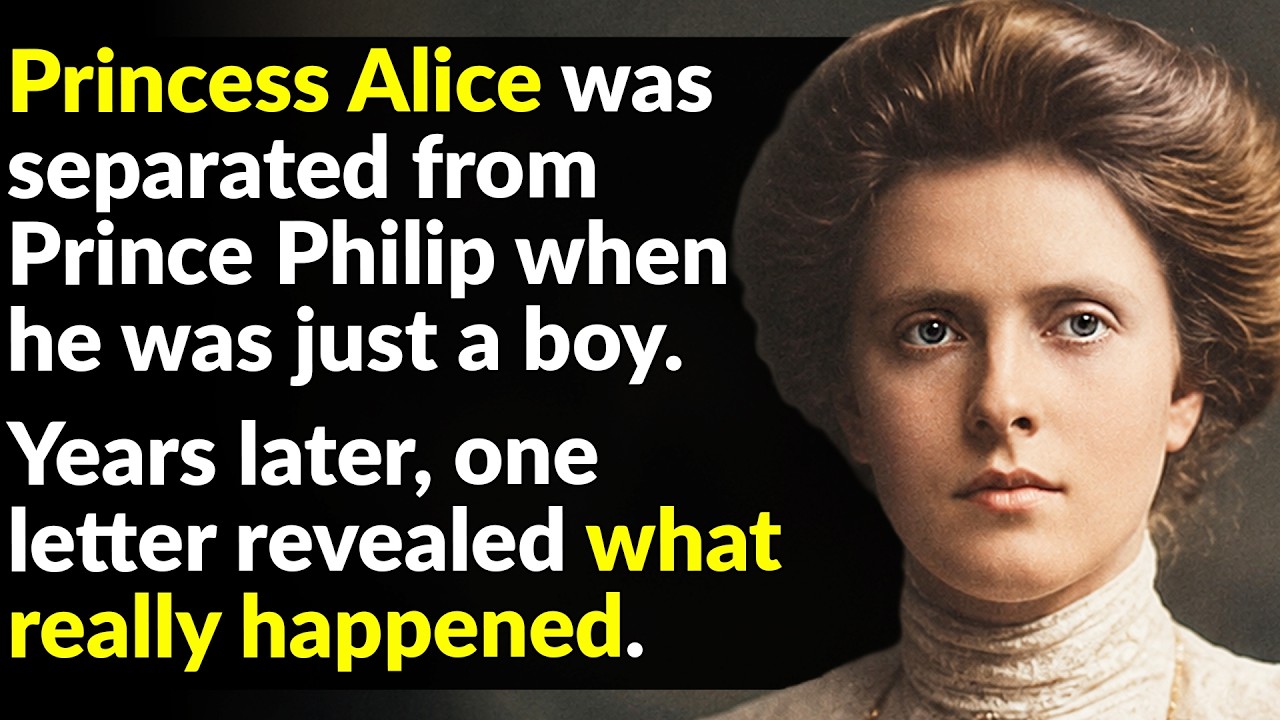
She looked him in the eye and said, “You can take your troops out of my country.” And if that response wasn’t courageous enough, she was also hiding a secret, one that would mean certain death if it got out. Years earlier, in 1913, a Jewish man named Haimaki Cohen was a close political ally and supporter of King George I of Greece during a time of great upheaval.
In return, the king promised that if he ever needed help, the monarchy would be there for him. By 1943, the king was long gone, but Cohen’s son still remembered the promise. With no other options, he ventured to the palace where he appealed to Princess Alice. She took in the Cohen family and hid them from the Germans for the rest of the war.
Later, Israel’s Holocaust Memorial Institution would declare her Righteous Among Nations for her efforts. She remained in Athens with the Cohens until 1944, when the Allies liberated the city. The liberation of Athens didn’t free the city from conflict. Though Axis forces fled, the fighting continued as communist guerrillas tried to wrest control of the capital from the British.
If anything, the city grew even more dangerous as the streets became a battleground. British forces begged Princess Alice to remain in shelter, but they didn’t know who they were dealing with. She openly walked the streets of the city distributing rations to children. One man tried to warn her that a stray bullet could strike her at any minute.
She replied, “They tell me that you don’t hear the shot that kills you, and in any case, I am deaf, so why worry?” Alice didn’t leave Athens until 1947. By then, her son Philip was finally getting married, and Alice had to meet the bride he chosen, the future Queen Elizabeth II. Princess Alice went from living off of meager war rations in Athens to sitting at a British royal wedding in the space of a few years.
She’d come a long way from begging for her freedom in a sanatorium. And now that the war was behind her, she could finally start living her life again. She never forgot about her meeting with her aunt, Elizabeth Fyodorovna, who spoke of founding a nursing order of nuns. Though Elizabeth died in the Bolshevik Revolution, Alice kept her spirit alive by realizing her dream.
She founded the Christian Sisterhood of Martha and Mary. In 1953, in one of the most extravagant gilded ceremonies in the world, Alice stood in a simple gray dress and wimple as she watched her daughter-in-law’s coronation. Afterwards, she returned to Greece. Though almost none of her family remained there and the monarchy was in tatters, Greece was her home until it wasn’t.
The 1967 colonels’ coup made it too dangerous for Alice to remain in Greece. She was a hero. She had royal blood, but the military dictatorship was a threat. Queen Elizabeth and Prince Philip invited her to live with them at Buckingham Palace. At this point, people in England whispered that Prince mother had gone senile, but that was mostly because of her appearance and her humble clothing.
Though incredibly frail and even deafer than ever before, Alice remained lucid until her final days. She died on December 5th, 1969 in Buckingham Palace. You would think that being a royal, Alice would have left a handsome will behind. In reality, she left no possessions at all. Charitable to a fault, she’d long since given everything away.
It was only after she died that the most heartbreaking details of her story emerged. After the people she trusted the most sent her to a sanatorium in 1930, Princess Alice scarcely saw anyone from her family for the rest of her life. Maybe she would have carried on like that if not for a tragedy that forced her to change her plans.
In 1937, her daughter Cecilie, her son-in-law, and two of her grandchildren lost their lives in a plane crash that shocked the world. Alice saw her husband, Prince Andrew, and her son, Prince Philip, for the first time in 6 years at her daughter’s funeral. Philip had been a boy when she’d seen him last, and now he was a strapping 16-year-old.
After their tearful reunion, Alice finally resumed contact with her family, though it was far too late to save her crumbling marriage. Prince Andrew succumbed to heart failure in Monaco in 1944. He’d barely seen Alice since he sent her off to the sanatorium in 1930. At the time of his death, Alice was in Athens helping the poor, but doing so was no walk in the park.
As the war went on, conditions in the city grew worse. Though Alice’s privilege protected her from the worst for a while, eventually she ended up in the muck with everyone else. When the allies liberated the city, a British statesman tracked her down. When he found her, he couldn’t believe his eyes.
Princess Alice, great granddaughter of Queen Victoria herself, was living in squalor. Her separation from her son Philip was a painful part of her history, and if one more thing had gone wrong for her during the war, it’s possible that they may have never reunited. Years later, Alice revealed to Philip in a letter just how dire things had really been for her in the final days of Germany’s occupation.
She went months without meat of any kind, and by the time the British arrived, she’d been living on nothing but bread and butter for weeks. The liberation came just in time. Princess Alice’s final wish was to be interred in Jerusalem at the Church of Mary Magdalene on the Mount of Olives. In 1988, she got her wish.
Thanks for watching History Xposed. If you love uncovering the best stories in history, hit like and subscribe to keep exploring with us. If you enjoyed this video, check out the others on screen for more amazing history content.