Slaughter at Eerde | September 1944 D
On the morning of the 24th of September 1944, 7 days into Operation Market Garden, the American paratroopers of the first battalion of the 501st Parachute Infantry Regiment of the 101st Airborne Division were subjected to a large-scale German attack at the town of Eid in the Netherlands.
Covered by artillery fire, the German attack commenced just before 0900 when approximately 200 German infantrymen supported by up to five Yak Panther tank destroyers deployed out from Shindle and advanced down the main road towards Eid. By 0940, the Germans had overwhelmed the forward American defensive line and were in position amongst sand dunes on the western outskirts of Eid where they regrouped and prepared to attack into the town itself.
The history of the 101st Airborne Division adds that the outpost platoon came rushing back with word that the town was about to be attacked by five tanks and 200 infantrymen coming down from Shindle. By the time Lieutenant Colonel Harry Kard, the first battalion’s commanding officer, got the report, the enemy was in the dunes, looking down the throats of his men.
On learning of the German attack, Lieutenant Colonel Harry Kinard sent a message to divisional headquarters requesting for immediate reinforcements. This was soon granted and at around 0950, nine British Sherman tanks from a squadron of the 44th Royal Tank Regiment were ordered to move as soon as possible to Eid and bolster the American defenses.
The war diary for the 44th Royal Tank Regiment records 0950 A squadron received orders to move to Eid and arranged for the defense of Eid as it appeared that the enemy were attacking in this area. Leaving Veagel, A Squadron arrived on the northern outskirts of Eid at around 10:15 from where it observed two of the German Yak Panthers moving into position near a train station just outside of the town.
Using their attached artillery observation officer, the squadron called down an artillery bombardment onto the two tanks in the hopes of forcing them to withdraw. However, this bombardment failed to have its desired effect and the two Yak Panthers remained in their positions. Following this, a squadron split up into two groups.
One of which consisting of six tanks took up firing positions covering the northwestern approaches to Eid, whilst the other made up of the remaining three tanks deployed into the town itself and made contact with the US paratroopers. Commanding this second group was Lieutenant Wallace Hooper, who positioned his Sherman tank along the main road on the town’s western edge.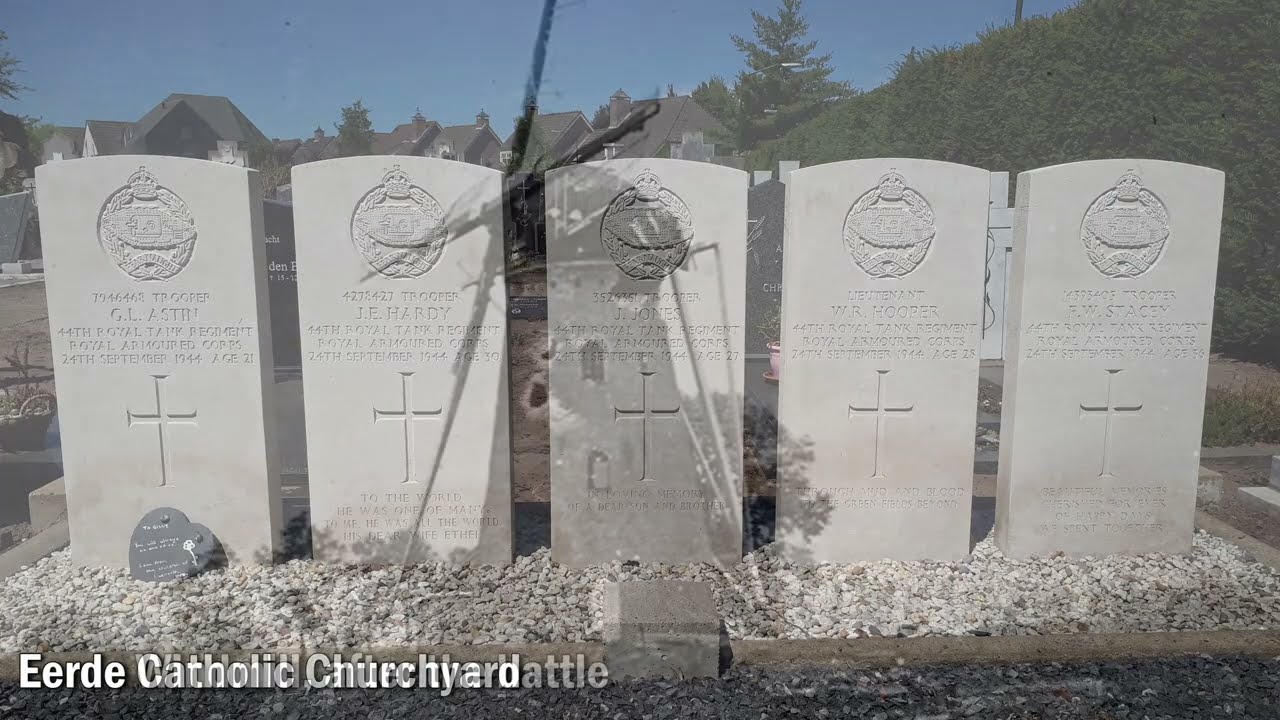
The other two Shermans in the meantime took a position close by, including one which cited itself behind a windmill. From these positions, the British tanks provided close fire support to the American paratroopers who successfully halted the German advance and began preparing to launch a counterattack to retake the ground they had lost.
Most notably, the area of the sand dunes. The history of the 101st Airborne continues. Fighting all along the line was close and heavy. Feeling that the dunes were the crucial terrain feature of the area, Colonel Kinard concentrated on cleaning them out. His first attack plans hinged on the Sherman tanks. Accordingly, at around 1100, Latutenant Wallace Hooper was approached by an American officer named Captain Robert Phillips, who informed the British left tenant of the American plans and requested that his free Shermans attack into the sand dunes in support to the paratroopers. Peering out from his turret, Lieutenant Hooper quickly rejected this proposal, pointing out that not only were the sand dunes unsuitable for armored warfare, but that the area was very open and known to be covered by Yag Panthers. For the next few minutes, the two officers argued back and forth in the matter until suddenly at 11:03, an explosion went off as an armored-piercing round struck
Lieutenant Hooper’s tank. Historian Carol Margar explains that one of the Yag Panthers cut loose from the sand dunes and hit the tank. The armor-piercing shell going straight through and setting the tank on fire. Left tenant Hooper was blown from the turret and fell on the ground, horribly wounded in the groin and with one leg almost off at the hip.
Despite his injuries, he yelled to the paratroopers, dragging him to safety, “Save my men. Get them out. They’ll burn to death.” Tragically, despite being pulled to safety and given immediate medical treatment, Latutenant Wallace Hooper succumbed to his wounds at midday on the 24th of September, 1944. Just 2 minutes after Lieutenant Hooper’s tank was hit, a second round fired from one of the A Panthers struck the Sherman positioned behind the windmill, and set the tank ablaze.
In the driver’s seat to this Sherman was 21-year-old Trooper Gilbert Aston, who was killed instantly by the blast. Then at 11:09, the third Sherman was also hit and destroyed. Thus, within just 6 minutes, all three Sherman tanks have been knocked out. Of the 15 crewmen, nine managed to bail out from the tanks and get to safety, although each one suffered varying degrees of wounds.
Of the remaining six, five were killed in action and are now laid to rest in the Eid Catholic Churchyard. The sixth crewman, 21-year-old trooper John Anderson, was labeled as missing in action, presumed killed, and he is today commemorated on the Grusbee Memorial, and has no known grave. Following the loss of the three Sherman tanks, news of the engagement filtered through to the remainder of A squadron, which not willing to suffer any additional casualties pulled back from the front line and consolidated into a tight-knit formation on the northern edge of Eid with a unit’s war diary noting that 11:15 A squadron drawing in slightly to the village of Eid to form a tighter ring. 1211 A squadron report American infantry with them are beginning to move slowly forward. When the infantry report the railway is clear, then a squadron will advance and assist. Without armored support, the US paratroopers of the first battalion of
the 501st parachute infantry regiment launched their attack to retake the sand dunes at 12:15 on the 24th of September. Supported by artillery fire, the paratroopers immediately became embroiled in heavy fighting that at times developed into close quarter hand-to-hand combat. Present with the first battalion that day was Lieutenant Colonel Lawrence Cachel who recalled after the war.
The paratroopers were beyond control. In twos and threes they jumped on the Germans in the foxholes clubbing them shooting them at point blank crange diving from the next position. I saw them in twos and threes jump into machine gun nests. I saw some of our men go individually at foxholes containing two or three Germans.
It was courage such as I’d never imagined possible. almost foolish courage and I doubt if any group of men could have held their ground against it. By evening on the 24th of September 1944, the first battalion had retaken the sand dunes and driven the Germans away from the western edge of Eid. The American paratroopers then dug in for the night with enemy activity in the area limited to the occasional artillery and mortar shelling.
Meanwhile, with night falling and the railway line still in enemy hands, the Shermans of A squadron remained in their positions behind the front line with the units war diary concluding 1830. It was then too dark for A squadron to participate in any operations. Accordingly, A squadron withdrew to form Close Liga in the village of Eid.