The American Trick That Made M36 Jacksons Deadly Against Heavy German Tanks in Just Minutes D
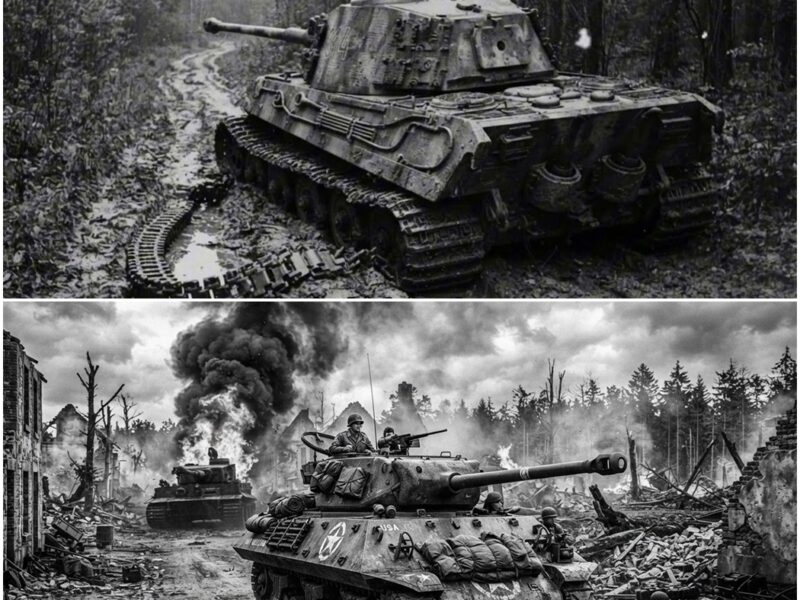
December 23rd, 1944, near Verdenne, Belgium. Temperature, 12° F, visibility, less than 400 yd through falling snow. A single M36 Jackson tank destroyer, its open-top turret caked in frost, sits idling behind a shattered farmhouse. Ahead, through the tree line, a King Tiger, 69 tons of German steel, 185 mm of sloped frontal armor, grinds forward at 8 mph.
On paper, this shouldn’t have been a fight at all. The Jackson’s hull armor was barely an inch thick in places. Its turret had no roof. Its 90-mm gun, by the manufacturer’s own numbers, couldn’t punch through a Tiger’s glacis plate at any range that mattered. Standard military thinking said this encounter should end with a smoking American wreck and a German tank rolling on unscathed.
It didn’t happen that way. Within minutes, the Tiger was burning. This is the story of how American tank destroyer crews turned a machine built on compromise into a killer of the heaviest armor Germany ever fielded. Not by beating German engineering at its own game, but by refusing to play that game at all.
By late 1944, German tank doctrine was built on a simple premise: armor and gun caliber win engagements. The Tiger I carried 120 mm of frontal armor and an 88-mm KwK 36 gun. The King Tiger introduced that autumn up to this 250-185 mm of sloped steel and the fearsome 88-mm KwK 43 L/71, a gun capable of killing an M4 Sherman at over 2,000 yd.
German commanders and American ordnance officers alike ran the numbers on the M36 Jackson and reached the same grim conclusion. The M36’s 90-mm M3 gun, firing standard M82 armor-piercing shells, could penetrate roughly 120 mm of vertical armor at 1,000 yd. Against a King Tiger’s sloped frontal plate, that dropped effectively lower.
The slope alone added the equivalent of dozens of millimeters. Critics in the US Army’s own ordnance department had argued for years that American tank destroyers were under gunned. They were right about the raw math. A frontal duel at range, gun for gun, armor for armor, favored the German tank almost every time.
The secret wasn’t in the gun’s raw penetration figure. It was in what the army did with ammunition, mobility, and crew procedure once it accepted it couldn’t win the armor race. Late 1944, American ordnance depots began distributing the T30E16 high velocity armor piercing round, HVAP, for the 90 mm gun. Unlike standard AP shot, HVAP used a tungsten carbide core wrapped in a lightweight aluminum body driven to a muzzle velocity near 3,350 ft per second, several hundred feet per second faster than standard rounds. At 500 yd, HVAP could penetrate roughly 230 mm of armor, enough to defeat a King Tiger’s front plate, comfortably enough to punch through the thinner 80 mm side armor of any Panther or Tiger I at almost any combat range. The catch, HVAP was scarce. Many crews received only two or three rounds per vehicle per week in late 1944, so the gun alone wasn’t the whole answer. The real trick was tactical, and it came from the vehicle’s other traits.
The M36 rode on the M10 chassis, mechanically related to the M4 Sherman, giving it a top speed near 26 mph and a power to weight ratio the King Tiger, hobbled by chronic transmission failures and a 700 horsepower engine hauling nearly 70 tons, simply couldn’t match. German heavies broke down constantly.
Engine fires, stripped final drives, transmissions that failed after 50 mi of road march were common complaints in German unit logs from the Ardennes campaign. American tank destroyer battalions exploited this directly. Rather than meeting German armor head-on, M36 crews used speed and open turret visibility.
The same open top that made them vulnerable to shrapnel and tree bursts also gave commanders a 360° unobstructed view to reposition faster than the enemy could traverse a turret or reorient a hull. The doctrine, refined through 1944, was blunt. Never fight where the German gun is strongest.
Flank, wait, strike the side or rear where 80 mm armor, not 150 or 185, was the target. It seemed like a compromise forced by weakness. To the crews using it, it was simply how you killed something you couldn’t out-armor. If you’re finding this deep dive into World War II armor tactics interesting, consider subscribing.
The 703rd Tank Destroyer Battalion, attached to the 82nd Airborne Division, engaged elements of Kampfgruppe Peiper’s column near Stoumont and later Cheneux in the third week of December 1944. Battalion after-action reports from that period describe M36 and M10 crews repeatedly declining head-on engagement with Tiger I and Panther columns moving along constrained road networks.
The same narrow, muddy Ardennes lanes that left German heavies with almost no room to maneuver off-road. Instead, destroyer crews used the terrain the Germans depended on against them. Panthers and Tigers, road-bound by weight and mechanical fragility, couldn’t easily flank into open fields without risking a thrown track or bogged hull.
American crews used this predictability. They’d let a column commit to a road, then engage from angled positions where a single well-placed 90-mm round into a side hull or turret ring could immobilize or kill a tank that no frontal shot would have touched. Near La Gleize on December 24th, elements of Kampfgruppe Peiper lost several King Tigers and Panthers not to dramatic frontal duels, but to a combination of fuel exhaustion, mechanical breakdown, and flanking engagements by American tank destroyers and infantry anti-tank teams working in tandem. Several vehicles were abandoned intact by their crews rather than lost outright in combat. A detailed German logistics reports from the campaign confirmed repeatedly fuel shortages and breakdowns claimed as many heavy tanks in the Ardennes as American guns did. Where M36s did engage directly, the numbers tell the story. Ordnance survey teams examining knocked-out German armor in the Ardennes sector through January 1945 found that a disproportionate share of penetrating hits on Panthers and Tigers struck the side hull, turret side, or rear deck,
not the frontal glasses. This wasn’t because American gunners preferred those shots, it was because those were the only shots the 90-mm gun could reliably win. And crews trained relentlessly to maneuver into position for them before firing at all. This wasn’t accidental improvisation dressed up afterward as doctrine.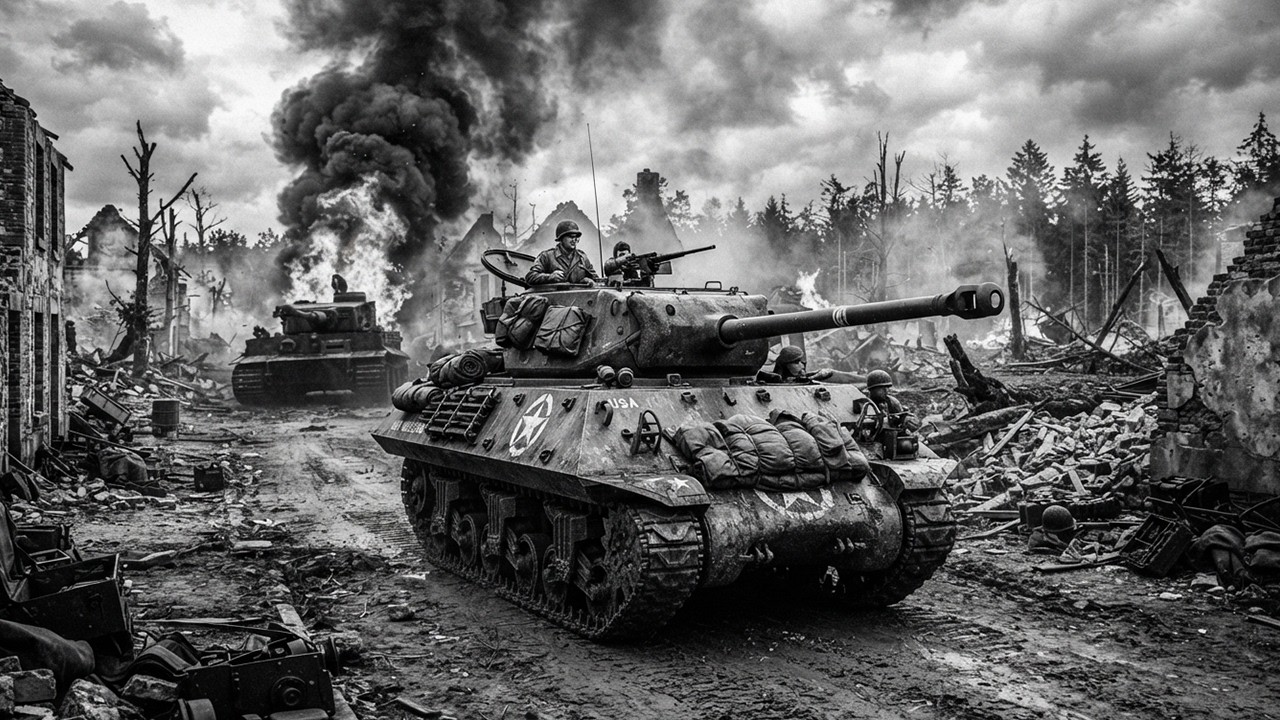
American tank destroyer command, going back to the formation of the doctrine in 1941 under Lieutenant General Leslie McNair, had built the entire tank destroyer concept around the idea that these vehicles were not meant to slug it out with enemy armor in prepared static positions. They were meant to react, reposition, and strike from the flank, hit, and displace before the enemy could bring its heavier gun to bear.
What looked good on a testing range, German armor thickness, German gun penetration tables, clean numbers under ideal conditions, broke down in the mud, cold, and chaos of actual combat. A King Tiger’s frontal armor meant nothing if the vehicle sat stalled with a thrown track on a forest road exposed on its flank to a tank destroyer it never saw coming.
The M36’s thin armor meant less when the vehicle’s job was never to stand and absorb a hit in the first place, but to shoot and reposition within seconds. Commanders pushing this doctrine weren’t clinging to an inferior tool out of necessity alone. They’d concluded correctly that mobility and crew discipline could substitute for armor that American industry, focused on producing thousands of vehicles rather than perfecting a handful of heavy designs, was never going to match plate for plate. The M36 entered service in September 1944 specifically because earlier tank destroyers armed with 76-mm guns had already proven too weak against German heavies at Normandy. The 90-mm gun was a stopgap improvement bought with speed as its true partner, not its replacement. Battlefields aren’t gunnery ranges, they’re a mess of frozen roads, breakdowns, fuel shortages, poor visibility, and split-second decisions. In that mess, a fast, well-positioned tank destroyer with a crew trained to find the one angle that mattered was worth more than raw frontal armor thickness ever was.
German heavy tank crews, for all their vehicles individual superiority, were fighting a war of attrition against a doctrine built specifically to avoid the fight they were best suited for. By the war’s final months, US Army assessments of Ardennes engagements increasingly noted that the kill ratio question, Tiger versus Sherman, Tiger versus Jackson, gun for gun, was the wrong question.
The right one was which side controlled when and where the fight actually happened. American tank destroyer crews using speed, HVAP ammunition when they had it, and unglamorous flanking patience answered that question in their favor again and again through the winter of 1944 and into 1945.
The M36 Jackson was never going to out-armor a King Tiger. It didn’t need to. It needed 5 minutes of positioning, one clean shot at 80 mm of steel instead of 145, and a crew willing to wait for it. If you found this video insightful, it explores how American crews turned a technically out-gunned tank destroyer into a lethal weapon against Germany’s heaviest armor through speed, ammunition innovation, and flanking doctrine rather than raw firepower.
Like this video, subscribe, and hit the bell for more. Thanks for watching.