The ‘Crude’ Bush War Truck That Became the Blueprint for Every NATO Soldier Alive Today D
November the 16th, 1973. A dirt road in northern South-West Africa, close to the Angolan border. A heavy vehicle rolls forward through the red dust. It is bulky, angular, and strange-looking. Its underside tapers to a sharp angle, like the keel of a boat turned upside down. The men inside it are not soldiers.
They are researchers from the Council for Scientific and Industrial Research in Pretoria, and they are here to watch something explode. Buried under the road ahead is 21 kg of TNT. That is roughly equivalent to two Soviet TM-57 anti-tank mines stacked together. It is enough explosive to flip an armored car, shred a truck chassis, and kill everyone inside without mercy.
The vehicle drives over it. The blast tears into the road. Dirt and debris erupt in every direction. The vehicle heaves violently. Components rip away from the axles. Smoke boils upward. Then the dust settles. The two men inside climb out. One has a small cut on his arm. The other has a ringing in his ears. That was it.
Two men, one exploded mine, no deaths. That single test on a dirt road in a forgotten war most of the world never heard of, changed military vehicle design forever. It gave birth to a concept that would eventually save thousands of British, American, and NATO soldiers in the wars of the 21st century.
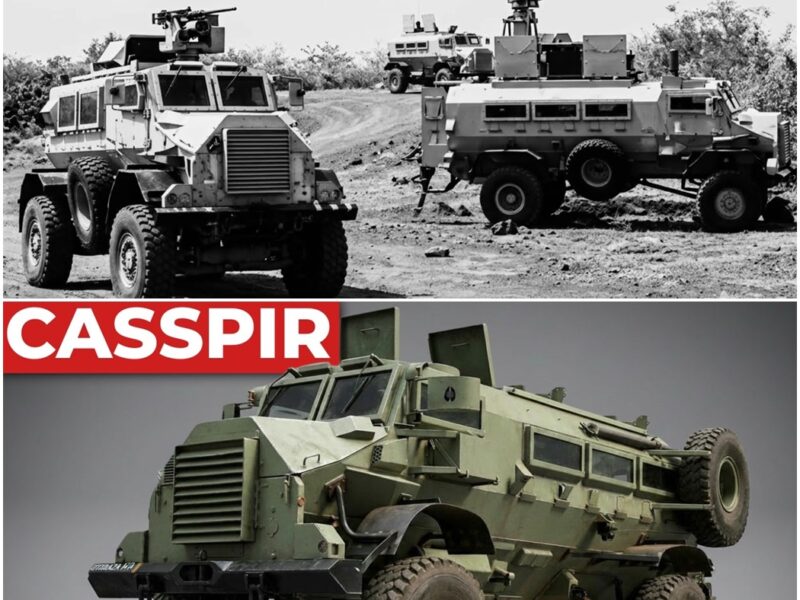
It would reshape the entire global defense industry, and it started here, in the red dust of southern Africa, built by a team of scientists under an arms embargo, working with truck parts and improvised metal, solving a problem that every other military on Earth had simply refused to think about. Its name was the Casspir, and it is the crude, angular, forgotten ancestor of every armored vehicle that protected soldiers from roadside bombs in Iraq and Afghanistan.
To understand why the Casspir existed, you need to understand the war that made it necessary. The South African Border War began on August 26th, 1966. It was a counterinsurgency conflict fought across the vast, flat, sun-baked terrain of South-West Africa, the territory now known as Namibia, and into southern Angola.
On one side stood the South African Defence Force and the South African Police. On the other stood PLAN, the People’s Liberation Army of Namibia, the armed wing of SWAPO. The conflict would grind on for more than two decades. It was brutal, isolated, and almost entirely invisible to the outside world. PLAN was supplied with weapons from the Soviet Union and its allies.
Among the most devastating of those weapons were landmines, specifically the TM-57 anti-tank mine, a Soviet-designed pressure-detonated device packed with a cast TNT charge weighing 7 kg. The insurgents buried them in sand roads, river crossings, and dry stream beds throughout Ovamboland in northern Namibia. A single mine could tear the wheel and axle off a standard military vehicle, detonate the fuel tank, and kill or maim everyone inside within fractions of a second.
In the early years of the conflict, South African convoys rolled through this terrain in standard military trucks with flat steel floors. The results were catastrophic. When a mine detonated under a flat floor, the blast energy had nowhere to go. It transferred directly upward through the floor, through the seats, through the spines of the men sitting inside.
The vehicle would stop. Men would die, and the insurgents would fade back into the bush, leaving only a crater in the road. By the early 1970s, South Africa had a mine crisis, and it was about to get worse. In 1977, the United Nations imposed a mandatory arms embargo on South Africa over the apartheid government’s policies.
South Africa was now completely cut off from foreign military equipment. It could not buy vehicles from Britain, the United States, or Germany. It could not import spare parts. It could not purchase foreign armor plate. If it was going to solve the mine problem, it was going to have to solve it alone. That constraint, brutal as it was, forced a breakthrough that the rest of the world would not catch up to for 30 years.
The man who made that breakthrough possible was Dr. Vernon Peregrine Joint of the CSIR. Joint was, by all accounts, an unusual figure. He had entered university at age 15 because, as one profile later recorded, he had always liked to blow things up. He had trained as a physicist and an engineer, and by the early 1970s, he was leading a small team at the CSIR’s Chemical Defense Unit in Pretoria, tasked with a single question.
Could a vehicle be built that would keep its occupants alive when a mine exploded underneath it? The answer that most militaries had tried was simple addition. Take a flat-bottomed vehicle, add thicker steel to the floor. The problem with that approach was fundamental. Blast energy does not care how thick your floor is if the floor is flat.
A flat surface couples directly with the shock wave, amplifying the upward force. The only way to break that coupling was to change the shape of the floor entirely. Joint and his team began with physics rather than tradition. If the underside of a vehicle was not flat, but angled, sharply angled, like the V-shaped prow of a ship, the blast energy would deflect outward to the sides rather than channeling straight up into the passenger compartment.
Combined with high ground clearance to give the fireball room to expand before it reached the hull, and with suspension components designed to break away cleanly rather than transfer energy upward, a vehicle could theoretically survive a detonation that would destroy anything built on flat-floor principles. The testing was improvised, empirical, and at times remarkable.
The team filled tires with water to test blast transfer. They hung sandbags inside prototype hulls to simulate occupants. They measured blast pressures with instruments they built themselves. And in one documented validation test, they strapped a sedated baboon into the driver’s seat of a prototype, drove it over a live mine, and watched the animal climb out afterward with only a cut lip.
If a baboon could survive, a soldier could survive. That test in November 1973, with the hyena prototype and its two uninjured researchers, confirmed the principle in the field. Dr. Joint and his team had cracked the problem. But what emerged from those years of testing was not the Casspir, not yet.
The first vehicles to apply Joint’s principles in real service were crude predecessors. The Hyena was followed by the Hippo, a blast-proof box hull on a Bedford RL truck chassis, which reached the South African police in the mid-1970s. Then came the Buffel, which used Joint’s V-shaped seating arrangement on a Unimog chassis and entered service in 1978.
The Buffel worked, it saved lives. Roughly 2,400 of them were eventually built, but the Buffel had real weaknesses. Its cab and troop compartment were separate, making coordination in a firefight difficult. Its open top left occupants exposed. Its Unimog chassis, never designed for the loads it was carrying, suffered under the punishment of border war terrain.
The next vehicle would have to be different, not a truck fitted with a protective tub, something designed from the ground up as a unified fighting machine. The first Casspir prototype, informally named Flossie by the development team, was delivered from the CSIR in 1978. It was built largely from Bedford truck components and it was rough, but its concept was sound.
The hull was a monocoque structure, meaning the armored body itself was the chassis. There was no separate frame underneath. The V-shaped floor was integral to the entire structure. The engine, transmission, and fuel tank were enclosed within the armored hull. The crew compartment and troop section were unified, giving a commander full situational awareness of his men.
The suspension arms were designed to shear away cleanly on detonation rather than driving metal shards upward into the hull. An improved prototype with a Mercedes-Benz drive line was ready by May 1979. After roughly 2 years of testing and refinement, the South African police placed its first production order in March 1980.
The production Casspir Mark II was powered by an ADE diesel engine, a locally built licensed version of the Mercedes-Benz OM 352, producing around 166 horsepower. It weighed approximately 12,500 kg combat loaded and it could carry two crew plus up to 10 fully equipped soldiers inside its armored hull.
Ground clearance was 410 mm, meaning more than 16 in between the road surface and the lowest point of the V-shaped floor. It could reach 90 km/h on a paved road and carry enough fuel to operate for 750 km without resupply. Its windows were 52 mm of bulletproof glass. Its hull was proof against 7.
62 mm rifle fire at close range, and it was certified to survive the detonation of a triple TM-57 mine under any wheel, 21 kg of TNT, without killing the occupants. Nothing in the Western world could do that. Nothing. The name Casspir was coined by a South African police administrator named Eddie Coromba in May 1979. It was an anagram combining the initials of the South African police and the CSIR, the two institutions whose collaboration had brought the vehicle into existence.
The unit that would make the Casspir famous was Koevoet, the Afrikaans word for crowbar, established by the South African police under Colonel Hans Dreyer. Koevoet was a dedicated counterinsurgency force operating in Ovamboland from 1979. Its tactics were built entirely around the Casspir. Each Koevoet team typically fielded four Casspirs, a Blessbok logistics vehicle, and a Duka fuel tanker, allowing it to operate independently for 5 to 7 days over 600 to 800 km.
Teams employed expert Ovambo trackers who followed insurgent spoor on foot while the Casspirs moved behind them. On contact, the drivers performed what they called the mall, the Afrikaans word for the whirlpool. All four vehicles drove through and around the contact simultaneously from different directions, creating a storm of crossing fire that was almost impossible to survive.
Insurgent groups that opened fire on a Koevoet team frequently found themselves driven over. The tempo was extraordinary. Koevoet teams averaged 200 engagements per year against groups ranging from five to 200 fighters. The fighting was relentless, close, and brutal, and the mines kept coming. PLAN laid them constantly.
Roads that had been clear one morning were mined by evening. Covert teams hit mines regularly, sometimes twice in the same week. Casspirs were detonated, damaged, and recovered. Axles were blown off. Wheels were destroyed, but the men inside kept walking away. The headline figure documented in the reference work Surviving the Ride by Steve Camp and Helmoed Heitman is one that should stop any military historian cold.
Over the 50 months between January 1978 and March 1988, across all South African mine protected vehicles, including the Buffel and the Casspir, only 33 soldiers and police officers died in 533 mine detonations. 90 of those detonations involved multiple mines detonating simultaneously.
533 mine strikes, 33 deaths. In a conventional military vehicle with a flat steel floor, 533 mine strikes would have been 533 potential mass casualty events. The Casspir and its predecessors did not eliminate death, but they changed the statistical reality of mine warfare in a way that was almost incomprehensible. The vehicle absorbed the punishment.
It broke. Its components failed by design, and the men inside survived to fight again. There is a human dimension to this record that numbers alone cannot capture. A covert tracker named Kamongo was involved in more than 50 firefights during his service. He survived five anti-personnel mine explosions.
He survived a POMZ shrapnel burst. He was inside a Casspir when an RPG rocket struck its hull directly. He was still fighting. Eventually, after years of service, he lost a leg to a mine, not in a Casspir, on foot in the bush. That is the nature of what the Casspir was. It could not protect men walking outside it.
But while they were inside it, they had a fighting chance that no military vehicle anywhere else in the world could offer them. It is necessary to acknowledge what else the Casspir became during this period. The same vehicle that protected covert trackers in Ovamboland was also deployed by the South African police in the townships during the apartheid government’s internal crackdown of the 1980s.
In Soweto, in the Eastern Cape, in communities across South Africa, the Casspir became a symbol of state violence against civilian populations. The United Nations condemned covert itself for human rights abuses. The apartheid era role of this vehicle is documented in the Apartheid Museum in Johannesburg, and it is part of the Casspir’s history.
The same design that saved lives in one context was used to suppress resistance in another. History is rarely simple. The Casspir is not simple. Now, if you’re finding value in this deep examination of military hardware and the wars that shaped it, hit subscribe. It costs nothing. It takes 1 second, and it helps the channel grow.
By the mid-1980s, South Africa had built more than 2,000 Casspirs and its support variants, including the Blesbok logistics freighter, the Duiker fuel tanker, the Gemsbok recovery vehicle, and an ambulance version. Engineers had made over 1,200 individual modifications to the design since production began. The vehicle had been tested in combat to a degree that no test range could replicate, but the world was not watching.
The Western world’s militaries had their own ideas about what armored vehicles should do. They should stop bullets, artillery fragments, and anti-tank weapons. The landmine was treated as a logistics problem, a threat to convoys in low-intensity conflicts, not something that warranted rethinking the fundamental geometry of a vehicle’s underside.
American Humvees had flat floors, British Land Rovers had flat floors, German armored cars had flat floors. The idea that the shape of the floor beneath a soldier’s feet was a life-or-death engineering decision had simply never penetrated mainstream Western military thinking. Then came Iraq.
The United States invaded Iraq in March 2003. Within months, insurgents had adapted to the reality of American military dominance in open combat and shifted to a weapon that did not care how many Apache helicopters or Abrams tanks the Americans had. They buried IEDs, improvised explosive devices, in roads, under culverts, inside dead animals, beneath piles of debris.
The blast directed upward through flat steel floors into the spines and legs and skulls of soldiers sitting inside. By 2005 and 2006, IEDs accounted for roughly 70% of all American and coalition killed and wounded in Iraq. The flat-bottomed up-armored Humvee, even with additional steel bolted to its underside, was proving catastrophically inadequate.
The Pentagon was watching soldiers die in vehicles that the South Africans had identified as fundamentally flawed in design terms 30 years earlier. The solution was sitting in South Africa. A team of American military officials and defense researchers flew to South Africa and watched a Casspir drive across a live minefield.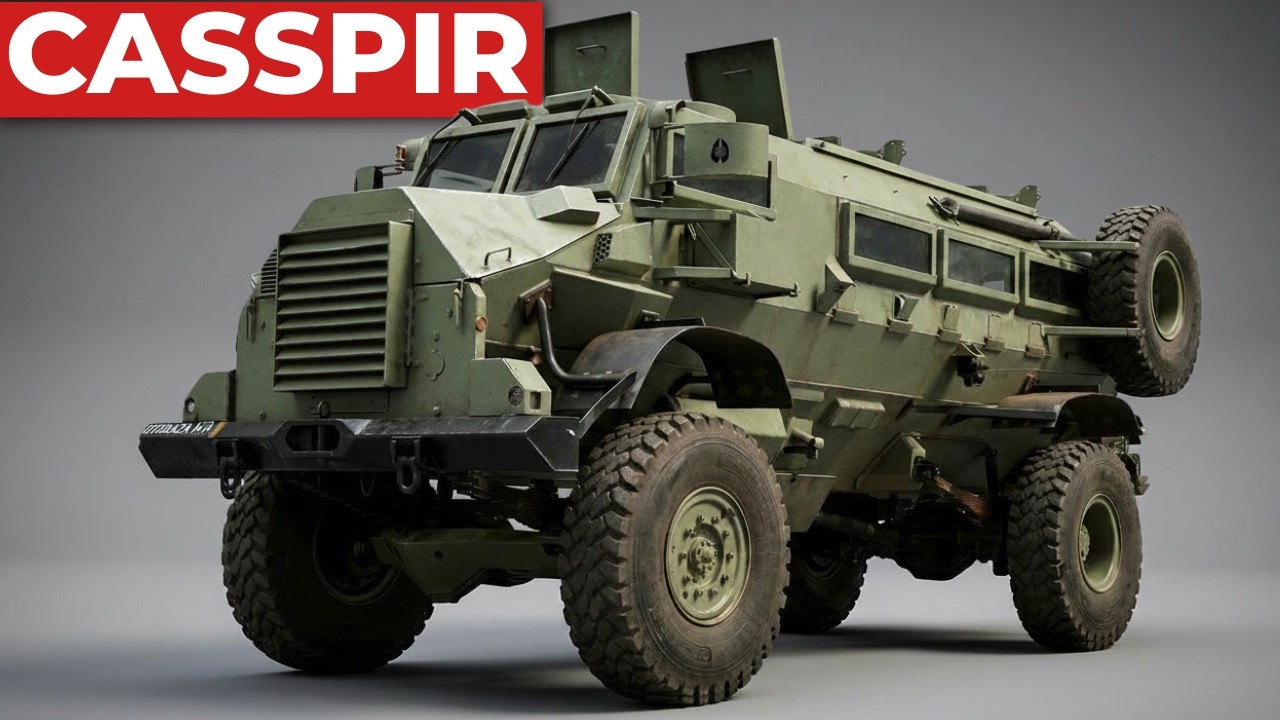
They saw with their own eyes what Dr. Vernon Joynt had proved in 1973. The shape of the floor was everything. What followed was one of the most direct transfers of an engineering concept from one war to another in modern defense history. Force Protection Incorporated, a defense company based in Ladson, South Carolina, had already been studying South African mine protection principles.
It had secured design input rooted in the South African MPV lineage and had produced two vehicles built on those principles, the Cougar and the Buffalo. But in 2004, Force Protection hired Dr. Vernon Joynt himself as its chief scientist and chief technology officer. The man who had designed the Casspir’s predecessor, who had overseen the V-hull principle from its first live test to mass production, was now working in South Carolina applying that same knowledge to vehicles that would go to Iraq and Afghanistan. The result was documented almost immediately. By the end of 2004, the United States Marine Corps reported that the Cougar had sustained more than 300 IED strikes in Iraq without a single fatality to its occupants. 300 strikes, no deaths. 533 mine detonations, 33 deaths. 300 IED strikes, no deaths. The mathematics of the V-hull first proven on a dirt road in Namibia in 1973 were producing the same results in the suburbs of Fallujah
and the roads of Al Anbar province three decades later. The Pentagon moved fast. In 2007, Defense Secretary Robert Gates made the mine resistant ambush protected vehicle, the MRAP, the single highest acquisition priority in the entire United States Department of Defense. Production lines were stood up simultaneously across seven manufacturers.
The familiar vehicles of that program, the Cougar, the Buffalo, the RG-31 Nyala, the RG-33, were all built on the same foundational principle that Dr. Jooste had first tested in South Africa. The RG-31 Nyala itself was a direct corporate descendant of the South African mine protection lineage built by Land Systems OMC in South Africa, the same company whose predecessors had manufactured the Casspir. Britain joined the program.
The United Kingdom took the six-wheeled Cougar airframe and fielded it as the Mastiff, modified by NP Aerospace. British soldiers in Helmand province and on the roads of central Iraq rode in a vehicle whose V-shaped floor was the direct engineering heir of the Casspir. The Mastiff served for years in theater before suffering its first IED fatality inside the vehicle.
The Ridgeback, a four-wheeled variant on the same principle, followed. The scale of what happened next is almost difficult to process. By October 1, 2012, when the Pentagon formally closed the MRAP production line, the United States military had fielded 27,740 mine resistant ambush protected vehicles.
The total program cost was $47.7 billion. Deputy Defense Secretary Ashton Carter, at the program’s retirement ceremony, described the MRAP as one of the most important vehicle acquisitions to come off a production line since World War II. The Joint Program Office for MRAP vehicles estimated that the vehicles had saved as many as 40,000 lives, 10,000 in Iraq and 30,000 in Afghanistan.
That figure has been challenged by some analysts who argued the methodology was too broad and that casualties would not have been that high had soldiers ridden in Humvees under the same conditions. The debate is real and it is honest to acknowledge it, but even the program’s harshest critics agreed that the vehicles had saved very large numbers of lives.
American combat data consistently showed that IED fatality rates inside MRAPs were between 9 and 14 times lower than inside up-armored Humvees. Marine General James Conway, serving in Al Anbar province, put it simply. He said he had yet to lose a Marine who was riding inside an MRAP. No one measured those soldiers’ lives in billions of dollars. The Pentagon paid $47.
7 billion for them anyway. And the concept that justified every dollar of that program, the V-shaped hull, the high ground clearance, the breakaway suspension, the monocoque armored body that is its own chassis, was first assembled in a workshop in Pretoria. It was first tested on a dirt road in Namibia.
It was first confirmed in combat by a police counterinsurgency unit fighting a war most of the world had forgotten. And it was first mass-produced in a factory in South Africa by a company that eventually became part of BAE Systems, which supplied it directly to the armies of the nations it would go on to protect. More than 2,800 Casspirs of all variants have been built.
The vehicle has served in more than 20 nations. India acquired roughly 255 reconditioned vehicles for counterinsurgency operations in Kashmir. Germany donated 29 to Mali for peacekeeping. The United Nations operated them across Central Africa and the Horn of Africa. The current production model, the Casspir NG 2000, is still built today by Denel Mechem, the direct institutional descendant of Dr.
Jooste’s original CSIR team. Preserved Casspirs sit in the South African Police Museum in Pretoria and in the Apartheid Museum in Johannesburg, each representing a different and genuine chapter of the same vehicle’s history. Return for a moment to that dirt road in northern Namibia, November 1973. The dust still settling.
Two men climbing out of a shattered hull with nothing worse than a cut arm and a ringing in their ears. The blast had torn the vehicle apart beneath them. The frame was gone. The axle was gone. The tires were gone. But the floor had held. The angle had worked. The shockwave had run outward instead of upward.
And the two men inside had lived because of a geometric decision made by a physicist in Pretoria who had looked at a landmine problem and decided to think about it differently. The Casspir was not elegant. It was not beautiful. Other vehicles of its era were faster, more sophisticated, and more aesthetically refined. The Casspir looked crude. It looked agricultural.
It looked like something assembled in a workshop from parts that were never designed for it. Because for the first prototype, that is exactly what it was. But it worked. On the mine roads of Namibia, it worked. In the townships of the apartheid state, it was used for purposes its designers had not intended.
In the sand of Ovamboland, after 533 detonations, it had saved life after life after life. And three decades later, on the roads of Iraq and Afghanistan, its grandchildren were doing the same thing. 27,740 vehicles, $47.7 billion. An uncountable number of soldiers who drove home from wars in the Middle East because the floor beneath their feet was shaped like the keel of a boat, an idea first proven on a dirt road in Africa by a scientist who liked to blow things up, building the answer to a problem the rest of the world had not yet thought to ask. That is not coincidence. That is not luck. That is what happens when a country with no allies, no foreign weapons, and no other option forces itself to solve a problem that everyone else was too comfortable to face.