The Dark Reason German Soldiers Feared the British Churchill Crocodile D
Dawn, 7th of June, 1944. A field south of Crepul, Normandy. Lieutenant Sherman is asleep in his tank. Two Churchill Crocodiles harbored overnight with a squadron of Westminster Dragoons Flail tanks. Guns, lorries, signals equipment, a whole slice of Second Army parked in the open waiting for daylight.
Then the wood behind them opens fire. A German battery hidden a few hundred yards to the rear had sat there all night. Nobody had known it. The Flail tanks, thin-skinned and unarmed against artillery, pull back under covering fire. Sherman gathers whoever is standing nearby, gunners, signalers, a handful of Royal Artillery and Royal Signals men, and turns them into infantry.
Two tanks, a scratch platoon assembled out of men who were never trained to be one. One wood full of Germans who do not yet know what is about to happen to them. The Crocodiles flame the pillbox. The Crabs work the dugouts with high explosive and machine gun fire. A hundred Germans walk out and surrender. Five guns go with them.
Every weapon answers a problem, and the Crocodiles problem had a name. The British Army’s repeated failure to break a fortified position without paying for every yard of it in infantry dead. That failure had a name, Dieppe, August 1942. Canadian and British troops went ashore against concrete strongpoints that neither small arms nor light armor could touch, and the raid collapsed at the water’s edge.
Among the improvised answers tried that morning was the Churchill Oake, a rushed flame conversion designed by Major J.M. Oake of the Royal Tank Regiment. Three Churchill Mark II’s code named bull, boar, and beetle each carrying a hull mounted flame projector fed from an internal fuel tank behind the driver.
All three were lost before they achieved anything, but the idea they represented did not die with them. The petroleum warfare department had already been working on something better since early in the war. A gas pressure flame system tested through 1942 on Valentine tanks that used thickened fuel to throw a jet of flame far beyond anything a man could carry on his back.
In August 1942, the war office actually canceled tank mounted flame development outright. The official judgment was that a tank was too vulnerable at flame range to be worth the risk and the job should stay with man packed throwers and flame fitted universal carriers, vehicles like the wasp. The petroleum warfare department kept refining the fuel mixture and the trailer system regardless without an official program behind it.
The turning point came in 1943 when Major General Percy Hobart watched the system demonstrated and put his own authority behind the Ministry of Supply to get it into production for the coming invasion. Hobart wanted specialized armor built around single well understood battlefield problems rather than general purpose tanks asked to do everything badly.
The flame tank became one of Hobart’s funnies gathered with mine clearing flails and bridge laying tanks under the new 79th armored division. Before the Churchill was chosen, other chassis had already been tried and found wanting. The Cockatrice and Basilisk mounted flame equipment on armored lorries too thinly protected to survive the fire they were meant to draw.
The wasp, a flame fitted universal carrier, worked well enough at short range but carried no gun and precious little armor of its own. Useful against a trench line, useless against anything with a machine gun sighted to cover open ground. The Department of Tank Design settled on the Churchill precisely because it was already the infantry tank the Valentine had been retired to make way for.
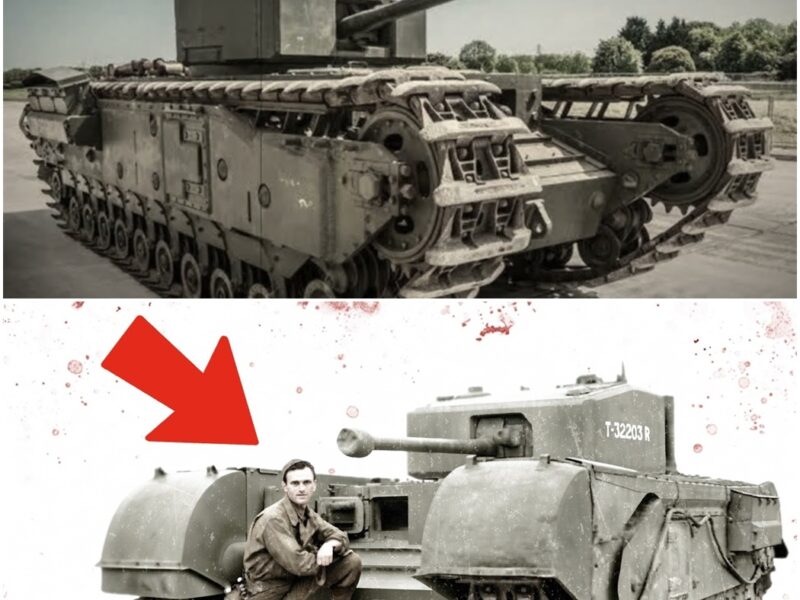
Slow, heavily armored, built to survive close to the enemy rather than maneuver away from him. That was the one quality none of the earlier flame vehicles had possessed. What emerged from all that was the Churchill Mark VII, chassis designation A22F, in production from October 1943. It kept its fighting capability largely intact.
A 75-mm gun with its coaxial 7.92-mm BESA machine gun, up to 152-mm of frontal armor, a five-man crew. Some earlier conversions built on the Churchill Mark IV carried the older six-pounder gun instead, but the principle held regardless of mark. Whatever main armament the tank carried before conversion, it kept carrying afterward.
What changed was the hull machine gun. In its place went a flame projector fed through an armored pipe running beneath the hull to a jettisonable trailer towed behind. That trailer carried roughly 1,800 L of thickened fuel and its own compressed gas propellant, enough for around 81-second bursts at a range the trials reports put between 80 and 120 yd.
800 conversion kits were built in total. 250 of them were held back in reserve, earmarked for a war against Japan that everyone still assumed would be running long after Germany was finished. The kits were designed so that REME workshops could fit them to any Churchill Mark VII in the field. In practice, almost none were converted that way.
It made more sense to build dedicated regiments trained specifically on the flame system than to hand an untrained crew a weapon this specialized and hope for the best. The Germans already had a flamethrower. They’d built a decade of doctrine around it, and that doctrine was not foolish. The Flammenwerfer 35 and the lighter Flammenwerfer 41 that replaced it from 1941 onward were man-portable weapons carried by specialist assault pioneers, Sturm Pioneer, trained to work with a dedicated rifle escort. The weapon held around 12 L of fuel, enough for perhaps 10 seconds of continuous fire delivered in short bursts at an effective range of 25 to 35 m. German doctrine treated this correctly for what it was, a weapon that short-ranged had to rely on surprise, speed, and covering fire. So, operators worked in close
coordination with infantry who protected them for the last stretch of the approach. It had worked against French and Dutch fortifications in 1940. It kept working through the house-to-house fighting at Stalingrad in 1942 and 1943. The doctrine was rational because it was built to match the exact limitations of the weapon it governed.
Get close, burn fast, and hope the covering fire holds long enough to get the man out again. German static defenses across northern France were laid out on the same logic in reverse. A bunker’s machine gun arcs were sighted to cover the ground any flamethrower attack would have to cross because everyone on both sides understood that flame meant a man walking into range on foot protected by nothing but supporting fire and timing.
Kill him before he reaches 30 m and the flame threat dies with him. It was a defense built for a weapon carried by a rifleman because until 1944, that was the only kind of flame weapon either army had fielded in numbers. At La Cambe Year on the 6th of June, that assumption held for exactly as long as the crocodiles hadn’t yet fired.
Lieutenant Sherman’s two tanks put two rounds of 75 mm and a few bursts of Besa into a German gun crew near the village, and 12 men surrendered without a flame shot being used at all. Proof, if anyone still needed it, that the mere presence of the weapon was already doing work the Germans own doctrine had never had to plan against.
At Sammoville, on the 26th the assumption was tested properly. Captain G.H. Strachan’s 4 and 5 troops, 141st Regiment Royal Armoured Corps, supported the 6th Royal Scots Fusiliers in clearing the village house by house. The crocodiles worked through the streets flaming buildings one at a time, burning through the night, while a single fortified courtyard at map reference 933687 held out only because the ground allowed just one tank at a time to reach it.
Nobody had to walk anywhere for that fire to arrive. The men delivering it never left armor plate a German machine gunner could reach with anything he was carrying. That was the wound. The flame itself was no worse than what the Wehrmacht already understood and had built its bunkers to survive. What had changed was the man carrying it.
He had simply stopped being a target. The Germans understood exactly how much a rifleman’s exposure mattered because their own Sturmpioniere paid for it constantly. A man carrying a Flammenwerfer 41 was recognizable at a glance. The tanks strapped to his back, the wand in his hands, the awkward gait of 80 lb of fuel and pressure cylinders.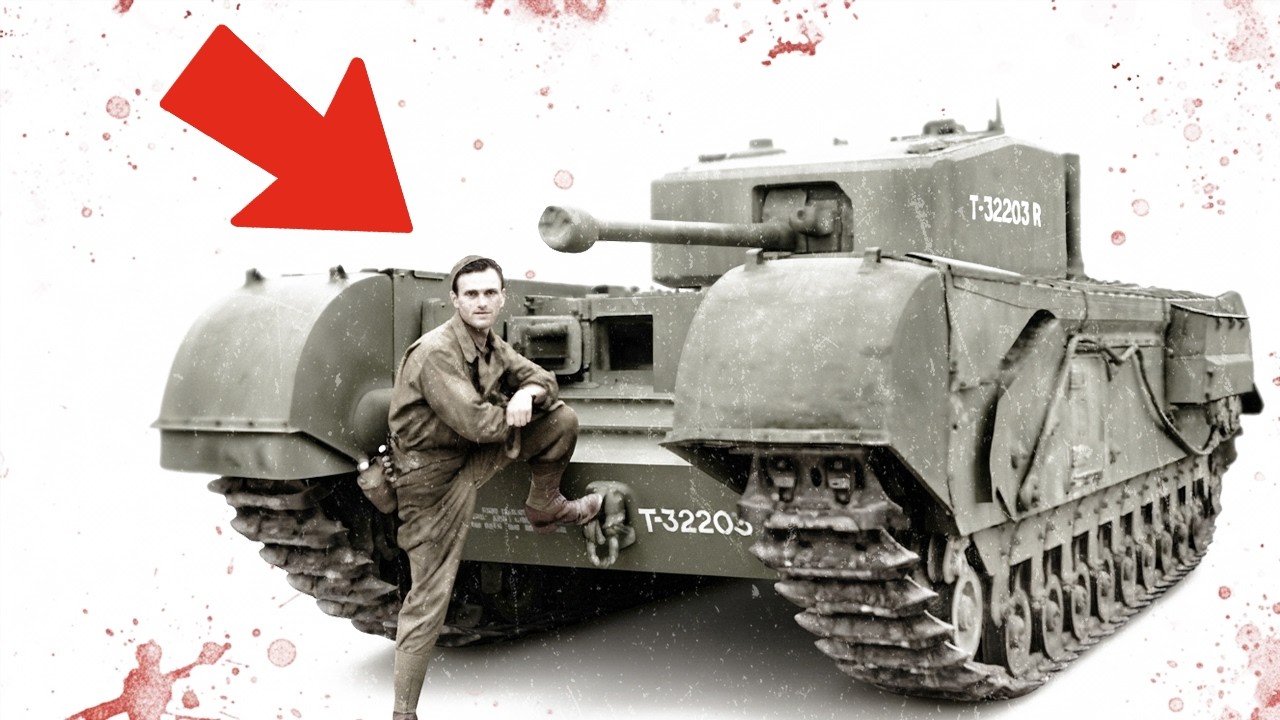
Some crews painted the equipment to resemble an ordinary pack and rifle, hoping to buy an extra few seconds before an enemy rifleman worked out what he was looking at. It rarely bought much. Flame operators on both sides of the war were prioritized targets the instant they were identified, precisely because the doctrine governing their use assumed, correctly, that killing the operator was the only reliable way to stop the weapon.
The entire German theory of flame combat rested on that trade. Enormous danger to one man in exchange for a weapon capable of clearing what small arms alone could not. Here is the dark reason. German defensive doctrine had never been built to defeat flame at real standoff range because nothing delivering flame at that range had ever been thrown against it in numbers.
Germany had its own tank-mounted flame vehicles, Flammpanzer conversions on the Panzer II and Panzer III, but these still fought at ranges close to a man-portable throwers, and none combined that flame with armor, a retained main gun, and the fuel capacity the Crocodile carried behind it. Every flame weapon German infantry had actually faced, mounted or man-carried, still meant closing to somewhere near 30 m and exposing something, a man or a thin-skinned vehicle, to do it.
The architecture of a defended strongpoint, the sighting of the MG 42, the depth of the wire, the killing ground in front of the bunker mouth, assumed that whatever approached carrying fire would be stoppable well before it arrived close enough to use it. The Crocodile broke that architecture without needing to be a better flamethrower than the one the Germans already had.
It only needed to be an armored one. That same range advantage, three to four times beyond the distance German positions had ever been built to interdict a flame attack, did half the work. Its armor did the rest. Plate thick enough to shrug off the small arms and machine gun fire that would have killed a man carrying the Flammenwerfer 41 outright, so that fire simply struck the hull and did nothing at all.
The 75-mm gun meant the tank could keep fighting throughout. There was no rifleman standing exposed in the open for a defender to shoot, and no 30-m gap in the ground where the old plan still worked. Because that plan had never accounted for a flame weapon that didn’t need to enter it. The dark reason the Crocodile terrified German infantry was not the fire itself.
It was the total sudden collapse of the one countermeasure their doctrine had ever relied on. The Wehrmacht never fielded a longer-ranged flame weapon of its own to answer it. What survives instead is a pattern reported across numerous wartime and postwar accounts of German troops treating captured Crocodile crews differently from a standard tank crew.
In the worst accounts, executing them on the spot rather than taking them prisoner. What is certain and is documented in the regimental record is the British Crocodile crews were paid an additional sixpence a day in recognition of the danger, and that the Ministry of Supply classed the mechanism itself as sufficiently secret that a Crocodile disabled beyond recovery was to be destroyed on the spot by demolition charge or by airstrike if nothing else could reach it, rather than risk it falling into German hands intact. Whatever the truth of the executions, the danger money and the destruction orders point at the same thing. An army with no technical answer to a weapon it could not outrange. And a defending force that seems in places to have treated using it as something other than ordinary war. That is what institutional failure looks like once the drawing board has nothing left to offer. The official record of the weapon’s effect survives in a wartime analysis
covering 31 Crocodile actions between June and October 1944. Enemy dead attributed directly to flame across those actions. 154 enemy soldiers who surrendered rather than face it. 5,425 35 men persuaded to give up for every one the flame itself killed. The report’s own conclusion was blunt about where the weapon’s value actually lay.
In the collapse of enemy resistance the mere threat of it produced and the British casualties far more than in the killing itself. That ratio held as the campaign moved beyond Normandy’s hedgerows. At Le Havre in September 1944 during Operation Astonia Crocodiles worked alongside the rest of the 79th Armoured Division against the garrison Hitler had personally ordered held to the last man.
The port fell in 3 days. 11,300 German troops went into captivity rather than test that order against the tanks now approaching their strong points. At Fort Montbarey defending the approaches to Brest the garrison held out against repeated flame attacks for as long as they still had a working supply of gas masks.
A detail that says more about what they feared from the weapon than any surrender figure could. When the masks ran out so did the resistance. More than 60 prisoners came out of the fort. In October C Squadron supported the 53rd Welsh Division’s assault on s-Hertogenbosch in Holland. And by that point in the campaign German units facing the 79th Armoured Division had learned to identify a Crocodile at whatever range their optics allowed and to direct every available anti-tank round toward it first ahead of any other target on the field including tanks that could actually threaten their own armor at greater range. The same capability that broke German bunkers in 1944 was still being used for a very different purpose by the spring of 1945. When British forces liberated Bergen-Belsen, medical officers declared the camp’s original huts too infested with typhus-carrying lice to be safely
occupied by anyone, survivors included. Crocodiles and flame fitted Universal Carriers were brought in to burn the empty huts to the ground, hut by hut, as a public health measure rather than a combat one. It is a strange final entry in the record of a weapon designed to break Atlantic Wall concrete.
A reminder that the range and control which made it terrifying to a defended bunker also made it usable, carefully and deliberately, in a context that had nothing to do with the enemy at all. That reallocation of fire is the arithmetic of fear working in both directions. The tank that could not be stopped at the range German doctrine expected became the tank every German gun crew was told to find and kill first.
The clearest sign that the only countermeasure left was a standing order, not a doctrinal fix. Spend armor-piercing ammunition, their scarcest resource, disproportionately on one vehicle type wherever it appeared. The Germans had adapted the only way still open to them by accepting that the range problem could no longer be solved and reallocating their firepower around that fact.
Some German officers, according to accounts collected by the Allies after the fact, are said to have called the Crocodile un-British. An odd complaint from an army whose own flamethrower troops had done exactly this to French, Dutch, and Soviet fortifications for four straight years. What had actually changed their minds was simpler than any question of fairness.
The Wehrmacht had spent a decade making its peace with the version of flame warfare it knew how to survive. And this one, it didn’t. A defensive doctrine is only ever as good as the assumptions built into it. And every assumption has a range attached to it, whether the men who wrote the field manual ever bothered to state it or not.
The German army had spent the better part of a decade teaching its soldiers exactly how far a man carrying a flamethrower could get before he had to be killed. Nobody in that training program had ever needed to teach them what to do when the flamethrower stopped needing a man to carry it at all. Because until the summer of 1944, that possibility simply hadn’t existed for anyone to plan against.
That is the packing worth carrying away from a tank most people remember, if they remember it at all, as a curiosity. A Churchill towing a trailer of fuel across the Norman bocage. The weapons that break an army are rarely the ones that hit hardest. They’re the ones that quietly step outside the boundary the enemy spent years building an entire defense around.
Leaving that defense intact, correctly reasoned, and irrelevant to the fight in front of it. The Churchill Crocodile did not outfight the Wehrmacht’s flame doctrine. It simply stood outside its range, and there was nothing in 10 years of German field manuals that had prepared anyone for that. If you want the next weapon whose story worked the same way, subscribe and turn on notifications for Combat Unclassified.