The ‘Forgotten’ Gun Britain Helped Build That Three Nations Dug Out Of Storage For Ukraine D
April 2022, somewhere in Eastern Ukraine, a howitzer crew finishes a fire mission, then does something no Soviet-era gun in the country could do. The crew folds in the trails, presses a switch, and the howitzer drives itself out of the firing position under its own power. No tractor, no prime mover, just a flat-four Volkswagen engine in the carriage, pushing 9 tons of artillery into the tree line before the counter-battery rounds arrive.
That gun was designed 45 years earlier to kill Soviet tanks on the North German Plain. Britain led the program. West Germany and Italy built the components. The Royal Artillery accepted it into service in 1979, then Britain sold every single one of them. Today, three nations have dug into their storage depots and pushed this gun back into combat against the army it was originally built to stop.
None of them are using it the way the Cold War planners imagined. All of them are using it anyway. This is the story of the FH70, a weapon designed under British leadership, abandoned by the British Army, and now killing Russian armor through someone else’s hands. By the early 1960s, NATO’s medium artillery was a museum collection still in uniform.
The American M114 had entered service in 1942. The British 5.5-in medium gun had also entered service in 1942. Both were nearly 20 years old when the alliance began looking at what would come next. The problem was straightforward. Soviet armor doctrine assumed mass, hundreds of tanks moving through the Fulda Gap, thousands of vehicles pushing across the North German Plain.
NATO needed a howitzer that could break up that mass at long range, fire fast enough to matter, and survive the counter-battery duel that would follow every shoot. The existing guns failed on all three counts. Range was limited to roughly 15 km. Rate of fire was slow. And the guns sat exposed in their positions, dependent on prime movers to relocate after every mission.
In 1963, NATO codified the requirement. Basic military requirement 39 called for a new 155-mm close support gun, range 24 km with standard ammunition, roughly 30 km with rocket-assisted projectiles, a burst rate of three rounds in under 15 seconds, and one feature no other gun in the alliance possessed, a detachable auxiliary power unit that would let the gun reposition without waiting for a truck.
The United States looked at the requirement and decided to build alone. Rock Island Arsenal began work on what would become the M198. The Americans wanted lighter weight and helicopter portability. They were not interested in a self-propelling power unit on a towed gun. They left the program. Britain, West Germany, and Italy did not.
They saw something different in the requirement, a chance to build a single European artillery piece that all three armies could share, a weapon that would replace World War II era guns across the alliance, a program that would keep European ordnance design alive against American competition. In 1968, Britain and West Germany signed the founding memorandum of understanding.
Italy joined the program in 1970. The three nations divided the engineering work according to industrial strength. Britain took the lead. Vickers Limited became the coordinating design authority for the entire program, not a partner, not a contributor, the lead. According to the official program work share documents preserved in Royal Ordnance Archives, Vickers controlled the carriage, the traversing gear, and the integration of every component built in Germany and Italy.
The British company effectively ran the gun. Underneath Vickers, the Royal Armament Research and Development Establishment took responsibility for the most important piece of the entire weapon, the shell. The L15 high explosive projectile was a British design. According to Royal Ordnance specifications, the L15 weighs 43.
5 kg and contains 11.3 kg of high explosive filler. Standard reference sources note this remains the largest high explosive load ever packed into a conventional 155 mm shell. The gun could throw existing NATO ammunition, but the L15 was its purpose-built round, and it hit harder than anything in its class.
Germany’s Rheinmetall took the barrel and the breech. The 39-caliber monoblock tube measured just over 6 m. The semi-automatic vertical sliding block breech held a 12-primer magazine, allowing rapid loading without manually inserting a primer between each round. Rheinmetall also built the Volkswagen-powered auxiliary power unit that would define the gun’s reputation.
Italy’s Oto Melara built the cradle, the recoil system, and the elevating gear. The Italian engineering allowed elevation from -5° to +70° with 56° of traverse to each side. The specifications, cross-referenced across Jane’s publications, Royal Ordnance trial data, and manufacturer documents tell the story of what the three nations achieved together.
Maximum range with the British L15 shell reached 24.7 km. With rocket-assisted projectiles, the gun reached approximately 30 km. Muzzle velocity at full charge hit 827 m/s. The burst rate achieved three rounds in roughly 13 seconds. Sustained fire ran at two rounds per minute. The gun weighed approximately 9.3 tons in firing position.
It needed a crew of eight, reducible to four through British innovations including one-man laying and a flick-ramming loading system. But the feature that made the FH70 unlike any other towed howitzer in NATO was sitting between the trails. The auxiliary power unit was a flat-four Volkswagen engine, approximately 1.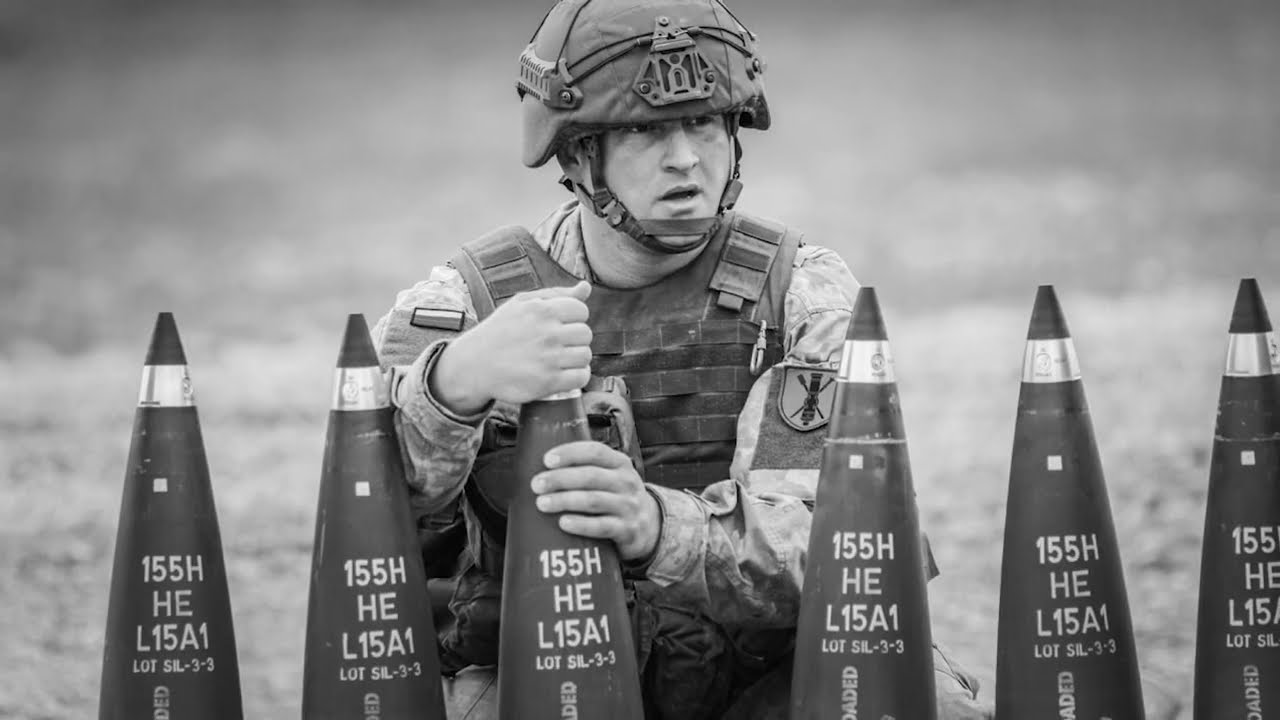
8 L, driving a hydraulic pump and the main wheels. With it, the gun could move itself at 16 km/h, climb a 34% gradient, and reach firing positions no 6×6 tractor could pull it into. The Royal Artillery called it the only towed howitzer in the world with its own engine. That phrase would follow the gun for the next four decades, and Ukrainian gunners would repeat it word for word in 2022.
Britain also pioneered the logistics around the gun. The unit load container carried 17 complete rounds with fuses already fitted at the depot. For 155-mm artillery in the 1970s, this was new. It cut resupply times dramatically and shaped how NATO would handle artillery ammunition for the next 30 years.
The first British guns arrived in 1978. The FH70 entered Royal Artillery service in December 1979 and reached full operational status in 1980. First Regiment Royal Horse Artillery ran the troop trials and became the first unit to deploy the gun in support of 24th Air Portable Brigade. Total production, drawn from Royal Ordnance and Jane’s records, reached approximately 1,007 guns built across all variants.
The United Kingdom received 67. West Germany received 150. Italy received approximately 162. Saudi Arabia bought 72. Oman, Malaysia, Morocco, the Netherlands, Norway, Lebanon, and Estonia all joined the customer list. The largest single operator turned out to be Japan, which license-built approximately 480 guns at Japan Steel Works.
The 39-caliber ordnance from the FH70 would later form the basis of Japan’s Type 99 self-propelled howitzer. A weapon built by three European nations had become the standard medium gun across four continents. Quick moment here. If you’re finding this interesting, a like on this video genuinely helps the channel reach more people who care about British engineering history.
Now, back to what happened when the gun finally met its enemy. The first major combat use of the British FH70 came in 1991 during Operation Granby, the British contribution to the Gulf War. Royal Artillery regiments deployed the gun in the Western desert against Iraqi positions. Performance matched the trials data.
The guns shot, moved under their own power to alternate positions, and shot again, with crews praising the auxiliary power unit for the first time in a real shooting war. Then Britain replaced it. The AS90 self-propelled gun entered service from 1993. Built by VSEL, the AS90 carried the same 39-caliber ordnance pattern that had served on the FH70, and it fired the same L15 family of shells.
The British Army was not abandoning the engineering. It was placing the engineering on tracks. By 1999, the Territorial Army’s last FH70 regiment stood down. Around 2003, Britain sold its remaining fleet. 15 guns went to Malaysia. 15 went to Oman. The rest scattered to museums and private collectors. The nation that had led the design, built the carriage, and developed the shell no longer operated a single example of its own howitzer.
West Germany retired its guns by 2002, switching entirely to the self-propelled PzH 2000. Italy held onto roughly 160 examples, refurbishing them under contracts with Ares and Leonardo. As recently as January 2024, then came February 2022, when Russia invaded Ukraine. Ukrainian artillery was almost entirely Soviet pattern, 122-mm D-30 guns, 152-mm D-20 howitzers, and 2S65s to B systems.
All of it depended on Russian and ex-Soviet ammunition stockpiles that Ukraine could not replace. Ukraine needed NATO standard 155-mm artillery, and it needed it immediately. Italy responded first. According to La Repubblica reporting from May 13, 2022, Rome approved FH70 deliveries from its operational reserve.
By late May, the guns were firing in combat, identifiable in Ukrainian footage by their Iveco Astra tractor vehicles, Italy never disclosed the exact number transferred, though estimates place it in the dozens. Estonia followed in January 2023. Estonian Ambassador to Ukraine Kaimo Kuusk announced on January 23, 2023 that Estonia would donate its entire 155 mm artillery park, 24 FH70 howitzers, 36 D-30 guns, as part of a package worth approximately 113 million euros.
Kuusk stated, according to Estonian government records, that the goal was to remove excuses for other nations to hold back. Ukrainian crews started using the guns within days of arrival. The 44th Separate Artillery Brigade and the Hetman Danylo Apostol Artillery Brigade took the early deliveries. A Ukrainian gunner told Radio Liberty in October 2022, in a quote later carried by Militarny, that accuracy was determined by the first projectile landing within 50 to 60 m of the target, and that the second projectile could hit the target directly. A Ukrainian commander stated that the FH70 could destroy a target in two or three rounds where a D-20 needed 10 or more. In July 2023, according to Deputy Defense Minister Hanna Maliar said the gun had helped stop a column of 17 Russian tanks attempting to break through the front line in a single engagement. The crews praised the auxiliary power unit most of all. One gunner described how the
personnel barely strained because almost everything in the howitzer was hydraulic. The gun could fire a mission, withdraw under its own power, and reach concealment before the Russian counter-battery response landed. The gun has paid a price for that work. Russian Lancet loitering munitions have struck FH70 positions since late 2022, including verified strikes during the 2023 counteroffensive when guns were caught in tree line firing positions.
The howitzer’s weight, approximately 9.3 tons, makes it slower to displace than the 4.2 ton American M777 howitzer that Ukraine also operates. The Royal Ordnance L15 shell, designed in the 1970s, predates the precision guided artillery rounds that now dominate top-tier NATO inventories, but the gun is still firing, still accurate, still preferred by its crews over the Soviet pattern alternatives that Ukraine inherited.
The comparison with the American M198 tells the strategic story. The M198 is lighter, around 7.3 tons, and reaches similar range, but it carries no auxiliary power unit, requires a nine-man crew, and cannot move itself off a fire mission. The tri-national engineering choice that Washington dismissed in the 1960s is now the feature keeping Ukrainian gun crews alive.
The verdict is harder to ignore the longer the war runs. Britain led the design of a 155 mm howitzer in the late 1960s to stop Soviet tanks attacking NATO positions in Central Europe. 45 years later, that gun, built by the tri-national program Britain coordinated, firing the shell Britain designed, is killing Russian tanks attacking a European nation that was not even part of NATO when the program began.
The Royal Artillery no longer operates the FH70. The Bundeswehr retired it years ago and now ships PzH 2000 systems east instead. Italy keeps refurbishing its fleet and keeps sending what it can. Estonia gave its share away in a single announcement. Japan still operates more of them than anyone, untouched by the war but watching every after-action report.
And Ukraine fires every round it can get. The Cold War gun returned to do exactly what its British designers built it to do. The flag on the carriage is different. The target is the same.