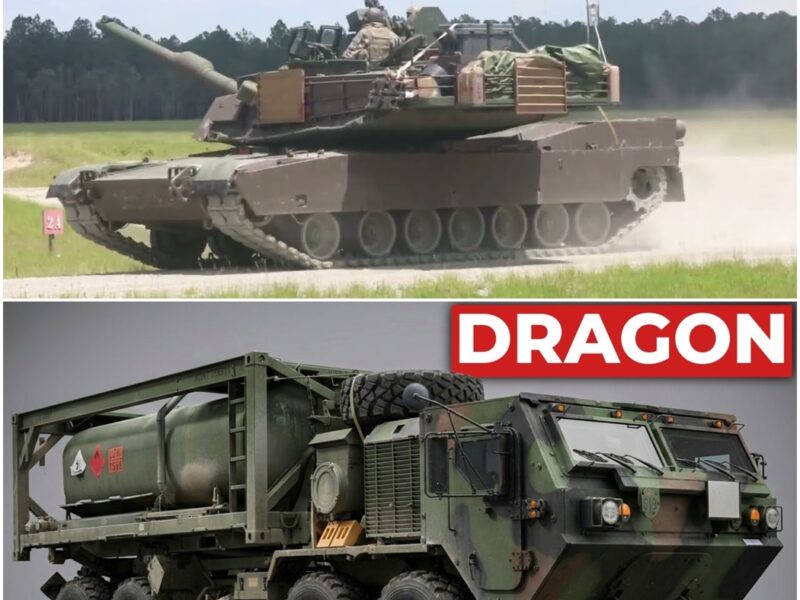
The ‘Harmless’ American Truck That Kept The M1 Abrams Alive Against Saddam’s Army D
The most powerful tank on the planet burns through 60 gall of fuel every single hour it moves. 60 gall. That is not a misprint. The American M1 Abrams, the machine that crushed the Iraqi Republican Guard in under 100 hours. The vehicle every NATO commander wanted on their front line, drinks fuel faster than any engine in ground warfare history.
And the moment its 505gal tank runs dry, it becomes nothing more than 70 tons of silent useless steel sitting in the desert. So, here is the question nobody in the audience ever thinks to ask. Who refuels it? Who drives an unarmored truck loaded with 2500 gall of jet fuel straight through ambush corridors? Through sandstorms that strip paint from metal through temperatures that swing from 55° in summer to minus40 in winter.
Who keeps every Abrams, every Bradley, every Howitzer, and every forward operating base alive when the shooting starts? The answer weighs over 33,000 empty. It rides on eight wheels across axles that can climb a 60% gradient. It has no cannon, no missile launcher, no armor plating in its original form, and no name recognition outside the logistics community.
It has been in production since 1982. Over 35,000 have rolled off the assembly line in Oshkosh, Wisconsin. And without it, the most expensive military force ever assembled would grind to a complete halt within 72 hours. This is the heavy expanded mobility tactical truck, the HMT. The vehicle the Pentagon classified as a support asset, but which turned out to be the single most important piece of equipment in every American ground war for four decades.
To understand why this truck exists, you need to understand the disaster it replaced. In the late 1970s, the United States Army had a logistics problem that no amount of firepower could solve. The service was building an entirely new generation of armored vehicles around the M1 Abrams and the M2 Bradley.
These machines were faster, heavier, and more lethal than anything that came before them. They were also catastrophically thirsty. The Abrams ran on a Honeywell gas turbine engine, the same class of power plant found in helicopters. At tactical idle, it consumed roughly 30 gall. At full cross-country speed, it consumed 60. A single armored division on the move could drain 500,000 gallons of fuel in a single day.
An entire core during a major offensive could consume 2 million gallons every 24 hours. And the truck the army relied on to deliver that fuel was the M520 Go. The Goer was a four-w wheeled articulated vehicle built by Caterpillar. It was amphibious. It could haul 8 tons off-road and it was a mechanical nightmare.
The vehicle had no suspension at all. On paved roads, it bounced so violently that drivers reported back injuries after routine convoys. Its cab was mounted on an oscillating joint that could swing unpredictably, and the army had built so few of them, roughly 1,300 between 1972 and 1976, that spare parts were not even listed in the official supply catalog until years after the vehicle entered service.
The Goa could survive a jungle trail. It could not sustain an armored blitz creek across a continent. The army needed something entirely different. It needed a heavy truck that could haul 10 tons of fuel or ammunition across terrain that would destroy a civilian vehicle, keep pace with 60 mph tank formations on the highway, operate in temperatures from -50° F with an Arctic kit to 120° in the shade, and do all of this with an automatic transmission and commercial components.
Simple enough for any mechanic in the motorpool to maintain. In March of 1978, the Army launched what it called the High Mobility Tactical Truck Market Survey. It tested candidates from four manufacturers. PAC teamed with General Motors. AM General submitted a design. Man of Germany offered a European alternative.
And Oshkosh Truck Corporation, a midsized firm from Wisconsin known for building snow plows and concrete mixers, entered a bid that almost nobody expected to win. The PAC team was the front runner. They had a pre-production line already established. But on May 22nd, 1981, the United States Army Tank Automotive Command awarded Oshkosh a 5-year fixedpric contract valued at $251 million.
Oshkosh had submitted the cheaper bid. The first prototype rolled out in December of that year. Pre-production vehicles followed in March of 1982, and by September of 1982, full rate production had begun. The truck Oshkosh delivered was an 8×8 all-wheel drive platform with a forward control cab seating two.
The original A0 variant ran a Detroit diesel 8V92 turbocharged V8 producing 445 horsepower through an Allison four-speed automatic transmission. It could reach 62 mph on road. It could ford 4 ft of water without preparation. It could climb gradients that would stall a commercial lorry and it could carry its full payload across sand, mud, snow, and broken rock without losing traction.
But the genius of the HMT was not any single specification. It was the variant system. Oshkosh built the same chassis into six distinct configurations. Each one solving a different logistics problem. The M977 was the baseline cargo truck with a light crane for self-loading. The M978 was the fuel tanker carrying 2500 g in a single armored Bowser.
The M984 was the wrecker fitted with a heavy crane rated at 10,000 lb and a 60,000lb recovery winch capable of dragging a disabled Abrams out of a ditch. The M985 carried ammunition and Patriot missiles with a heavy material handling crane. The M983 served as the tractor unit for the Patriot air defense system. And later, the M1120 introduced a hook lift system that could swap flat rack containers in minutes, turning one truck into a fuel hauler, an ammunition carrier, or a bridging transporter, depending on what the mission demanded. One chassis, six missions, every single one of them invisible to the public and indispensable to the force. Before covering where this truck actually fought, if this kind of deep dive into the machines behind the front lines is something you enjoy, hit subscribe. It takes a second and it helps the channel grow. The HMT got its first real test in January of 1991 when Operation Desert Storm launched the largest armored offensive since the Second World War. The Seventh Corps, the main striking
force of the coalition, needed to drive over 250 km into Iraq in under 100 hours. The problem was fuel. Seventh Corps alone consumed over 2 million gallons per day. The army had positioned large 5,000galon semi-tankers along the main supply routes. But when those tankers hit soft sand, they bogged down immediately.
They could not leave the roads. That left the M978. The 2500gal HMT tanker became the only vehicle in the theater capable of shuttling fuel forward across open desert to the advancing M1 Abrams formations. Additional HMT fuel trucks were specifically issued to the core before the ground offensive began. Without them, the tanks would have outrun their own supply lines within the first day.
Across the entire theater, Lieutenant General William Pagonis commanded a logistics operation that pumped 1.3 billion gallons of fuel and moved roughly 7 million tons of supplies. 7th Corps alone moved 5.6 million gallons of fuel and 56,000 tons of ammunition during the offensive phase.
Every gallon that reached the front across open desert rode on the back of an HMT. The large roadbound tankers could handle the highways. The last 50 km, the stretch between the paved road and the tank formation charging through Iraqi positions at 40 mph belonged to the M978 and nothing else.
When the ground war ended in 100 hours, the Abrams got the credit. Television cameras filmed burning Iraqi armor. Generals gave press conferences in front of Bradley fighting vehicles. The HMT drove home in silence. No journalist embedded with a fuel convoy. No photographer wanted a picture of a tanker truck parked behind a sandb at 3:00 in the morning.
But every commander in the theater knew the same truth. The offensive moved at the speed of the fuel truck, not the speed of the tank. 12 years later, the truck faced a very different war. On March 23, 2003, during the opening days of the invasion of Iraq, the 507th Maintenance Company took a wrong turn into the city of Nyria.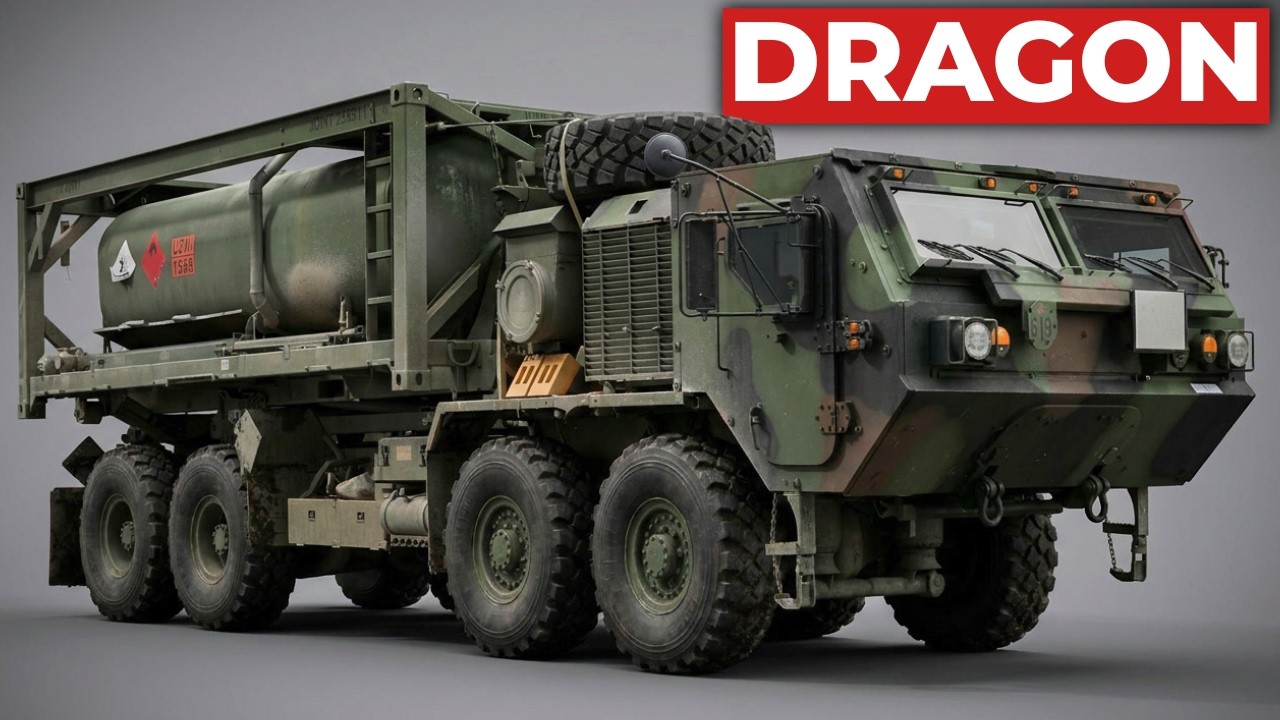
The convoy included 18 vehicles, among them several HMTs. They drove straight into an ambush. Small arms fire, rocket propelled grenades, mortar rounds, and tank shells tore through the column. At least 15 of the 18 vehicles were destroyed. 11 soldiers were killed. Six were captured, including Private Firstclass Jessica Lynch.
The massacre at Naseria exposed a brutal truth. The HMT had no armor. Its cab was welded steel designed for durability, not ballistic protection. Crews sat high above the road, which gave them some passive protection against buried mines. But against direct fire and improvised explosive devices, they were completely exposed.
By December of 2004, only about 10% of the 4,800 medium and heavy transport trucks operating in Iraq had any armor at all. Soldiers in the field improvised. Some welded scrap steel to their cabs. Others bolted armored glass panels scavenged from up armored Humvees onto makeshift frames. The Pentagon scrambled to respond.
A company called Similar had actually built 186 add-on armor kits for HMTS during the Bosnia deployment in the 1990s, but those kits had never been issued. They sat in storage for nearly a decade when the IED threat exploded in Iraq. The army pulled them out of warehouses and rushed them into theater as a stop cap.
They did not meet the blast protection requirements of the Army’s own 1996 standards, but they were better than nothing. By late 2006, BAE Systems had supplied roughly 3600 crew protection kits for the HMT and its sister vehicle, the palletized load system. These kits added armor panels, blast deflectors, ballistic glass, and armored roof hatches.
They protected against 7.62 mm ball ammunition, artillery fragments, and the pressure waves of buried IEDs. Each kit added roughly 3,000 lb to the vehicle’s weight. The experience in Iraq transformed the HMT permanently. The A4 generation, which entered production in July of 2008, was built from the factory with an integral armor system.
Oshkosh called it the Akit and Bkit philosophy. The Akit was composite armor baked into the cab structure from the start. The Bkit was bolt-on applique armor that could be added or removed depending on the threat level. A tanker variant received its own dedicated armor module. The truck that had gone to war naked now came off the assembly line ready for the blast.
In Afghanistan, the HMT operated in conditions that would have destroyed the old M520 Goer in a week. The terrain was vertical. Supply routes climbed through mountain passes at altitudes where diesel engines lost power and tires lost grip on loose gravel switchbacks with thousand ft drops and no guardrails. M978 tankers supported forward arming and refueling points at altitude, delivering jet fuel to helicopter units operating from remote bases in the Hindu Kush, where no pipeline could reach and no railway existed. M984 wreckers recovered damaged vehicles from roads carved into mountain sides using their 60,000lb winches to drag wrecked MRAPs back from ambush sites before the enemy could plant secondary devices. Convoy crews innovated constantly. Some learned to pack entire helicopter refueling systems into a single HMT cab to reduce the number of vehicles exposed on dangerous routes. Others modified cargo beds to carry water bladders for bases that had
no well and no river within 50 km. Every technique was improvised, every solution born from necessity, and every mission depended on the same eight-w wheeled chassis that had first rolled off the line in Wisconsin two decades earlier. No foreign alternative ever matched it at the combination of payload, mobility, and operating tempo the Americans demanded.
When man of Germany competed against Oshkosh in 1981, their truck lost on price. When Canada ran a separate heavy truck competition in 1988, an Austrian design won instead of the Oshkosh entry. But the Canadian Army never conducted the kind of thousand km armored dashes that defined American doctrine.
Their logistics requirements were simply smaller. The Soviet Union built its own heavy logistics fleet during the same period, but with a fundamentally different philosophy. The Kra 260 produced 300 horsepower and carried 9 tons on a 6×6 chassis. The Ural 4320 was lighter, simpler, and produced in enormous numbers. Both were rugged vehicles designed to be repaired with basic tools in field conditions, but they lacked the automatic transmissions.
The 8-wheel drive configurations, and the payload capacities that the HMT offered, Soviet military doctrine accepted slower logistics tempos because Soviet armored vehicles burned less fuel. The T72 diesel tank consumed roughly a third of what the Abrams turbine demanded. The Soviets did not need an HMT because they did not build an Abrams.
Today, the Rin Metal MHX family serves eight NATO nations, including the United Kingdom, Australia, and Germany. It remains the primary competitor for the HMT’s eventual replacement, and represents the closest Western equivalent in capability and scale. That replacement was supposed to be the common tactical truck.
In January of 2023, the Army announced prototype agreements worth over $24 million with four manufacturers. The program could ultimately produce up to 40,000 trucks worth $14 billion. But in late 2025, the Army paused the entire acquisition after industry responses raised concerns that sent planners back to the drawing board.
The HMT, now 44 years old, is still in production. In August of 2024, the Army awarded Oshkosh a new contract valued at $ 1.54 billion, keeping the line running through 2031. Over 35,000 new build HMTs have been produced. More than 12,500 have been rebuilt and recapitalized. The truck now serves with the armed forces of over 20 nations from Bahrain and Brazil to South Korea, Taiwan, and Ukraine.
No one builds a statue of a fuel truck. No museum puts a tanker variant on a pedestal with a velvet rope and a spotlight. No child asks for a toy HMT for Christmas. No film director stages a chase scene with a 10-tonon fuel Bowser lumbering across the desert at 60 mph. The HMT has no Hollywood film, no bestselling book, no nickname that civilians would recognize.
Soldiers called it the Dragon Wagon, a name borrowed from a Second World War tank transporter. And even that name faded from common use as the trucks became so routine that nobody thought to mention them at all. Some surplus examples have ended up in civilian hands, converted into overland expedition campers by enthusiasts who wanted the most capable off-road platform money could buy.
That is the closest the HMT has come to fame outside the military. But here is what the data says. Every single American armored offensive since 1985 has depended on this vehicle. Without the M978 tanker, no Abrams moves. Without the M984 wrecker, no disabled vehicle comes home. Without the M977 cargo truck, no ammunition reaches the howitzer line.
No spare parts reach the motorpool. No rations reach the soldiers who fire the weapons that win the wars. It has genuine shortcomings that no amount of upgrades can fully erase. It has no armor in its blood. It was not built to fight. It was not fast, not glamorous, not feared. It was too wide for European roads, too heavy for temporary bridges, and too ugly for a recruitment poster, but it climbed 60% gradients in the Afghan mountains.
It crossed 4 ft of standing water without preparation. It operated at minus 50° in Arctic exercises, and at 55° in the Iraqi summer, it survived IEDs that would have torn a Humvey in half, not because it was armored, but because its crews sat high enough that the blast passed beneath them.
The replacement is paused. The production line is still running. The truck that was supposed to be a temporary answer to a 1970s logistics problem is now the longest serving heavy tactical vehicle in the American infantry. 44 years, six variants, 35,000 built, every war since the Cold War, in the sands of Kuwait, in the streets of Baghdad, in the mountains of Kandahar, on frozen proving grounds in Alaska, and on loading ramps at airfields across four continents.
That is not a supply truck. That is the reason the supply got through.