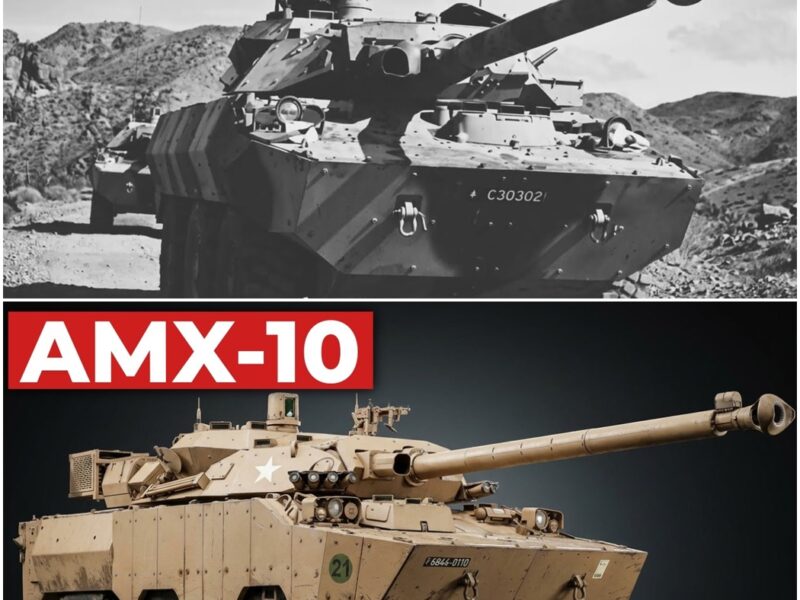
The ‘Harmless’ French Recon Car Ukraine Used to Kill Russian Tanks at 1,500 Metres D
France called it a reconnaissance vehicle. It weighed under 17 tons, sat on six wheels, and carried no belly armor worth mentioning. By every official definition, it was built to look and run, not to fight. Ukraine put 105-mm armor-piercing rounds through Russian tanks at 1,500 m with it. The AMX-10RC is the size of a light truck.
It turns like a tracked vehicle because its drivetrain was copied directly from a French infantry carrier. Its hull is welded aluminum, the kind that stops small arms and not much else. A single artillery fragment in the right place detonates the ammunition storage and kills all four crew before anyone reaches the hatch.
And yet this vehicle fought in Chad, Iraq, Afghanistan, and Mali. It outlasted every wheeled armored vehicle France ever built. And in 2023, it became the first Western armored fighting vehicle delivered to Ukraine, arriving before the Leopard 2s, before the Bradleys, before any of the vehicles the world was actually arguing about.
It is still in service today, not because it is the best vehicle for the job, because it turned out to be than anyone admitted. To understand how a French cavalry car ended up destroying Russian armor on the steppes of southern Ukraine, you need to understand the problem France faced in the late 1960s. France had spent the previous decade operating the Panhard EBR, an eight-wheeled armored car with a 75-mm gun that dated from the 1940s.
By 1967, it was obsolete, outgunned by Soviet armor, and too slow for the distances French cavalry units were expected to cover across Central Europe. The French army needed something that could race ahead of the main force, find the enemy, and if necessary, destroy his armor before retreating.
Not a tank, a gun on wheels, fast enough to run, accurate enough to kill before running became necessary. In September 1970, the Atelier de Construction de Satory à Bourges began work on what would become the AMX-10RC. The designation meant exactly what it said. Rou, meaning wheels, canon, meaning gun. The requirement was clear.
put the heaviest gun possible onto the lightest possible wheeled platform, have the best optics available, and make the whole thing amphibious. The result was unlike anything else in service. The hull was welded aluminum, kept deliberately thin to save weight. The suspension was hydropneumatic, allowing the crew to raise or lower the vehicle’s ground clearance while moving from 21 cm to 60, which let it cross terrain that would stop a conventional wheeled vehicle.
The drivetrain was taken directly from the tracked AMX 10P infantry carrier, which gave the 6×6 configuration something unusual, skid steering. The AMX 10RC does not turn its wheels to change direction. It slows the wheels on one side and accelerates the other, exactly as a tracked vehicle does. On loose ground, this works well.
On paved roads at speed, it is less graceful. The gun was a 105-mm rifled cannon, the F2, firing a proprietary French ammunition family that was not compatible with any NATO stockpile. This decision would matter later. The fire control system included a laser rangefinder and low-light optics, eventually upgraded with thermal sights taken from retired AMX 30 B2 tanks.
The official penetration figures were ambitious. The armor-piercing fin-stabilized discarding sabot round was rated to defeat a single heavy tank target at 1,200 m and a triple hardened target at 2,200 m with above 90% hit probability at 2,000 m. The vehicle had no gun stabilizer.
To fire accurately, the crew stopped the vehicle. First, the first production vehicles went to the second regiment of Hussars at Sourdun in 1981. France ultimately built 457 of them, keeping 337 for home service and exporting the rest. Morocco took 108, Qatar took 12. The French Army fielded them in cavalry regiments across Germany, then later across Africa, then across the Middle East.
France classified the AMX 10RC as a heavy armament combat vehicle under the 1990 Conventional Armed Forces in Europe Treaty, not as a battle tank. Some accounts describe this as deliberate treaty evasion. It was not. The vehicle was designed in 1970, 20 years before that treaty existed. Its wheeled configuration and sub-tank weight placed it in a different category by default, not by calculation.
The design came first, the classification followed. Before we get into where this vehicle actually fought, if you are enjoying this deep dive into military history, hit subscribe. It takes a second and it helps the channel grow. The AMX 10RC went to war for the first time in August 1983.
France deployed a squadron under Operation Manta to deter a combined Libyan and rebel armored advance into central Chad. The presence of the AMX 10RCs was enough. Libyan armor did not advance. No engagement took place. At the time, it was the most capable armored vehicle France had ever deployed south of the Sahara.
The real test came in 1991. France contributed roughly 14,000 troops to the Gulf War coalition under General Michel Roquejeoffre, operating on the far western flank of the American 18th Airborne Corps. The formation was called the 6th Light Armored Division, known in operation as Division Daguet. It fielded approximately 40 AMX 10RCs alongside 44 AMX 30 B2 tanks of the 4th Regiment of Dragons.
The French mission was to protect the coalition’s open western flank, sweep deep into Iraq, and seize the airfield at As-Salman, roughly 150 km inside Iraqi territory. They did so in under 24 hours. The Iraqi 45th Infantry Division collapsed. French forces took approximately 2,500 prisoners. The 4th Regiment of Dragons reported destroying 10 tanks and three infantry carriers with American A-10 air support covering the armor engagements.
The AMX 10RCs received additional frontal armor for the deployment, an infrared jammer to defeat anti-tank missiles, and upgraded thermal cameras capable of identifying targets at 4,000 m. They lost nothing to enemy action. Afghanistan was different. The regiment of marine infantry and armor, known as the RICM, deployed its cavalry squadron, Le Centurion, to Kapisa province around 2009.
The terrain was valleys and irrigation ditches and pressure plate devices buried on routes that offered no alternative. In late January 2011, during Operation Kuma in the Bedrao Valley of Kapisa province, an AMX 10 RC from Battle Group Richelieu detonated an improvised explosive device. The vehicle survived.
The threat in that country was not the enemy’s guns. It was the ground itself. Mali proved the same point more lethally. Operation Serval launched in January 2013 when French forces intervened to stop a jihadist advance on Bamako. The AMX 10 RCs of the RICM drove west across several hundred kilometers of Saharan terrain in the opening days of the operation, providing fire support for the advance that retook Timbuktu and Gao.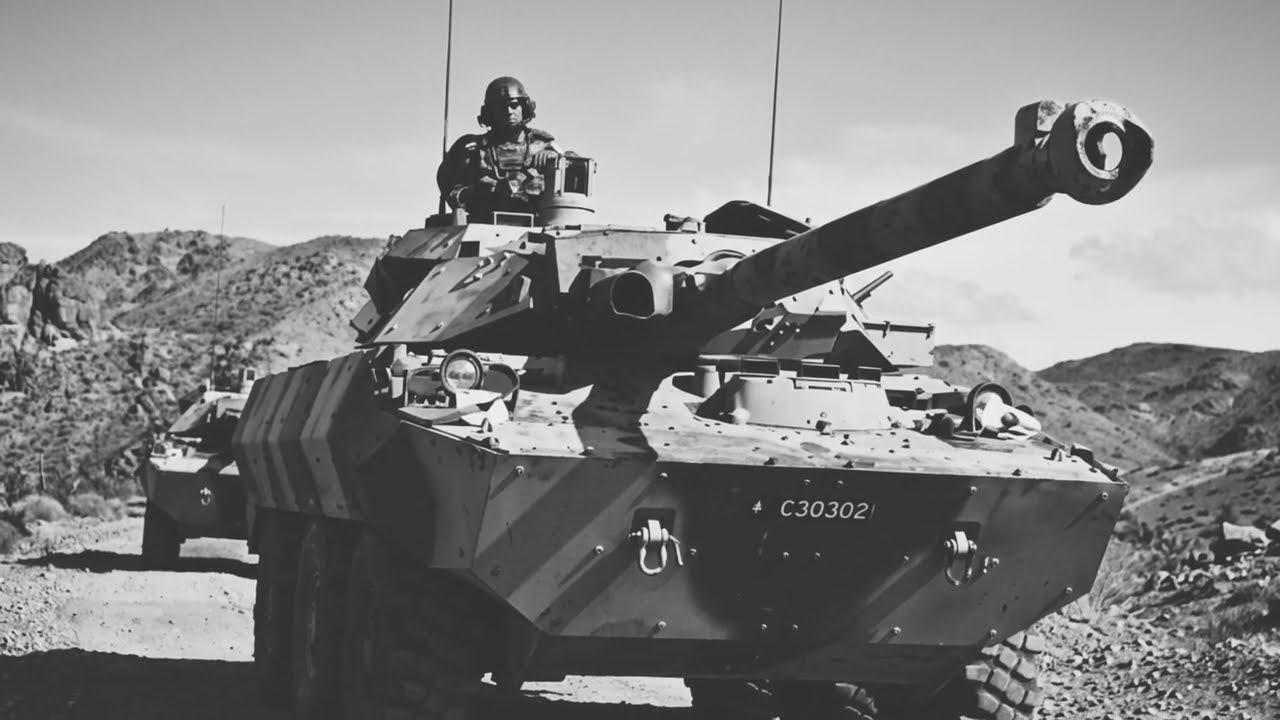
The vehicle performed well in the desert, fast and reliable across open ground. On March 16th, 2013, an AMX 10 RC driver was killed by a pressure plate improvised explosive device. The belly armor, never its strong point, did not protect him. The vehicle’s record across those decades was not the record of a protected fighting machine.
It was the record of a precision instrument that worked well when used correctly and died when the ground exploded underneath it. By January 2023, France had roughly 240 AMX 10 RCs in service and was already replacing them with the new Jaguar 6×6. On January 4, 2023, President Emmanuel Macron announced France would donate AMX 10 RCs to Ukraine.
It was the first commitment by any Western nation to provide armored vehicles with guns large enough to destroy Russian armor. The announcement catalyzed everything that followed: Bradley deliveries, leopard negotiations. The entire Western heavy armor discussion traces back to that single French announcement.
The first 14 vehicles left France in mid-February. By March 15th, Defense Minister Sébastien Lecornu told the National Assembly they had arrived and some were already at the front. France ultimately sent 38 vehicles to the 37th Separate Marine Brigade of the Ukrainian Navy. Crews were trained at the Cavalry School in Saumur and at the Canjuers camp.
The French training program normally ran 6 months. Ukrainian crews completed it in one. The vehicle reached the front in time for the June 2023 counteroffensive in southern Donetsk. What happened next was not what anyone planned. The 37th Brigade used the AMX 10 RCs to lead frontal assaults at Velyka Novosilka and Novodonetske, pushing them directly into defended Russian positions at close range.
The vehicle was never designed for this. Its aluminum hull was not proof against the auto cannon rounds that Russian infantry carriers carry as standard armament. Its wheels, all six of them, could be shredded by a single burst of artillery fragments. Major Spartnets, one of the 37th Brigade’s battalion commander, described what happened when a Russian shell struck a vehicle in his unit.
The fragments pierced the aluminum. The ammunition storage detonated. The crew of four did not escape. He told journalists afterward that the guns are good and the observation devices are very good, but the armor is too thin to use these vehicles in a frontal assault. A fully loaded AMX 10 RC was later captured by Russian forces and filmed in Russian hands.
By May 2025, Oryx, the open-source equipment tracking project, had confirmed six of the 38 vehicles lost. Three destroyed, two abandoned, and one captured. The vehicle was failing at a job it was never built to do. What Ukraine discovered next was more useful. The AMX 10 RCs 105-mm gun, with no stabilizer and no requirement to fire on the move, turned out to be extremely accurate at long range when the vehicle was stationary and the target was identified by drone.
Crews began using it not as a cavalry recon vehicle and not as an assault tank, but as a mobile precision gun, repositioning after each shot, engaging at distances the Russian crews could not effectively return fire across. The thermal optics, taken from retired French main battle tanks, could identify targets at ranges the vehicle’s designers had considered theoretical.
Crewman Rapier described firing rates of one round every 6 seconds with a well-trained loader, sending 11 or 12 rounds into a position before repositioning. Ukrainian Defense Minister Oleksii Reznikov, after test driving one in April 2023, called it a sniper rifle on fast wheels. That description turned out to be more accurate than the word tank, which Western media had been using since January.
Compare it to what arrived alongside it. The American M2 Bradley is tracked, far heavier, and mounts a 25-mm auto cannon with anti-tank missiles and room for infantry. The German Leopard 2 is a true main battle tank, 60 tons, 120-mm smoothbore, composite armor that the AMX-10 RC’s gun would struggle to penetrate from the front.
The AMX-10 RC belongs to a different category entirely, alongside the Italian Centauro and the Japanese Type 16, wheeled fire support platforms designed for speed and precision over protection and mass. The vehicle’s designers in 1970 understood this. They built a cavalry gun, not a tank. The problem in Ukraine in 2023 was that the West sent it as tank substitute because nothing better was politically possible in January.
By late 2023, the vehicle had found the role that suited it, mobile artillery, drone-cued precision fire, shoot and move. The doctrine that had proved useless in frontal assaults against defended positions proved highly effective in the fluid attritional war along the Dnipro. The AMX-10 RC has now been in service for 45 years.
The vehicle France designed to replace it, the Jaguar, began entering service in 2022 and will take a decade to complete the transition. The AMX-10 RC’s Morocco bought in 1978 are still in Moroccan service. Ukraine is still using the 32 that remain. It was not elegant. It never claimed to be. The aluminum hull is a liability in a minefield.
The ammunition is incompatible with NATO stockpiles. The belly will not stop a pressure plate. The wheels will not survive a burst of auto cannon fire from a Russian infantry carrier at close range, but the gun is accurate. The optics are better than anything Russia deployed in comparable vehicles. The thermal sights salvaged from a tank that was itself retired can reach out to 4,000 m in the dark.
At 1,500 m, stationary, with a target identified by drone, and a loader who has practiced his task until the motion is automatic, the AMX-10 RC will put a 105-mm armor-piercing round through a Russian tank. France called it a reconnaissance vehicle. Ukraine called it a sniper rifle. Both were right.