The Jewels Mary Queen of Scots Wore to Her Own Execution D
She was 44 years old on the morning of February 8th, 1587, and she dressed with the precision of someone who understood she would never have another audience this large again. 300 people had assembled in the great hall of Fotheringhay Castle, Northamptonshire, to watch her die. She couldn’t stop the execution.
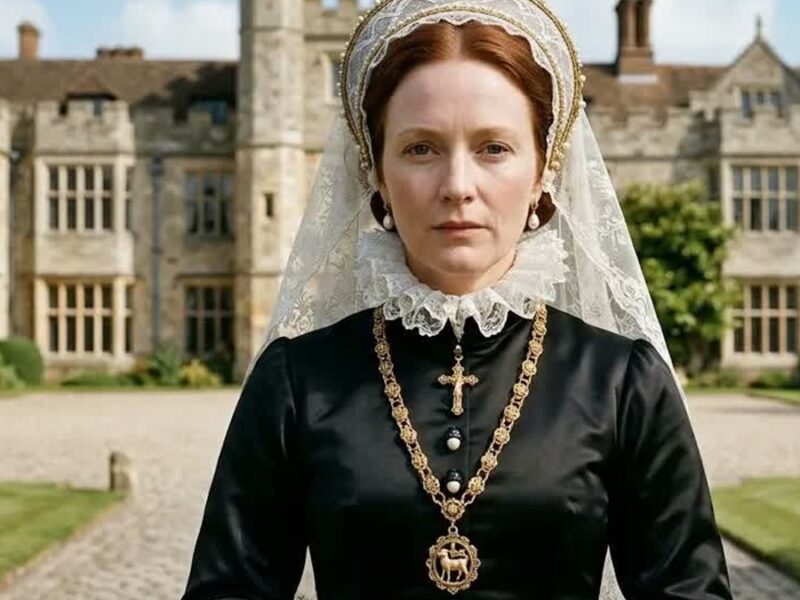
She couldn’t unsign the death warrant Elizabeth the first had authorized 7 days earlier. But she had spent the previous night preparing every detail of what those 300 people would see. Starting from the outside in, the outer gown was black satin, painted, a surface finish that gave it a lacquered, almost reflective quality, with a long train and sleeves reaching the floor.
Down the front, acorn-shaped buttons of jet and pearl. Through the deliberately slashed outer sleeves, half sleeves of purple velvet were visible, a color choice that carried precise social and religious meaning in an era when fabric color was legible as language. Her shoes were Spanish leather, rough side outward.
Her stockings were worsted wool in watchet, a pale sky blue, clocked with silver thread at the ankle. Her garters were green silk. Around her neck, she wore a pomander chain and an Agnus Dei, a small disk of pressed wax stamped with the figure of a lamb, a devotional object used in Catholic prayer. A veil of fine lawn, edged with bone lace and bowed out with wire, covered her head.
In her hands, a crucifix and a prayer book. At her girdle, two rosaries, one of them gold with a golden cross at its end. Robert Wingfield, a gentleman who was present in the Great Hall, left one of the most detailed eyewitness accounts of the day. His narrative was preserved in the British Library’s Lansdowne Manuscripts, noted there in Lord Burghley’s own handwriting.
8th of February, 1586. The manner of the Queen of Scots’ death at Fotheringhay, written by Robert Y. The date in that notation reflects the Julian calendar then used in England. By modern Gregorian convention, the date is February 8th, 1587. To every Protestant observer standing in that hall, Mary’s black outer ensemble read as the wardrobe of a penitent widow, controlled, somber, deliberately unflamboyant.
They had no idea what she was wearing underneath. When Jane Kennedy and Elizabeth Curle, two of Mary’s ladies-in-waiting, helped her remove the outer gown on the scaffold, the room saw what had been concealed beneath the black satin. A crimson satin bodice, cut low at the back, trimmed with lace.
A crimson velvet petticoat. One of the women handed her a pair of crimson sleeves. Every piece of fabric touching her skin was red. Crimson was the liturgical color of martyrdom in the Catholic Church, of saints who had died for their faith, of witnesses who refused to recant. By removing her outer gown in a single choreographed motion, Mary had converted a state execution into a sacrament, or at least into the visual vocabulary of one.
Without speaking a single word, she told every Catholic who had ever hear this story exactly how she intended her death to be classified. Antonia Fraser, in her 1969 biography, describes the moment. Stripped of her black, she stood in her red petticoat, wearing all red, the liturgical color of martyrdom in the Catholic Church, and she died in it.
She apparently found the moment worth a small joke. As her ladies helped her out of the black gown, she smiled and told the room she had never had such grooms before, nor ever put off her clothes before such a company. Her last words, spoken in Latin while kneeling at the block, were In manus tuas, Domine, commendo spiritum meum.
Into your hands, Lord, I commend my spirit. This wasn’t improvisation. 2 hours past midnight that morning, Mary had been at her desk completing a letter to Henry III of France. In it, she wrote, “The Catholic faith and the assertion of my God-given right to the English throne are the two issues on which I am condemned.
” That letter now sits in the National Library of Scotland. Before writing it, she had spent hours distributing her jewelry, her purses, and her clothing among the women of her household. The outfit she would wear in a few hours was already chosen. Every object she would carry had been selected.
She went to the block as a woman who had been planning this moment for longer than the English state realized. The man operating the axe was known as Bull, the public executioner, who had traveled north to Fotheringhay disguised as a serving man, carrying his axe in a trunk under the personal direction of William Cecil, Lord Burghley.
He and his assistant knelt before Mary and asked her forgiveness. She gave it. “I forgive you with all my heart. For now, I hope you shall make an end of all my troubles.” The execution that followed was grotesque. Bull’s first blow missed her neck entirely and struck the back of her head. The second severed the neck except for a thin strand of sinew, which he then cut through with the axe blade.
When he lifted the head and called, “God save the queen,” the auburn hair in his fist came away from the skull. It was a wig. Her real hair, the hair she had grown through 19 years of English captivity, was short and gray. She had been 24 when first imprisoned by Protestant forces in Scotland, 44 when she died.
Wingfield recorded that her face was so transformed by death that few could remember her by her dead face. Cecil’s own nephew, standing in the hall, wrote to his uncle afterward that her lips went on moving for a quarter of an hour after the severing. Then Bull moved to remove her garters, a traditional perquisite of the executioner, and found the dog.
A small Skye terrier had been concealed inside Mary’s skirts through the entire execution. The animal refused to leave. Pulled free by force, it ran immediately back to the body and lay down in the blood pooled between her head and shoulders. Wingfield’s account is direct about it. The dog was imbued with her blood and couldn’t be gotten forth but by force, yet afterward wouldn’t depart from the dead corpse.
It had to be carried away and washed before it would stop trying to return. The executioners were dismissed with cash and strict instructions. They were to leave Fotheringhay without a single item that had belonged to her. The English authorities in that hall understood immediately what had gone wrong.
They had executed a Catholic queen on Protestant legal grounds, and she had turned the event into theater. The fear driving the response was theologically specific. Catholic veneration of relics wasn’t a vague cultural concern in 1587. It was a living practice maintained across Europe and kept alive in secret by England’s Catholic recusant community.
A fragment of cloth worn by someone the church recognized as a martyr was, in that framework, a sacred object with intercessory power. Protestant England had spent 50 years dismantling exactly that tradition, closing shrines, destroying reliquaries, dispersing the bones of medieval saints. Mary Stuart wasn’t going to manufacture a fresh supply of holy material from a scaffold in Northamptonshire.
The orders went out before her body was cold. Everything was to be burned. The clothing, the wooden block, anything touched by her blood into the fireplace in the great hall. Wingfield’s account confirms it directly. All things else were that had any blood was either burned or washed clean. The jet and pearl buttons went into the fire, the watch at stockings clocked with silver, the green garters, the purple velvet sleeves, the crimson bodice and petticoat that had made 300 witnesses go silent.
The executioners were paid and dismissed without a button between them. Her body was embalmed, sealed in a lead coffin, and left at Fotheringhay until July 1587, when she was given a Protestant burial at Peterborough Cathedral. Her heart and internal organs, removed during embalming, were buried secretly within the castle walls, rather than risk them entering circulation as relics.
In 1612, her son James VI and I had her exhumed and reinterred in Westminster Abbey in a chapel directly opposite the tomb of Elizabeth I. Even in death, she remained politically inconvenient. The state had done everything it could reach. What it couldn’t reach was what Mary had already given away. On the night of February 7th, 1587, Mary distributed her possessions systematically among the women who served her.
Jane Kennedy received items, Elizabeth Curle received items, Gillis Mowbray, who had joined Mary’s household in 1585 and served through her final years of captivity, received gold bracelets, a crystal jewel set in gold, and a set of gold pomander beads. A pomander bead is a small hollow sphere of precious metal designed to be filled with perfumed resin or other aromatic compounds.
In the 16th century, they were worn as necklaces or incorporated into prayer beads, functioning as portable scent containers in environments where pleasant smells were mark of status and bad air was thought to carry disease. Mary’s pomander beads were gold. When scientists at the National Museum of Scotland later analyzed them, they found traces of perfumed resin still sealed inside the hollow spheres, chemically preserved across four centuries.
Whatever Mary chose to smell like on the morning she was executed is still in there. On the scaffold itself, when Bull moved toward Mary’s gold rosary, Jane Kennedy objected aloud. Mary intervened. The executioner would receive money rather than the rosary and the Agnus Dei. The rosary wouldn’t change hands on that platform.
The destruction order burned what it could reach. It couldn’t reach what had already left the building. Geoffrey Mowbray carried the pomander beads out of Fotheringay. In the 17th century, one of the Clerks of Pennycuik, a Scottish family, the name pronounced Pennycuik, married Mowbray’s granddaughter, and with that marriage came the beads, preserved as a relic of Mary Stuart by people who knew exactly what they held.
The Clerks kept them for roughly 300 years before they were acquired by the National Museum of Scotland in Edinburgh, where they are held today as part of the collection known as the Pennycuik Jewels. They are small objects, irregular gold spheres, the kind that wouldn’t stop a visitor in a museum without a label.
The label explains that these pomander beads were given by Mary, Queen of Scots, to her lady attendant on the eve of her execution at Fotheringay, that Jane Kennedy had just blindfolded their owner with a white veil embroidered in gold when the axe was readied 12 ft away. They sat in Mary’s hands on February 8th, 1587.
They are in Edinburgh now. Whatever scent she chose that morning is still in there, sealed in gold, going nowhere. The gold rosary took a different route, one that winds through two generations of a family that paid for its Catholic faith in blood, separately from Mary, and because of her. According to Arundel Castle’s own historical records, the rosary Mary carried to the scaffold was bequeathed to Anne, Countess of Arundel, wife of Philip Howard, the 13th Earl of Arundel.
To understand why this matters requires knowing Philip Howard’s father first. Thomas Howard, the 4th Duke of Norfolk, was proposed as Mary’s husband in 1569. Though he presented himself publicly as a Protestant, his faith and his ambitions led him into the Ridolfi plot, a Catholic conspiracy to overthrow Elizabeth I, place Mary on the English throne, and restore Catholicism in England.
The plot failed. Norfolk was arrested, tried for treason, and executed in 1572. He died on a scaffold in part because of his connection to Mary Stuart. His son Philip inherited neither the title nor the freedom, but he kept the faith. Philip Howard converted openly to Catholicism, was imprisoned in the Tower of London in 1585, and died there in 1595, 10 years later, having refused to convert back to Protestantism in exchange for release.
He never saw his son again after his arrest. He never left the Tower alive. In 1970, Pope Paul the VI canonized him as one of the 40 Martyrs of England and Wales, a saint of the Catholic Church. The rosary the Protestant state had tried to seize from a dying woman on a scaffold in Northamptonshire found its way into the hands of the family of a man executed for wanting to help her, and was kept by the wife of a man who was eventually declared a martyr for the same faith she had worn in crimson to her death. It passed from Anne Howard into the broader family collection and came to rest at Arundel Castle, the Howard family seat in West Sussex, where it remained for over 400 years. Arundel Castle has stood on its site since the 11th century. The Howard family has held it since the 15th.
By the early 21st century, the gold rosary was displayed there in a glass case, authenticated, cataloged, described in the castle’s records as irreplaceable, and worth over 1 million pounds. Not primarily for the gold, for what it was and where it had been. On the night of May 21st, 2021, at 10:30 in the evening, thieves entered the castle through a window.
Sussex police received the alarm. Officers arrived within minutes, according to the department’s own statement. The thieves were already gone. They had smashed a display case, taken the rosary along with other artifacts, and cleared out before police reached the building. The total estimated value of items stolen exceeded 1 million pounds.
In September 2021, a man was arrested in connection with the raid. No reports confirmed that any of the stolen artifacts were recovered. The rosary’s whereabouts remain unknown. Historians and law enforcement have stated their concern plainly. The historical value of the rosary vastly outweighs its material value, but its material value, the gold itself, is untraceable once melted.
A theft crew operating for profit has every reason to destroy a famous object and no reason to hold it. The working assumption, stated publicly in the aftermath of the raid, is that the rosary may no longer exist as an object. It survived the execution at Fotheringhay. It survived the fire that consumed everything else in the great hall.
It survived the fall of the Duke of Norfolk and the imprisonment of his son and 400 years of political and religious upheaval across the full span of British history from Elizabeth the first to Elizabeth the second. Two world wars, the dissolution of the British Empire, every dynasty from Tudor to Windsor.
434 years, then a window, a smashed glass case, and 10 minutes somewhere in West Sussex on a May evening in 2021. Robert Beale, the clerk of the Privy Council who had read the death warrant at Fotheringhay, made a sketch of the execution and forwarded it to the Privy Council. It now belongs to the British Library.
Wingfield’s written account, preserved in the Lansdowne manuscripts under Burghley’s handwriting, remains one of the finest primary documents of any Tudor era event. Because witnesses wrote what they saw within hours and because those documents survived, the precise record of what Mary wore that day, the jet buttons, the white jet stockings, the green garters, the two rosaries, the crimson beneath the black, is recoverable in detail that most 16th century events simply don’t allow.
Mary had understood that words and objects outlast the people who try to suppress them. Her letter to Henry the third named her cause. Her outfit illustrated it. The gold she pressed into Gilles Mowbray’s hands the night before was her insurance policy against the fire she knew was coming.
She distributed herself, her faith, her statement, her scent, into objects that left Fotheringhay in the hands of loyal women, and into the written record of 300 witnesses who saw exactly what she was wearing when she died. She dressed for posterity. The evidence that she won is in Edinburgh. Small gold spheres, slightly irregular, sealed since the morning of February 8th, 1587, still holding traces of whatever perfume she chose for the last day of her life.
And that Arundel Castle, there is a display case with an absence in it now. A gap that thieves opened in May 2021. A hole in the record where the rosary used to be. Both facts belong to her legacy. The survival and the loss. She couldn’t have predicted the smash and grab. But she understood better than anyone that history is fought over.
That the powerful destroy what they can’t control. And that the only defense against destruction is scattering your evidence widely enough that no single fire can consume all of it. 400 years of evidence suggests she got that calculation exactly right. Subscribe for more stories like this.