The ‘Overdue’ British Patrol Vehicle That Took 37 Deaths and a Supreme Court Ruling to Build D
It is the summer of 2005. Somewhere in southern Iraq, a Land Rover is moving through the dust. Inside, four British soldiers. Around them, less than a centimeter of composite armor. The same protection the British Army used against rioters in Belfast in the 1990s. Beneath them, a flat steel floor.
No blast deflecting hull. No reinforced seats. Nothing between those four men and whatever the insurgents buried in the road the night before. When the device detonates, the flat floor channels the entire force of the explosion straight up through the floor, through the seats, through the men. The Land Rover that was supposed to protect them becomes the instrument of their deaths.
The soldiers who drove these vehicles had a name for them. They called them mobile coffins. This is the story of what the British Army built when they could no longer pretend those words were an exaggeration. This is the Foxhound, a vehicle born out of institutional failure, political pressure, and the deaths of 37 British soldiers.
And it is one of the most extraordinary pieces of engineering ever produced for the British Army. If you want to see more stories like this one, vehicles forged from necessity, from scandal, from the hard lessons of war, subscribe to The War Foundry. This is where hardware meets history. The Land Rover in question was the Snatch, officially designated the truck utility medium with vehicle protection kit.
A name so bureaucratically detached from reality, it might have been designed to obscure what the vehicle actually was. The Snatch had been built for Northern Ireland. Its composite armor stopped bricks, petrol bombs, rifle rounds at range. In the context of the Troubles, urban, low intensity, politically managed, it was adequate.
The Army bought nearly 1,000 of them. Then came Iraq. Then came Afghanistan. Then came the improvised explosive device, the IED, which is simply a bomb in a road, and which does not care what the vehicle above it was designed for. Against the IEDs being deployed across Basra and Helmand province, the Snatch’s armor was useless.
Its flat floor was a death trap, and the British government kept sending soldiers out in them anyway. The families of the dead were the ones who finally forced the reckoning. Sue Smith lost her son, Private Phillip Hewitt of the 1st Battalion Staffordshire Regiment on the 16th of July, 2005. He was killed by a roadside bomb in Al Amarah while driving a Snatch.
He had told his mother he was driving a Warrior, a proper armored fighting vehicle, because he knew she would worry if she knew the truth. After his death, a letter emerged. Hewitt had written to his uncle that some soldiers were deliberately failing their driving test to avoid being assigned to Snatch patrols. In 2008, Corporal Sarah Bryant became the first British servicewoman killed in Afghanistan.
She died alongside Corporal Shaun Reeve, Lance Corporal Richard Larkin, and Trooper Paul Stout when their Snatch Vixen struck a device east of Lashkar Gah. The vehicle gave them nothing. Sue Smith and other bereaved families took the Ministry of Defense to the Supreme Court in 2013. The court ruled that the Human Rights Act applied to British troops on active operations abroad, and that families could pursue negligence claims against the MOD for sending soldiers out in inadequate vehicles.
It was a legal earthquake. Three years later, the Chilcot Inquiry into the Iraq War identified the failure to replace the Snatch as one of the central equipment failures of the entire campaign. And in 2017, 12 years after Phillip Hewitt died on a road in Iraq, Defense Secretary Sir Michael Fallon finally wrote a letter of apology to the families.
37 deaths, 12 years, one letter. The army had not been idle in those 12 years. It had been arguing internally, bureaucratically, expensively about what should replace the Snatch, and the answer it eventually reached was more radical than anyone expected. The problem with simply buying a heavier vehicle was that heavier vehicles solved one problem and created several others.
The British army already had the Mastiff, a massive six-wheeled armored vehicle derived from the American Cougar MRAP, weighing over 20 tons. The Mastiff was formidably protected. When it entered service in Afghanistan, it went roughly six years before its V-shaped blast-deflecting hull was defeated by a device powerful enough to kill the occupants. The concept worked.
But the Mastiff could not fly inside a Chinook helicopter. It could not turn in the narrow alleys of Helmand’s villages. It could not go where British soldiers actually needed to go. A vehicle that cannot reach the patrol cannot protect the patrol. What the army needed was something that had never quite existed before.
Mastiff-level protection in a package the size and weight of a large 4×4. The engineers they turned to were told to solve a problem that many believed was physically impossible. Force Protection Europe, the British arm of the American company that built the Cougar and the Buffalo, partnered with the engineering firm Ricardo to form what became known as Team Ocelot.
Their design brief was unambiguous. Create a vehicle weighing under 8 tons that could absorb the same blast loads as a 20-ton MRAP and still be carried under slung beneath a Chinook. If those requirements sound contradictory, that is because they are. The only way to meet all of them simultaneously was to rethink the vehicle from the ground up.
The result was the Ocelot, later named Foxhound when it entered British Army service, following the canine naming convention already established by Mastiff, Ridgeback, and Wolfhound. And its architecture was unlike anything the army had ever operated. At the heart of the Foxhound is what its designers call the skateboard, an armored V-shaped spine that runs the length of the vehicle and contains everything that would normally be scattered across a conventional chassis.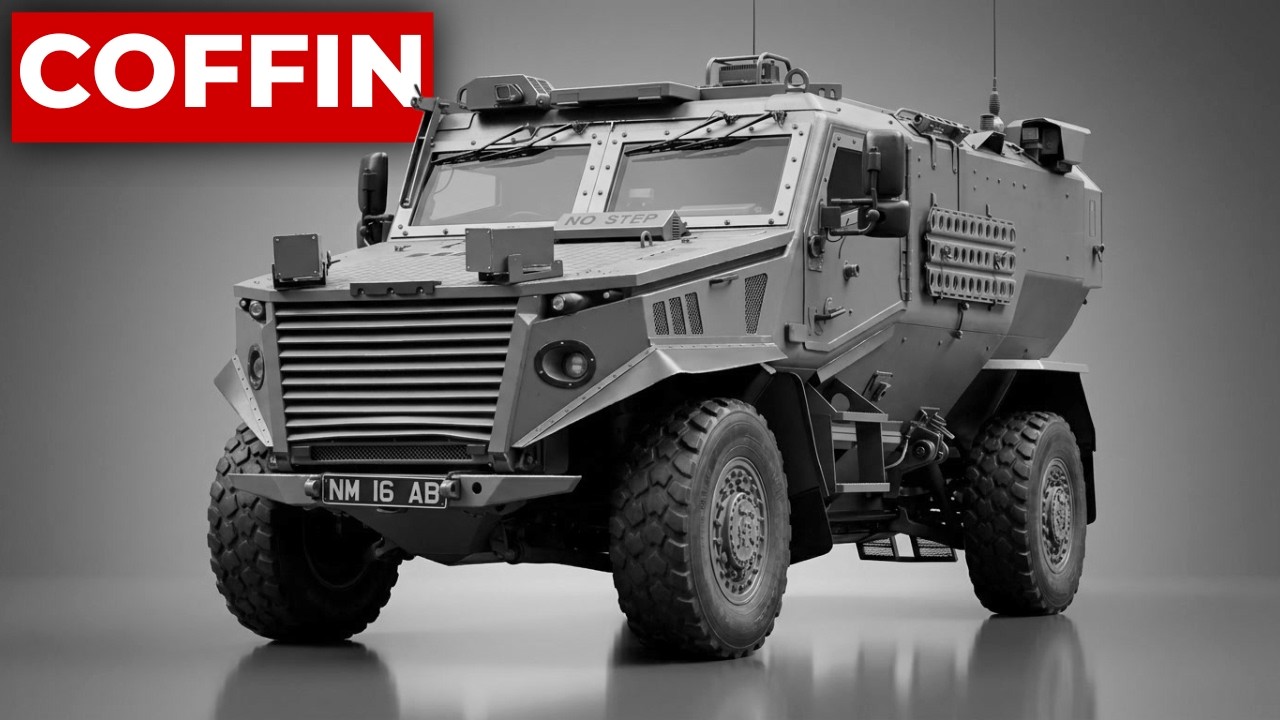
The engine, the transmission, the fuel tanks, the batteries, the electrical generator, all of it is packaged inside the spine beneath the crew floor, creating a sealed armored keel. Above the spine, the crew pod bolts on as a separate module, demountable, swappable in approximately 30 minutes, replaceable in the field without specialist equipment.
The V-hull works on a simple principle. When a blast detonates beneath a flat-bottom vehicle, the force has nowhere to go but straight up. The Snatch floor, the Snatch seats, and the Snatch crew absorb all of it. The V-hull redirects the blast outward and away from the crew cell, dissipating the energy before it reaches the people inside. This is not new physics.
What is new is achieving it at 7 and 1/2 tons. Equally important is what does not penetrate the crew floor. In a conventional vehicle, the steering column, the gear linkage, the brake pedal connections, all of them pass through the floor and into the occupant space. Each one is a potential channel for blast energy.
The Foxhound’s V-hull spine contains all of those components beneath the armored floor. Nothing mechanical passes through the crew cell. The seats are suspended and fitted with five-point harnesses designed to hold occupants in place as the blast wave passes. Taken together, these design choices represent a fundamentally different philosophy of protection, not armor alone, but geometry.
The armor itself was developed with DSTL, the MOD’s Defense Science Laboratory, using composite materials and manufacturing processes borrowed from Formula 1. The vehicle is lighter than any steel-armored alternative could achieve, and the protection it provides exceeds what the weight suggests. Add-on armor panels allow the protection level to be increased for specific threat environments.
The vehicle can be driven away on three wheels after losing one to a blast. It has a 12-m turning circle, roughly the same as a London bus, achieved through four-wheel steering. It can be fully air-transported in a C-17 or C-130 and slung beneath the Chinook. Two companies competed for the contract. Force Protection’s Europe’s Ocelot went up against the SPV 400, built by Supacat and NP Aerospace.
Both were clean-sheet British designs. Both were described by their makers as meeting the blast protection requirement. After extensive trials, the MOD selected the Ocelot as preferred bidder in September 2010. An initial order worth 180 million pounds was placed in November 2010. Further orders followed.
The final fleet came to approximately 400 vehicles at a program cost of of 370 million pounds, roughly 900,000 pounds per vehicle. Assembled at Merthyr Tydfil in Wales, the first five Foxhounds flew into Camp Bastion on the 2nd of June 2012. It was a moment the families of the dead had been waiting for.
It was also, as The Spectator noted at the time, 5 years too late. British combat operations in Helmand ended in October 2014. The Foxhound had 26 months in the theater that had killed 37 of its predecessors. That is not a criticism of the vehicle. It is a criticism of the decisions that delayed it. In Helmand, Foxhound operated in the roles for which it had been designed, mobile patrolling in the narrow lanes and compounds where Mastiff could not go, quick reaction force tasks, convoy protection, mentoring and partnering with Afghan forces. The army described its blast survivability as unprecedented for its size and weight. What can be said with confidence is that the vehicle was tested against the threat that had made the Snatch infamous. And the design principles behind it, the V-hull, the suspended crew cell, the sealed spine, had been proven across thousands of strikes on Cougar and Mastiff vehicles. The geometry worked. It had always worked. The question was only ever whether it could be made small enough. The vehicles that most closely compare to the Foxhound tell you exactly what it was
trying to achieve and why. The American Buffalo and Cougar are its conceptual ancestors. The US Marine Corps had reported in 2004 that no troops had been killed in over 300 IED strikes on Cougars. Those vehicles proved the principle, but they were large, heavy, and built for American logistics infrastructure.
The Mastiff brought that principle to British service, but at a scale that limited its tactical usefulness. The Ridgeback was smaller, but still too heavy for the agile patrol niche. The Foxhound filled the gap that all of them left open. The patrol that had to be on foot one moment, in a vehicle the next, and airlifted somewhere else entirely the moment after that.
The Foxhound never left service when Afghanistan ended. In January 2014, the MOD transitioned it from a wartime urgent operational requirement into the Army’s core fleet, a permanent asset, not a crisis purchase. Six infantry battalions restructured around it. RAF Regiment squadrons adopted it for airfield defense.
It deployed to Bosnia, to Oman, to Iraq under Operation Tel Tal, to Poland on NATO’s eastern flank. At the DSEI exhibition in 2025, a new variant appeared carrying a multi-role missile system and a 30 mm cannon configured for air defense and counter-drone operations, a mission the designers of 2010 could not have imagined, but that the modular architecture had always made possible.
The pod comes off in 30 minutes. Another pod goes on. The British Army currently plans to retire its Foxhound fleet around 2030, replacing it under the land mobility program with a next-generation light protected vehicle, General Dynamics, which now owns Force Protection, is offering an upgraded Foxhound Mark II and a mid-life update that could extend service life to 2043.
That decision has not been made. The vehicle that was built to answer an urgent question about how British soldiers die may outlast the generation of soldiers it was built to protect. There is a version of this story in which the Foxhound is simply a good piece of engineering, clever, capable, efficiently procured.
In some ways it is exactly that, but the fuller version begins in a field in southern Iraq in 2005 with a flat steel floor and a device in the road and a mother who was told her son was safe because he was driving something better than he actually was. The Snatch killed 37 people because someone decided that adequate protection was enough.
The Foxhound exists because eventually that decision became indefensible in Parliament, in the Supreme Court, in the Chilcot report, in a letter from a defense secretary to a woman who had been waiting 12 years for someone in authority to say they were sorry. A vehicle is only as good as the decision that produced it.
The Foxhound is a very good vehicle. It should not have taken 37 deaths to build it. That is what it means to build something from necessity. That is the Foxhound.