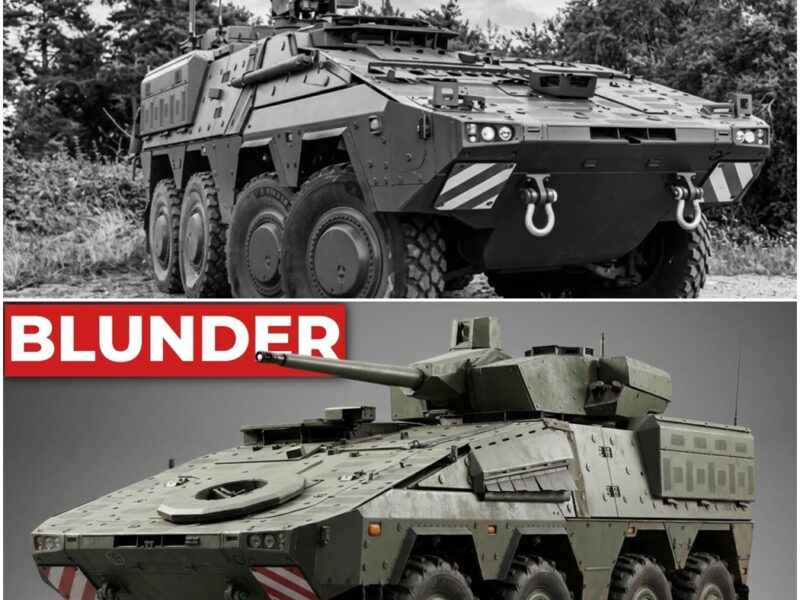
The ‘Pointless’ NATO 8×8 That Cost Britain Fifty Seven Million to Quit, Five Billion to Rejoin D
1993, a design office in Munich, Germany. Engineers from two nations are working on the same problem. A problem that every major Western army has been wrestling with since the Cold War ended. The world has changed. The threat has changed. Fixed front lines and mass tank battles are no longer the future.
The future is Balkans, Somalia, Sierra Leone. Rapid deployment, expeditionary warfare, troops arriving fast, fighting in broken terrain, and needing protection that keeps pace with them. The vehicle they are designing is not yet named. It does not yet exist. But on the drawing boards, it is already enormous.
A hulking, steel-bodied, eight-wheeled machine with an unusual feature at its core, a feature no armored vehicle has ever used at scale before. The body splits in two. The lower section, the chassis and engine, is one piece. The upper section, the fighting compartment, is another, separate, swappable, removable in the field in under an hour.
It sounds impractical. It sounds over-engineered. It sounds like the kind of thing that looks brilliant in a PowerPoint presentation and falls apart the moment it meets real soldiers and real mud. Three nations would spend a decade designing and funding it. Then one of them would walk away, call it unnecessary, and invest heavily in an alternative that would collapse into one of the worst procurement disasters in modern British military history.
Then that same nation would come back 16 years later, spending 5 billion pounds to buy the vehicle it had abandoned, becoming, in a final twist of extraordinary irony, that vehicle’s single largest customer in the world. Its name is the Boxer. And the story of how Britain helped to build it, rejected it, failed without it, and then bought it back at enormous cost is one of the most embarrassing and instructive chapters in the history of British defense procurement.
To understand why Britain made that decision in 2003, and why it would spend the next decade regretting it, you need to understand the problem NATO armies faced in the 1990s. The Cold War had ended, and with it the logic that had shaped British armored forces for 40 years, the British Army of the Rhine was built to stop Soviet armor rolling through the Fulda Gap.
Heavy tanks, heavy infantry fighting vehicles, fixed positions along fixed lines. That doctrine demanded a certain kind of vehicle, tracked, heavily armored, slow to deploy, designed to fight in the same valley for weeks. By 1992, that valley was irrelevant. The conflicts erupting across the globe demanded something different.
Speed of deployment, enough protection to survive ambush, enough versatility to shift between peacekeeping and combat at short notice. The Americans called it medium weight, the British called it rapid effect. The name changed, the requirement did not. NATO needed a wheeled armored vehicle that could do everything and be anywhere.
France, Germany, and Britain began serious cooperative work in 1993. The French pulled out in 1999. Paris wanted something lighter, better suited to African deployments, and the industrial relationship was, as always, complicated. France went on to build its own vehicle, the VBCI. Britain and Germany pressed on.
The Netherlands joined in 2001. A program management agency called OCCAR oversaw the contract. An industrial consortium called ARTEC was formed, bringing together Krauss-Maffei Wegmann and Rheinmetall in Germany, with the Dutch firm Stork, and in Britain, a company called Alvis was building the first British prototypes at a factory in Telford, Shropshire.
In December 2002, the vehicle was formally named Boxer. British engineers had contributed to its design. British taxpayers had contributed roughly 57 million pounds to its development. British industry was producing hardware, and the vehicle, by every measurable standard, was genuinely impressive.
The Boxer was built around a concept that its designers called the drive module and mission module system. The lower portion of the vehicle, the drive module, contains the engine, the driver’s position, the transmission, the running gear, and the crew protection structure. The upper portion, the mission module, is a self-contained pod.
bolt it on, connect the cabling, drive away, unbolt it, attach a different pod, the same chassis becomes an ambulance, a command post, an infantry carrier, an engineer vehicle, or an artillery platform, depending on what the mission demands. No other vehicle in NATO service could do this. The concept meant that a single fleet of drive modules could, in theory, be reconfigured to meet almost any operational need without ordering and maintaining separate vehicle types for every role. The engine powering that drive module was the MTU 8V 199, a diesel unit producing 530 kW, or roughly 715 horsepower, coupled to an Allison automatic transmission offering seven forward gears and three reverse. The entire power pack could be removed and replaced in the field in approximately 20 to 30 minutes. Top road speed was around 103 km/h. Operational range exceeded 1,000 km on internal fuel. The hull provided baseline protection at STANAG 4569 level four, meaning it could
withstand heavy machine gun rounds at close range and artillery fragmentation, with upgrades available for the frontal arc. The floor was designed with a V-shaped geometry and triple layering against mine blast. The crew sat in blast-attenuating seats. A full nuclear, biological, and chemical protection system was standard.
It weighed approximately 33 tons at baseline, more with upgrades, and that weight was the problem. 33 tons was too heavy for a Hercules C-130 transport aircraft. That was the British military’s standard strategic air transport workforce. Britain’s doctrine after the 2002 strategic defense review new chapter called for rapid expeditionary deployments.
Troops arriving fast by air into uncertain environments. If your armored vehicle cannot fit on your transport aircraft, your rapid deployment doctrine has a fundamental problem. On July 17, 2003, Armed Forces Minister Adam Ingram stood up in Parliament and announced that Britain was withdrawing from the Boxer program. The vehicle was, he said, not ideally suited to the type of operations envisaged under the Strategic Defence Review New Chapter.
The money spent was written off. The Alvis production work in Telford ceased. Germany and the Netherlands carried on. Britain would build its own vehicle instead, something lighter, something faster, something better. Britain would call it the Future Rapid Effect System. Before we get to what happened next, if you are finding this deep dive into British military procurement and armored vehicle history useful, hit subscribe. It costs nothing.
It takes 1 second, and it helps this channel to keep producing this kind of detailed military analysis. The Future Rapid Effect System, known universally as FRES, was conceived on a grand scale. The British Army wanted a family of medium-weight, network-enabled, air-deployable vehicles across multiple roles.
Utility carriers, specialist vehicles, reconnaissance platforms, medium armor, maneuver support. The requirement ran to more than 3,000 vehicles across the variants, with an acquisition value estimated at roughly 16 billion pounds. It was, on paper, everything that Boxer was not. Lighter, more deployable, more British. The program began generating requirements, then revised requirements, then reviews of the requirements.
A system of systems integrator was appointed to manage the architecture, a role occupied for a time by a joint team involving Thales and Boeing. The complexity of the management structure grew. The requirements kept shifting. The weight kept growing as protection demands increased. In 2007, the Ministry of Defence reached a decision point on the utility vehicle strand of FRES.
Three candidates were brought forward for what became known as the trials of truth. Their purpose was to identify the best vehicle available. Three vehicles were tested, the Piranha V from General Dynamics, the VBCI from France, and the Boxer, the same vehicle Britain had rejected and Germany had continued to develop.
The Boxer was back at the table 4 years after Britain had walked away from it. In May 2008, the Piranha 5 was named as the provisional preferred bidder. General Dynamics had won. Britain, it seemed, was not going back to Boxer after all. The Piranha 5 was lighter, amphibious, cheaper per unit, and aligned with the weight targets FRES demanded.
In December 2008, the Piranha 5’s preferred bidder status was withdrawn. Negotiations had broken down over commercial terms and intellectual property. The contract was not signed. The procurement collapsed. The utility vehicle strand of FRES entered a prolonged crisis. It was redesignated, restructured, and slowly starved of decisions and funding.
The Defense Select Committee in Westminster described the program in language unusual for a parliamentary committee as a fiasco. By 2012, a senior Ministry of Defense source told reporters that FRES was, in their words, dead in the water. The specialist vehicle strand of FRES survived, eventually becoming the Ajax program, which would develop its own catastrophic problems with noise, vibration, and crew health concerns that kept it out of service for years after its contracted delivery date.
Britain had rejected Boxer in 2003. Britain had failed to replace it with anything, and for the years in between, British mechanized infantry continued to rely on vehicles that were already old when FRES had been conceived, the FV432, a tracked personnel carrier from the 1960s, the Warrior, an infantry fighting vehicle that entered service in the 1980s.
In Iraq and Afghanistan, the gap was filled by urgent operational requirement vehicles procured in haste, Mastiff, Ridgeback, Foxhound, all excellent at what they were designed for. None of the mechanized infantry vehicles in any conventional sense. Meanwhile, the nations that had stayed with Boxer were fielding it.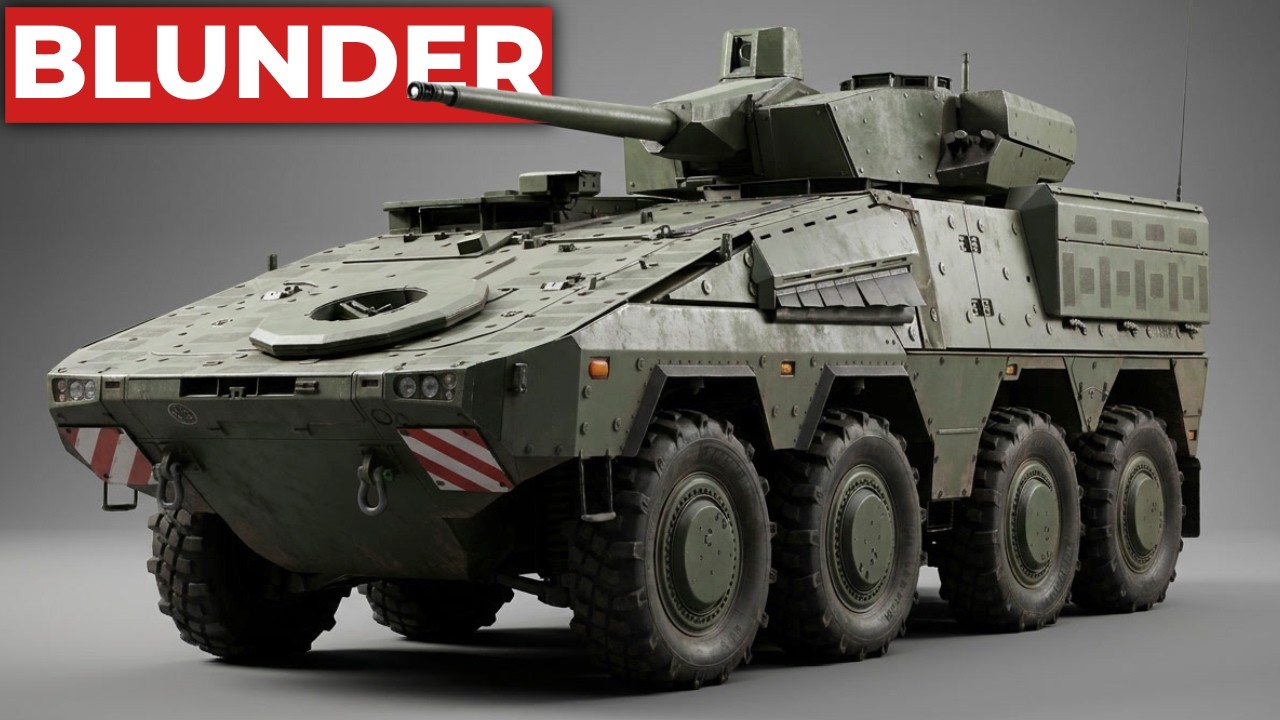
Germany received its first production vehicles in 2009 and 2010. By July 28, 2011, the first German Boxers arrived at Camp Marmal in Mazar-i-Sharif, northern Afghanistan, deployed with the International Security Assistance Force. The initial tranche was small, approximately five to seven vehicles, growing to around 31 by January 2013, including ambulance variants that arrived in December 2012.
German soldiers operating Boxer in Afghanistan found themselves in exactly the environment that Britain had cited as a reason to reject the vehicle in 2003, improvised explosive devices, ambushes on convoy routes. The constant low-intensity threat of a counterinsurgency campaign in broken terrain, extreme heat, and dust conditions that destroyed lesser equipment.
The region around Mazar-i-Sharif was not forgiving country. Temperatures in summer exceeded 50° C. Roads were unpaved tracks that dissolved in rain and became traps of compacted ruts in the dry season. Dust entered every mechanical system. Every vehicle deployed to northern Afghanistan was tested in ways that peacetime trials could not replicate.
The Boxer performed. German parliamentary commissioner reports from the period recorded that soldiers found the vehicle well suited to the deployment and a substantial improvement over the aging Fuchs it replaced. The driver’s position, separated from the mission module, gave the crew genuine protection even in the event of penetration of the upper compartment.
The blast attenuating seats and V-shaped floor absorbed ground burst energy in a way that earlier German vehicles could not match. The modular concept proved operationally practical. When an ambulance was needed, the module was changed. When a different configuration was required for a patrol, the drive module was reconfigured.
The flexibility that had looked like over-engineering on paper looked like operational genius in the field. The lessons learned in Afghanistan were fed directly into an improved production standard. The A2 standard addressed specific vulnerabilities identified by German crews in theater. The vehicle got better because it was being used.
That is how military equipment matures, not in design offices, in contact with the enemy. The Netherlands fielded its own Boxer fleet from 2013 onward, deploying vehicles with NATO’s enhanced forward presence battle group in Lithuania. Australian interest was growing. Lithuania had already placed an order. A vehicle that Britain had declared unnecessary was becoming one of NATO’s most widely adopted platforms.
In Westminster, the questions were getting uncomfortable. Parliament had watched FRES collapse. Ajax was delayed and troubled. The strike brigade concept, the successor to the rapid deployment logic that had originally Britain away from Boxer needed a vehicle. The British Army was restructuring around two armored brigade combat teams and needed a modern protected wheeled 8 by 8 infantry carrier as a matter of operational urgency.
The defense secretary and senior military leadership reviewed the available options. The requirement was for what the Ministry of Defense now called a mechanized infantry vehicle, 8 by 8, well protected, proven in service, available from a credible supplier with some prospect of UK industrial content.
In March 2018, the Ministry of Defense announced that Britain would rejoin the Boxer program through ARTEC. The announcement was made over a bank holiday weekend with Parliament in recess. Some observers noted the timing. Lieutenant General Paul Jaques, the Ministry of Defense’s chief of material for land, appeared before the Defense Select Committee to justify the decision. He was direct.
Boxer was, in his assessment, the best protected vehicle available in the class. It offered the best power-to-weight ratio. It had the best mobility. It had been proven in operational service with allied nations, and procuring through OCCAR, the existing program management agency, offered significant value.
The United Kingdom was, in effect, buying into a mature production program that had already resolved the development risks Britain had declined to share. Members of the committee asked the obvious question. Britain had helped design this vehicle. Britain had spent 57 million pounds contributing to its development.
Britain had walked away. And now Britain was buying it back through a non-competitive single-source contract. What had changed? The answer was, ultimately, that everything had changed. The threat had changed. The doctrine had changed. The promised alternative had failed entirely. And the vehicle that Britain had rejected had spent 16 years proving itself.
The contract was signed in November 2019. The value was 2.3 billion pounds for an initial tranche. The supplier was Artec. The production arrangement was notably British in one respect. Rheinmetall BAE Systems Land, a joint venture known as RBSL, was established to produce a significant portion of the UK fleet at the old Alvis factory in Telford, Shropshire.
The same Telford facility where British engineers had built the original Boxer prototypes before the program was canceled in 2003. The wheels of military procurement move slowly. Sometimes they make a full circle. RBSL was awarded a subcontract worth approximately 860 million pounds to build more than 260 vehicles at Telford, covering command and specialist carrier variants.
KMW and WFEL, its partner at Stockport in Greater Manchester, took the remaining production share. Rolls-Royce Solutions UK, operating from East Grinstead in West Sussex, was contracted to manufacture 523 MTU engines entirely within Britain. The industrial footprint of the program was substantially domestic.
In late 2022, the United Kingdom placed an order for 100 additional vehicles, raising the total Boxer MIV order to 623 vehicles across four variants: 146 infantry carriers, 212 command vehicles, 200 specialist carriers, and 65 ambulances. The total program investment was confirmed at 5 billion pounds. 623 vehicles, 5 billion pounds for a vehicle Britain had walked away from when it had the chance to stay in for 57 million on January 21, 2025.
At the International Armored Vehicles Conference, Defense Procurement Minister Maria Eagle stood alongside the first Boxer vehicle to have been entirely built in the United Kingdom. It had been assembled at Telford. It carried British-made armor. It ran on a British-made engine. The program was, by any measure, behind schedule.
Initial operating capability, once targeted for around 2025, had slipped. Production was running at approximately 100 vehicles per year, placing completion of the full order around 2031. The full British Army requirement, stated officially as 1,305 vehicles, remained well beyond the current funded order.
These were real problems. But they were the problems of a program that existed, was producing vehicles, and was building the industrial base to sustain them. They were not the problems of a program that had collapsed entirely. FRES was the comparison. Next to FRES, the MIV program, slow and expensive as it was, looked like a model of delivery.
And while Britain was still waiting for its first vehicles in squadron service, the Boxer was expanding globally. Germany had grown its fleet to over 400 vehicles, with further orders placed for the Sky Ranger 30 air defense variant, and for an extraordinary development, a wheeled self-propelled howitzer built on the Boxer drive module called the RCH 155.
The RCH 155 placed the artillery gun module from the Panzerhaubitze 2000, a 155 mm cannon, in a fully automated turret onto the Boxer chassis. The crew was reduced to two. The system could fire on the move. It required no preparation time. The gun could engage targets at ranges beyond 40 km, and the entire system could be reconfigured into a different role by swapping the mission module.
Germany ordered 84 RCH 155 systems in December 2025. Britain announced its intention to procure the system as a replacement for the aging AS90 howitzer. Ukraine had already received the first examples in January 2025, deployed operationally. Australia had selected Boxer under its Land 400 Phase 2 program, ordering 211 combat reconnaissance vehicles fitted with a manned Lance turret carrying a 30-mm cannon.
The Australian contract alone was valued at 4.28 billion Australian dollars. Lithuania operated over 100 Boxer variants designated Vilkas, armed with 30-mm cannon and Spike anti-tank missiles. Qatar had placed order. OCCAR reported by the end of 2024 that more than 700 Boxer vehicles had been delivered to Germany, the Netherlands, and Lithuania with the total number of vehicles on order across the program’s four original nations exceeding 1,350 at a combined value above 6.
2 billion euros. A vehicle declared pointless and unnecessary by Britain in 2003 had become one of the defining armored platforms of the early 21st century. More than 12 nations were operating or had ordered it. It was fighting in Ukraine. It was deployed across NATO’s eastern flank. It was on its way to equipping the British Army’s restructured mechanized brigades.
Step back, return to Telford 2003. The engineers who had built the first British Boxer prototypes packed away their tools and moved on to other programs. 57 million pounds of British design and development work was written off. The Ministry of Defense turned its attention to the Future Rapid Effect System, a program of extraordinary ambition and catastrophic execution.
Boxer was too heavy. Britain needed something lighter. The logic seemed sound. The alternative was worse. FRES produced nothing. Ajax produced something eventually, but not without years of failure and serious questions about crew safety. The armored vehicles budget consumed billions in studies, contracts, reviews, and aborted procurements.
Money that produced no vehicles and no capability. Britain’s mechanized infantry rode to war in Iraq on FV432s, built in the 1960s. They mounted Warrior vehicles designed in the 1970s. They were protected from roadside bombs by MRAPs bought in haste because the original capability program had collapsed.
And Germany, which had stayed in Boxer, deployed a modern protected modular vehicle to Afghanistan and brought it home and improved it. And sold it to Australia, Lithuania, the Netherlands, and now Ukraine. The argument against Boxer in 2003 was not unreasonable. It was too heavy for C-130 transport. It was expensive. It was a joint program with German industrial interest at its heart.
Britain believed it could do better alone. On paper, the alternatives looked attractive. The Piranha V from General Dynamics was lighter, amphibious, and cheaper per unit. The Patria AMV, widely adopted by Poland and Finland among others, weighed roughly 32 tons and offered genuine amphibious capability without preparation.
The American Stryker family was deployable by C-130, proven in Iraq and Afghanistan, available in volume. Against those competitors, Boxer looked heavy, complex, and expensive. In practice, every one of those advantages came at a cost. The Stryker’s lighter protection was manageable in the American context because the United States possessed the logistics and fire support to compensate.
Piranha V’s amphibious capability added complexity and limited the protection ceiling. The Patria AMV was well regarded, but its protection was not in Boxer’s class. What Boxer offered, and what none of the alternatives matched, was the combination of a very high protection ceiling, the modular mission module system, and a power pack that could be swapped in the field by a small team in half an hour.
The entire premise of the program was that battlefield flexibility and crew survivability were worth the weight and cost premium. Germany and the Netherlands had concluded they were right, so eventually had Australia, Lithuania, and Ukraine. The evidence accumulated for 16 years. Britain observed it all from the outside. It could not What the engineers at Telford understood in 2002, what ARTEC had built, and what Germany’s soldiers had proved in the dust of northern Afghanistan, was that a vehicle does not have to be the lightest option to be the right one. It does not have to fit on one aircraft to be strategically relevant. It has to work. It has to protect the soldiers inside it. It has to keep working as the threat evolves, and it has to be available. 623 Boxers are now on order for the British Army. The first British-built example rolled out of the Telford factory in January 2025, the same factory where Britain built its last Boxer prototype 22 years earlier, before walking away. The vehicle did not change. The threat
did not change. The requirement did not change. Britain changed its mind. Some might call that a failure of foresight. Some might call it a failure of institutional nerve. Some might simply call it expensive. What it undeniably is is a lesson. Proven capability, shared development, and allied interoperability are worth more than the promise of something better that may never arrive.
Britain learned that lesson. It cost 5 billion pounds to learn it.