The Queen Mother Treated Staff Like They Were Beneath Her — And Everyone Knew S
Every royal myth has a servants’ corridor. In the front rooms, the dining rooms and drawing rooms, the palaces and the parlors, the Queen Mother smiled, waved, and became the grandmother of the nation. She wore pastels that photographed in soft focus. She accepted flowers from small children and seemed genuinely to delight in the exchange.
She survived the Blitz, outlived her husband by 50 years, attended horse races at 99, and died in her sleep on 30th March 2002 at Royal Lodge, Windsor, aged 101 with the Queen beside her. When her coffin was carried to Westminster Hall, an estimated 200,000 people queued along the Thames to file past it.
The tenor bell of Westminster Abbey tolled once for each year of her life. But behind the doors where people carried trays, heated rooms stood at attention, and waited to be spoken to, a very different verdict kept appearing. Not one bad mood. Not one difficult day. The same words again and again, snob, nasty, the worst person she had ever worked for.
So, what happens when the people with the least power become the best witnesses? They tell their children. Their children tell theirs. The record accumulates not in libraries or official biographies, but in memory, stubborn, inconvenient, and remarkably consistent. The woman who could bring a crowd to tears on a walkabout was apparently quite a different proposition once the door marked staff swung shut.
To understand why that gap existed, and why it persisted for over a century without consequence. You have to understand both halves of it. The same did image first, then the servants’ corridor. The myth wasn’t manufactured from nothing. It was built on specific documented events during a period when the stakes were real enough that fabrication wouldn’t have held.
On 13 September 1940, a German Heinkel flew low over central London and dropped of bombs across the forecourt of Buckingham Palace. King George VI and Queen Elizabeth were in residence. Neither was hurt, but the palace’s private chapel was destroyed and glass from shattered windows embedded itself across the courtyard.
Before the masonry had settled, Elizabeth made the remark that would define the next 60 years of her public life. “I’m glad we’ve been bombed,” she said. “It makes me feel I can look the East End in the face.” The East End had been burning since 7 September, the night 449 German bombers hit the docks.
The working-class districts running along the Thames, Stepney, Poplar, Bermondsey, had borne the full weight of the Luftwaffe, while the West End and its palaces remained largely untouched. When the palace was hit, that class division cracked open, at least publicly. The royal family had been in the blast radius.
The image of shared danger wasn’t entirely false. Elizabeth had already understood the problem. When she and the King first toured the bomb sites of the East End in September 1940, the reception was openly hostile. Rubbish was thrown at her car. Crowds jeered. She arrived wearing expensive clothes to streets where people had just lost everything, and the gap was obvious to everyone present.
She moved to close it with characteristic instinct, having Norman Hartnell redesign her public wardrobe into what he called the rainbow of hope. Gentle, soft-focus colors rather than the morning black that might have read as royal grief rather than national solidarity. The jeering stopped.
The photographs multiplied. Throughout the war, she and George VI visited bomb sites, hospitals, factories, and the communities most devastated by the German campaign. The government had at various points advised evacuating the royal children to Canada. Elizabeth’s response had already become legend. “The children won’t go without me.
I won’t leave the king, and the king will never leave.” By the time Germany surrendered, the two of them had constructed something genuinely difficult to fabricate. A reputation for physical solidarity with people who had nothing. It took real choices made under real conditions. After George VI died on 6th February, 1952, she had 50 years left in which to bank that reputation at compound interest.
The pastel dresses continued. The walkabouts continued. She attended Cheltenham and Ascot, fished for salmon in Scotland. On one celebrated occasion, dragging a 20-lb salmon home in the dark at Balmoral, arriving late for dinner, holding it up and saying, “Sorry, but this is what has kept me.” She lunched at Claridge’s, at the Ritz, at Raymond Blanc’s Le Manoir aux Quat’Saisons near Oxford.
She entertained politicians, tycoons, and patrons of the arts at Royal Lodge, where weekend invitations were among the most prized in the social calendar. She became, with each passing decade, a more elaborately beloved figure. The last great Edwardian, the woman who seemed to remember everyone’s name, the gracious, silver-haired national grandmother who could be seen at 95 still doing 54 public engagements in a year, and at 99 still at the races.
When she died, the condolences came from everywhere. George W. Bush, Vladimir Putin, Jacques Chirac, South African President Thabo Mbeki, the King of Spain, the King of Jordan, all paid tribute. The queue to see her coffin stretched over Lambeth Bridge, forcing officials to extend the opening hours beyond the original schedule.
Four days of lying in state at Westminster Hall, a funeral at Westminster Abbey attended by 2,200 guests, 1,700 military personnel in the procession, a pipe band of 192 musicians drawn from 13 regiments. Her coffin draped in her personal standard, topped with camellias cut from her own gardens, her crown resting on a cushion.
The myth had held for 60 years. That it was so powerful is the only reason the alternative account required real resilience to survive. Because there was an alternative account, and it came from the people who knew her in the rooms without cameras. The official biography was always going to be sympathetic.
William Shawcross, commissioned by the royal family to write the definitive life with full, unrestricted access to the Queen Mother’s personal papers, letters, and diaries, produced a 1,000-page account published by Macmillan in 2009. Its Guardian reviewer, the historian Tristram Hunt, described it as the work of a man determined to empathize at all times with the royal point of view.
A second reviewer, Catherine Bennett, observed that Shawcross had chosen to do for her reputation precisely what had been done for her houses after her death. Preserve it exactly as it was in her lifetime. What slips through even that careful custody is instructive. When Elizabeth visited the East End after the palace bombing in September 1940, she wrote a letter home describing a site where 200 people had died under a bombed school.
She closed it with a postscript. Dear old BP is still standing, and that is the main thing. BP was Buckingham Palace. Small moments accumulate. The Independent didn’t wait for small moments. In a profile published during her lifetime, the paper described her as bigoted, snobbish, profligate, arguing that beneath her legendary charm is a tough old bird who has always managed to con us.
A mainstream broadsheet, under its own byline, applying those three words to the most beloved woman in Britain. The profile ran, “Nothing changed.” The myth was structurally impervious to named published criticism because the myth wasn’t dependent on evidence. It was dependent on a feeling.
And feelings don’t respond to profiles in newspapers. What the documented record does provide is a consistent portrait from people who had actual proximity to her across several decades and several different contexts. George VI’s private secretary, when asked to define her political philosophy, turned to a Victorian hymn.
It was, he said, “Best captured by All Things Bright and Beautiful. The rich man in his castle, the poor man at his gate. God made them high and lowly and ordered their estate. She wasn’t unusual for her background in holding that view. She was unusual in being simultaneously positioned as the woman of the people, the figure who shared your bomb damage, who wanted to look the East End in the face.
“I hate this classlessness thing,” she told the Labour peer and diarist Woodrow Wyatt, one of her closest confidants in later life. “It’s so unreal.” Her equerry, Colin Burgess, documented specific behavior in the same key. She wondered aloud, according to Burgess, why people were always thrusting babies at her to kiss.
A detail that sits uncomfortably beside the image of the natural, warm grandmother who lit up walkabouts. She mimicked the voice of a former servant who came back to visit. She mocked anyone who mispronounced “ma’am” with a broad A. The correct version, as she understood it, rhymes with “spam,” not “harm.
” The wife of the British ambassador to France, who had observed her across enough occasions to form a considered view, offered this: “Elizabeth was rather mocking, not very kind.” The journalist A. N. Wilson reported, in The Spectator, a conversation in which she described T. S. Eliot’s visit to Buckingham Palace to read from his own work.
She said something to the effect that they’d had this rather lugubrious man in a suit who read a poem she and others found baffling, a gloomy man who looked as though he worked in a bank. The poem was The Waste Land. Her response to Wilson’s published account was swift, denial. Wilson became the story that week, not the remark. The system ensured that.
Hugo Vickers, another biographer who worked with primary sources, documented a family matter that reveals the precise limits of her compassion with particular clarity. Two of her nieces, Nerissa and Katherine Bowes-Lyon, born with learning difficulties, had been placed in a psychiatric institution. For decades, Burke’s peerage listed them as dead.
They weren’t dead. When the story eventually became public, her response wasn’t grief or acknowledgement, but damage limitation. She ensured that it was noted on the record that the impairment wasn’t from her side of the family. The two women died in the institution without ever receiving a visit. These aren’t the actions of a monster in any theatrical sense.
They’re the actions of someone whose class formation had constructed, very efficiently, a partition between herself understanding and any sustained reckoning with how she was experienced by others. Whether that amounts to deliberate cruelty or to a more ordinary variety of aristocratic blindness is something the record doesn’t resolve cleanly.
What it does resolve is that the partition held, decade after decade, and that the structure surrounding her was specifically engineered to ensure it was never subjected to serious pressure. To understand how that partition was maintained on an ordinary Tuesday afternoon, you have to understand the physical architecture of her daily life.
Because the architecture is the argument. By the end of her life, the Queen Mother maintained a staff of 50. Housekeepers, butlers, footmen, pages, chefs, equerries, ladies-in-waiting, dressers, gardeners, chauffeurs, and a watchman. A real human being paid to sit on a chair outside her bedroom door throughout the night.
These 50 people traveled with her between five residences: Clarence House in London, Royal Lodge in Windsor Great Park, Birkhall on the Balmoral Estate in Scotland, the Castle of May in Caithness, and Walmer Castle in Kent. The daily choreography communicated hierarchy continuously and without rest.
A Fabergé bell summoned service. Footmen stood behind nearly every chair at dinner. At Birkhall, flowers were planted in the garden to bloom precisely upon her August arrival. Log fires burned in every room, even in summer, because she expected warmth when she arrived, and the summer temperature of the Scottish Highlands wasn’t consulted on the matter.
Every morning, without exception, a curtseying maid knocked on her bedroom door at exactly 7:30, carrying a bone china teacup, pink roses, and a copy of the Racing Post, and placed them beside her bed. Her annual income from the Civil List stood at 643,000 pounds. She spent considerably more than that.
Her overdraft at Coutts reached 4 million pounds. The Queen reportedly bailed her out to the tune of a million pounds or more each year. In 1994, she placed 2/3 of her fortune in trust for Princes William and Harry to avoid inheritance tax, which left her short of funds, which didn’t cause her to reduce her expenditure.
When Norman Hartnell warned her that the osprey feathers she was considering cost 100 pounds each, she jutted out her jaw and ordered another set in white. She expected her personal world to be prepared before she entered it. Her lady-in-waiting would arrive ahead of her at private homes to brief the hosts.
Precise requirements for how she was to be addressed, what she expected in her accommodation, what was needed in the rooms before she could enter them comfortably. Published accounts of her household described standing instructions carried by her staff. The bedroom gin and tonic prepared in advance to specification.
The hosts at a country weekend didn’t simply receive a guest, they received a set of conditions carried by a person whose job it was to ensure those conditions were met before her car reached the gate. When Winston Churchill needed to convince her to vacate Buckingham Palace after George VI’s death in 1952, he had to bribe her.
She described Clarence House, a five-story Nash mansion with gardens in St. James’s, as a horrid little house. Churchill also offered her the governorship of Australia as an alternative, which she declined with similar confidence. She insisted on creating her own courtesy title rather than accepting the one that emerged naturally from her situation.
She wouldn’t be the Queen’s mother. She would be Queen Elizabeth, the Queen Mother. Still a queen, still entitled to the curtsy, still positioned above almost everyone in the country. The title wasn’t ceremonial. It was a statement about the permanent ordering of things. Royal household employment contracts included a document called a deed of undertaking of confidentiality.
Staff signed an agreement not to disclose information relating to their work in the royal household. The text wasn’t ambiguous. You have been asked to sign a deed to agree not to disclose confidential information relating to your work in the royal household. This operated alongside the Official Secrets Act for relevant staff.
Before a new employee had completed their first week, they had signed away their right to describe their experience of it. The hierarchy below stairs mirrored the hierarchy above, and convention in aristocratic and royal households had long demanded that employers act as though the staff attending them didn’t quite exist.
Eyes averted. Not speaking unless directly addressed. Standing against walls when passing. The social hierarchy among servants replicated the social hierarchy of the family. Butlers and housekeepers at the top, scullery staff at the bottom. Each layer maintaining its separateness from the one beneath.
Any complaint from a junior staff member had to travel up through the same hierarchical chain that hired, evaluated, and could dismiss them. There was no independent grievance body. No external mechanism existed by which the person who brought the morning tray could formally object to how they were treated while delivering it.
The architecture of the household didn’t make cruelty inevitable. It made accountability impossible. Walking backwards out of a senior royal’s presence isn’t an invention. It’s a documented feature of British court protocol, traceable across centuries of formal procedure. You arrive before the royal. You stand until they sit.
You speak when directly addressed. When you leave, you don’t turn your back. You retreat facing the room until you reach the door. BBC guidance on meeting senior royals specifically instructed, “Never turn your back on them or walk in front of them.” General guidance on addressing members of the royal family confirms that guests should not talk unless spoken to, and shouldn’t sit before the royal was seated.
These weren’t the Queen Mother’s personal inventions. They were the standing architecture of royal deference, and they were applied throughout her household as a matter of routine. An account circulates persistently in online commentary and social media discussions of her household. The framing runs roughly as follows. A commission to paint her portrait comes with a set of rules.
You stand until she sits. You speak only when she speaks to you first. You don’t reach for a brush or shift a canvas before she is settled into the room. And when the session ends, when you need to leave, you don’t turn your back. You walk backwards to the door. The account typically ends with the painter’s response to the backwards walk requirement being, to put it gently, emphatic.
Something in the register of “Sod that.” The story catches because it contains, compressed into a single physical image, everything the verified record says about the system surrounding her. The specific incident, a named artist, a verifiable publication, a dated interview, can’t currently be traced to any primary source. The backwards walk was a real requirement, confirmed across multiple court etiquette documents and historical accounts.
The standing until seated, the speaking only when spoken to, both confirmed as general royal protocol. The specific confrontation, in the specific sharp terms that give it its satisfying ending, appears to be the distillation of a general institutional experience into a single scene, rather than the documentation of one particular afternoon.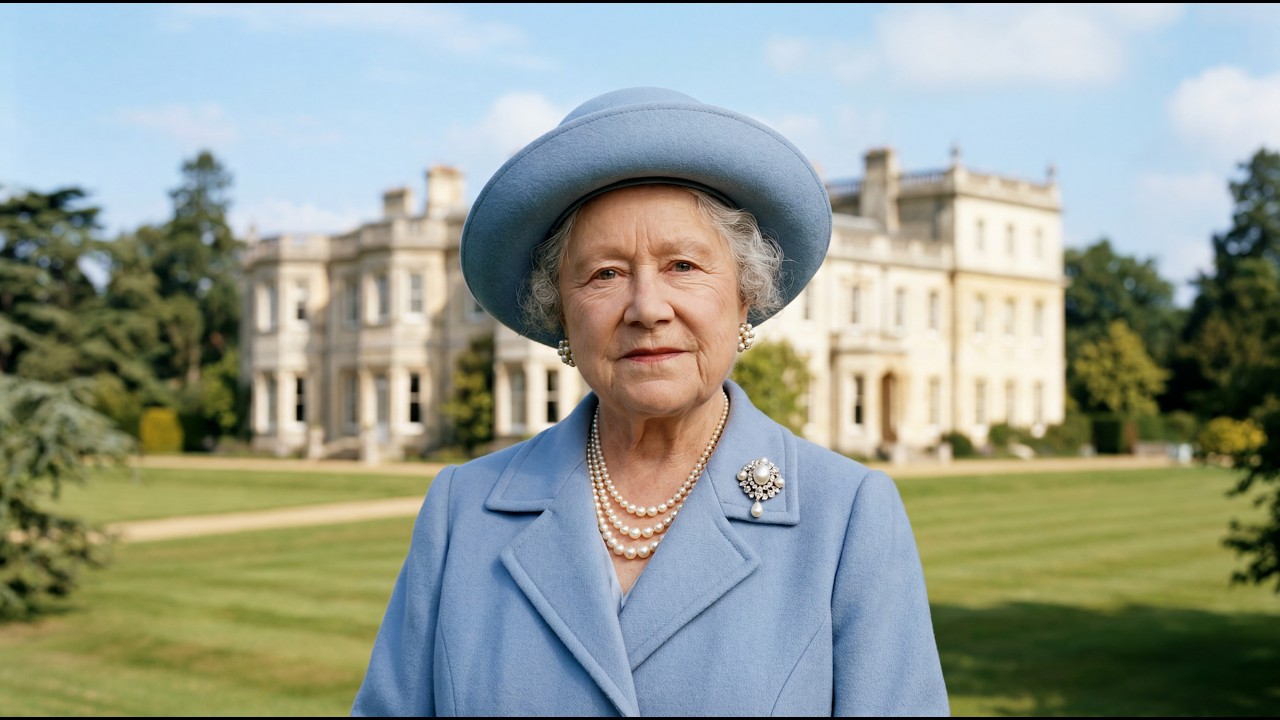
The honest version of that is damning enough on its own terms. What the verified record doesn’t need the anecdote to prove is that the human beings who entered that room to perform skilled professional work were expected, by architecture and by ancient protocol, to demonstrate their subordination through their bodies before they were permitted to speak.
What the record can document is the same dynamic expressed through accumulated smaller incidents. Michael Noakes, who painted a portrait of the Queen Mother, and is among the most thoroughly documented of her portrait artists is described in gallery commentary as having experienced her warmth and compassion directly.
The Philip Mould Gallery’s account of the Noakes portrait describes extended sittings and explicitly highlights the subject’s warmth and the compassion that the esteemed Queen Mother had for those around her. Prince Charles, who owned an earlier sketch by Noakes, praised his ability to capture the essence of his grandmother’s personality.
That is the record from the sitting room. The people who came with different credentials, not the established artist with connections to the Prince of Wales, but the maid, the footman, the lady in waiting who had to arrive early to carry the list of instructions, experienced something the gallery wall does not record.
And between those two receptions of the same person is the actual case. Then there is the question of what nasty meant in practical terms, not as a personalized adjective applied in a moment of pique, but as a consistent characterization offered by people who worked in proximity to her over time. The phrase “nasty piece of work” circulates in connection with her household, and in some versions connects her and Princess Margaret together, as though the assessment came from someone who had seen both of them in the same corridor. The specific origin of the phrase as a named, dated, verifiable staff account can’t be confirmed from any traceable primary source. What can be confirmed is that the word “nasty” doesn’t appear in isolation. It converges with snobbish, with bigoted, with rather mocking, not very kind, with the hymn about God-appointed hierarchy,
with the mockery of the servant’s voice, with the postscript about Buckingham Palace being the main thing after 200 people died under a bombed school. The convergence is the record. The more specific indictment that staff accompanying her on visits were badly housed, inadequately fed, kept in conditions that left them visibly in poor physical condition, while adjacent households treated their own workers with greater basic consideration, appears in accounts connected to her travels between her five residences. The detail is specific enough to have circulated with conviction, but it can’t be traced to a named published source in any primary account reviewed for this documentary. The structural argument it encapsulates, however, is independently confirmed. Academic histories of British domestic service document unheated staff bedrooms, inadequate provision, and the expectation that service workers would
absorb poor conditions as unremarkable. At Cragside House in Northumberland, Lord and Lady Armstrong’s Victorian staff were described as treated considerately, permitted to borrow novels from a household library, offered as a contrast to the standard of the era, rather than as its representative example.
The contrast existed. Whether the Queen Mother’s household sat at the indifferent end of it, the record as it stands doesn’t prove with the precision the claim requires. What the record does prove is that the system in which she operated was one in which the comfort and dignity of the people below her was simply not a formal category of concern.
One account that travels in the specific form of transmitted family memory runs approximately as follows. Someone’s grandmother worked for the Queen Mother or knew someone who did and described her as the worst person she had ever worked for. That account exists in the register of oral history, the kind of testimony that was never going to reach the Shawcross archive, was never going to survive the confidentiality deed, was never going to be offered to a biographer with access to the royal correspondence. It survives because it was charged with enough emotional weight that someone passed it on. Servants in royal and aristocratic households rarely controlled the official archive. The papers preserved in country house collections and national libraries overwhelmingly reflect the perspective of the family upstairs. Academic historians working on British domestic service have documented this absence specifically. Servant records become increasingly rare the further
down the household hierarchy you move. The people who polished the silver and laundered the cherub clothes on the four-poster and stood behind the chairs at dinner left behind very little that was written in their own hand and preserved in any institutional collection. Royal household staff operated under an additional constraint.
The confidentiality deed ensured that first-hand accounts almost never became public during the lifetime of the person they concerned and often not for long afterwards. William Tallon, Backstairs Billy, the Queen Mother’s long-serving steward, the man who walked her corgis and managed her days for decades, worked for years on a memoir that would have been among the most intimate accounts of her private self ever committed to paper.
He died before finishing it. It was never published. What he knew about those rooms, about those unrecorded conversations, about the face she showed when no camera was present, he took with him. The official biography was built from her materials, shaped by access granted on her family’s terms, and its 1,000 pages reflect that.
Princess Margaret, in the final weeks of her life before her death on 9 February 2002, destroyed letters that Princess Diana had written to the Queen Mother on the grounds that they were too private to preserve. The Queen Mother’s official biographers comment on this act of selective destruction was careful.
Understandable, although regrettable from a historical viewpoint. The archive was curated by the family, protected by signed legal agreements, and selectively destroyed by people with a direct interest in the outcome. The oral historian Alessandro Portelli, working on the methodology of spoken testimony, argued that the occurrence of consistent language across independent accounts constitutes meaningful historical evidence in its own right.
Evidence of how an experience was processed and remembered, not merely evidence of factual events. When snob and nasty and worst employer appear in separate accounts from people with no obvious connection to each other, the convergence suggests a real experience, rather than a shared fabrication. Not proof in any legal or archival sense, a pattern rather.
One that resists the explanation of coincidence, and that is more readily explained by a consistent reality than by coordinated invention. That’s the evidential argument for taking staff memory seriously. Not that oral accounts are infallible. Not that anecdote equals documentation. But that the people who signed confidentiality deeds and then 30 years later said something quietly to their families were recording something real.
They just weren’t permitted to do it in writing, in public, or with their names attached. Princess Margaret wasn’t the Queen Mother. Prince Andrew isn’t Princess Margaret. This is their story only in so far as it casts light on hers, and it does cast light, precisely because the behavior attributed to them in documented sources connects directly back to her name, her titles, and the culture she maintained around herself.
Andrew Lownie’s book entitled The Rise and Fall of the House of York documents specific allegations about Prince Andrew’s treatment of household staff. Among them, Andrew humiliated staff members who failed to use the correct titles when referring to Her Majesty the Queen Mother. The same book alleges he summoned maids from four floors down simply to open a curtain.
Reported as characteristic of a broader pattern of bullying behavior toward those below him in the domestic order. The connection between Andrew’s alleged conduct and the Queen Mother isn’t incidental or interpretative. In the documented accounts, the specific trigger for his staff mistreatment was the failure to perform precisely the deference her title required.
It was her dignity he was enforcing at the expense of whoever happened to be standing in the hallway. Princess Margaret is described across published household accounts as similarly unsparing. A former household staff member, writing in a published book, describes someone in the family circle as rude to all of us except Lilibet, who was going to be queen.
A household in which total deference at the apex was the operating assumption reliably produced in those positioned just below the apex, a particular kind of authority by proximity. The same assumption reissued downward, same force, different address. Where this came from requires no elaborate forensics.
A household in which servants were expected to maintain invisible presence, to move backwards out of rooms, to sign legal documents before describing what happened inside those rooms. That household didn’t become a different environment at the end of the working day. It was what everyone was breathing.
And the children raised at the top of it absorbed, without necessarily ever being taught it explicitly, a way of moving through the world in which the people managing your existence were a category rather than an experience. This is the transmission argument. Not that Elizabeth Bowes-Lyon sat her family down and provided instruction in the mistreatment of staff, rather that a culture with no corrective mechanism and no language for correction tends to reproduce itself in the people raised inside it because there is nothing to push back against it. The habit becomes invisible. The assumption becomes structure. The structure becomes the air. Return for a moment to the servants’ corridor, not as a metaphor, but as a physical fact. The footman standing behind the chair at dinner, straight-backed, not addressed. The curtsying maid at 7:30 with the bone china cup and the pink roses. Tapping on the door and backing away. The watchman
on his chair all night outside the bedroom. The lady-in-waiting who arrived first at every private house to brief the hosts, carrying the list of what was expected, making sure the room was arranged correctly before the car arrived. The 50 people who traveled with her between five houses and made it possible for her to live as though her comfort was the natural state of the universe.
The staff member who signed the confidentiality deed before the first week was out, who kept their head down for 30 years and then said something once, quietly at a kitchen table, to someone who remembered it. None of these people appear in the official biography as anything more than background maintenance. Shawcross lists a staff of 50 and returns to the races and the lunches and the letters to Churchill.
The archive was built around the person in the chair. The 200,000 people who queued to file past the coffin weren’t wrong to queue. The bell tolling 101 times wasn’t unearned. The woman who stood in the blast radius of a German bomb in September 1940 and said she was glad of it because now she could look the East End in the face, made a real contribution to something real at a moment when it mattered.
The myth wasn’t nothing, but the question that runs underneath all of this isn’t whether she could charm a crowd. She could. The question is what that charm was worth if the people who carried her trays, heated her rooms, backed out of her presence, and signed documents promising never to describe their time in her service paid for it in dignity.
The Independent called her bigoted, snobbish, and profligate. Her husband’s private secretary located her politics in a hymn about God-appointed hierarchy. Her equerry documented her mockery of a servant’s voice. The story that travels most insistently about the backwards walk carries because it says in one physical image what the verified record says across 50 smaller details.
That the royal gave you permission to be in her presence and that you were expected to express your gratitude by becoming, for the duration of the encounter, something less than fully yourself. Just because you’re royal doesn’t give you the right to treat people like shite. The people with the least power in this story were the most honest witnesses to it.
They had nothing to protect except the truth. The structure that surrounded her, the deeds, the hierarchies, the confidentiality agreements, the watchman on the chair, was designed to ensure that truth stayed in the servants’ corridor. It didn’t stay there entirely. It never does. Subscribe for more stories like this.