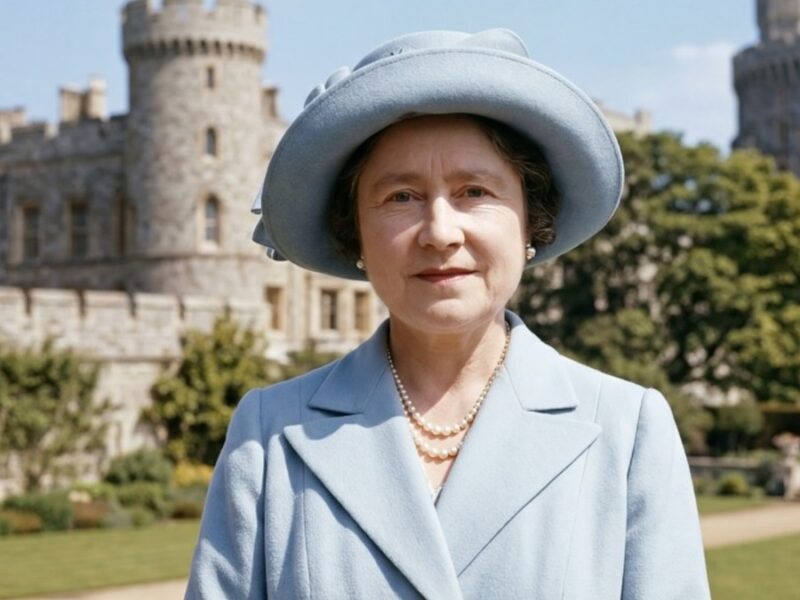
The Queen Mother Was Sweet in Public — Staff Saw the “Nasty Piece of WorkD
A guard outside Windsor Castle, reportedly remembered a phrase, just four words, “A nasty piece of work.” That’s the verdict circulating now in YouTube videos and Facebook comments, attributed to someone whose father-in-law served at the gates. No name given, no service dates, no corroborating document.
By the standards of any serious archive or biography, it proves nothing on its own. And yet, the phrase keeps traveling. Not because it can be verified, but because it names something the palace’s own silence was specifically designed to prevent from being named. What it actually felt like to serve behind the performance.
Elizabeth Angela Marguerite Bowes-Lyon was born on 4 August 1900, the ninth of 10 children of Claude Bowes-Lyon, 14th Earl of Strathmore and Kinghorne. She died on 30 March 2002 at Royal Lodge, Windsor, aged 101. In the century between those two dates, she built one of the most durable public personas in British royal history.
William Shawcross, who wrote her authorized biography with unprecedented access to her private papers and the royal archives at Windsor Castle, described her as the most beloved British monarch of the 20th century. Harold Nicolson called her the greatest queen since Cleopatra. She became, in her later decades, the soft-spoken, pastel-coated grandmother of the nation.
The figure who managed to remain popular, even as the rest of the monarchy absorbed scandal after scandal, across the last 30 years of her life. Cecil Beaton, society photographer, royal insider, a man who photographed her dozens of times, offered a different description. A marshmallow made on a welding machine.
That tension between what she appeared to be and what people who knew her privately observed is where the harder story lives. Not a takedown, a structural argument about who maintained the performance and why maintaining it was, for the people who did so, compulsory rather than chosen. The wartime image is where the public persona crystallized into something approaching myth.
To understand the gap between the public Queen Mother and the private one, you have to understand first why the public version landed so completely, why tens of millions of people across half a century believed in it, needed it, and returned to it even when the evidence was complicated. By September 1939, there was genuine discussion in the British government about evacuating the Queen and her daughters overseas.
Canada was the named destination. The position that came back, recorded across secondary accounts consistent with her documented public conduct throughout the war, was that the children wouldn’t go without her. She wouldn’t leave the king and the king would never leave. Whatever the precise wording of the original exchange, the decision itself is established. They stayed.
The public knowledge of that decision was foundational to everything that followed. On 13 September 1940, the Luftwaffe dropped a bomb through the roof of Buckingham Palace, while both the King and Queen were in residence. The Palace took nine direct hits across the duration of the war. After the first bombing, Elizabeth wrote a private letter, accessed by Shawcross for the official biography, which makes it the closest available primary source, in which she said she could now look the East End in the eye. The Guardian’s 2009 coverage of the Shawcross biography cites the letter directly. The phrase, in her handwriting, capturing the logic she had constructed for herself. The Palace had been bombed. Therefore, she had earned something. The wording varies slightly across
secondary accounts, in the eye versus in the face, but the sentiment is anchored in a documented private letter. She believed the bombing gave her moral standing with civilians who had lost everything. Picture what those visits actually looked like. The Queen arriving in the rubble of a bombed street in Bethnal Green or Bermondsey, dressed in the pastel tones Norman Hartnell had specifically selected to avoid the morning associations of black.
He called it the rainbow of hope, a calculated choice from a couturier who understood that clothing communicated in advance of any word. She would step out of the car onto broken glass and fractured brick, surrounded by crowds who had spent the previous night in underground stations, who had come up that morning to discover that the house was still standing or it wasn’t.
People came to see her wearing whatever they had left. She wore what she would wear to a formal occasion. She explained her reasoning directly. If people came out to see her, they wore their best. She should reciprocate in kind. That explanation didn’t immediately work.
The first visits provoked genuine hostility. Rubbish was thrown. Crowds jeered. There was raw fury at the sight of expensive clothes walking through streets where people had died in their beds. She went back anyway. And again. And again. Over months, the crowds changed. The persistence, showing up, shaking hands, speaking to people whose homes were rubble, doing it repeatedly across a long war, wasn’t nothing.
It was demanding public labor performed consistently. And the British public recognized it as such. The wartime reputation wasn’t fabricated. It was built on genuine presence during genuine suffering. And the myth and the reality overlapped there in ways that made the myth essentially indestructible.
The complication is visible only from outside the newsreel frame. The King and Queen spent working days at Buckingham Palace, but their nights at Windsor Castle, 20 miles to the west, a considerably safer location than central London. Their daughters were based at Windsor throughout the war. The palace shelter was reinforced in ways that no terrorist house in Stepney could replicate.
Intelligence warnings gave them preparation that ordinary civilians didn’t have. A formal evacuation plan for the King’s person existed and was documented. The King’s private army records the preparations made. The blanket statement that they remained in the city throughout the Blitz is, as one historical account has characterized it, misleadingly absolute.
None of this was officially secret. It simply wasn’t the story the newsreel cameras told. And it wasn’t the story that people living through the Blitz needed to hear. The images of royalty and rubble served a function that accurate shelter differentials wouldn’t. The public believed a version of events that was emotionally true and structurally simplified.
That public belief is the foundation on which the Queen Mum persona was subsequently constructed decade by decade until it became unchallengeable. After George VI died in his sleep at Sandringham House on the night of 5th to 6th February 1952, lung cancer with coronary thrombosis, his death occurring while Princess Elizabeth was in Kenya, Elizabeth became Queen Mother at 51.
She would hold that title for 50 more years. The bereaved widow persona she inhabited in the years following his death was emotionally credible and publicly powerful. She had loved him. She had helped him through a reign he had never wanted, a stammer he had to fight every time a microphone was placed in front of him, and a war that aged him in ways the official photographs could only partially conceal.
Her grief after his death was visible and apparently genuine. It anchored the widow image she occupied for the rest of her life. What she built on top of that grief is what academic analysis describes with unusual clinical precision. A scholarly study of her later public representation describes the construction of the aged Queen Mother as a specific cultural project.
Her image fostered and reveled in media attention across the 1960s, 1970s, and 1980s in ways that were continuously managed and renewed. The transition from wartime Queen Consort to national grandmother was gradual, accumulating across decades rather than arriving at a single decisive moment. By the time of her centenary documentary in 2000, 100 minutes of tribute television titled A Century of the Queen Mother, the archetype was so thoroughly embedded that public criticism had become functionally impossible in mainstream British media. You could be skeptical of the institution, of Charles, of Andrew, of the entire modern royal apparatus. You couldn’t seriously criticize the Queen Mum. She existed in a separate category. YouGov polling conducted in retrospect puts the numbers plainly.
81% of Britons held a positive opinion of her. 51% described that opinion as very positive. During the worst years of the monarchy’s public standing, the Diana years, the Camilla years, the period when the institution’s approval ratings dropped to their lowest point in decades, the Queen Mother held her separate and largely unaffected position.
Public scandals contaminated almost every other senior royal. She was upstream of them, untouched. That insulation was institutionally valuable, which generated enormous incentive for the people around her to manage their account of her very carefully. And the institution she lived inside had specific mechanisms for ensuring they did.
The most precise published observation about the Queen Mother’s private character in the documentary record doesn’t come from a palace servant. It comes from Steven Tennant, an aristocratic social figure who moved in her circles, quoted in Hugo Vickers’ 2005 biography Elizabeth, the Queen Mother, a work Vickers spent 17 years producing, described by its publisher as authoritative and affectionate, and based on the private recollections of people who knew her closely.
The Financial Times called Vickers the most knowledgeable royal biographer on the planet. “This isn’t a marginal text,” Tennant wrote. “She looked everything that she wasn’t. Gentle, gullible, tenderness mingled with dispassionate serenity, cool, well-bred, remote. Behind this veil she schemed and vacillated, hard as nails.
” The precision of that observation is worth sitting with as a technical matter. Tennant doesn’t describe cruelty. He doesn’t describe drunkenness or abuse. He describes a structural gap between the surface and what operated underneath it. A gap that was, in his account, deliberate.
The softness was a designed exterior. Something harder ran the machine. The surface communicated one set of qualities. The actual operational personality was different. Tennant was an insider, not a servant. His register is the register of aristocratic social observation, not service-level testimony. He experienced her as a peer or near peer, someone who could be frank with her without professional consequence, whose impressions could be recorded without institutional sanction.
What the below-stairs version of that observation might have looked like, whether it was sharper or softer, or whether it would have used different language entirely, is precisely what the confidentiality system prevented from entering the record. Beaton’s phrase operates at the same register.
A marshmallow made on a welding machine. The surface quality real and genuine. The structural underpinning something harder and more industrial. Both observations come from people who had social access. Neither comes from the kitchens or the corridors or the rooms where luggage was packed and schedules were maintained by people who couldn’t answer back.
Vickers’ affectionate biography preserved both observations and survived the editing. Hard as nails appears in a book described by its own publisher as authoritative and affectionate. That tells you something about what the threshold of publication allowed in sympathetic royal biography.
What didn’t survive? What was never submitted to an editor in the first place is a different question. The authorized biography by Shawcross tells a recognizably different story. Access unmatched in British royal biography. Private letters, official papers, the full royal archives. The book runs to over a thousand pages.
The Guardian’s 2009 review noted that in the second half one decade glided into another with the basic pattern of her days, weeks, months. A description of prose that was tracking a life without subjecting it to significant interrogation. Shawcross notes that many former members of Queen Elizabeth’s staff helped me with obvious delight in the subject.
The Los Angeles Times review characterized his portrait as a woman of steely resolve and unrelenting smile. Even the sympathetic framing concedes the steel. It doesn’t ask what the steel was used for. Frances Donaldson, a serious literary biographer whose life of P. G. Wodehouse remains a standard work, named the structural problem in a 1995 piece for the literary review.
“The Queen Mother,” Donaldson wrote, “was protected by a carapace of praise more impenetrable than the walls of the royal vault, making genuine criticism almost impossible to publish during her lifetime.” This wasn’t a gossip allegation. Donaldson was documenting an institutional feature. The critical protection surrounding the Queen Mother had become so complete, it functioned as a kind of architecture.
The praise itself was the wall. Tanya Gold, writing in The Guardian in 2009, on the occasion of the Shawcross publication, 7 years after the Queen Mother’s death, was less measured. She was sure there existed a pile of anecdotal evidence of a harder private character behind the public warmth. That’s opinion journalism, not documentary evidence, but it describes the accumulated weight of commentary that had been pressing against the authorized portrait for years in the spaces the biographies couldn’t occupy. What the aggregate of named, published sources actually establishes is this. The public portrait and the private portrait were in documented tension, noted by people who had social access. The service level testimony, what household staff, footmen, kitchen workers, the people who stood in rooms with her when she no longer needed to
perform actually observed, is largely unavailable. Not necessarily because it doesn’t exist, but because the institution was designed to prevent it from becoming part of the formal record. That is the documented reality. It’s less dramatic than a single verified revelation, and it’s worth naming as a historical fact independent of what the answer to the underlying question might be.
The royal household enforced its culture of silence as a condition of belonging. The mid-century version operated through cultural pressure so total, it required no formal instrument to function. Marion Crawford, Crawfie, served as royal governess to the young Elizabeth and Margaret from the 1930s through the mid-1940s.
In 1950, she published The Little Princesses, a warm, entirely affectionate memoir of the two girls’ childhood. Games at Buckingham Palace, riding lessons, family routines. No secrets disclosed, no damaging revelations. She was subsequently ostracized completely. Cut off from the royal family, publicly disavowed, erased from the household’s official memory for the remaining decades of her life.
Historians cite the Crawford case as the clearest documented example of what the institution did to people who spoke publicly about what they had seen. Not in anger, not to damage anyone, but simply because they had spoken at all. The Crawford lesson propagated through the household without needing to be stated explicitly.
Every person who entered royal service after 1950 understood, from a specific named example, what public disclosure cost. No footman needed to be warned, no housekeeper needed a briefing. The example was the lesson. The financial architecture reinforced the cultural pressure. Published accounts of royal household employment document that private staff in royal households were paid far below the market rate.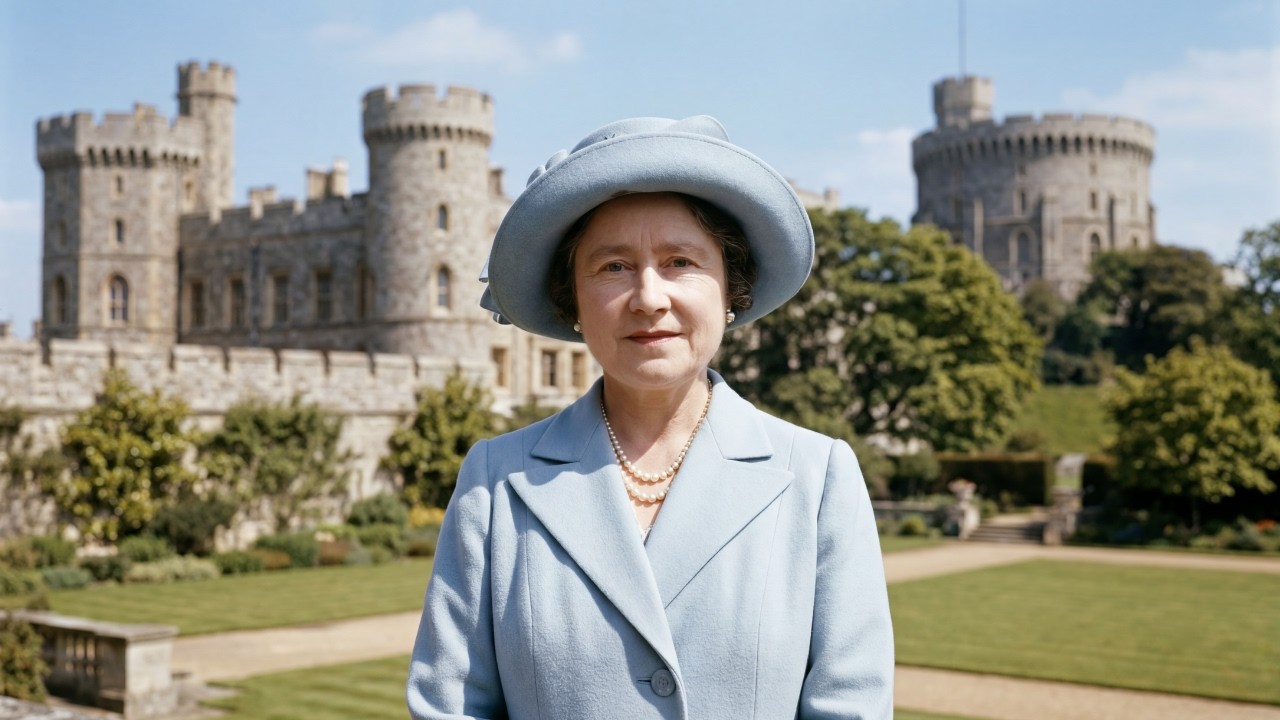
One insider account from the period describes women from poor backgrounds expected to work 12-hour days. Another account from a figure who explicitly turned down palace employment describes the appeal of having freedom I had never known, and overtime paid, as sufficient reason to work elsewhere.
The contrast with palace conditions implied in the comparison. The skills, the clearances, the institutional references, the professional identity built over years of royal service. All of it was tied to continued good standing. Walking away was rarely economically practical. Speaking out was professionally catastrophic.
What this created was a labor arrangement in which the most informed witnesses were simultaneously the most constrained. The people who served the Queen Mother’s meals, packed her bags, arranged her schedule, stood in her rooms and corridors and morning routines when she had no audience to perform for.
Those were the people legally and culturally forbidden from describing what they saw there. Long service is sometimes cited as evidence of warmth. William Tallon, Backstairs Billy, the Queen Mother’s personal page, served from 1951, beginning in the household of George VI, continuing through her widowhood until her death 51 years later.
51 years of service is offered in popular accounts as proof that she was easy to love, personally generous, the kind of employer whose staff stayed because they wanted to. That interpretation is possible. It coexists with the Crawford lesson, the below-market wages, the enforced culture of silence, and the absence of any published memoir by Tallon himself, who died in 2007 without writing one.
Long service is one kind of testimony. It’s also what the combined operation of those other factors tends to produce. The Buckingham Palace employment record contains one additional documented fact that belongs in any account of the institution the Queen Mother helped constitute. A Guardian investigation established that the royal household explicitly barred colored immigrants or foreigners from serving in clerical roles until at least the late 1960s.
This isn’t about her personal conduct in isolation. It’s about the institutional apparatus within which her entire private life operated. An institution whose formal discrimination across the mid-20th century was documented and structural, operating across the same decades in which its servants couldn’t publicly describe their experience of it.
The palace labor system and the Queen Mother’s private reputation aren’t analytically separable. She lived inside the system. The system protected her from external account. The question of what she was actually like to serve is a question the system’s architecture made it impossible to answer from outside.
And that impossibility isn’t a failure of research. It’s the system operating exactly as it was designed to operate. Major Colin Burgess served as the Queen Mother’s equerry, her fixer, the man whose job description encompassed whatever the job needed to include on any given day. His account of her daily routine was published in a piece for the Daily Mail and constitutes the most specific, named, primary insider testimony about her private habits in the accessible public record.
The routine ran on a reliable daily clock. At noon, two parts Dubonnet to one part gin with a slice of lemon placed under the ice. The proportions weren’t approximate. They were a standard, a ratio established and maintained. Dubonnet itself deserves a line. It’s a French aromatized wine-based aperitif, 14.
8% alcohol in its European formulation, created in 1846 by the chemist Joseph Dubonnet in response to a French government competition to find a way of persuading foreign legionnaires in North Africa to swallow quinine. The quinine combated malaria, but was almost undrinkably bitter on its own.
Dubonnet dissolved it into something palatable. By the mid-20th century, its primary British associations were specifically royal. Both the Queen Mother and later Elizabeth II kept it as a daily preference. Dubonnet was awarded a royal warrant by Elizabeth II in November 2021. The drink her mother had taken every morning for decades became an officially endorsed household product.
Before a journey, the Queen Mother sent a written note to Tallinn with her packing requirements. This note survived. It has been sold at auction and reported publicly. The instructions were direct. Pack two small bottles of Dubonnet and gin in case it’s needed. The phrasing is characteristic, unembarrassed, matter-of-fact, as if adequate provision of spirits for travel were a perfectly routine item on a luggage checklist.
For her, it was. Lunch brought heavy red wine. Burgess describes her fondness for the clarets with a specific emphasis. “Memorable” is his word, suggesting that the quantity left an impression even on a man whose professional role required him to be present. Port followed occasionally. At 6:00 in the evening came what she called, in Burgess’s account, the magic hour.
She would turn to him directly. “Colin, are we at the magic hour?” He would mix her a martini. After a couple of martinis, dinner brought one or two glasses of pink champagne. Burgess’s overall description of her daily existence, a sedate routine revolving largely around lunch and rather a lot of booze.
His explicit position on the label that has since attached itself to her in popular commentary, she was nowhere near being an alcoholic. He stated this in print clearly in the same account that describes the noon Dubonnet and gin, the memorable clarets, the occasional port, the magic hour martinis, and the dinner champagne.
Nancy Mitford, attending one lunch from the outside as a social observer rather than a household employee, described her experience afterward. Two dry martinis before the meal, wine throughout it, port at the end, with every other guest exhausted from trying to keep pace with the consumption. One meal, one observer, but fully consistent with the daily pattern Burgess documents across the whole routine.
The popular extrapolation, that the daily pattern adds up to 70 drinks a week, and therefore constitutes clinical alcoholism, applies arithmetic to a named source who specifically rejected that conclusion. The underlying daily pattern comes from an equerry who was present. The label is an inference he personally denied.
What Burgess’s account does not contain is any connection between the drinking and behavioral volatility directed at staff. He describes the routine as sedate. He presents a woman who maintained composure and never appeared intoxicated in any way that he felt required documentation. No named biographer in the accessible published record explicitly connects her alcohol consumption to whatever private behavior the phrase nasty piece of work is pointing toward.
That absence may be exculpatory. It may reflect which version of her experience made it into print, and whose version didn’t. For 50 years, Elizabeth II ruled a monarchy that included her mother as an independent, publicly beloved, institutionally complex presence. This isn’t interpretation. It’s the arithmetic of their overlapping positions.
The Queen Mother maintained three separate households: Clarence House in London, Royal Lodge at Windsor, and the Castle of Mey in Caithness, a remote northern Scottish coastal property she began restoring from near ruin starting in the year George VI died, 1952. The castle’s renovation becoming a private project that occupied her in the first years of her widowhood and anchored her to Scotland for the rest of her life.
All three households were funded from the Civil List throughout her widowhood. All of it was public expenditure the sovereign was institutionally responsible for and couldn’t credibly question. For 50 years managing the monarchy’s image meant managing an image that included the Queen Mother as a figure Elizabeth could neither control nor afford to distance herself from publicly.
Imagine Elizabeth’s position precisely. On the one hand, a sovereign inheriting a throne she had not expected to occupy at 25, managing a monarchy navigating the end of empire, navigating television, navigating Diana, navigating everything the 20th century threw at the institution. On the other hand, a beloved mother who had been the most popular royal figure in the country for decades, who maintained her own staff and her own establishments and her own public role and her own habits.
All of it requiring institutional management that fell to the daughter who was simultaneously head of state. Royal biographer Sally Bedell Smith, writing after both women’s deaths, noted that following the deaths of Princess Margaret and the Queen Mother in 2002, Elizabeth appeared like a new person at 75.
Bedell Smith describes the preceding period as one of profound grief. Both observations are present in her account. The grief was real and documented. The description of Elizabeth as a new person after those deaths, lighter, visibly changed, is also real. And it suggests something about what the preceding decades carried alongside the closeness.
The Townsend affair of 1953 offers the clearest documented window into how the Queen Mother’s household functioned as an institutional management site within Elizabeth’s reign. Princess Margaret’s relationship with Group Captain Peter Townsend, a divorcee, created a constitutional problem that the palace had to navigate publicly and privately.
Alan Lascelles, pronounced Lascelles in standard British English, the French origin preserved in spelling but simplified in pronunciation, had by 1953 already served three kings. He had entered royal service as private secretary to the Prince of Wales in 1920. His own diaries, edited by Duff Hart Davis and published as King’s Counselor, were described as indiscreet and very revealing, particularly regarding Edward the VIII, whose character Lascelles assessed with considerable severity.
As George VI’s severe and traditional private secretary, that is, the characterization in Crown documentation of the period, he spelled out the requirements of the Royal Marriages Act to Elizabeth II directly. Townsend wrote afterward that both he and the Queen agreed he should leave the Queen Mother’s household.
The management of the crisis happened at the Queen Mother’s residence. Elizabeth navigated the institutional consequences. After the Queen Mother’s death, up to 100 staff at Clarence House were told they could face redundancy when Prince Charles moved his operations in. 100 people whose professional identities had been built around a single woman’s household, processed out in the administrative weeks following her death.
Tallon learned where he stood. “I was upset,” he said afterward, “and they didn’t care. As far as the household was concerned, I was simply an ex-employee.” That complaint was directed at the royal household bureaucracy after her death, not at the Queen Mother personally during her lifetime. The distinction matters for what it says about her specifically, but it also illustrates what royal service meant structurally.
You were essential until you weren’t. And then the institution processed you the same way it processed everything else. Alexander Larman’s 2023 biography, Backstairs Billy, reconstructs his life in detail from the outside. Tallon himself never published a memoir. He died in 2007 following liver failure.
His account of 51 years behind those doors, whatever it contained, whatever he had observed across half a century of a woman’s private life, went with him. Princess Margaret’s private reputation followed a pattern that rhymes with what the critical biographical tradition describes about her mother. Craig Brown’s biography, Ma’am Darling, captures a private character that was, in Brown’s framing, nowhere near the softness her public image projected.
Staff accounts exist in published form, anonymized and compressed as royal household testimony consistently is, but present in the wicked wit of Princess Margaret and in Anne Edwards Royal Sisters. One documented account notes that Margaret started drinking at 11:30 in the morning. The drink? Dubonnet.
Hugo Vickers, discussing this pattern in a separate context, described the ratio. Two parts Dubonnet to one part gin, beginning before noon. The identical ratio her mother favored. The family preference continuing across generations, right down to the timing and the measure. Anne Edwards Royal Sisters contains one structural observation that belongs in any account of the institution, rather than the personalities within it.
In royal households, private staff were paid far below the market rate. A published attributed biography of the royal family states this plainly. It’s a data point about working conditions, not about any specific individuals treatment of any specific servant, but it establishes the economic structure within which whatever private behavior occurred was never easy to leave.
Prince Andrew generated his own wave of documented staff complaints in more recent years. The controversial former butler, Paul Burrell, claimed to have witnessed Andrew’s pompous behavior and stated publicly that ex-staff had revolted against serving him. Other palace accounts present a different picture.
Some staff apparently using his first name with genuine warmth. The former royal equerry and biographer tradition is mixed on him. The pattern, taken broadly, is worth naming. The same institution that produced the most consistently beloved royal of the 20th century also produced a line of relatives whose treatment of service level staff generated documented complaint across generations.
Rank entitlement and public charm appear to have traveled through the family on their own independent tracks, sometimes in the same person, sometimes in different ones, without much apparent inheritance of the restraint that made the monarch herself professionally sustainable. Frances Donaldson’s 1995 observation requires one final examination.
The Queen Mother was protected by a carapace of praise more impenetrable than the walls of the royal vault. A description of a critical protection so complete it functioned as a form of structural censorship with no single censor. The public’s genuine love was itself part of the mechanism. The millions of people who adored the Queen Mother from a distance were also functionally part of the system that made her impossible to criticize in print.
They didn’t know that was what they were doing. They simply loved her, and their love made criticism socially and professionally dangerous for anyone who tried to articulate a different experience. The system produced the record we have. The authorized biography runs to over a thousand pages and draws on the royal archives.
The independent biography by Vickers is 17 years of research rendered in 624 pages, authoritative and affectionate. Preserving tenant and beaten while maintaining the affectionate frame, the critical material, Campbell’s account, the online commentary, the anonymous phrases, exists outside the scholarly mainstream, contested and largely unverifyable at the level of attribution a serious argument requires.
What sits in the center of all of it, the documented architecture. A woman who maintained a daily drinking routine her own equerry described as a sedate routine revolving largely around lunch and rather a lot of booze. A woman observed by by peer to have been hard as nails beneath the gentle surface. A woman whose household enforced silence through cultural destruction and below market wages.
A woman whose governess was publicly destroyed for publishing a warm memoir. A woman whose three separate households ran for 50 years on public money while the sovereign responsible for the monarchy’s image couldn’t credibly distance herself from them. None of those facts is individually damning. Together, they describe someone who had every structural advantage in controlling her own account and who operated within an institution designed to ensure those advantages held across an entire century. The moral proposition is simpler than the biographical complexity. The people who served her couldn’t answer back. They couldn’t publish. They couldn’t tell a biographer anything on the record that named them. The 12-hour days, the below market wages, the enforced culture of silence, the Marion Crawford lesson. All of it operational simultaneously across the same decades in which she was
being photographed in bombed streets and celebrated in centenary documentaries. Whatever the private reality of working in her household was, the people who lived it were required to absorb it without recourse. Not by personal cruelty necessarily, by structure. On 30th March 2002, Elizabeth Bowes-Lyon died at Royal Lodge, Windsor at 101.
The public mourning was extensive and genuine. Thousands queued outside Westminster Hall where her coffin lay in state. Tributes ran for days across every British newspaper and broadcast. The Queen, who had spent the entire 50 years of her reign navigating the institutional complexity of her mother’s position, grieved.
The grief was real. Within weeks, 100 staff at Clarence House were facing redundancy. Backstage, Billy had learned he was simply an ex-employee. The anonymous phrase, “a nasty piece of work,” may be exactly what it appears, an imprecise memory from an unnamed source traveling because it fills a space the formal record deliberately left empty.
It may be more accurate than the authorized biographies allow. The enforced silence that produced the quiet also makes those two possibilities indistinguishable from outside the household walls, and that indistinguishability isn’t a failure of inquiry. It’s the system working as it was designed to work.
What isn’t ambiguous is the structure itself. A woman whose private behavior was effectively unaccountable to the historical record, whose household enforced silence through cultural destruction and professional consequence, whose public image was so essential to the monarchy that criticism of her was functionally impossible during her lifetime.
That is a specific form of power, and it does not require a single anonymous phrase to be verified in order to be named. The public received the performance across a century. The performance was real and genuinely valued, built on wartime decisions and genuine presence and real grief. The cost of producing it belonged to the people who were paid not to describe what they saw while producing it.
Donaldson was right that the carapace of praise was more impenetrable than the royal vault. It remains so. The biographies that shape official memory are the authorized and affectionate ones. The critical tradition lives at the margins, contested, anonymized, legally constrained. What slips through is oblique.
Beaton’s marshmallow on a welding machine, tenants hard as nails. A literary review essay arguing the praise made honest assessment impossible. An equerry’s sedate account of the noon dubonnet and the magic hour martini offered apparently without awareness of what the portrait implies. The people who could have told the unvarnished version mostly couldn’t.
Some passed what they knew onward in exactly the form it eventually surfaced. A story told by a father-in-law to a child, third-hand, unnamed, untraceable, surviving as four words in an online comment. That is what the silence mechanism produces. Not proof, not documentation. A phrase anonymous and unverifiable traveling precisely because it fills the space the institution was careful to leave empty.
Subscribe for more stories like this.