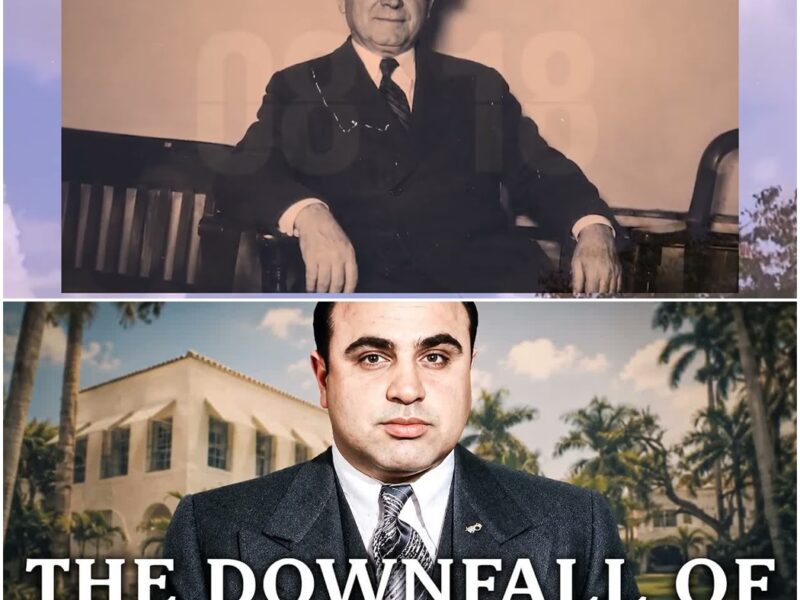
The Rise And Fall Of Al Capone — King Of Chicago’s Underworld D
At his peak, he had half of Chicago’s police department on his payroll. His organization employed over a thousand men and generated an estimated $60 million a year in 1920’s money. He was photographed at baseball games, gave interviews to newspapers, and threw soup kitchens open to the public during the depression, while simultaneously ordering the murders of rivals who crossed him.
He was the most powerful criminal in American history. And then, slowly and publicly, everything fell apart. The story of how Al Capone went from a teenage gang member in Brooklyn to the king of Chicago, and then from that throne to a federal prison cell, is one of the great American stories. Not because it glorifies what he did, but because the forces that brought him down were stranger and more ironic than anything his enemies could have planned.
Brooklyn and the education of a future gangster. The Brooklyn that Alphonse Gabriel Capone was born into on January 17th, 1899, was not a comfortable place to grow up. His parents, Gabriele and Teresa Capone, had emigrated from Naples, Italy, and settled in the Williamsburg section of Brooklyn alongside the large Italian immigrant community that was reshaping borough’s demographics in the late 19th century.
His father worked as a barber. His mother took in work where she could find it. There were eventually nine children crowded into the circumstances that working-class immigrant life in turn of the century Brooklyn provided. The neighborhood was a dense, loud, competitive environment. A patchwork of immigrant communities stacked alongside each other, each with its own social hierarchies, each navigating the particular challenges of being new Americans in a city that was welcoming in its official mythology and considerably less so in its daily practice. Italian immigrants in Brooklyn at the turn of the century occupied a specific and not always comfortable position in the city’s ethnic landscape. They were recent arrivals, Catholic, and associated in the public imagination with both labor and crime in ways that shaped how their children understood
their own options. For young men without education or connections, crime was one of the available paths. It offered money, status, and a form of organizational belonging that legitimate employment in Brooklyn’s factories and docks did not. The gang structures that had developed in neighborhoods like Williamsburg were not simply criminal enterprises.
They were social institutions with their own codes, their own hierarchies, their own forms of loyalty and obligation that made sense to young men who had grown up inside them. Capone was, by early accounts, a genuinely bright child. He was curious, observant, quick with numbers. The intelligence that would later allow him to run a multi-million dollar criminal organization with operational sophistication was present from his earliest years.
But the school system of that era in Brooklyn was not organized to keep a restless, street-smart Italian immigrant son engaged. And by the sixth grade, the relationship between Al Capone and formal education had reached its breaking point. He was expelled after a confrontation with a teacher and did not return.
He was not yet 14 years old. The streets became his next classroom. And the teacher who made the most lasting impression was a man named Johnny Torrio. Torrio was operating out of Brooklyn in those years, running the James Street Boys and maintaining connections to the Five Points Gang, one of New York’s most significant criminal organizations of the era.
He was, by all accounts of the people who knew him, extraordinarily intelligent and disciplined for his world. A man who saw crime not as a series of improvisational opportunistic acts, but as something that could be organized along genuinely corporate lines with management structures and strategic planning and sustainable revenue streams.
Torrio studied how legitimate businesses operated and applied those principles to criminal enterprise. He was a criminal theorist at a time when most criminals were operating on instinct. And the young Capone absorbed everything he had to teach. Through Torrio and the Five Points connection, Capone also encountered Lucky Luciano, another young Italian-American who would eventually build his own formidable empire.
And the social world of organized Brooklyn crime that was, in these years, developing the structures and relationships that would define American organized crime for the following generation. Capone’s physical mark from these years was the three scars on the left side of his face, acquired in 1918 at the Harvard Inn in Brooklyn, where he worked as a bouncer and bartender for Frankie Yale.
The altercation involved a man named Frank Galluccio, who cut Capone’s face with a knife after Capone made remarks about Galluccio’s sister. The wounds healed into the distinctive marks that the press would later use to define him, Scarface, a nickname he genuinely hated and that was never used in his presence by anyone who wanted to maintain good relations with him.
He turned his right side to cameras whenever possible and was known to grow agitated when reporters referenced the scars. Shortly after the incident, Capone moved briefly to Baltimore, working as a bookkeeper for an honest construction firm. A detail that later biographers have always found quietly significant, given how important the management of financial records would eventually become to his downfall.
He understood numbers. He was capable of maintaining accounts. He just applied those capabilities to enterprises that required him to hide them. Then Torrio called from Chicago and Capone went. Chicago, Colosimo, and the opening that changed everything. Chicago in 1919 was both a city of extraordinary legitimate commerce and a city whose relationship with law enforcement was famously transactional.
It was the gateway to the American Midwest, a rail hub, a meatpacking and manufacturing center, and a place where money moved in volumes that created ample opportunity for the kind of corruption that organized crime required to function. The political machine that governed Chicago had long understood that certain kinds of illegal activity were easier to manage than to eliminate and had organized the city accordingly.
Aldermen and ward bosses maintained relationships with criminal enterprises in their territories that were understood by everyone involved as matters of business rather than scandal. Johnny Torrio had been in Chicago since 1909, working for the man who dominated the city’s underworld, Big Jim Colosimo.
Colosimo was a genuine power, a man who had built a network of gambling operations and establishments across the city, who had corrupted the right officials, and who lived in a style that made him a visible and celebrated figure in Chicago’s nightlife. He had, by the standards of his world, achieved everything worth achieving.
He was also, in Torrio’s view, leaving an enormous amount of money on the table by refusing to see where the real opportunity was. The 18th Amendment to the United States Constitution, Prohibition, was ratified in January 1919, and went into effect in January 1920. The nationwide ban on the manufacture, sale, and transportation of alcohol was, from the perspective of organized crime, an extraordinary gift.
Chicago had voted 6 to 1 against Prohibition in the years leading up to its passage. A substantial majority of the American public wanted to continue drinking. The government had made it illegal for them to do so through legitimate means. The gap between public demand and legal supply was a business opportunity of historic dimensions, and any criminal organization that could supply alcohol at scale to a population that had voted against being denied, it stood to make fortunes that the previous generation of Chicago criminals had never imagined. Torrio saw this immediately, with a clarity that distinguished him from most of his contemporaries. He pushed Colosimo to move into bootlegging, to use the organization’s existing infrastructure of corruption, enforcement, and distribution to build an alcohol network that would dwarf anything they had previously operated.
Colosimo, comfortable with what he had and by most accounts distracted by a new marriage to a younger woman, refused. He saw no reason to take on the risks of the new enterprise when the existing business was profitable and manageable. Colosimo was shot to death on May 11th, 1920 in the anteroom of his own restaurant.
The shooter has never been definitively identified. Some historians point to Frankie Yale as the triggerman acting on Torrio’s behalf. Capone’s exact role, if any, has never been established with certainty. What is documented is that Torrio inherited the organization immediately and moved into bootlegging with the speed and decisiveness of someone who had been waiting for exactly this moment.
Torrio moved immediately into bootlegging. The organization’s existing networks of corruption, enforcement, and distribution were redirected towards supplying alcohol to a city that had never stopped wanting it. Capone was Torrio’s principal enforcer and operational partner, the man who handled the street-level realities of the business while Torrio managed the broader strategic picture.
The money was extraordinary. Prohibition era bootlegging generated revenues that legitimate businesses of similar scale could not match. And in Chicago, where the political infrastructure was already organized around accommodation rather than enforcement, the network grew with relatively limited interference.
What interference did come was often purchased. Capone was 21 years old and already richer than most people in any world he might have inhabited. The gang wars and the price of power. Chicago in the early 1920s was not a city with a single dominant criminal organization. It was a city with several competing ones, each controlling specific territories, each with its own alliances and enmities, each watching the others for weakness.
The money that prohibition had created was large enough to fight over. And fight over it they did. The North Side gang, led by Dion O’Banion, controlled the bootlegging operations in Chicago’s North Side neighborhoods and was a persistent rival to the Torrio-Capone operation. O’Banion was, by several accounts, genuinely difficult to deal with, unpredictable, personally confrontational, and willing to undercut agreements when he saw advantage in doing so.
He ran his criminal business out of his flower shop on North State Street, which gave him a curiously respectable public face while he simultaneously operated one of the most active bootlegging networks in the city. In 1924, he engineered a deal that left Torrio holding large quantities of beer right before a police raid.
A deliberate double-cross that cost Torrio significant money and credibility, and that Torrio considered an unambiguous declaration of hostilities. O’Banion was shot and killed in his flower shop in November 1924, gunned down by three men who arrived pretending to be customers picking up flowers for a wedding.
The Torrio-Capone organization was widely blamed. The North Side gang, restructuring under [ __ ] Weiss and then Bugs Moran, immediately began retaliating. In January 1925, Johnny Torrio was shot multiple times outside his apartment building on Clyde Avenue by Moran and associates. He survived.
A surgeon who happened to be nearby was credited with saving his life. But the experience profoundly shook him. After recovering in the hospital and then serving a brief jail sentence on a bootlegging conviction that O’Banion had engineered before his death, Torrio made a decision that surprised the criminal world he had spent decades building.
He retired. He handed the entire Chicago operation to Capone with a few words that functioned as both gift and warning and departed for Europe. Capone was 26 years old. He now controlled an organization with approximately 1,000 men, annual revenues estimated at $60 million, and the accumulated enemies of every rival who had contested the Chicago underworld across the previous The years that followed were years of extraordinary violence and extraordinary prosperity running in parallel.
Capone expanded the organization’s reach into suburbs, Cicero, Stickney, and surrounding areas that hadn’t previously been fully absorbed into Chicago’s criminal geography. He maintained the relationship with the political infrastructure that made operations possible. His business card listed his occupation as second-hand furniture dealer.
He was, in some meaningful sense, the most powerful private citizen in Illinois. He was photographed at boxing matches and baseball games, received standing ovations from crowds who knew exactly who he was, and gave interviews in which he presented himself as a businessman supplying what the public wanted in defiance of an unjust law.
He opened soup kitchens during the Depression, feeding thousands of people who had no other source of meals in a display of public generosity that was simultaneously genuine and calculated. He told journalists that he made money by supplying a public demand and that if he broke the law, his customers had no grounds for complaint about the arrangement.
And simultaneously, the violence continued. Capone’s brother, Frank, was killed in a shooting in 1924. Various associates and rivals died on both sides of ongoing conflicts. The city was, in the tabloid coverage of the era, constantly at war with itself. And Capone was at the center of all of it. The Saint Valentine’s Day Massacre.
February 14th, 1929 is the date that defined Al Capone in the public imagination more than any other. What happened in a North Side garage on that morning was the most dramatic single event of the Chicago gang wars. And its impact extended far beyond the specific casualties of that day. The target was Bugs Moran and his North Side organization, which had been a persistent thorn in the Capone operation for years.
The plan, as it was eventually executed, involved luring Moran and his men to the S M C Cartage Company garage at 2122 North Clark Street, a regular meeting point for the organization, with the promise of a hijacked whiskey delivery at an attractive price. Seven men assembled in the unheated garage that morning waiting for the shipment.
What arrived instead were two men dressed in police uniforms and two dressed in civilian clothes who entered the building and ordered the seven men to line up facing the brick wall. The seven men complied. They were bootleggers and enforcers, and they had been through police raids before. Being told to line up against a wall by men who appeared to be officers was not entirely unusual.
They stood with their hands on the wall and waited for what they assumed would be the ordinary process of an arrest. What followed was anything but ordinary. The men opened fire with Thompson submachine guns, firing repeatedly. Six of the seven men in the garage died at the scene from their wounds. The seventh, Frank Gusenberg, survived long enough for actual police to reach him, having been struck by multiple bullets.
When investigators asked him who had shot him, he refused to identify anyone. He died hours later without speaking. Bugs Moran himself was not among the dead. He had been approaching the garage when he saw what he believed were police officers entering the building, and he decided to wait. The decision saved his life.
When asked later about who he thought was responsible, he said that only Capone kills like that. No one was ever charged with the massacre. The identities of the shooters were never definitively established in a court of law, though investigators and historians have consistently concluded that the operation was planned and funded by the Capone organization.
Capone was in Florida at the time. The alibi was deliberate and documented. The massacre was the moment when the federal government’s attitude toward Capone changed fundamentally. President Herbert Hoover, who took office in March 1929, was reportedly furious about it and personally directed that federal resources be brought to bear against Capone specifically.
The most powerful criminal in America had just executed seven men in a garage in broad daylight and the federal government was going to do something about it. The question was how. And the answer, when it came, was one that nobody in the criminal world had anticipated. The men who brought him down. The approach that ultimately destroyed Al Capone was not the approach anyone would have predicted.
It did not involve catching him ordering a murder or transporting liquor. It involved his taxes. Eliot Ness and his team of prohibition agents, the group that the press and later popular culture would call the Untouchables because of their documented refusal to accept bribes, were making real inroads against Capone’s brewing and distribution operations.
Ness was 26 years old when he was assigned to lead the unit in 1930 and he approached the work with a combination of genuine idealism and tactical intelligence that was genuinely unusual in the prohibition era federal apparatus. Between 1930 and 1931, the Untouchables raided dozens of breweries and distilleries across Chicago documenting the connections between the facilities and Capone’s organization.
They caused real financial damage and generated significant press attention. Ness understood that publicity was part of the strategy. Every brewery raid that made the front page was pressure on Capone from a direction that money couldn’t easily address. But the Untouchables’ work, real and significant as it was, was not what put Capone in prison.
The actual tool of his downfall was a team of investigators from the Internal Revenue Service working under the direction of a special agent named Frank Wilson, who would later describe the case as the most significant and the most painstaking of his career. The theory was straightforward and had already been successfully applied to other organized crime figures in the years preceding the Capone investigation.
If you could prove that a person had received income significantly in excess of what they had reported to the federal government, you had a federal crime, regardless of how the income had been generated. American tax law did not distinguish between legal and illegal income. Money was money, and the obligation to report it and pay taxes on it applied to bootleggers and gamblers as surely as it applied to manufacturers and merchants.
The failure to report substantial income was tax evasion, and tax evasion was a federal crime carrying serious penalties. The challenge applied specifically to Capone was that he had been careful about direct financial connections. He didn’t maintain bank accounts in his own name. He didn’t sign checks.
The organization dealt primarily in cash and operated through layers of intermediaries specifically designed to create distance between Capone and any transaction that could be documented. His organizational structure, the corporate-style hierarchy that Torrio had originally developed and that Capone had refined, was partly designed to protect him from exactly this kind of financial scrutiny.
Wilson’s team spent years working through the problem. They interviewed dozens of witnesses across the organization’s territory. Gamblers, bookkeepers, lower-level operators who had knowledge of specific transactions, and who could be persuaded to share that knowledge under the right circumstances. They traced cash flows through gambling operations, through breweries, through the network of establishments the organization controlled.
They documented expenses, properties, services, goods that Capone had clearly authorized and received even when his name wasn’t directly on the paperwork. The key breakthrough was finding specific transactions that could be traced back to Capone personally and that demonstrated income far beyond anything he had ever reported.
A cashier’s check here. A documented purchase there. Witnesses who could place him as the recipient of specific sums at specific times. The evidence was never dramatic in the individual instance. It was the accumulation of dozens of careful, methodical documentations of specific financial events that built the case.
Wilson reportedly spent months reviewing coded betting slips and account books looking for connections. He found them. A federal grand jury was presented with the assembled evidence in 1931. The indictment charged Capone with 22 counts of tax evasion covering the years 1925 through 1929 and a related charge connected to prohibition violations.
Capone’s legal team initially believed that a deal was achievable. They negotiated with prosecutors and reached what they believed was an agreement. A guilty plea to reduced charges in exchange for a sentence of two to two and a half years. In the context of the charges Capone was facing, two years was survivable.
The organization would hold he would return. Judge James Wilkerson, assigned to the case, made clear that he was not party to any agreement reached between the prosecution and the defense. He was not bound by their understanding. He would sentence according to his own judgment of what the law required.
The deal fell apart. There would be a trial. The trial and the verdict. The trial of Al Capone in Chicago’s Federal Building in October 1931 was one of the most widely attended and reported legal proceedings in American history to that point. The courtroom was packed every day. Press coverage was nationwide and intense.
The defendant was the most famous criminal in the country. And the proceedings were followed with an interest that reflected both public fascination with the man and genuine understanding of the legal significance of what was happening. Capone came to court each day in expensive, well-tailored suits accompanied by his legal team, carrying himself with the composed authority that had characterized his public appearances throughout his years at the top of the Chicago underworld.
He did not take the stand in his own defense. The defense strategy was to challenge the government’s evidence rather than to offer any direct alternative account. The prosecution’s case rested on the documentation that Wilson and his team had assembled over years. The financial records, the traced transactions, the witnesses who could speak to specific payments and receipts at specific times.
The case was methodical and detailed, built on evidence that was difficult to dispute because it came from records and from people with direct knowledge of particular transactions. The government was not asking the jury to make a leap of logic. It was presenting a careful accumulation of documented financial facts.
Judge Wilkerson made a decision midway through the proceedings that was quietly significant. He swapped the entire jury that had been impaneled for a different one. Having received information that Capone’s associates had attempted to bribe or intimidate members of the original panel. He brought in a fresh jury from a different pool of potential jurors.
The defense had no opportunity to compromise the new panel. The jury deliberated for 8 hours before returning their verdict on October 17th, 1931. Guilty on five of the 22 tax evasion counts, not guilty on the prohibition conspiracy charges. Judge Wilkerson sentenced Capone to 11 years in federal prison.
The stiffest sentence ever handed down for tax evasion in American history to that point. Along with $10,000 in fines and the costs of the prosecution. Capone’s attorneys filed appeals immediately. Every appeal was denied. He was going to prison. And he was going for a long time. Alcatraz and the beginning of the end.
Al Capone began his sentence at the Atlanta Federal Penitentiary in May 1932. He was 33 years old. The organization he had built was still running. The men he had placed in positions of authority were still operating the gambling, the liquor distribution after prohibition’s end, and the other revenue streams.
He expected to to some degree of influence and to return to leadership after serving his time. What he had not fully anticipated was that the federal prison system was going to make this significantly more difficult than he imagined. In Atlanta, Capone quickly established a comfortable routine. He had a softer cell.
Better food arrived through unofficial channels. Visitors came more frequently than regulations strictly permitted. Prison officials who noted his pattern of conduct reported that he appeared to be managing aspects of his organization from inside the facility, receiving information, issuing informal guidance, maintaining the communications that kept him connected to the outside world.
His incarceration looked, from certain angles, more like a temporary relocation than a genuine disruption. The federal government’s response was to transfer him to a facility that had been specifically built to prevent exactly this kind of continued operation. Alcatraz Federal Penitentiary, sitting on a 12-acre island in San Francisco Bay, opened as a federal penitentiary in August 1933.
It had been a military prison before the federal system took it over and converted it into a maximum security institution designed with a very specific purpose, to hold the prisoners for whom every other federal facility had proven inadequate. The men sent there were not ordinary criminals. They were the ones who had continued to operate, to influence, to cause problems despite incarceration elsewhere.
The island’s isolation, surrounded by cold, swift-moving water that made unauthorized departure essentially impossible, eliminated the physical infrastructure that had allowed Capone to operate in Atlanta. Capone arrived at Alcatraz in August 1934 as inmate number 85. The warden, James A.
Johnston, made clear immediately that no special treatment of any kind would be extended to any inmate regardless of their previous prominence. No business visitors. Mail was strictly scrutinized. Privileges were earned through conduct, not purchased through money or reputation. Capone struggled with this reality.
He had spent 15 years in an environment where money and power translated directly into comfort and accommodation. Alcatraz was organized specifically to eliminate that translation. He worked in the laundry. He spent time in the prison’s workshop. He played in the prison band. He was not managing anything outside his cell block.
He also began during these years to show signs of the disease that would eventually end his life. Syphilis, contracted years earlier and never properly treated, was advancing to its tertiary stage. The disease was attacking his central nervous system, producing the neurological deterioration that untreated late-stage syphilis causes.
His mental clarity began to decline. He had periods of confusion and disorientation. The man who had once commanded a thousand men and managed a revenue stream of $60 million a year was losing the cognitive capacity that had made him what he was. In 1939, after serving 6 and 1/2 years of his 11-year sentence, Capone was released from Alcatraz to a correctional facility in Lewisburg, Pennsylvania, to serve the remaining portion of his term, and then released fully in November 1939.
He was 40 years old. He looked, by the accounts of those who saw him, considerably older. The syphilis had taken something irreplaceable. The final years and the mansion in Miami. Capone was released into a world that had moved on without him. The years he had spent in federal custody had been transformative ones for organized crime in America.
Prohibition had ended in December 1933, eliminating the single greatest revenue stream that had funded his organization’s rise. The men who had served under him had reorganized themselves during his imprisonment, forming new alliances and operating under new leadership structures that had developed without his input or oversight.
The Chicago Outfit, the organization that Capone had built, continued to exist and prosper. But it was no longer his in any meaningful operational sense. His mental deterioration made it impossible for him to reclaim what he had once been, even had the organizational landscape permitted it. He retired to his estate on Palm Island, Florida, the mansion in Miami Beach that he had purchased in 1928, a large waterfront property on Biscayne Bay with a private dock, a swimming pool he had added after purchase, and the kind of comfortable extravagance that had always characterized his spending. The Miami establishment had tried, in the years before his imprisonment, to force him out. The city sued to have him removed, classifying him as a public nuisance. But the property remained his, and it was where he went when there was
nowhere else to go. His wife, Mae, whom he had married in December 1918 before the Chicago years began and who had remained faithful and devoted through the trials and the prison sentence and the illness was there with their son. Sonny, who had been born deaf due to a botched surgery shortly after his birth, had grown up during his father’s years of power and imprisonment and had consistently maintained a private life at considerable distance from the public story of his father’s career.
The neurological damage from the syphilis was significant and progressive. By the early 1940s, Capone had, in the clinical assessment of his physicians, the mental capacity of a child. He spent his days fishing in the waters around the estate, playing cards with the small circle of trusted companions who still came to visit, walking the grounds in the Florida warmth.
He was not violent. He was not calculating. He was not managing anything. By most accounts of the people who visited him in these final years, he was something close to genuinely content within the limits his condition imposed. A man who had lost the capacity to fully comprehend the distance between who he had been and who he was now, which may have been, in its way, a mercy.
He was cared for by Mae with a devotion that the people around them found genuinely moving. The woman he had married as a teenager in Brooklyn, who had spent the middle years of her life as the wife of the most famous criminal in America, and then as the caregiver of a man who was steadily losing himself, was the constant presence of his final decade.
She managed his affairs, his medical care, his daily existence. She never spoke publicly about what the years had cost her. On January 25th, 1947, one week after his 48th birthday, Capone suffered a stroke at the Palm Island estate. His heart failed that morning. The official cause of death was cardiac arrest, complicated by pneumonia, and the neurological deterioration of the syphilis that had been present in his body for more than two decades.
He was 48 years old. The man who had once been photographed at baseball games receiving standing ovations from the citizens of the city he had helped corrupt died quietly in Florida with his family around him. In a house he had bought with money from an empire that had long since passed to other hands.
What the downfall meant. The downfall of Al Capone is not really a story about the triumph of law and order over crime, though it has sometimes been told that way. It is a more complicated story about the specific limits of power, the unexpected directions from which destruction arrives, and the particular irony of being brought down not by your enemies or by the violence you had generated, but by the ordinary legal requirement that everyone pay their taxes.
Capone had survived assassination attempts, gang wars, and years of sustained pressure from local law enforcement. He had paid his way out of innumerable difficulties. He had built an organization sophisticated enough that direct evidence of his crimes was almost impossible to obtain through conventional means.
He had, in the specific language of his world, managed everything except the paper trail. It was the paper trail that got him. Elliot Ness and The Untouchables are the figures that popular culture remembers from this story. They have books and films and a television series named after them. Their work was real and it was significant.
They raided breweries, documented connections, and harassed Capone’s operation publicly in ways that created genuine pressure. But it was Frank Wilson and the IRS agents who actually put Capone in prison working through financial records in a way that was genuinely unglamorous and took years of meticulous, patient effort.
Wilson reportedly reviewed 18,000 pages of documents and conducted interviews with hundreds of witnesses across the years of the investigation. The Untouchables got the headlines. The accountants built the case. The legal principle that the Capone case established, that illegal income is taxable income, and that failure to report it constitutes a federal crime, remained a central tool in American law enforcement for decades after his conviction.
The same approach was used against organized crime figures throughout the mid-20th century and beyond, making Al Capone’s prosecution one of the most consequential legal precedents in American criminal law. Al Capone’s conviction became the template for dismantling the kind of criminal enterprise that generated money through channels that made direct evidence nearly impossible to obtain.
The tax code did what bullets could not. The organization he built, the Chicago Outfit, survived him by decades. It continued operating through the 1940s, 1950s, and well beyond under a succession of leaders who inherited the organizational principles that Torrio had originated and Capone had perfected.
The structure proved considerably more durable than the man who had most famously inhabited it. What Torrio had conceived as a criminal corporation with its management structures, its revenue streams, its carefully maintained political accommodations outlasted the era of prohibition, the era of Capone, and most of the individuals who had built it.
The city of Chicago has a complicated and sometimes reluctant relationship with his memory. He is simultaneously one of the most recognizable names in its history and an embarrassment. A demonstration of how thoroughly the political and law enforcement infrastructure of the city had been organized around accommodation of corruption during the prohibition era.
The soup kitchens he funded, the baseball games he attended, the tabloid celebrity that made him for a period genuinely the most famous private citizen in America. All of it exists alongside the violence that sustained the enterprise and the officials who accepted payment to look the other way.
Capone’s wife, Mae, never remarried after his death. She lived until 1986, outliving her husband by nearly 40 years, maintaining the quiet private life she had always kept in the background of his extraordinary public one. Their son, Sonny, who had been born deaf due to a medical error in infancy, lived in Florida, consistently refusing to discuss his father publicly, working in the restaurant industry, and maintaining the anonymity that his father’s name made genuinely difficult to sustain.
The scars on Capone’s face, which he had spent his career trying to conceal by turning his right side toward cameras whenever possible, became after his death the most reproduced image of him. The man who had wanted to be seen as a businessman is remembered as the gangster. The careful financial management that might have kept him free was undone by the financial records he didn’t keep carefully enough.
In the end, what Al Capone discovered was the same thing that every criminal enterprise of sufficient scale eventually discovers. That the very success that makes you powerful also makes you visible. And that visibility brings scrutiny from directions you didn’t anticipate and can’t purchase away. He was the king of the Chicago underworld.
He was brought down by accountants. If you enjoyed this video, please like and subscribe to our channel so you never miss out on more fascinating stories.