The Simple British Horsa Bridge Trick That Landed Anti-Tank Guns Beside the Caen Bridges Before Dawn D
The clock reads 16 minutes past midnight on the 6th of June 1944. And above the Normandy countryside, a wooden airplane the size of a small house is falling silently through the dark. There is no engine roar, no drone of propellers, only the rush of wind over fabriccovered wings and the creek of a plywood fuselage bearing the weight of 30 men.
Their equipment and something far heavier crouched in the belly of the machine behind them. This is a Horser glider cut loose from its towing aircraft some 8 km out and it is diving towards three narrow fields beside the car canal and the river or with a precision that would have seemed impossible only 2 years earlier. Inside, soldiers of the ox and bucks, light infantry, brace themselves, boots planted, weapons across their laps, while behind the cockpit, bulkhead, a sixpounder anti-tank gun, sits lashed to the floor with webbing and rope, its long barrel pointing towards the tail. The pilot peering through a windscreen already flecked with condensation has perhaps 90 seconds to find a field he has only ever seen on aerial photographs and a scale model back in England. And
to put a glider with no engine and no second attempt onto ground that may be mined may be occupied and is certainly too small for comfort. Somewhere below, two bridges cross the water. And if the Germans have time to reach the demolition charges wired beneath them before British troops arrive, an entire invasion could stall on the wrong side of a river.
What follows in the next few minutes will decide whether the assault on Normy’s eastern flank begins with momentum or with disaster. And the reason it does not end in disaster owes less to luck than to a simple, almost stubbornly practical piece of British engineering thinking. One that solved a problem nobody else had managed to crack.
How do you land a gun heavy enough to stop a tank silently, accurately, and in one piece in the middle of the night without an engine to correct your mistakes? To understand why this moment mattered, it helps to understand what airborne forces could not yet do by the middle of the Second World War. Parachute infantry had proven their worth in Cree and in North Africa, but they had also proven a hard truth.
A man who jumps from an airplane can carry a rifle. Perhaps a machine gun broken into pieces, but he cannot carry a field gun. and he certainly cannot carry the sort of weapon needed to knock out a German tank. The German invasion of Cree in May 1941 had shown both the promise and the poverty of airborne assault.
German paratroopers took the island, but at a cost so severe, close to 4,000 casualties, that Hitler afterwards refused to sanction another large airborne operation for the rest of the war. British planners studying that campaign drew a different lesson. The problem was not the concept of vertical envelopment. It was the equipment.
Lightly armed men dropped by parachute could seize ground, but they could not hold it against armor. And Normandy’s coast bristled with the promise of German Panza divisions held in reserve, ready to counterattack any beach head within hours. If British and Canadian forces were to land on the invasion beaches on the morning of June 6th, someone needed to secure the vital bridges over the KH Canal and the OR on the eastern flank before dawn, preventing German reinforcements from rolling across them. And whoever did the securing needed the means to fight off tanks, not just infantry. A parachute could deliver a man. It could not deliver a sixp pounder gun weighing over half a ton. Nor could a light aircraft land conventionally near enemy positions without alerting every sentry with an earshot.
The existing solution, towed transport gliders like the American Waco, could carry troops and light loads, but nothing in Allied service could put a genuinely effective anti-armour weapon down accurately, silently, and intact beside a target measured in meters rather than kilome.
Without an answer to that problem, the entire eastern flank of the invasion was vulnerable to exactly the kind of armored counterattack that had crushed lesser assaults before. The answer came from an unglamorous corner of British industry and from the drawing offices of Airspeed Limited based at Portsmouth, working alongside the general aircraft company and built in dispersed factories across the country by firms more accustomed to furniture and joinery than aviation.
Because the Horser was made almost entirely of wood, this was not a limitation so much as a deliberate choice since wood and glue construction meant that furniture makers, cabinet shops, and piano manufacturers up and down Britain could be pressed into building aircraft components without competing for the light alloys needed elsewhere in the war effort.
The finished glider stretched almost 20 m from nose to tail with a wingspan of over 26 m, roughly the length of two double-decker buses parked end to end. Yet, it weighed only around 3 1/2 tons empty, light enough that a 4engineed bomber could tow it across the channel on a rope some 80 m long.
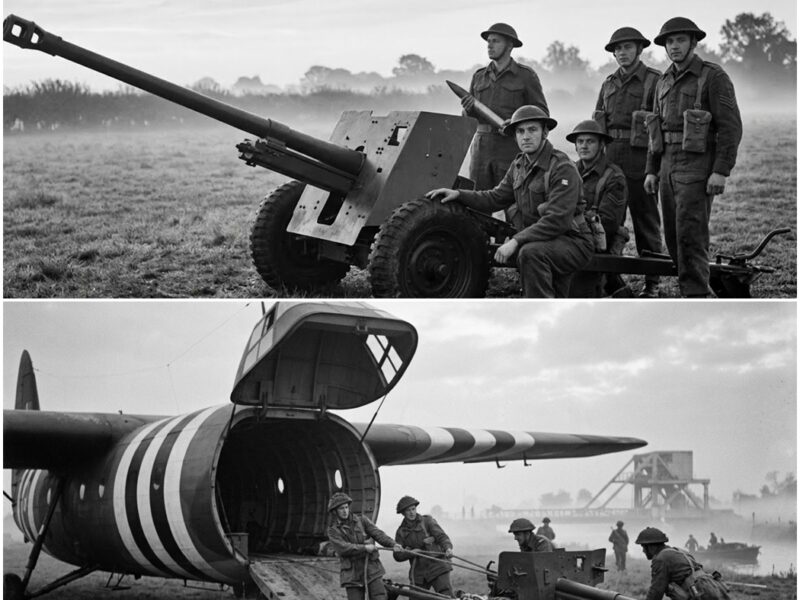
What made the horse so remarkable was not simply its size, but the way its designers solved the problem of delivering heavy cargo with pinpoint accuracy. The nose of certain variants could be detached entirely, swinging open on hinges, so that a jeep, an anti-tank gun, or a trailer of ammunition could be driven or wheeled straight out onto the landing ground the moment the aircraft stopped moving, sparing troops the agonizing minutes of unloading through a side door under fire.
Inside that six pounder gun and its ammunition was secured with a webbing harness system specifically engineered to survive the violence of landing because a horseer did not land so much as arrive hitting the ground at around 100 km an hour with skids rather than wheels on many models designed to be used once and then abandoned or salvaged for parts.
The sound of that arrival, according to men who lived through it, was somewhere between a controlled car crash and a cathedral falling down. A splintering, grinding shriek of wood and metal absorbing an impact that would have destroyed a conventional aircraft. Pilots trained for months at the glider pilot regiment schools to manage the descent, releasing the tow rope high over the French coast and then flying a silent curving approach using nothing but the moonlight, a stopwatch, and an intimate memory of a scale model of the landing zone built back in England from aerial reconnaissance photographs. Production numbers remain difficult to state with total confidence since wartime records were dispersed among many small contractors and some documentation did not survive. But historians generally agree that somewhere in the region of 3,500 to 3,800 horses were built before the wars
end. An extraordinary output for an aircraft that existed in the truest sense to be flown once and wrecked deliberately on arrival. If you are finding this interesting, a quick subscribe helps more than you know. The trick that made all this workable on the night of the invasion was elegantly simple once explained, though it demanded extraordinary skill to execute.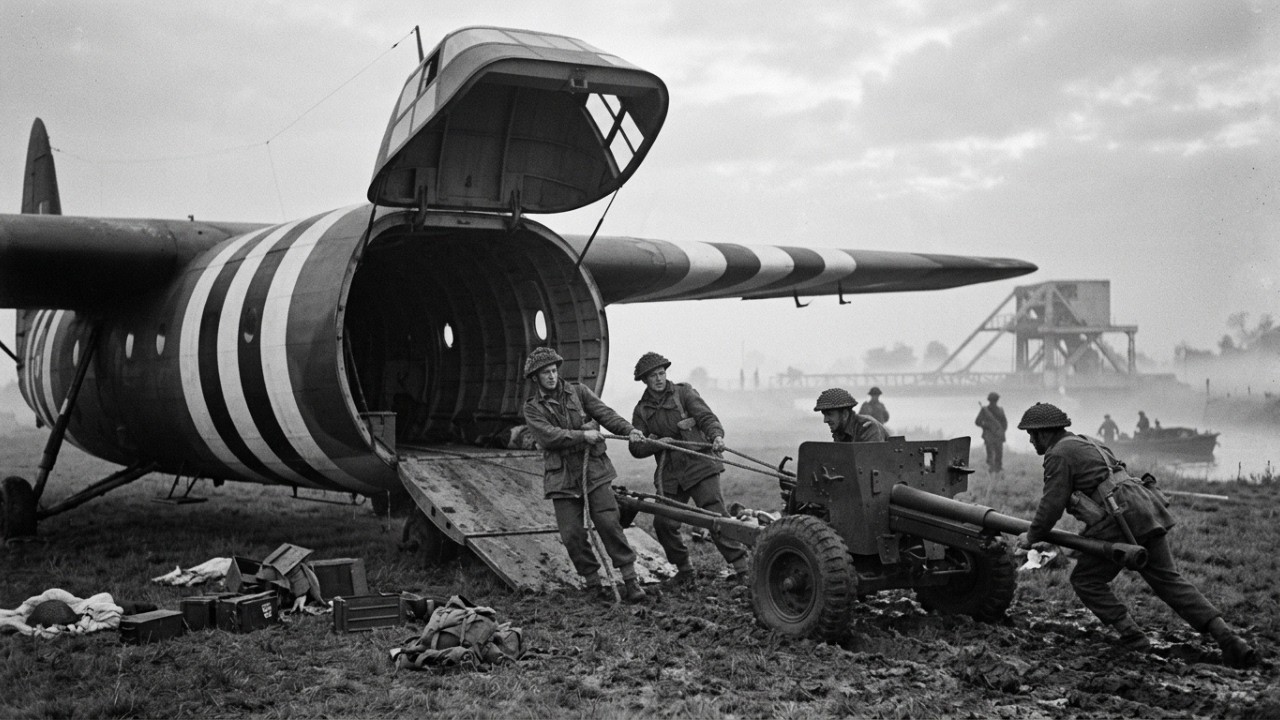
Rather than attempting to land conventionally near the bridges, which would have meant a long noisy approach vulnerable to detection, the gliders carrying the Ox and Bucks assault troops and their supporting weapons released from their tow aircraft at considerable altitude and distance, then descended in a series of calculated turns towards fields chosen specifically because they lay within a few hundred meters of the two bridges over the canal and the river.
Major John Howard’s Kudar Force landed with astonishing accuracy in the fields beside the Kong Canal Bridge in the opening minutes of June 6th, seizing the crossing within about 10 minutes of touchdown, a feat later commemorators would come to call Pegasus Bridge. the anti-tank guns and heavier equipment that followed in subsequent glider waves landing in the same general area and further inland near Ranville gave the lightly armed paratroopers and glider infantry something they had never possessed before in an airborne operation of this kind, a genuine means of stopping German armor before it could roll across the bridges and threaten the invasion beaches. When German tanks did probe towards the position in the hours after dawn, they met defenders who could shoot back with something more than
rifles and grenades. Accounts from German prisoners taken in the area described confusion and disbelief that British forces had arrived in such strength and with such heavy equipment seemingly out of nowhere in the dark without warning. Precise casualty figures and exact tallies of enemy vehicles destroyed in these very first hours remain difficult to pin down since fighting continued for days and records from the confused opening phase of the invasion are often fragmentaryary.
But the psychological effect of German troops discovering that British paratroopers had brought anti-tank guns with them is well attested in postwar accounts and interviews with veterans on both sides. Germany’s own airborne forces having built a formidable reputation over Cree never developed an equivalent solution to the problem of delivering heavy weapons by air.
Partly because Hitler’s reluctance to sanction another major airborne operation after 1941 starved German glider development of the priority it needed and partly because German transport gliders such as the Gother go 242 never matched the load carrying ambition of the horse’s larger cargo variant. The Americans, for their part, relied heavily on the smaller Waco CG4A, a capable aircraft, but one considerably lighter and less voluminous than the Horser, generally unable to carry a loaded jeep and a six pounder gun and its crew in a single lift, meaning American airborne divisions landing further west near Smeiggles had to rely more heavily on separate drops of heavier equipment by parachute. a method both less accurate and more prone to losing or damaging vital
weapons on landing. British planners had in effect built the only Allied aircraft of the invasion specifically configured to deliver anti-tank firepower with the same precision as infantry landing gun and gunner together rather than scattering them across a battlefield. This distinction mattered enormously on an eastern flank where the terrain funneled any German counterattack directly across those two bridges, meaning that a small, accurately delivered anti-tank capability was worth vastly more than a larger but scattered one. Later in the war, the Americans would field their own larger glider designs, and both nations would continue to refine glider tactics. But the horses early combat debut at Pegasus Bridge remained a demonstration of how thoroughly the British had thought through the logistics of airborne heavy weapons before anyone else managed to put the concept into
practice. Assessing the true impact of the Horser and its cargo of anti-tank guns requires some humility because much of what made the operation succeed was the extraordinary flying skill of individual pilots rather than the aircraft alone. And separating the contribution of the machine from the contribution of the men who flew it is not always straightforward.
What can be said with confidence is that the bridges over the Khn canal and the river or were captured intact and held throughout June 6th against German counterattacks, denying enemy armor a direct route towards the invasion beaches during the critical early hours when the beach head was at its most fragile.
The presence of anti-tank guns delivered by glider gave the defenders a credible deterrent against German armor. the parachute troops alone could not have provided. And while it is impossible to say with certainty how many tanks were deterred rather than destroyed, the psychological value of visible anti-tank capability should not be underestimated in an engagement where German commanders were making rapid decisions with incomplete information about British strength.
The horse’s design also influenced later thinking about airborne logistics, reinforcing the principle that heavy weapons needed dedicated delivery systems rather than improvised solutions, a lesson carried into postwar airborne doctrine across NATO forces. Surviving examples of the Horser are rare today since the aircraft were built to be used once, but visitors can see a reconstructed Horser glider at the Airborne Assault Museum at Duxford in Cambridge.
And the Pegasus Bridge Memorial Museum near Ranville in Normandy displays artifacts and a replica glider close to the original landing zone, allowing anyone to stand in roughly the same field where Howard’s men and the guns behind them came down in the dark 80 years ago. Return with me for a moment to that field beside the canal in the minutes after midnight.
The wooden aircraft that carried an anti-tank gun across the English Channel now lies broken and silent in the grass. Its work already done in the few seconds it took to skid to a halt precisely where its pilot intended. There was no engine to fail, no fuel to catch fire, no noise to announce its coming until the very instant it arrived.
And by the time German centuries understood what had happened, British troops were already moving towards the bridge with a weapon capable of stopping the counterattack that would surely follow. It was, in the truest sense, a simple trick. Build an aircraft from wood so factories across the country could produce it without competing for scarce materials.
Design it to carry not just men, but the guns those men would need to survive. and trust ordinary pilots to fly it with extraordinary precision into fields they had only ever seen in photographs. No radar guided it in. No engine corrected its final approach. Only calculation, rehearsal, and nerve.
The bridges at Kong were held. The eastern flank of the invasion did not collapse. And a piece of unglamorous, quietly ingenious engineering had done exactly what parachutes alone never could. Delivering the means to stop a tank into the one place. At the one moment it was needed most.
Simple in concept, devastating in effect. And in the story of that longest of days, it was a wooden glider, not a tank, not a battleship that got there