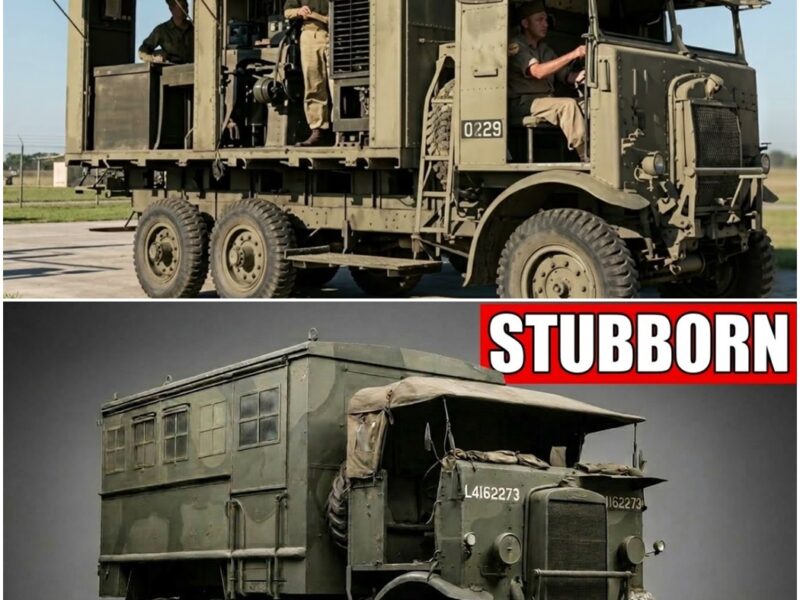
The ‘Stubborn’ British Recovery Truck That Dragged Burning Tanks From Minefields Under Direct Fire D
1939, the Leyland Motors Works, Hovel Lane, Lancashire, England. A six-wheeled truck rolls off the production line and onto the factory yard. It is 22 ft long, 7 and 1/2 ft wide, painted in flat military green, and it weighs just over 3 tons unladen. Its engine produces 73 horsepower. 73.
A London taxicab of the same year produced more. The cab has no doors, no windscreen. The engine block sits between the driver and the passenger, radiating heat through bare metal casing. Mounted on the rear flatbed is a steel gantry with a hand-crank traveling block, or in some variants, a gasoline-electric crane powered by its own separate petrol engine, capable of lifting approximately 3 tons.
It looked like a builder’s lorry. It looked like something that belonged on a construction site, not a battlefield. And yet this truck, multiplied by 6,542, would carry the British Army’s repair capability across every theater of the Second World War. It would serve in France, North Africa, Sicily, Italy, Burma, and Northwest Europe.
It would carry lathes, cranes, welding kits, and mobile workshops into the field. It would recover wrecked carriers from minefields, swap tank engines under fire, and drag burning vehicles off road so that the advance could continue. One of them would carry Field Marshal Montgomery’s personal office from El Alamein to the Rhine.
Its name was the Leyland Retriever, and it was the most important British military vehicle that nobody has ever heard of. To understand why the Leyland Retriever existed, you need to understand the problem Britain faced at the start of mechanized warfare. By 1939, the British Army was transitioning from horses to engines at an extraordinary pace.
Tanks, armored cars, Bren carriers, artillery tractors, and tens of thousands of lorries were flooding into service. But every one of those machines broke down. They threw tracks. They overheated. They were hit by enemy fire. And when they stopped, someone had to fix them or drag them away, often under the same fire that had disabled them in the first place.
In the late 1920s, the War Office had established a subsidy scheme that paid civilian haulage operators to buy lorries built to military specification. The idea was simple. In peacetime, the trucks earned their keep on British roads. In wartime, they could be requisitioned overnight. The War Office designed a special articulated rear bogie for six-wheel chassis, a twin live axle arrangement that kept all four rear wheels on the ground over broken terrain, and released the patent free to any manufacturer willing to build to military standards. Leyland Motors was an early adopter. Their six-wheel Terrier, introduced in 1928, evolved through the 1930s into a militarized forward control chassis, model code WLW. When war came, Leyland’s drawing office refined the design into what became the Retriever, and War Office orders began arriving immediately. The vehicle itself was a masterpiece of practical restraint. Its Leyland four-cylinder, water-cooled, overhead camshaft engine displaced 5,895
cubic centimeters and produced 73 brake horsepower at 2,120 revolutions per minute, modest numbers, but the drivetrain told a more interesting story. A four-speed gearbox mated to a two-speed transfer box gave eight forward ratios, feeding power to both rear axles through the War Department pattern articulated bogie.
The front axle steered but did not drive. This was a 6×4 configuration, meaning six wheels, four driven, and it was specifically designed for the kind of rutted, cratered, shell-damaged roads that defined the rear areas of a battlefield. Hydraulic servo-assisted brakes were a refinement for the period. Suspension was conventional semi-elliptic leaf springs at the front with the articulated bogie at the rear.
The truck rode on single 900 by 20 tires all round, carried a payload of 3 long tons cross-country, and had a range of roughly 195 miles on a 31-gallon tank. Top speed was around 28 mph on a paved road, but the specifications alone do not explain the Retriever’s value. What made it indispensable was its adaptability.
Leyland built the Retriever in over 20 different body configurations. General service cargo, breakdown gantry, Coles crane, lifting derrick, flat floor machinery lorry, mobile workshop, folding boat equipment bridging truck, searchlight platform, generator lorry, wireless lorry, photographic survey vehicle, mobile darkroom, and even a mobile church.
The breakdown gantry variant was the heart of the recovery fleet. A longitudinal steel runway ran the length of the cargo bed, carrying a hand-operated traveling block that could lift 3 tons. The Coles crane variant, fitted with a Mark VI gasoline-electric crane, could swing loads clear of a damaged vehicle’s engine bay, lower a replacement power plant into position, and have the casualty running again within hours instead of days.
Now, before we get into where the Retriever actually served and what it did under fire, if you are enjoying this deep dive into British wartime engineering, hit subscribe. It takes a second, costs nothing, and helps the channel grow. To understand the Retriever’s contribution to the war, you first need to understand the organization that operated it.
On October 1st, 1942, the Royal Electrical and Mechanical Engineers, known as REME, was established by royal warrant. The Beverage Committee on Skilled Men in the Services had concluded that the army was wasting thousands of qualified electricians and mechanics in unskilled infantry roles.
Approximately 5,000 officers and 80,000 men transferred from the Royal Army Ordnance Corps, augmented by tradesmen from the Royal Engineers and the Royal Army Service Corps. By May 1945, REME had grown to roughly 8,000 officers and 152,000 other ranks, making it one of the largest corps in the British Army. REME organized repair on a three-tier system designed to push capability as far forward as possible.
Light aid detachments, small teams of 12 to 25 men commanded by a captain, sat at battalion level and handled minor running repairs and forward recovery. Brigade and field workshops commanded by majors handled medium repairs including engine changes. This was exactly the work for which the Retrievers Coles crane was designed.
Base workshops, often occupying requisitioned factories in liberated cities, carried out major rebuilds. The Retriever served in theater where British troops fought. Thousands went to France with the British Expeditionary Force in 1939 and 1940 and most of those were lost at Dunkirk among the roughly 65,000 vehicles abandoned on the beaches.
But it was in North Africa that the Retrievers role became strategically decisive after the second battle of El Alamein in October and November of 1942, REME recovery teams fanned out across the battlefield with Scammell Pioneers, Sherman armored recovery vehicles and Leyland Retrievers.
The numbers tell the story with brutal clarity. REME recovered 1,244 Allied tanks from the Alamein battlefield. Of those, 1,007 were repaired and returned to combat. Every single one of the roughly 450 Axis tank losses at Alamein was permanent because Rommel was retreating and abandoning his wrecks. The British held the ground.
They recovered their casualties and the gap between those two facts was one of the single greatest force multipliers of the war. Montgomery himself addressed his REME craftsmen after the battle and told them they keep the punch in the army’s fist. That phrase sits today at the entrance to the REME museum at Lyneham.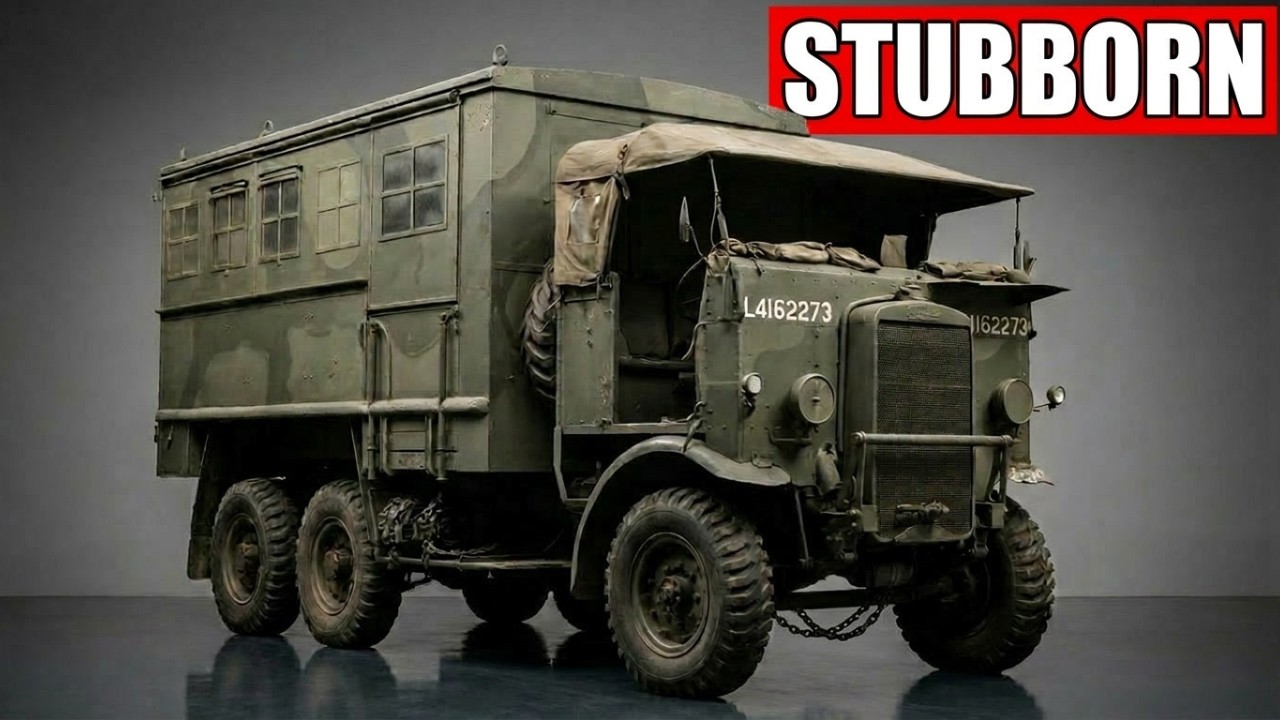
One variant of the Retriever deserves special mention. In June 1940, with invasion imminent and RAF airfields virtually undefended, Admiral Sir Edward Evans visited the Leyland factory and proposed bolting armor plate onto the Retriever chassis to create an improvised armored truck for airfield defense. Leyland and the LMS Railways Carriage Works built 336 of these armored retrievers designated the Beaver E within 10 days of approval.
They were crude, they were heavy, and they were the only armored vehicles defending dozens of British airfields during the summer when German invasion was expected daily. In Normandy, the system proved itself again under far more intense conditions of approximately 1667 British and Commonwealth tanks knocked out between June 6th, 1944 8th, 1945, only 1211 were written off as total losses.
The remaining 456 were recovered, repaired, and returned to service. Some individual tank hulls went through brigade and divisional workshops three and four times during the campaign. Operation Goodwood in July 1944 is the case in point. Contemporary accounts reported 400 British tanks knocked out in 3 days of fighting south of Caen.
The actual number of permanent write-offs was closer to 250. The gap between those numbers, roughly 150 tanks returned to service within days, was the work of REME recovery crews operating Scammell Pioneers, Sherman armored recovery vehicles, and Leyland Retrievers. The 8th Corps was largely combat ready again within 48 hours.
The 53rd Welsh Infantry Division’s REME alone logged 555 vehicles damaged by enemy action and 6,250 damaged by mechanical failure at light aid detachment level alone. That second figure, more than 10 times the first, captures the relentless daily volume of mechanical work that kept divisions mobile.
The most famous retriever of the war belonged not to a recovery unit, but to a field marshal. In February 1941, British forces captured Italian General Annibale Bergonzoli at Beda Fomm. With him came a coach-built Lancia Caravan body. British workshops removed that body from its Italian chassis and remounted it on a Leyland Retriever 6×4 frame.
Lieutenant General Neil Ritchie used it first. Montgomery took it over in August 1942 and lived in it through the desert campaign, through Sicily, Italy, and all the way into Northwest Europe. Winston Churchill slept in it during his visits to the front. It survives today at the Imperial War Museum at Duxford.
A much published photograph from June 1944 shows a Retriever fitted with a breakdown gantry crossing Pegasus Bridge, the famous canal bridge seized by glider troops of the 6th Airborne Division on the night before D-Day. The truck belonged to the 79th Armoured Division’s first assault brigade workshop. It had crossed the channel, driven through the beachhead, and arrived at the bridge within days of the landings to begin recovering damaged vehicles from the surrounding roads and ditches.
No one photographed it because it was remarkable. They photographed it because it was there doing what Retrievers always did. The human cost of the recovery war was real and largely unrecorded. Major Yarker commanded the 6th Guards Tank Brigade workshop, a REME unit, preparing for the Normandy invasion in Kent.
At 700 hours on June 24th, 1944, a German V1 flying bomb struck the workshop camp directly. 51 REME craftsmen were killed. More than 40 were wounded. The unit had not yet embarked for France. Yarker rebuilt the workshop, crossed the channel, and went on to recover and repair tanks through the entire Northwest Europe campaign.
His brigade commander, Brigadier Greenacre, later wrote that recovery often had to be carried out in difficult or dangerous circumstances and that Yarker fully realized how fond the crews became of their own tanks. That understanding, that a tank was not just metal, but a crew’s home and survival, drove the recovery men to take extraordinary risks.
On paper, the Scammell Pioneer looked superior. It was heavier, diesel-powered, carried an 8-ton winch against the Retriever’s five, and its famous walking beam rear bogie could climb obstacles that would ground the Retriever entirely. The AEC Matador, a 4×4 medium artillery tractor with 95 brake horsepower and a 7-ton winch, was more capable off-road and more popular with crews.
American LaFrance wreckers, true 6×6 vehicles with cranes rated at over 20 tons, outclassed the Retriever in every dimension, but the British Army did not need 6,500 heavy wreckers. It needed 6,500 trucks that could carry cranes, lathes, welding kits, spare engines, and mobile workshops into the field and keep them there.
The Retriever that role because it was simple enough to maintain, cheap enough to mass produce, and adaptable enough to accept 20 different body types on one chassis. The Scammell Pioneer, for all its superiority, was produced in fewer than 2,000 units. The Retriever outnumbered it more than 3:1.
The Retriever was withdrawn from British service in the late 1940s and replaced by the Leyland Martian, a 10-ton 6×6 with a Rolls-Royce straight-8 engine, and later the AEC Militant. Surplus Retrievers entered civilian life as showman’s tractors at traveling fairs, breakdown trucks for haulage firms, and timber tractors in forestry operations.
Between 10 and 25 are believed to survive worldwide, with only a handful in running condition. Montgomery’s Caravan Retriever at Duxford, the REME Museum at Lyneham, and the British Commercial Vehicle Museum in Leyland itself hold the most significant examples. 1939, the Leyland Motors Works, Hough Lane, Lancashire.
A six-wheel truck with 73 horsepower, no doors, no windscreen, and a hand-cranked gantry bolted to its back. It was underpowered. It was not armored. It could not tow a tank. It had no all-wheel drive. It was outclassed by nearly every specialist vehicle in its company, and yet it worked. It worked in the sand of Libya and the mud of Normandy.
It worked in the mountains of Italy and the jungles of Burma. It worked because 6,500 of them, spread across 20 body variants and crewed by 160,000 REME craftsmen kept an entire mechanized army in the fight at El Alamein. 1,244 Allied tanks were recovered from the battlefield. 1,007 went back to war. Every one of Rommel’s 450 losses was permanent. That is not luck.
That is not superior firepower. That is the difference between an army that recovers its wounded machines and one that leaves them behind. The Leyland Retriever was not fast. It was not powerful. It was not famous. It was British and it kept the punch in the army’s fist.