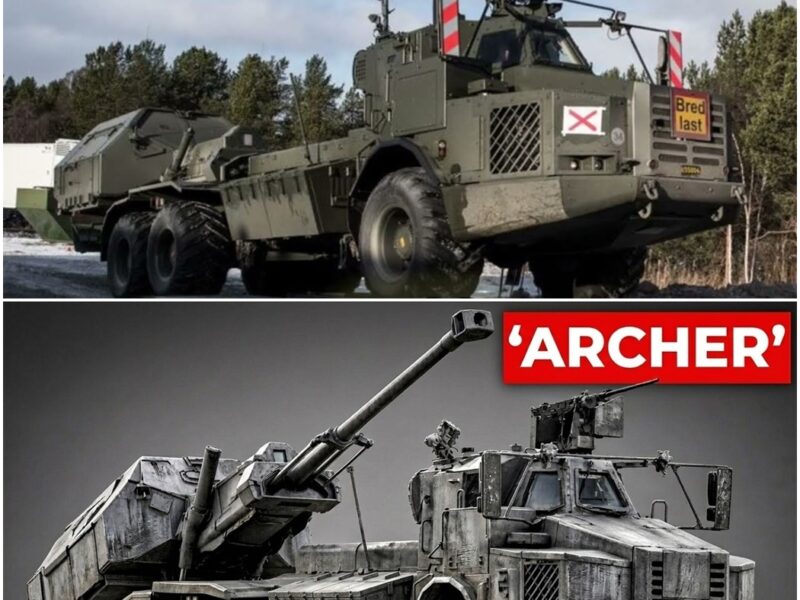
The Swedish ‘Beast’ Ukraine Calls Sniper Artillery — That Became Russia’s Nightmare D
Luhansk region, January 2024. A Swedish-built howitzer rolls to a stop in open Ukrainian farmland. 14 seconds later, 14, not 14 minutes, it fires its first shell. It fires two more in rapid succession. Then, before the very first shell it launched has even reached the ground 30 km away, the vehicle is already moving again, abandoning the position it just fired from.
A Ukrainian artillery crew member, a man who had spent years operating a Soviet-built D-20 howitzer that took a team of soldiers and several minutes just to prepare for a single shot, watched this happen and gave the new gun a nickname that stuck immediately: sniper artillery. Its actual name is the Archer, and it represents something the artillery world had never fully achieved before.
A gun that can fire and disappear faster than the enemy can find it. Before this video ends, you will understand why Sweden spent over a decade developing an artillery system that can complete its mission and be in motion again within seconds of the last shell leaving the barrel. Why Ukrainian gunners switched from praising its firepower to praising something much stranger.
The fact that the gun barely needs them. And why this single piece of military engineering has become one of the most quietly important weapon systems of the entire war in Ukraine. But here is the detail that should already be sitting with you. The Archer can fire its first shot just 14 seconds after coming to a complete stop.
The crew never leaves the armored cab. In an artillery duel where survival depends on speed, Sweden built a gun that does almost everything by itself. The Archer’s story begins not with a clean sheet of paper, but with an old Swedish howitzer called the FH 77. Originally a towed gun requiring a full crew to physically manhandle it into firing position, manually load each shell, and aim using mechanical sights.
Through the 1990s, Swedish and Norwegian engineers began studying how to mount that same proven 155 mm 52 caliber barrel onto a fully automated self-propelled chassis, eliminating almost every manual step that had defined artillery operations since the Second World War. The program moved through prototype designations FH 77 AD and FH 77 BD before Norway withdrew from the joint development in 2013, leaving Sweden to push the project to completion alone.
The Swedish Army received its first pre-production units in September 2013. By February 2016, the Archer was officially in service. It had taken from the 1990s concept studies until full operational deployment, nearly two decades to build a gun that could do automatically what it took human crews minutes to do manually.
What emerged was built on a 6×6 articulated all-terrain truck chassis with the entire 155 mm gun system, ammunition magazine, and loading mechanism integrated into a single automated turret module. The crew of three to four sits inside an armored cab completely separated from the gun itself, operating everything through a digital fire control system.
The gun can carry 21 rounds ready to fire, loaded automatically from an internal magazine without anyone stepping outside the vehicle. It can fire its entire ready ammunition load in 3 and 1/2 minutes. It can complete deployment from road march configuration to first shot in 20 seconds. and with a 52 caliber barrel, it can strike targets up to 50 km away, far enough that the gun is often safely beyond the range of the very weapons it just destroyed.
This combination of speed and automation solves a problem that has defined artillery survivability since the invention of counter-battery radar. The moment a gun fires, its position becomes known, and the only question is how quickly the enemy can convert that knowledge into a return strike. Traditional towed artillery might take minutes to displace after firing, minutes during which a counter-battery radar can calculate the firing position and direct return fire or a drone strike onto the exact coordinates. The Archer compresses that entire vulnerable window into seconds. Fire the mission, retreat before the first shell has even landed. By the time enemy reconnaissance has processed the firing signature, the gun that produced it is already a kilometer away on a road the enemy cannot predict. Sweden began transferring Archer systems to Ukraine in early 2023, with the first
eight units confirmed in Ukrainian hands by mid-November after an intensive crew training program in Sweden. These were drawn directly from Swedish Army storage, guns that had been sitting in reserve, fully operational, while Ukraine desperately needed exactly this kind of capability.
The systems went immediately to Ukraine’s 45th Artillery Brigade, with additional units later integrated into the 43rd Artillery Brigade. Ukrainian gunners, many of whom had spent years operating Soviet-era towed guns requiring manual loading and minutes of setup time, found themselves operating a system that did almost everything the old guns required a full crew and significant physical effort to accomplish, now compressed into automated sequences measured in seconds.
The combat record came quickly. In March 2024, reconnaissance unit of Ukraine’s 63rd Mechanized Brigade detected multiple Russian D-20 howitzers near Kreminna. An Archer crew of the 45th Artillery Brigade received the targeting data, moved into position, and executed a counter-battery mission that destroyed three Russian artillery pieces before displacing.
Verified by Ukrainian drone footage. In May 2024, the same brigade used an Archer to destroy a Russian 2S19 Msta-S self-propelled howitzer near Chervona Popivka, a target spotted by a Ukrainian reconnaissance team and confirmed destroyed by follow-up drone observation. These were not isolated lucky shots.
They were the exact tactical pattern the Archer was designed to execute. Detect, strike, vanish, repeat. A raiding system rather than a static gun position. The system was not invulnerable. In February 2024, an Archer near Kupiansk was struck by a Russian loitering munition. Russian sources claimed the howitzer was destroyed.
Ukrainian sources maintained the damage was likely repairable. A difference that matters less for the specific vehicle than for what it reveals about the broader war. Drone warfare become precise enough to threaten even a gun designed specifically to outrun traditional counter-battery response times. The Archer had been engineered to defeat radar-driven artillery duels from the 1990s design era.
The drone-saturated battlefield of 2024 represented a threat its original Swedish engineers had not fully anticipated, just as the Marder’s designers in 1971 had not anticipated improvised explosive devices in Afghanistan four decades later. Every generation of weapon eventually meets a threat it’s design era could not foresee.
Sweden’s commitment to keeping Archers in Ukrainian hands has only deepened. In March 2025, Swedish Defense Minister Pål Jonson announced an additional 18 Archer systems alongside five ARTHUR counter-battery radar systems. Sophisticated detection equipment capable of tracking incoming artillery fire at ranges up to 40 km and feeding that data directly into counter-battery response systems.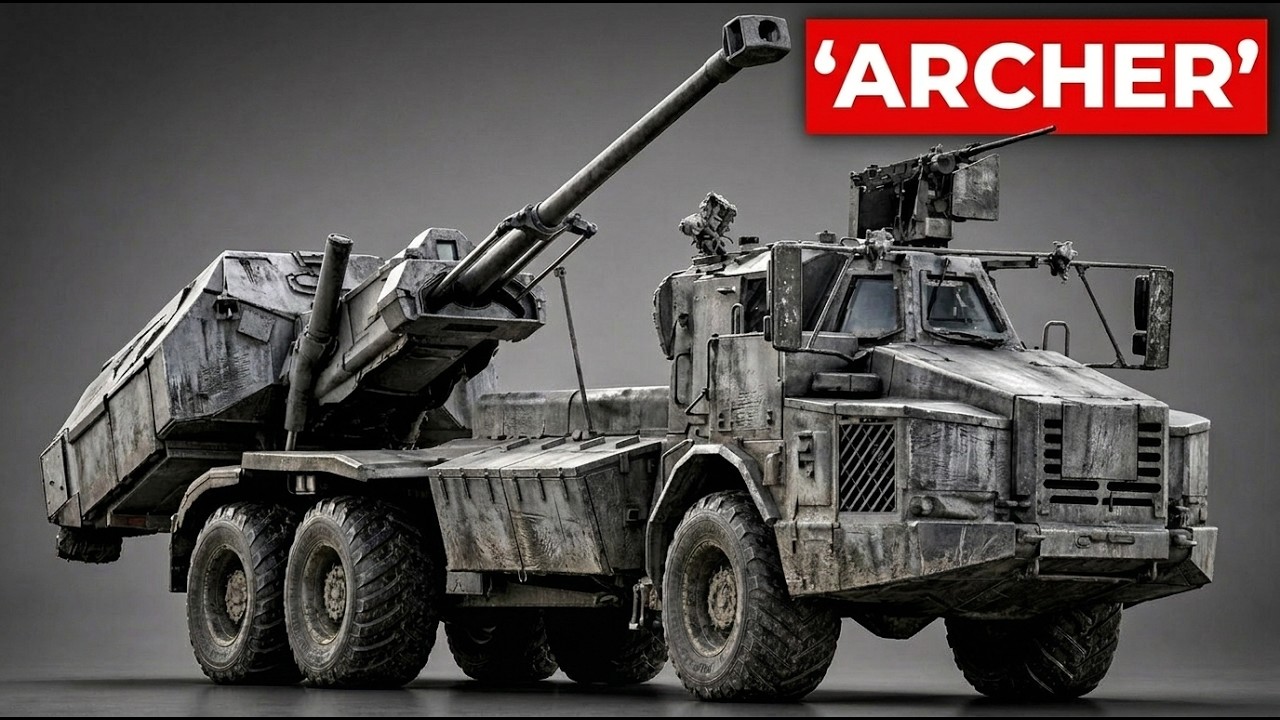
The package, valued at approximately $300 million, represented a deliberate pairing. Give Ukraine more of the guns that fire and vanish and pair them with the radar systems that help detect exactly the kind of enemy artillery that Archers are built to silence. By January 2026, Swedish authorities confirmed that 26 Archer systems had already been transferred to Ukraine out of a planned total of 44.
A sustained, expanding commitment rather than a single donation. What Ukrainian crews ultimately reported about the Archer went beyond simple praise for its firepower. The recurring theme, repeated across multiple units and multiple years of combat, was almost a kind of disbelief at how little the system asked of its human operators compared to everything Soviet-designed artillery had demanded. The gun aimed itself.
The gun loaded itself. The gun calculated its own firing solution. The crew’s job had shifted from physical artillery operation to tactical decision-making. Where to position, when to fire, when to run. That shift, more than the range or the rate of fire, is what separates the Archer from nearly everything else.
Firing 155 mm shells on the modern battlefield. Sweden had not just built a faster gun, it had built a fundamentally different relationship between soldier and weapon. Here is where we are. A Swedish artillery program that began as 1990s research into automating an old towed howitzer became, three decades later, one of the most effective counter-battery weapons in an active European war that did not exist when the engineering began.
It fires its first shot 14 seconds after stopping. It can be gone before its own shell lands. 26 delivered to Ukraine, 18 more committed, a planned total of 44 and counting. Drone warfare has already proven it is not invincible. Nothing on a modern battlefield is. But, in an artillery duel where the only thing that matters is speed, Sweden built a gun that barely needs the humans operating it and gave Ukrainian gunners who grew up loading Soviet shells by hand a weapon that does almost everything except decide where to point it. Subscribe. Next week, we cover the radar system Sweden sent alongside it and why finding the enemy’s gun has become just as important as outrunning your own shell.