The Tank Crews Who Welded Spare Tracks — And Became Invincible D
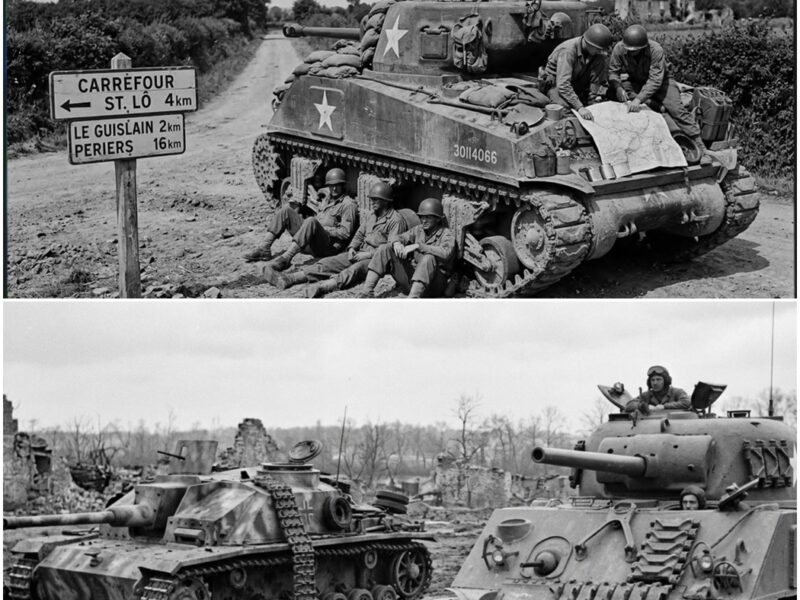
On the morning of July the 25th, 1944, somewhere in the bocage country south of Saint Lo, a Sherman M4A1 from the 2nd Armored Division rolled forward with 11 extra track links bolted and welded across its glacis plate, another row strapped to the turret face, and sandbags stacked along the hull sides like masonry.
To an inspecting ordnance officer flown in from Washington 2 weeks earlier, the tank looked like a junkyard had been dragged into combat formation. The added steel and rubber weighed nearly 4,000 lb, killed the tank’s already mediocre power-to-weight ratio, and violated every weight distribution chart Detroit Arsenal had published.
On paper, this shouldn’t have worked. The track links bolted to the front added perhaps 2 in of additional standoff distance and a few hundred extra pounds of mild steel and rubber in a war already being decided by armor thickness measured in tens of millimeters. Yet that tank, and hundreds like it, survived hits from German Panzerschreck rockets and 75-mm Pak 40 rounds that should have killed everyone inside.
The junk wasn’t decoration. It was the single most effective field modification of the entire Normandy campaign, and the engineers who designed armor on paper were the last people to understand why it worked. Standard armor doctrine in 1944 emphasized homogeneous rolled steel plate sloped at calculated angles to maximize effective thickness against flat trajectory anti-tank rounds.
The Sherman’s frontal glacis carried 51 mm of armor sloped at 47°, giving a calculated effective thickness of roughly 75 mm against a round arriving head-on. German ordnance officers studying captured tanks dismissed the loose track links bolted on top as wasted weight. Their own Panzer 4 crews occasionally added spare track, but mostly for spalling protection against small arms fire, not as a serious counter to shaped charge weapons.
British and American armor designers were even more skeptical. The Ballistic Research Laboratory at Aberdeen ran tests on standoff armor concepts in 1943 and concluded that air gaps needed to be precisely calculated, uniform, and bonded with specific materials to defeat kinetic penetrators. A pile of loose, irregularly shaped track links welded on by a tank crew with a field welding kit and no engineering background looked to the men who wrote the manuals like exactly the kind of amateur tinkering that got crews killed by adding weight without adding protection. The technical reality was that German infantry by mid-1944 weren’t primarily killing Shermans with PzB 40 rounds. They were killing them with a Panzerfaust both shaped charge weapons that worked by a completely different mechanism than solid armor-piercing shot. A shaped charge detonates and forms a high-velocity jet of molten copper and gas, but that jet needs to form and stabilize over a specific distance, roughly four to six times the diameter of the charge, before it reaches peak penetration.
The Panzerschreck’s 80-mm warhead needed about 150 mm of standoff to fully form its jet. Disrupt that formation distance with anything solid in the way, even something as crude as a loose stack of T-shaped or block-style steel track links with rubber chevrons, and the jet either failed to form completely or detonated early against the spaced steel, burning through the track links and the air gap behind them before it ever reached the actual hull plate.
The secret was in the gap, not the steel. It didn’t matter that the track links weren’t engineered standoff armor in the technical sense. What mattered was that they were dense enough to trigger detonation and far enough from the hull to let the jet lose coherence before it arrived. Crews who’d never read a ballistics manual had discovered, through trial, error, and burned out tanks, the exact geometry that Aberdeen’s researchers were still calculating with slide rules.
The proof came in the hedgerow fighting through July and August 1944. The 2nd Armored Division’s after-action reports from the Saint-Lô breakout documented multiple incidents of Sherman tanks taking direct Panzerschreck hits on track reinforced glacis plates and crews walking away with nothing worse than a concussion and ringing ears.
One tank from the 67th Armored Regiment took a Panzerschreck round square on the bow on August 3rd near Vire. The jet burned through three track links and stopped against the whole plate, leaving a crater, but never penetrating. The crew reported the explosion felt like getting hit with a sledgehammer through a mattress, violent but survivable, and nobody inside was wounded.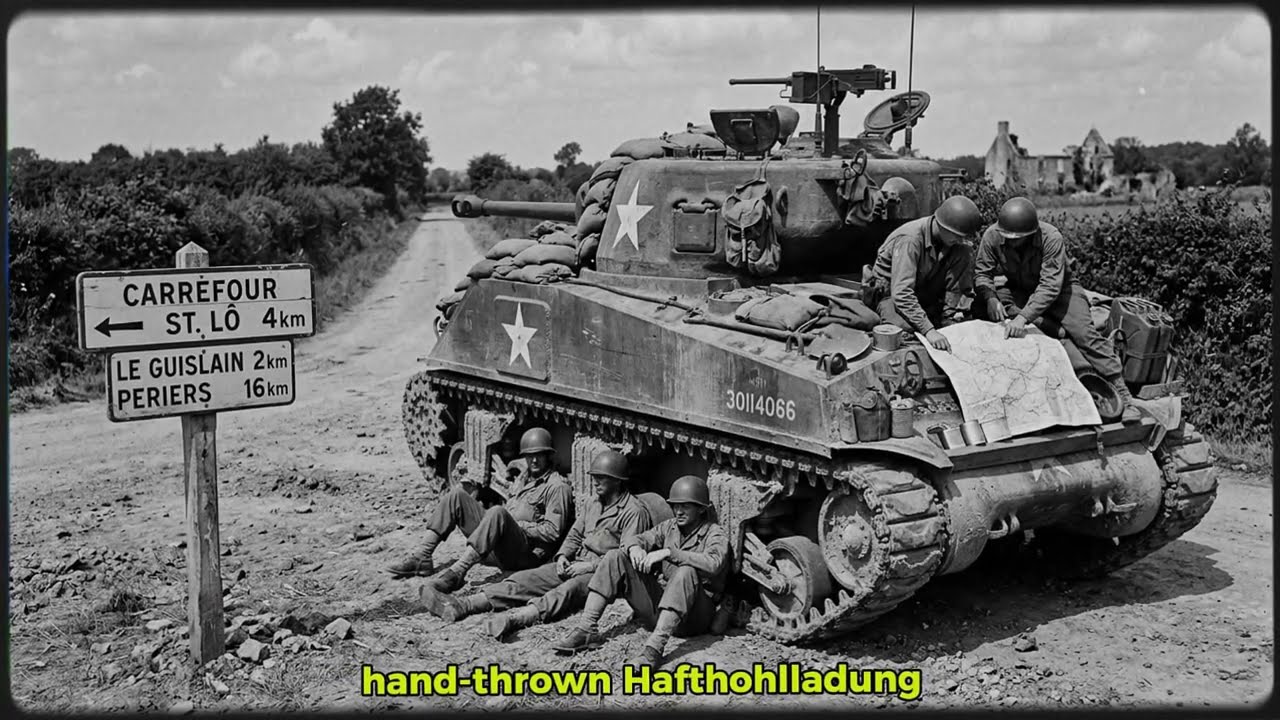
Compare that to the 743rd Tank Battalion’s records from the same period, where bow on Panzerschreck hits against unmodified Shermans penetrated cleanly in the majority of documented cases, frequently killing the driver and bow gunner outright from the jet and the resulting spall. German Panzerfaust crews captured near Mortain in early August told interrogators they’d begun deliberately aiming for the flanks and rear of American tanks instead of the heavily reinforced front glacis plates, because frontal shots that should have been kills were bouncing or burning out against the track and sandbag arrays without penetrating. That’s documented in the First Army G-2 Periodic Report for the second week of August 1944. Enemy infantry adjusting their entire targeting doctrine because of the supposedly junk modification had changed the calculus of where a shaped charge could actually kill a tank. The sandbags told a similar story but through a different mechanism, and this is where the engineers were proven wrong twice over. The original theory among crews who started piling sandbags on Sherman hulls
in June 1944 was that the sand itself would absorb kinetic energy from solid shot rounds, the way sand absorbs a bullet at a firing range. Ordnance testing later in 1944 demonstrated that sandbags did almost nothing against high-velocity kinetic rounds like the 75 mm AP shot that German tanks and anti-tank guns fired.
The round simply punched through sand and canvas as if it weren’t there, sometimes even tearing the bags free entirely. Reports from the Armored Board specifically criticized crews for wasting weight and mobility on a modification that tested as useless. But the testing missed what the sandbags were actually defeating in practice.
Hand-thrown Hafthohlladung magnetic mines and close-range Panzerfaust hits where the standoff and disruption effect mattered far more than raw energy absorption. Plus, the simple morale value of a visibly thickened tank to crews fighting through hedgerows where German infantry with hand weapons could get within 10 or 15 m before anyone saw them.
Crews kept piling on sandbags through the fall of 1944, not because they’d read a study, but because the tanks that came back from missions intact were consistently the ones with the extra bulk, and the tanks that didn’t come back tended to be the bare ones. That correlation, repeated across hundreds of small unit actions, was data the armored board’s controlled firing range tests never captured, because the range tests didn’t replicate the actual weapon mix and engagement ranges of bocage combat. This wasn’t accidental engineering, and it wasn’t superstition either, even though it looked like both to outside observers. Commanders who initially ordered the track link armor removed to save weight, and several did, in the early weeks after D-Day, citing maintenance officer complaints about strained suspension components and reduced fuel range, reversed those orders within weeks once casualty reports from track reinforced versus unmodified companies started circulating. Major General Edward Brooks, commanding the 2nd Armored Division, is recorded in division correspondence from July 1944 explicitly overriding an ordnance recommendation to standardize removal of
non-regulation applique, because his unit’s own loss figures showed a clear survival advantage for tanks carrying it. Brooks wasn’t clinging to a folk remedy. He was looking at numbers his own intelligence section had compiled, showing that tanks with additional track and sandbag armor in his division were surviving panzer shrek hits at a noticeably higher rate than tanks without it, even accounting for crew experience and tactical situation.
The maintenance officers were right that the weight strained the suspension and ate into operational range. The crews were right that the modification kept them alive. Both things were true simultaneously, and a war fought in hedgerows at close range, where every tank eventually took a hit from something, made survivability the variable that mattered more.
The deeper principle, the one that separated the men designing armor in a laboratory from the men fighting in a Norman wheat field was that armor doesn’t have to stop a round outright to do its job. It sometimes just has to change where and how that round arrives. A test range measures penetration against a controlled single perpendicular shot fired from a known distance under ideal conditions.
A hedgerow firefight delivers shaped charge warheads from unpredictable angles, ranges as close as 5 m, sometimes through smoke, sometimes after the gunner has already been wounded and is firing one-handed. Under those chaotic conditions, a crude air gap that disrupted jet formation by even a few centimeters, or sandbag layer that absorbed the blast wave from a contact detonated mine, did real and measurable work that no clean engineering test had been designed to capture.
Crews understood instinctively what the Ballistic Research Laboratory would only formally document in post-war studies on spaced and standoff armor, that a shaped charge jet is a fragile, time-sensitive phenomenon, and almost anything placed in its path before it stabilizes degrades its performance.
Even materials never intended as armor. The tank crews who welded on spare track links weren’t experts. They were survivors who’d watched friends die in unmodified tanks and adjusted their equipment based on what kept other crews alive, building empirical knowledge one burned-out hole at a time, faster than any testing board back home could write it up, approve it, and ship the fix to the front.