The ‘Terrifying’ British Thermobaric Rocket That Turns Bunkers Into Ovens D
The 24th of February, 2022, 04:30 hours. A Russian armored column rolls south through the darkness towards Kyiv. T-72B3s, T-80s, infantry fighting vehicles, hundreds of them. Inside the lead tanks, Russian crews stare at thermal displays showing empty fields ahead. Their explosive reactive armor panels glint in the pre-dawn light.
600 mm of composite protection faces forward. Every countermeasure is active. Every sensor is scanning. They are watching the wrong direction. 300 m away, a Ukrainian conscript with 6 hours of weapons training raises a tube to his shoulder. It weighs 12 and 1/2 kg. It costs less than a family car. He tracks the lead tank for 3 seconds, then pulls the trigger.
The missile launches with a muffled thump, accelerates to 200 m per second, and flies directly over the tank’s turret, 1 m above the roof. Then it fires downward. The T-72’s turret armor is 40 mm thick on top. The missile’s warhead penetrates more than 500 mm. The crew never knew what killed them.
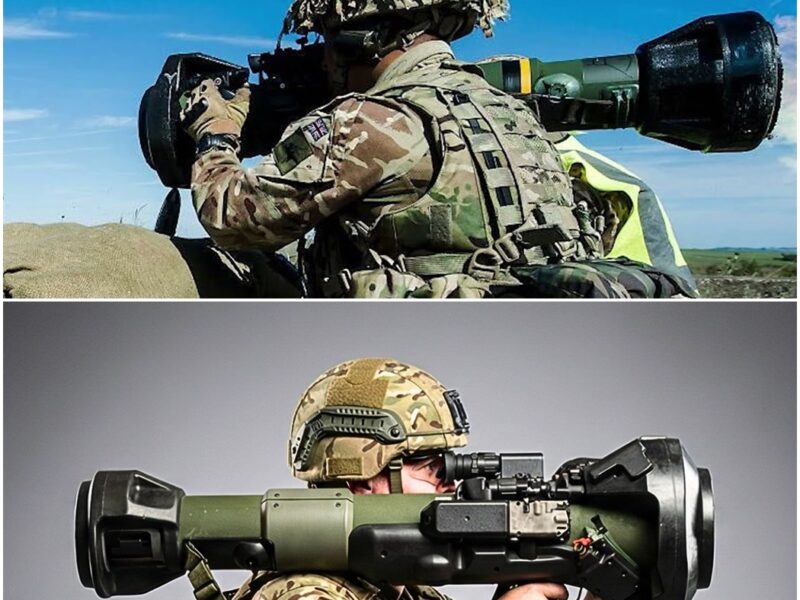
Their infrared warning receivers detected nothing. Their laser sensors triggered no alarm. Their reactive armor, angled to defeat frontal attacks, provided zero protection from above. This is the NLAW, the next generation light anti-tank weapon, a joint British and Swedish system that changed modern armored warfare by asking one simple question.
Why attack a tank where the armor is thickest when you can attack where it is thinnest? The problem the NLAW was designed to solve dated back decades. By the 1980s, main battle tank armor had reached a point where shoulder-launched weapons could no longer reliably defeat it. The Soviet T-72, introduced in 1973, carried composite armor equivalent to 410 mm of rolled homogeneous steel on its turret front.
The T-80, fielded in 1976, pushed this further. And reactive armor, explosive panels that detonated outward to disrupt incoming shaped charges added another layer of protection that rendered most infantry anti-tank weapons ineffective. Britain’s answer at the time was the LAW 80, a 94-mm unguided rocket that entered service in 1987.
It could penetrate 600 to 700 mm of armor, enough for contemporary threats. But, it had critical weaknesses. No guidance meant low hit probability against moving targets. No confined space capability meant soldiers could not fire from buildings without killing themselves with backblast. And no top attack mode meant every engagement was a frontal assault against the thickest armor a tank possessed.
The mathematics were brutal. A T-72’s frontal arc could defeat almost any infantry weapon, but its roof armor was just 15 to 40 mm thick. The same tank that was nearly invulnerable from the front was catastrophically vulnerable from above. Every main battle tank ever built shares this weakness.
Turret roofs cannot be heavily armored without making the vehicle too heavy to move. The engineering compromise is universal and unavoidable. British defense planners recognized this vulnerability as early as 1987 when the Defense Research Establishment began surveying replacements for the LAW 80 before it had even entered full service.
The concept was designated Staff Requirement Land 7098. The specification demanded a weapon under 12 and 1/2 kg that could hit moving targets at 400 m, stationary targets at 600 m, and fire safely from inside buildings. Most critically, it had to attack tanks from above. Two competing designs emerged.
Enlaw 1 was a short-range unguided rocket. Enlaw 4 was a guided weapon with top attack capability. The requirement crystallized in 1997 when the Defense Procurement Agency invited tenders. In January 2001, two bids competed. Saab Bofors Dynamics of Sweden proposed the MBTLAW. Matra BAE Dynamics offered the Kestrel, derived from the American FGM-172 SRAW.
Saab won in May 2002. A memorandum of understanding between the British DPA and Swedish FMV followed in June. The assessment phase cost 18 million pounds, split between Saab, Britain and Sweden. The full contract for development, manufacture and support totaled approximately 400 million pounds.
What Britain and Sweden purchased was not merely a missile. It was a fundamentally new approach to killing tanks. The NLAW’s lethality comes from two innovations working together. The first is predicted line of sight guidance, or PLOS. The second is overfly top attack mode, or OTA.
Understanding these is essential to understanding why this weapon terrified Russian tank crews. PLOS works differently from any other anti-tank missile in service. The operator tracks a moving target through a Trijicon 2.5 by 20 ACOG sight for 2 to 3 seconds. During this time, the missile’s inertial measurement unit, manufactured by BAE Systems in Plymouth, using silicon rate sensors, records the operator’s aiming movement and computes the target’s trajectory, speed, direction, distance, all calculated from how the operator moves the launcher to keep the target centered. Upon firing, the missile flies an autonomous pre-programmed intercept path. No wire trails behind it, no infrared seeker homes on engine heat, no laser illuminates the target, no radio link connects it to the operator. The missile knows where the target will be and flies there independently. This makes it genuinely fire and forget. The operator can immediately take cover, relocate, or
engage another target. More critically, it makes the NLAW completely unjammable. Modern tanks carry increasingly sophisticated countermeasures. Laser warning receivers detect targeting beams. Infrared dazzlers blind heat-seeking missiles. Active protection systems shoot down incoming projectiles. None of these work against NLAW.
There is no signal to detect, no seeker to blind. The missile emits nothing after launch. The target receives zero warning until the moment of impact. In overfly top attack mode, the missile flies approximately 1 m above the operator’s line of sight. When it’s combined magnetic and optical proximity sensors detect the target passing beneath, the warhead detonates and fires an explosively formed penetrator downward.
This technology descends directly from the Swedish RBS 56 BILL 2 missile. The copper liner of the shape charge transforms into a superheated metal slug traveling at thousands of meters per second punching through the tank’s roof and into the crew compartment, ammunition storage, and engine. The warhead weighs 1.
8 kg and contains 850 g of insensitive munition compliant PBX explosive. It penetrates more than 500 mm of rolled homogeneous armor. A T-72 roof is 40 mm. A T-90 roof is similar. The margin is catastrophic overkill. No main battle tank roof armor can survive. The weapon also has a direct attack mode for soft-skinned vehicles, bunkers, and low-flying helicopters.
In DA mode, the missile flies straight along the line of sight and detonates on contact. The DA mode is the secondary function. OTA is what makes NLAW unique. Soft launch capability completes the tactical picture. Using a salt water countermass system derived from AT4 CS technology, the NLAW can fire safely from enclosed spaces as small as 4 by 2.5 by 2.
5 m through windows as small as 1 by 1 m. The missile exits the tube at just 40 m per second with minimal backblast. The main rocket motor ignites approximately 8 m from the launcher accelerating to a maximum 200 m per second. This allows infantry to fire from buildings, ruins, and vehicles without injury. Development hit problems.
Qualification failures in November 2006 forced delays. The originally planned 2006 in service date slipped. The MOD purchased 2,584 CS systems in 2004 as a bridge designated L2A1 ILAW, interim light anti-tank weapon. Full and low production finally began at Thales Air Defense in Belfast, Northern Ireland in 2008 with first deliveries in December of that year.
The weapon entered service with British, Swedish, and Finnish forces in 2009. Now, before we see how this performed in combat, if you’re enjoying this deep dive into British engineering, hit subscribe. It takes a second, costs nothing, and helps the channel grow. All right, let’s get into the combat record.
The UK began delivering NLAWs to Ukraine on the 17th of January 2022, 5 weeks before the Russian invasion. RAFC 17 Globemaster transports flew at least five sorties to Boryspil Airport near Kyiv. Video confirmed the weapons on the 19th of January. This initial batch of approximately 2,000 units came with UK training personnel under the existing Operation Orbital framework.
Britain was first before the Americans sent Javelins, before the Germans debated Panzerfausts, before the invasion even began. British NLAWs were already in Ukrainian hands. By mid-March, the UK had delivered over 4,000 NLAWs. By May 2023, more than 5,000 confirmed. Ukraine received an estimated 12,000 NLAWs from all sources combined, including Luxembourg’s entire stock of 100 units.
The weapon’s impact during the Battle of Kyiv from the 24th of February to the 2nd of April 2022 proved everything the designers had promised. At Bucha, Ukrainian troops from the 4th Company, 2nd Mechanized Battalion ambushed Russian convoys using NLAWs along Vokzalna Street. At Ivankiv on the 26th of February, a Ukrainian commander walking through destroyed vehicles while carrying an NLAW became one of the war’s earliest iconic images.
At the Brovary and Skybyn ambush on the 9th and 10th of March, Ukrainian forces from the Azov special operations detachment and 72nd Mechanized Brigade destroyed multiple vehicles from the Russian 6th Tank Regiment and 239th Tank Regiment, 90th Guards Tank Division. The engagement reportedly killed regimental commander Colonel Andriy Zakharov, a senior Ukrainian military officer, estimated NLAW’s accounted for 30 to 40% of Russian tank kills in the early phase.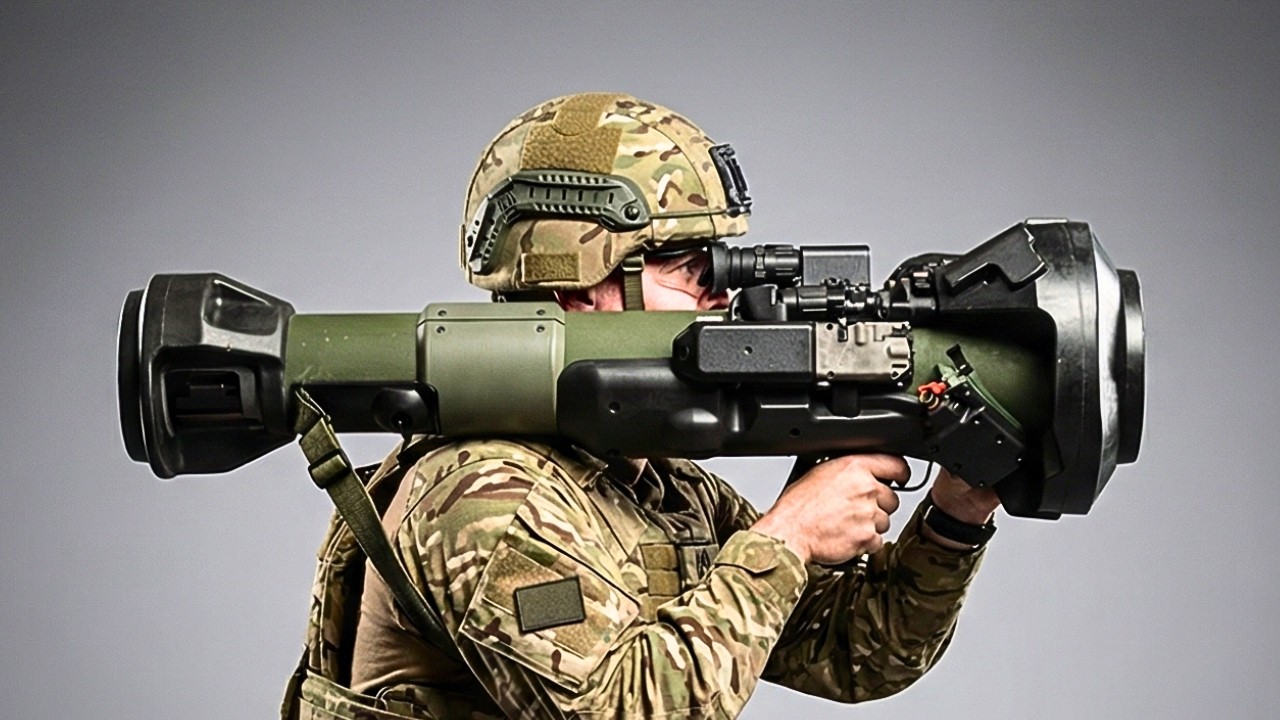
While this figure has not been independently verified, what is verified is the weapon’s role in layered defense. The Royal United Services Institute’s landmark November 2022 report, the most authoritative analysis of the early fighting, noted that NLAW was distributed widely to ground-holding units, whilst Javelins were reserved for special forces due to the command launch unit’s additional surveillance capabilities.
Training took hours for NLAW versus weeks for Ukraine’s domestic Stugna-P system. A conscript who had never touched an anti-tank weapon could be combat-ready with NLAW in a single afternoon. This mattered enormously when Ukraine was mobilizing every available soldier to defend the capital. Ukrainian operator Anatoliy of the 128th Mountain Assault Brigade provided the most detailed first-hand comparison.
He stated that NLAW was great in close combat at ranges from 20 to 600 m, and therefore indispensable in close-range situations such as urban combat. He added that Javelin was better outside cities at 1,000 to 2,000-plus m, and the two systems worked best coupled to each other.
The RUSI report injected important nuance into the NLAW narrative. It cautioned that despite the prominence of anti-tank guided weapons in the public narrative, Ukraine blunted Russia’s attempt to seize Kyiv using massed fires from two artillery brigades. The role of anti-tank missiles, while significant, has been somewhat oversold relative to artillery, mines, drones, and Ukrainian domestic weapons like the Stugna-P.
But, in the specific context of the road to Kyiv, in those critical first days when Russian columns expected to reach the capital within 72 hours, NLAW performed exactly as designed. Cheap enough to distribute widely, simple enough to train quickly, effective enough to kill the most modern Russian tanks, and utterly immune to every countermeasure the Russians possessed.
One limitation emerged in combat. The NLAW’s single warhead is vulnerable to properly installed explosive reactive armor in direct attack mode. Analysis of battlefield wreckage showed at least one case of Relikt ERA successfully defeating an NLAW fired at a T-72B3 turret in DA mode. However, in OTA mode, this limitation is largely irrelevant.
Tank roofs carry minimal or no ERA. UK MOD intelligence from August 2022 also assessed that Russian forces maintained a poor culture of ERA use dating back to the first Chechen War, with many tanks missing ERA blocks entirely. The comparative analysis tells the story of where NLAW fits in modern anti-armor capability.
Against the FGM-148 Javelin, NLAW wins on cost at approximately $35,000 versus $178,000 per engagement. It wins on weight at 12.5 kg versus 22.3 kg. It wins on training time at hours versus weeks. It wins on engagement speed at approximately 5 seconds versus 20 to 30 seconds. And it wins on electronic signature with zero detectable emissions versus an infrared lock-on that some warning systems can detect.
Javelin wins decisively on range at up to 4,750 m versus 800 m. It wins on armor penetration at 600 to 800 mm with a tandem warhead defeating ERA. It wins on night and thermal capability through the command launch unit’s excellent surveillance imaging. And it wins on all weather performance. For the price of one Javelin engagement, an army can field four to five NLAWs.
They are complementary weapons, not competitors. Against the Panzerfaust 3, NLAW’s guidance and top attack capability are transformative advantages. The Panzerfaust 3 IT’s tandem warhead achieves up to 900 mm penetration at roughly 1/3 the cost, approximately $11,000. But the Panzerfaust 3 is unguided with no top attack mode, limiting its effectiveness against modern main battle tanks with ERA.
Against the RPG-7, the technology gap spans six decades. The RPG-7’s standard rounds penetrate just 260 to 300 mm and are effectively useless against modern main battle tank frontal armor. Its advantage is extreme cheapness at approximately $2,000 for the launcher with rounds from $14 and global ubiquity.
The RPG-29 Vampir is more dangerous. Its tandem warhead has penetrated a Challenger 2, but it weighs 18.8 kg, is unguided, and has a 500-m range. The UK initially ordered 14,002 units. After donating thousands to Ukraine, a 229 million-pound replenishment order for approximately 7,000 additional units was placed in December 2022 with deliveries running from 2023 through 2026.
Total UK procurement stands at roughly 21,000 units. Production is split between Saab Bofors Dynamics for overall design and missile production, Thales Belfast for final assembly and UK-specific integration, BAE Systems Plymouth for the inertial measurement unit, and Saab Bofors Dynamics Switzerland for the warhead.
The production sustains over 500 jobs in the UK. The British Army itself has never used NLAW in combat. It entered service in 2009, by which point UK operations in Afghanistan were counterinsurgency against an enemy without significant armor. British forces have trained extensively with the weapon in NATO exercises, including Operation Cabrit in Estonia, but Ukraine provided something better than British combat data.
It provided proof at scale against a peer adversary with modern armor, electronic warfare, and active protection systems. Every specification Saab and BAE Systems claimed was validated under the most demanding conditions possible. And the weapon was there because Britain acted first, delivering NLAWs before anyone else, weeks before the invasion began.
The strategic impact extends beyond killed tanks. NLAW fundamentally changed the economics of armored warfare. A T-72B3 costs approximately 2 to 3 million dollars. A T-90 costs 4 to 5 million dollars. An NLAW costs approximately 35,000 dollars. When a single infantryman with minimal training can destroy a main battle tank worth 100 times more than his weapon, the mathematics of armored assault collapse.
Russia’s 40-mile convoy stalled not because Ukraine had superior tanks, but because every hedgerow, every building, every tree line might contain a soldier with a tube that could kill any vehicle in the column. The NLAW did not win the Battle of Kyiv alone. Artillery did, mines did, drones did, Ukrainian courage did, but it contributed something no other weapon could.
The ability to arm every infantry section with genuine main battle tank killing capability, distributed so widely that Russian armor could not maneuver safely anywhere near Ukrainian positions. 24,000 units produced globally, 12,000 to Ukraine, thousands of Russian vehicles destroyed or abandoned, all from a weapon that began as a 1987 British requirement to replace an obsolete rocket launcher.
Return to that February morning outside Kyiv. The Russian tank commander is scanning his thermal display for threats, looking forward, looking left, looking right, never up. The NLAW does not attack where you’re looking. It attacks where you cannot look, where your armor is thinnest, where your countermeasures cannot reach, where no tank crew expects to die.
That is what British and Swedish engineers understood when they designed this weapon. Not how to punch through thicker armor, how to avoid it entirely. Not how to defeat countermeasures, how to be invisible to them. The NLAW does not outpower a tank. It outthinks one. 12 and 1/2 kg, 1,016 mm long, 3 seconds to track, 5 seconds to fire, one missile, one kill, no warning.
The tank was always vulnerable from above. Britain just built the weapon that exploited it.