The ‘Tiny’ British APC That Carried Commandos Into Every War for Fifty Years D
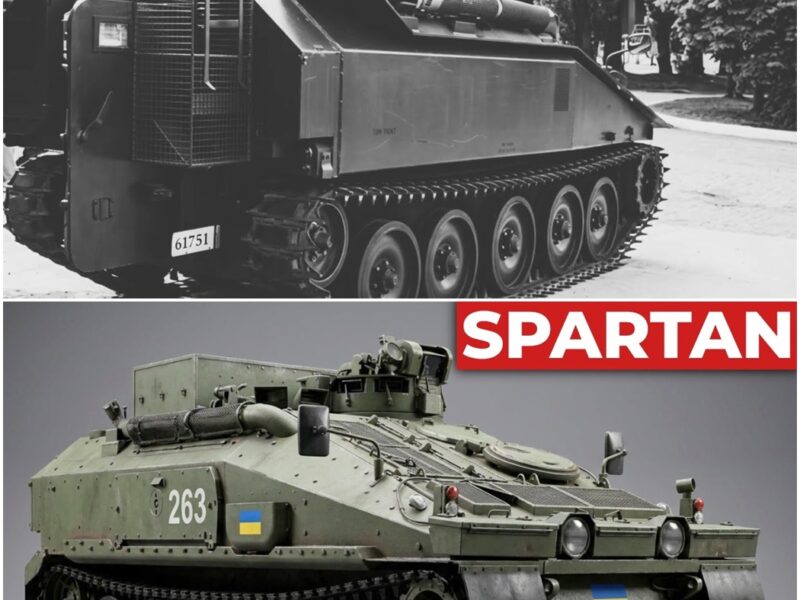
1967, the Alvis works, Holyhead Road, Coventry. A tracked vehicle rolls out of the production bay and into the autumn light. It is low, very low. A man standing beside it can rest his elbow on the roof without stretching. It has no turret to speak of, no main gun, no silhouette that signals danger from a distance.
It looks, to put it bluntly, like a metal garden shed bolted onto a set of tank tracks. Engineers watch it move across the test ground and say very little. It is lighter than a London bus. Its armor is not steel. It is aluminum, the same material used to wrap sandwiches. Observers who know their armored vehicles watch it and reach the same conclusion.
This machine is too small, too light, too lightly armed. It carries four soldiers in a space not much larger than the back of a transit van. And if anything heavier than a rifle round finds it at the wrong angle, the crew inside will know about it immediately. And yet, that small, quiet aluminum box would go on to fight on four continents.
It would carry mortar teams across the deserts of Iraq and the mountain valleys of Afghanistan. It would slip through the rubble of Sarajevo and the gorges of Kosovo at moments when heavier vehicles could not follow. It would serve the British Army for nearly 50 years without ever once being replaced by anything that could do everything it did.
And in 2022, after Britain had officially retired it, ordinary Ukrainian citizens would raise millions of dollars in a single weekend to put it back into frontline combat against a modern enemy. Its designation was FV103 Spartan. It was the most quietly capable armored personnel carrier Britain ever built.
And almost nobody outside the military has heard of it. To understand why the Spartan existed, you need to understand the crisis Britain faced in the early 1960s. The empire was ending. Garrisons that had once been permanent in Kenya, Malaya, Cyprus, Aden were being wound down one by one. But the conflicts that replaced colonialism were not disappearing. They were multiplying.
The British Army found itself needing to reach trouble spots not over months by ship, but over days by air. The strategic logic was brutal and simple. If you cannot get your armor there fast, your armor is useless. The vehicles Britain relied on in that era, the Alvis Saladin armored car, the Alvis Saracen wheeled personnel carrier, the Ferret Scout Car, were capable machines, but they had limits.
They were wheeled, which meant certain terrain beat them. They were relatively large, and they were not designed with air transport as a primary requirement. In 1961, the British General Staff issued two operational requirements. GSOR 1006 and GSOR 1010. The core demand was a single family of light tracked fighting vehicles, all sharing the same automotive components, that could be flown into a theater by C-130 Hercules transport aircraft, and driven off the ramp ready to fight.
Two vehicles would fit in one Hercules. The whole concept was built around that number. The contract went to Alvis of Coventry in 1967. 30 prototypes were ordered. The family they would produce had a name, Combat Vehicle Reconnaissance Tracked, CVR(T). Every vehicle in the family would start with the letter S, following Alvis tradition.
Scorpion for fire support, Scimitar for reconnaissance, Striker for anti-tank missiles, Samaritan for medical evacuation, Sultan for command, Samson for recovery, and Spartan, the armored personnel carrier, the vehicle designed not to fight its way through an objective, but to carry the men who would.
The Spartan entered British Army service in 1978. It was replacing the Saracen, the wheeled 6×6 box that had served since the early 1950s. What replaced it was smaller in almost every dimension, and that smallness was entirely deliberate. The Spartan sat on a welded aluminum alloy hull, not steel. Aluminum was chosen because it saved weight, and weight was everything.
The completed vehicle in its standard configuration came in at 10,000 670 kg, just under 10 and 1/2 tons. For comparison, the British Army’s other tracked personnel carrier, the FV432, weighed 15 tons and was made of steel. The American M113 weighed 14 tons. The Spartan weighed barely 2/3 of either. That saving had consequences everywhere.
The ground pressure the Spartan exerted on soft ground was approximately 5 lb per square inch. That figure is comparable to the pressure a soldier exerts walking on the same ground. Where heavier vehicles sank into mud, marsh, or loose sand, the Spartan floated across it. In the boggy conditions of the Falkland Islands, this quality had already proved itself with the Spartan’s cousins, the Scorpion and the Scimitar, machines that cross terrain wheeled vehicles refused to enter. The engine that drove it was the Jaguar J60, a 4.2 L inline six-cylinder petrol unit derived directly from the Jaguar XK car engine, derated for military use to produce around 190 horsepower. That engine in a 10 and 1/2 ton vehicle produced a power-to-weight ratio that gave the Spartan a road speed of 96 km/h, roughly 60 mph. Heavier armored personnel carriers of the era managed half that. A Spartan could pace a Land Rover on a highway and outrun it on broken ground. The armor protection was a calculated trade.
The aluminum alloy hull was proof against 14.5 mm armor-piercing rounds from the front at 200 m. The sides and rear would stop 7.62 mm rounds and artillery splinters. Against heavier weapons, the crew took their chances. That was the bargain the designer struck. The vehicle was not built to absorb punishment.
It was built to move fast enough that punishment would be hard to deliver. Armament was a single 7.62 mm general-purpose machine gun on the commander’s cupola, with banks of four smoke dischargers on each side of the hull. There was no main gun. There was no missile system in the base variant.
The Spartan’s job was to carry people, not to fight for position. The crew consisted of two or three, a driver in the front left hull, a commander in the forward crew compartment, and in the rear a section of four soldiers, five passengers if the vehicle was lightly crewed. They sat in a space that veterans consistently describe as tight, not impossible, not unbearable, but tight.
There were no firing ports. The passengers could not fight from inside. They were protected in transit and they dismounted to operate. What the Spartan carried determined its entire identity as a machine. It did not carry infantry sections for deliberate assaults. The FV432 did that and later the Warrior infantry fighting vehicle would do it better.
The Spartan carried specialists, Royal Engineer Reconnaissance Teams going forward to assess bridges, mines, and crossing points, mortar fire controllers getting close enough to a target to bring accurate fire, air defense missile teams who needed to reach their firing position before the aircraft arrived, anti-tank guided weapon crews carrying Milan missiles to ambush positions, and the reconnaissance soldiers of the cavalry regiments, the men whose job was to find the enemy, measure him, and report back without being seen. That last role defined everything. A Scorpion or Scimitar could fight to gain information, but the fighting vehicles of a reconnaissance regiment needed a vehicle that could carry the rest of the troop, the extra ammunition, the spare crew, the signals equipment. The Spartan was that vehicle. Where a Scimitar went, a Spartan was rarely far behind. The CVR(T) family also gave the British Army something unusual in the 1970s, total logistic commonality across an entire range of specialized vehicles. A Spartan, a Samson, a Sultan, and a Scimitar shared the same engine, the
same transmission, the same suspension components, the same tracks. A Spartan driver could maintain a Scimitar. A Scimitar driver could cross-deck into a Spartan in an emergency. For a small army operating in remote theaters with long supply lines, this was not an incidental virtue, it was a decisive one.
691 Spartans were delivered to the British Army by 1986. Across the entire CVR(T) family, 1,863 vehicles were built for British service alone. 23 nations would eventually operate vehicles from the family. It was the most successful British armored vehicle program of the post-war era. Now, before we get into where the Spartan actually fought, if you are finding this deep dive into British military engineering worth your time, hit subscribe.
It costs nothing and it helps the channel keep making videos exactly like this one. 1991, the Iraqi desert just south of the Iraqi border with Kuwait. Operation Granby, Britain’s contribution to the coalition effort to liberate Kuwait from Iraqi occupation. The 1st British Armoured Division was in theater. Inside the Reconnaissance Regiment, the 16th/5th Queen’s Royal Lancers, something specific was happening.
The regiment’s order of battle included 36 Scimitars and 12 Spartans. A squadron of the 1st Queen’s Dragoon Guards, attached for the operation, added four more Spartans. Some of those Spartans had been modified, fitted with the Milan Compact turret, a two-man anti-tank launcher system carrying 13 Milan missiles.
The modified Spartan became the FV120 Spartan Milan Compact Turret. It was an anti-tank vehicle disguised as an armored personnel carrier and it would fight as such. On the morning of February 25, 1991, the 16th/5th Lancers crossed the berm into Iraq ahead of the main armored force. Their job was to find the gaps in the Iraqi defensive line and guide the division through.
Reconnaissance groups were organized around eight Scimitars and four Spartan Milan Compact Turret vehicles. With a Recovery Samson on hand, they were small groups, fast groups, designed to probe and withdraw. What they found when they crossed the berm was an Iraqi army already cracking under the weight of six weeks of air bombardment.
Positions were abandoned. Soldiers were surrendering. But, the threat was not gone. Iraqi armor was still present. Iraqi artillery was still firing and the job of the reconnaissance groups was to stay ahead of the main force, to keep moving, to keep feeding information back, the Spartan proved itself in that environment not through a single dramatic engagement, but through endurance.
It kept pace with the Scimitars across terrain that had defeated heavier vehicles. It kept the specialist teams, the mortar fire controllers, the forward air controllers within range of the fight when they needed to be. When the ground offensive ended on February 28th, 1991, the 16th/5th Lancers were astride the Kuwait to Basra Highway, having led the division through its entire advance.
The Gulf War gave the Spartan its combat debut. The Balkans gave it something harder. 1992, northern Bosnia, the United Nations Protection Force, UNPROFOR, began deploying British troops to former Yugoslavia. The conflict was not conventional. There were no clear front lines. There were checkpoints manned by militias who answered to no central authority, roads that were safe one day and fatal the next, and a civilian population being systematically destroyed.
The British contingent brought Warrior infantry fighting vehicles for presence and firepower, but the Warrior, at 25 tons with a 30 mm cannon, announced itself everywhere it went. Militia leaders knew what it was and what it meant when it arrived. The Spartan, by contrast, was anonymous. Low, small, quiet by comparison, it could be sent through checkpoints and into tense districts in a way that a Warrior column could not.
Commanders used this deliberately. The Spartan’s size, which critics had always cited as a weakness, became an operational advantage in a war where presence could escalate a situation as easily as it could control one. The reconnaissance squadrons deployed to Bosnia, men from the Light Dragoons, the Household Cavalry, the Queen’s Dragoon Guards, demonstrated a quality the designers in Coventry had built in from the start.
A full squadron of CVR(T) vehicles could be loaded onto C-130 Hercules transports, flown from Germany to Split on the Adriatic coast, and be operational in northern Bosnia within 7 days of receiving the order to move. No other armored vehicle system in the British infantry could match that deployment speed.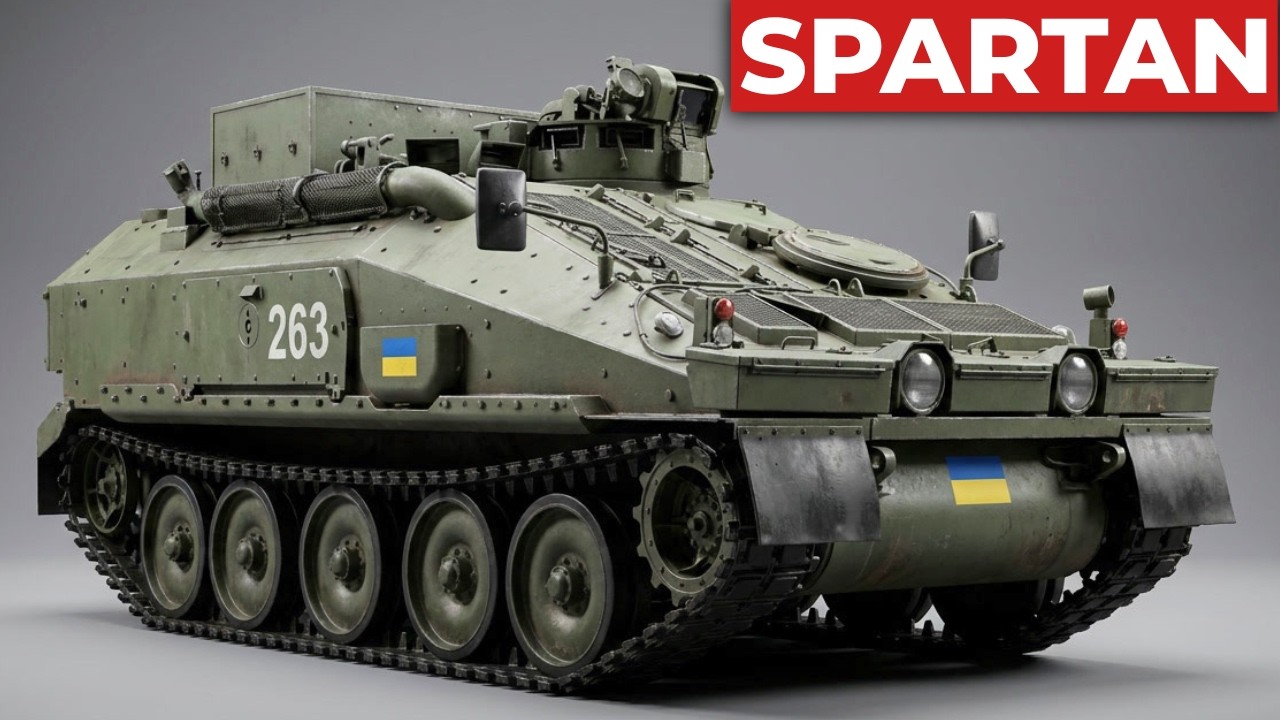
The Spartan served through Operation Grapple and its successors, through the ceasefire agreements and the implementation force that followed, through years of patrols on roads that had been shelled and repaired and shelled again. They carried liaison teams, medical teams, and specialist observers into areas where wheeled vehicles could not guarantee traction, and where anything larger than a Spartan would have been unable to navigate the rubble. Then, Kosovo, June 1999.
The peace agreement had just been signed. NATO’s Kosovo Force, KFOR, needed to enter the province fast before the situation on the ground could deteriorate further. The route from Macedonia into Kosovo ran through the Kaçanik Gorge, a narrow mountain pass with the road carved into the rock face and the river running alongside it.
It was barely wide enough for tracked vehicles moving in single file. The CVR(T) squadrons went through that gorge. Their size was not a limitation. It was the reason they were sent first. They reached Pristina ahead of the Russian forces that had moved up from Bosnia. The reconnaissance elements of KFOR were in the province and operational before most of the main force had cleared the border.
The Spartan, the vehicle that critics had spent 20 years describing as too small, had just led a NATO force into a contested capital. In the years that followed, the conflicts changed in nature in ways the designers of the CVR(T) had never anticipated. 2003, southern Iraq, Operation Telic, the British invasion of Iraq began on the Al Faw peninsula, where a planned hovercraft assault had to be abandoned after Royal Engineers found the beaches too heavily mined for safe landing.
Vehicles crossed by land instead. C Squadron of the Queen’s Dragoon Guards, equipped with Scimitars, supported 3 Commando Brigade through the advance on Basra. Spartans moved with them, carrying the specialist teams the fight required. The urban environment of southern Iraq was unlike anything the CVR(T) he been designed for.
The threat was not Soviet armor. It was improvised explosive devices, roadside bombs made from artillery shells, from mortar rounds, from anything that could be buried under a road surface and detonated by a pressure plate or a wire. Against these weapons, the Spartan’s aluminum hull offered limited protection. It had been designed for a Cold War battlefield where the primary threat was shaped charge warheads and high-velocity cannon rounds.
The IED threat was something else entirely. The military response was rapid. A program of theater upgrades began. The theater entry standard Herrick package, developed for Afghanistan, wrapped the Spartan in Plasan ceramic and Kevlar applique armor. Bar armor, a cage of steel rods that caused rocket-propelled grenades to detonate before reaching the hull, was fitted around the rear and sides.
Electronic jamming systems were installed to interrupt remote detonation signals. The weight climbed to approximately 11 tons. The vehicle looked nothing like its 1978 production form, but it moved and it protected. Crew members who operated the upgraded Spartan in Afghanistan described the difference plainly.
The additional protection gave them a degree of confidence the basic vehicle had not. There are documented cases of mine strikes and rocket-propelled grenade impacts on upgraded vehicles where crews escaped serious injury. The armor held when it was asked to, but not always. July 4, 2009, Helmand province, Afghanistan.
Operation Panchai Palang, Panther’s Claw, was one of the largest British operations of the entire Afghanistan campaign. Around 3,000 soldiers were pushing into the insurgent-controlled areas north of Lashkar Gah, cutting off supply routes, clearing compounds, securing ground for the forthcoming Afghan elections. It was grinding, methodical, and lethal.
Private Robert Laws of the 2nd Battalion, The Mercian Regiment, was 18 years old. He had joined the battalion the previous year, and Helmand in the summer of 2009 was his first operational deployment. On the morning of July 4, his Spartan was struck by a rocket-propelled grenade. Private Laws was killed.
He was one of the youngest soldiers to die in Afghanistan. His commanding officer described him as a professional and dedicated young soldier who had shown exceptional promise. His family in Brentwood, Staffordshire, received the news of his death on a day that should have been a celebration. It was the 4th of July.
He had turned 18 the week before. The Spartan carried men like Private Laws because it was the vehicle that could get where the mission required. It was fast enough to move with reconnaissance elements and light enough to cross terrain that heavier vehicles could not. Those same qualities that made it operationally indispensable placed its crews in a level of risk that had never been fully calculated.
When the design was finalized in Coventry in the 1960s, that was the fundamental tension at the heart of the machine. On paper, the Spartan looked inadequate against its contemporaries. The American M113 carried 11 soldiers and weighed 14 tons. The Soviet BMP-1 was a true infantry fighting vehicle with a 73-mm gun and anti-tank guided missiles.
On a Cold War European battlefield, neither could match the Spartan in strategic mobility. They could not be flown into a theater by C-130. They could not cross the Kakonik Gorge in single file. They could not slip through Sarajevo without generating a diplomatic incident. The British Army understood this trade from the beginning.
The Spartan was never intended to be the primary carrier for a deliberate assault. It was the vehicle for the men who operated in the space between the main force and the enemy where weight and noise and profile were as dangerous as firepower. The Warrior infantry fighting vehicle arrived in British service in the mid-1980s and took over the assault role entirely.
It weighed 25 tons. It mounted a 30-mm cannon. It was a formidable machine. It also could not fit inside a C-130 Hercules. The Warrior replaced the FV432. It never replaced the Spartan. 691 Spartans had been delivered by 1986. By 2006, 478 remained in the British inventory. The Ministry of Defense began drawing the vehicle down from around 2009, replacing its roles with lighter wheeled vehicles, and eventually with the Ajax family of armored vehicles under the Scout Specialist Vehicle program.
The Scimitar, the Spartan’s closest relative in the CVR family, soldiered on in British service until 2023. The Spartan was formally retired from front-line British use, and then something unexpected happened. April 2022, Russia’s invasion of Ukraine had been underway for 6 weeks. The British government announced a £100 million military aid package for Ukraine.
Inside that package, 35 FV103 Spartans. Vehicles that the British Army had finished with, that had been held in storage or used for training, were loaded onto transport and sent east. They arrived in a war that looked nothing like the Cold War scenario the Spartan had been built for. The terrain was not German river lines and forest belts.
It was Ukrainian farmland, shelled cities, and heavily mined approach routes. Ukrainian crews received the vehicles and put them to work. Many replaced the standard 7.62 mm machine gun with improvised mounts for the Browning M2 12.7 mm heavy machine gun, a weapon with nearly four times the range and striking power of the original armament.
In November 2022, the Serhiy Prytula Charity Foundation in Ukraine launched a public fundraising appeal. The campaign, called Grab Them All, asked ordinary Ukrainian citizens to donate money to purchase armored vehicles for the army. Within approximately 36 hours, the foundation had raised the equivalent of around 6 and 1/2 million dollars.
The purchase that followed included 101 tracked armored vehicles across eight models, among them additional FV103 Spartans. The people of Ukraine, not their government, bought them. By January 2025, Ukrainian records showed 17 Spartans destroyed, four damaged, and two captured. The vehicle was still in front-line use, still moving specialist teams across contested ground, still doing the thing it had always done.
1967, the Alvis works, Holyhead Road, Coventry. A machine too small, too light, too lightly armed, rolled out into the autumn light, and the engineer said very little. It had no main gun. It had no impressive silhouette. It carried four soldiers in a box of aluminum and asked them to trust it.
Its critics pointed to the armor thickness, the passenger capacity, the single machine gun, and called it inadequate. They were not entirely wrong. The Spartan was cold in the European winter and suffocating in the Middle Eastern summer. Its original petrol engine was a fire risk. Four passengers was not a section.
In Iraq and in Afghanistan, the improvised explosive device found the gaps in its aluminum hull that the designers had gambled would not matter. Sometimes they mattered profoundly. And yet, it went where heavier vehicles could not follow. In the desert south of Basra, in the gorges above Pristina, in the shelled streets of Sarajevo, in the mountain valleys of Helmand, it arrived.
It arrived because it weighed 10 and 1/2 tons, and not 15. It arrived because two of them fit inside a single C-130 Hercules, and that meant a British government could project armored capability to any airfield on Earth within days of making the decision to act. 23 nations bought it. The people of Ukraine funded its purchase with a public collection.
More than 50 years after the first prototype rolled out of the Alvis works on Holyhead Road, the Spartan was in frontline combat. That is not an accident of history. That is a machine that was designed correctly for the problem it was built to solve. The problem was not how to win a firefight.
The problem was how to get the right men to the right place at the right time when no other vehicle could make the journey. The Spartan was not glamorous. It was not feared. It was not the vehicle that features in the photographs from the moment of victory. It was the vehicle that got the team there before the photograph was taken.
That is what it was. That is what it did. And in the fields of Eastern Ukraine, that is what it is doing still.