The ‘Tiny’ British Recon Tank That Outfought Every Larger Vehicle From Falklands To Baghdad D
March 28th, 2003. 05:30 hours. The Shatt al-Arab waterway, 40 km north of Basra. A small British vehicle moves alone across the marshland. 8 tons, three crew, a 30 mm cannon. Orange recognition panels stretched tight across its hull. 12,000 ft above, an American A-10 Thunderbolt banks into a strafing run.
The pilot mistakes the orange panels for rocket launchers. He fires anyway. Inside the burning turret, an 18-year-old driver named Christopher Finney is about to do something that will earn him the George Cross. He will climb out of the wreck. He will reach back inside three times to drag his wounded gunner clear.
He will radio a Mayday under fire. He will take shrapnel in the legs. And he will become the youngest military George Cross recipient in British history. The vehicle he climbed out of looked ridiculous on paper. It was smaller than a London bus. Its armor was aluminum, not steel. Its engine was lifted from a Jaguar saloon car. Critics called it tin sardine.
They called it a death trap on tracks. It would serve for 52 years across four continents. It would fight in the Falklands, the Gulf, Bosnia, Kosovo, Iraq, Afghanistan, and now Ukraine. It would outlive the empire that built it, the Soviet enemy it was designed to scout, and three generations of replacement programs costing billions.
Its designation was the FV107 Scimitar, and it was the most stubborn small tank Britain ever built. To understand why the Scimitar existed, you need to understand the problem Britain faced in the 1960s. The 1957 defense white paper had gutted the British Army. The empire was contracting.
Trouble was flaring in Aden, Borneo, Belize, Hong Kong. London needed a new kind of armored vehicle. Small enough to fly anywhere, quiet enough to scout enemy lines, lethal enough to kill what it found. Two complete vehicles had to fit inside one Lockheed C-130 Hercules. The vehicle had to survive being parachute dropped on a pallet.
Its ground pressure had to match a soldier on foot, so it could cross peat bog and jungle floor where heavier tanks would sink. The 30-year-old Saladin armored car could not do these things. Nothing could. The contract went to Alvis Limited of Holyhead Road, Coventry. In September 1967, Alvis had built the Saladin. Alvis had built the Saracen.
Alvis had built the Stalwart. Now they would build a family, eight vehicles sharing one chassis, all named with the letter S. Scorpion, Striker, Spartan, Samaritan, Sultan, Samson, Sabre, and the close reconnaissance variant, the Scimitar. The first Scorpion rolled out of the Holyhead Road plant on January 23, 1969.
The first Scimitar followed in 1971. By 1974, the British Army was taking deliveries. The vehicle itself was a masterpiece of practical compromise. Combat weight, 7.8 tons. Length, 4.9 m. Width, 2.2 m. Locked exactly to the inside dimension of a C-130 cargo bay. Ground pressure, 33.8 kN per square meter, which the Ministry of Defense officially described as similar to that of a soldier on foot.
This meant the Scimitar could cross terrain that defeated wheeled scout cars, tractors, and Land Rovers. The engine was a 4.2 L Jaguar XK petrol unit, the same block fitted to the Jaguar XJ6 saloon. It was derated to 195 horsepower, so it could run on low-octane military fuel. Top speed, 80 km/h. Range, 644 km.
The petrol choice was controversial from day one. The rest of NATO was moving to diesel, but no diesel of suitable size existed in the early 1970s. The Jaguar engine was what was available. The armor was aluminum alloy, welded throughout, roughly 12.7 mm thick at its thinnest. It would stop a 14.
5 mm heavy machine gun round at 200 m. It would not stop an RPG. It would not stop an auto cannon. It would not stop a tank gun. The crew of three accepted this trade because the alternative was to be too heavy to fly, too heavy to swim, too heavy to cross peat. The main armament was where the Scimitar earned its reputation.
The 30 mm L21AARDEN designed by Norman Brent at the Royal Small Arms Factory at Enfield Lock. Long recoil, forward case ejection, which meant no fumes inside the sealed turret. Manually loaded with three-round clips. Magazine of six rounds ready. 90 rounds per minute cyclic. Effective range, 1,500 to 2,000 m.
Accuracy so fine that a trained gunner could place a 1-m group at 1,000 m. The AARDEN was quiet. It was the quietest auto cannon of its caliber in NATO service. For a reconnaissance vehicle, this mattered more than any other specification. A gun you could not hear was a gun the enemy could not locate.
With armor-piercing discarding sabot ammunition, the Scimitar could penetrate a Soviet BMP frontally at any combat range. With sabot, it could kill a T-55 from the side or rear. The British did not build reconnaissance to observe and avoid contact. The British built reconnaissance to fight for intelligence and survive long enough to report.
Now, before we get into where this vehicle actually fought, if you are enjoying this deep dive into British military engineering, hit subscribe. It takes a second, costs nothing, and helps the channel grow. The Scimitar’s first war came in the South Atlantic in the spring of 1982, when Argentina seized the Falkland Islands.
The British task force sailed south with exactly nine armored vehicles. Four Scorpions, four Scimitars, and one Samson recovery vehicle. Three troops and four troops. B Squadron, the Blues and Royals, Household Cavalry, around 30 men. The smallest armored unit ever sent to a major war. They were also the only British armored vehicles in the entire conflict.
They landed at San Carlos on May 21st. The terrain was peat bog, soaked, soft, treacherous. Argentine Panhard armored cars in Stanley could not move because their wheels sank into the ground. The Scimitars and Scorpions, with their ground pressure of a man on foot, simply drove on. On the night of June 13, Lieutenant Mark Coreth of four troop was supporting a diversionary attack on Mount Tumbledown.
His Scorpion struck an Argentine anti-tank mine. The blast lifted the 8-ton vehicle several feet into the air. The engine dismounted. A track shredded. But the aluminum hull held. The crew suffered only minor injuries. The wreck was later airlifted out by Bravo November, the only Chinook to survive the loss of the Atlantic Conveyor, and was returned to service after REME repairs.
That same night, three troop under Lieutenant Lord Robin Innes-Ker supported two Para’s assault on Wireless Ridge. Captain Roger Field, in his memoir Scimitar into Stanley, described what he saw from the turret of vehicle 23 Bravo. Bright moonlight, deep frost, stretcher bearers moving across white ground.
He compared it to a battlefield of the First World War, not the 1980s. The Scimitars fired high explosive and armor-piercing semi-explosive rounds into Argentine positions, holding back depleted uranium sabot rounds for Argentine Panhards that never came. By the morning of June 14th, Scorpion 23 Alpha, flying the Blues and Royals regimental flag, reached the war memorial on the outskirts of Port Stanley.
War correspondent Max Hastings clung to the back of Captain Field’s Scimitar 23 Bravo as it rolled into the town. He became the first journalist into Stanley. Major General John Frost, the legendary two-para commander of Arnhem, wrote afterward that the speed and accuracy of fire from the Blues and Royals tanks had been a severe shock to the enemy.
Three Scimitars from that campaign, 23 Alpha, 23 Bravo, and 23 Charlie, are preserved today at Eden Camp Museum in North Yorkshire. Nine years later, the Scimitar went to a different kind of war. 24 February 1991. 3:00 hours. The British 1st Armoured Division crossed into Iraq through a breach cleared by American forces. At the front of the British advance moved the Scimitars of the 16th/5th Queen’s Royal Lancers.
Over 100 hours, they would lead the division 350 km across Iraqi desert, ending astride the Basra to Kuwait highway, 40 miles northwest of Kuwait City. On February 26th, a troop of Scimitars made contact with Iraqi T-62 main battle tanks near objective lead. The Scimitar gunners engaged with sabot rounds.
The 30 mm penetrators went through the frontal armor of the T-62s and killed them. One Scimitar took a hit in return. An Iraqi T-55 fired a 100 mm round directly into the British vehicle. The round passed through the thin aluminum armor, transited the entire hull, and exited the other side. It did not detonate. It did not fragment.
The crew were uninjured. They reported the incident, called in artillery, and continued their advance. The Scimitar should not have survived that hit, but it did. And the men inside lived to drink tea from the boiling vessel under the commander’s seat that same evening. After the Gulf came the Balkans.
Through the 1990s, the Scimitar served on Operations Resolute, Joint Endeavor, Joint Forge, and Joint Guardian. Bosnia, Croatia, Kosovo. Light Dragoons, Queen’s Royal Hussars, Royal Dragoon Guards, King’s Royal Hussars. Mountain valleys, mine-strewn forestry tracks, snowbound winter routes from Vitez to Banja Luka to Pristina.
The Scimitar’s small size and low ground pressure suited the terrain. Its quiet AARDEN suited the political mission. There were no large engagements. The vehicle’s job was presence. It did the job for 14 tours. Then came Iraq again. The morning of March 28, 2003. Two Scimitars and two Spartans of D Squadron, Household Cavalry Regiment, were operating 30 km ahead of the main force, scouting for the Iraqi 6th Armoured Division.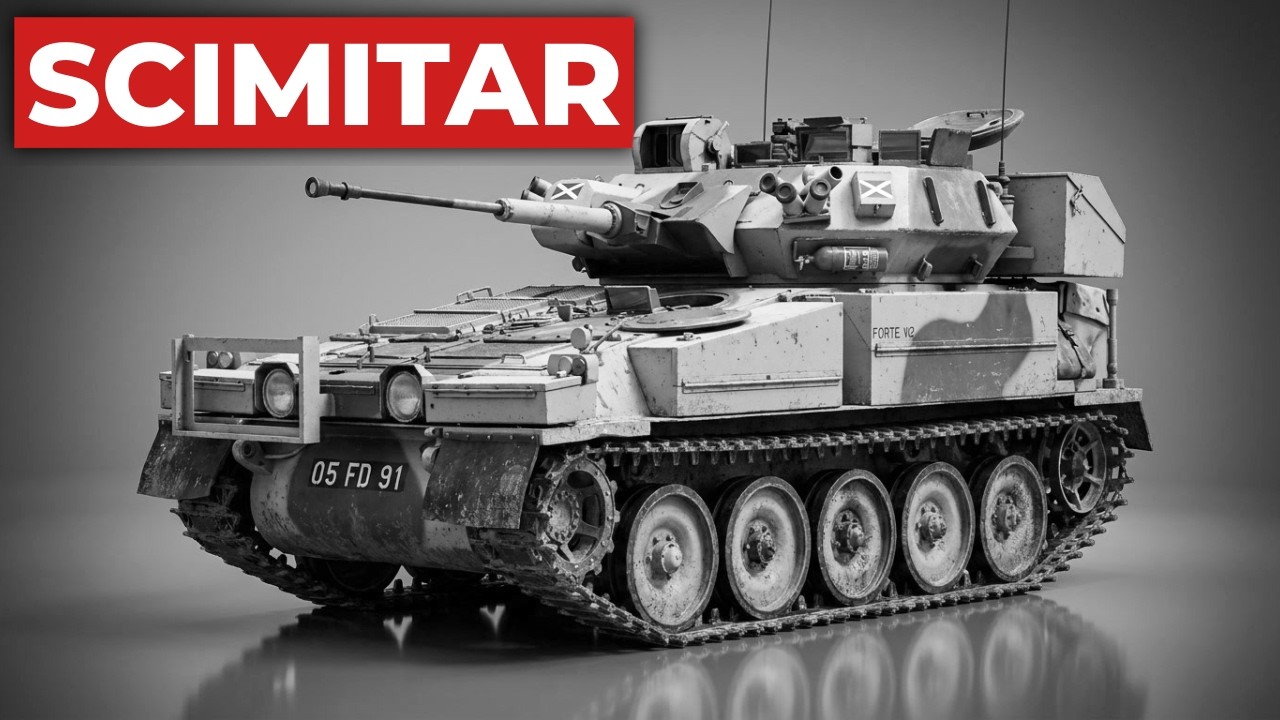
The crews wore desert combat dress. The vehicles wore orange overhead recognition panels, thermal reflectors, and Union Flags. From 12,000 ft, two American A-10 Thunderbolts of the 190th Fighter Squadron, Idaho Air National Guard, call signs Popoff 35 and Popoff 36, mistook the orange panels for Iraqi rocket launchers.
They attacked without authorization. In the lead Scimitar, 18-year-old Trooper Christopher Finney was the driver. His gunner, Lance Corporal of Horse Alan Tudball, was trapped in the burning turret. Finney climbed out of his hatch, ran around the vehicle, and dragged Tudball free. He moved the wounded man to cover and bandaged his wounds.
Then he climbed back inside the burning Scimitar to send a Mayday call by radio. Then the A-10s came around for a second strafing run. Finney threw himself across Tudball, taking shrapnel in the legs and lower back. Then he tried a third time, attempting to reach the second Scimitar to rescue Lance Corporal of Horse Matthew Hull.
He was driven back by exploding ammunition. Hull was killed in his vehicle three days short of his 27th birthday. Finney’s George Cross citation, gazetted on October 30, 2003, described his actions as displaying clear-headed courage and devotion to his comrades out of all proportion to his age and experience. He was 18 years old.
He remains the youngest military George Cross recipient in British history. The Oxford coroner, Andrew Walker, later returned a verdict of unlawful killing on Hull’s death. Neither American pilot was court-martialed. Three years after that, the Scimitar deployed to Helmand province.
The lessons of Afghanistan came hard and fast. Aluminum armor and improvised explosive devices were a poor combination. By 2009, the Ministry of Defense ordered an emergency upgrade. 50 Scimitars were rebuilt at Donnington and Telford by BAE Systems, mating a deeper mine-resistant Spartan derived hull to the Scimitar turret with relocated fuel tanks, air conditioning, and a Cummins diesel engine producing 235 horsepower.
They called it the Scimitar Mark II. The first Mark IIs arrived in Afghanistan in September 2011 with the First Queen’s Dragoon Guards. In November 2011, three Queen’s Dragoon Guard soldiers walked away unscathed when their Scimitar Mark II was engulfed by an IED blast in Nari Sarraj.
Lieutenant Peter Gordon Finlayson said it felt like a car crash and that 30 seconds later the jokes and banter started. He gave all credit to the Scimitar. Trooper Robert Griffiths, who took the worst of the blast, said he had never had such a buzz in his life. The crews added that the Taliban were afraid of the Scimitar Mark II and would not take it on head-to-head.
Trooper Philip Lawrence of the Light Dragoons was killed in his Scimitar by an IED on July 27, 2009, during follow-up operations after Operation Panther’s Claw. He was 22. He left a widow and an 8-month-old daughter. The Scimitar was officially withdrawn from frontline British Army service in April 2023, 52 years after its first acceptance.
It was supposed to be replaced by the Ajax. The numbers tell that story by themselves. 5.5 billion pounds. 589 vehicles ordered eight years late. Crew limited to 105 minutes inside the vehicle and 20 mph because the noise and vibration were causing nausea, hearing loss, and tingling hands. 310 soldiers needed hearing assessments.
11 were medically discharged with permanent hearing loss. The cannon could not fire on the move. The vehicle could not reverse over an obstacle higher than 20 cm. In November 2025, the Ministry of Defense declared the Ajax at initial operating capability. 16 days later, after 30 Household Cavalry and Royal Lancers soldiers reported the same symptoms during exercise Titan Storm, the program was halted again.
Two days before that halt, Ajax had won an award for mega project of the year. While Ajax sat on Salisbury Plain, the Scimitar went back to war. In September 2023, 23 Scimitar Mark IIs were prepared in 32 days by Rheinmetall BAE Systems Land and shipped to Ukraine. More followed in 2024.
Latvia, which had bought British surplus Scimitars years earlier, began onward donations of its own stocks. Ukrainian crews of the 127th Territorial Defense Brigade and the 67th Mechanized Brigade now use the Scimitar as overwatch for mobile anti-armor teams. Their feedback, reported by UK Defense Journal, is that the vehicle puts down suppressing fire when needed and gets out of dodge very quickly.
The Scimitar is now killing Russians in the country it was designed to fight Russians against. 54 years after its first prototype rolled off Holyhead Road. March 28, 2003, 5:30 hours. A small British vehicle alone on the Shatt al-Arab. 8 tons, aluminum armor, a Jaguar engine, a 30 mm cannon. By any specification on paper, it was inadequate.
Its armor could not stop a tank gun. Its engine ran on petrol when the rest of NATO ran on diesel. Its main armament was smaller than what most Soviet armored personnel carriers mounted. It had no thermal sight for its first quarter century in service. It had no spaced armor. It had no autoloader. It had nothing except a tracked chassis the weight of a soldier on foot, a quiet cannon that hit what it aimed at, and three men trained to fight forward and report back. And yet it worked.
It worked in the Battle of East Falkland. It worked in the Iraqi desert. It worked in the Bosnian mountains. It worked on the Helmand Green Zone. It worked on the Donbas frontline. It outlived the Soviet enemy it was built to scout. It outlived Alvis of Coventry, whose Holyhead Road plant is now a retail park.
It outlived three generations of replacement programs that cost more, weighed more, promised more, and delivered less. The Scimitar was not elegant. It was not heavy. It was not modern. It was British. And it worked when it mattered. That is not luck. That is the difference between theory and war.