The ‘Tiny’ Canadian Armored Car That Gave British Commanders Eyes Across Three Continents D
1942, General Motors of Canada, Oshawa, Ontario. A small armored car rolls off the assembly line. It is built on a truck chassis. It weighs over 4 tons. It stands nearly 8 ft tall. Three men crew it. It carries one Bren gun, one Boys anti-tank rifle, and a 4-in smoke discharger.
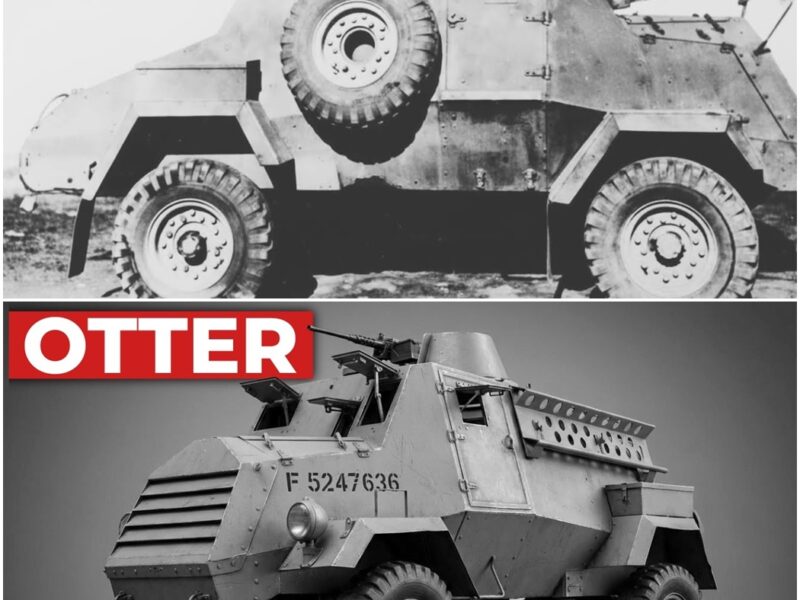
Against anything that actually fights back, it is practically defenseless. It looks wrong. Officers who saw it said so. It was too heavy for what it was supposed to do, too tall to hide, too slow to run. It was not the vehicle Britain asked for. It was not the vehicle Canada wanted to build. It was the vehicle Canada could build using truck parts already flowing off assembly lines by the tens of thousands, because Britain’s own factories were burning and drowning and stretched beyond their limits. It would go on to fight in Sicily, in Italy, in North Africa, in Normandy, across the Rhine, and in the mountains of Yugoslavia. It would serve Canadian reconnaissance regiments, Polish lancers, Italian partisans, the Royal Air Force Regiment, and postwar Dutch military police who used it to ram smugglers off the Belgian border. More than two dozen survived today in museums from Ottawa to Amersfoort to a fort in Paramaribo, Suriname, on the northern coast of South America. Its designation was the Otter Light Reconnaissance Car, Mark One. It was the most overlooked armored vehicle Canada ever built, and
it was exactly what the Commonwealth needed precisely because nothing better existed. To understand why the Otter existed, you need to understand what happened to Britain’s army on the beaches of Dunkirk in May 1940. When the British Expeditionary Force evacuated France, it left behind virtually everything it had driven, towed, and rolled into the continent over 9 months of war.
Thousands of vehicles, guns, radios, and reconnaissance cars sat abandoned on French soil. Britain needed to rebuild from nothing, and it needed to do so while its own factories were already overwhelmed producing tanks, aircraft, and naval vessels for a war being fought on every ocean simultaneously. Canada stepped in. The Canadian Military Pattern Vehicle Program became one of the largest industrial undertakings in the country’s history, eventually producing something in the range of 850,000 military vehicles before the war ended. General Motors of Canada, based in Oshawa, was at the center of this effort. When the War Office issued a specification for a light reconnaissance car that the whole Commonwealth could produce, Oshawa obtained blueprints for the British Humber Light Reconnaissance Car, Mark III, and their engineers went to work adapting it to North American components. The armored hull was fabricated by the Hamilton Bridge Company in Hamilton, Ontario. The same firm normally built steel bridges and structural frameworks. Now, it was building fighting vehicles. The engine came directly from the military truck
line, a GMC Model 270 inline six-cylinder petrol unit, producing around 105 horsepower. The chassis was the Chevrolet C15 Canadian Military Pattern Truck. This was deliberate. Spare parts for these components were already being shipped to every Commonwealth formation in every theater. An Otter could be repaired using the same components as a water truck or a supply lorry.
The vehicle that emerged in 1942 weighed 4,440 kg. It stretched 14 ft 9 in in length and stood nearly 8 ft tall. Its armor was 12 mm on the front and 8 mm on the sides. It could reach 47 mph on a road and was driven by a four-wheel drive system that gave it reasonable cross-country performance. Three crew members occupied tight quarters, a driver on the left, a commander on the right who operated the Boys anti-tank rifle and a smoke discharger, and a gunner in a small open-topped turret who served the .
303 Bren gun. A wireless set number 19 with dual aerials gave it dependable communications over distance. Every one of those specifications contains a battlefield meaning. 12 mm of frontal armor meant it could stop rifle caliber rounds and light machine gun fire, not much else.
47 mph meant it could outrun infantry and soft-skinned vehicles, but not anything with an engine. The Bren gun could kill German soldiers in the open. The Boys rifle could theoretically penetrate light armor at close range, though crews were under no illusions about what happened if they encountered an actual Panzer.
Wireless set number 19 was the vehicle’s most important piece of equipment. It was what made the Otter genuinely useful. Intelligence gathered means nothing if it cannot be transmitted. General Motors of Canada built 1,761 Otters before production ended in 1945. Of those, 877 were shipped overseas. Nine were lost in transit, almost certainly to U-boats.
Now, before we get into where these vehicles actually fought and what the men who crewed them endured, if you’re finding this story compelling, hit subscribe. It takes a moment, costs nothing, and helps this channel go deeper into the armored vehicles that built the Commonwealth’s war.
The Otter’s most important combat story begins in Sicily in July 1943. The 4th Princess Louise Dragoon Guards, the reconnaissance regiment of the 1st Canadian Infantry Division, landed at Sicily on 13 July 1943 with their Otters and Fox armored cars. They were immediately thrown into the kind of work that reconnaissance men have always done and have always dreaded.
Major Arthur Duck commanded the lead squadron. Within days of landing, General Guy Simonds pressured the regiment to beat an American formation into the Sicilian town of Enna. The Dragoon Guards mounted their armored cars and drove hard. A demolished culvert stopped them short of the town. Undeterred, one of the men commandeered a mule and pressed forward on foot.
Corporal Jackson walked into Enna’s central piazza first. The Canadians claimed the liberation. It was a glimpse of how the regiment would operate across the next 20 months. Fast, aggressive, creative, and frequently exposed to conditions the Otter was never built to handle.
On the Italian mainland, the terrain turned against every wheeled vehicle. Mountain roads barely wide enough for a single car. Blown bridges that no engineer could replace quickly. Winter rains that turned tracks into rivers. In the winter of 1943 to 1944, the situation grew so severe that the Dragoon Guards raised an entirely new squadron for a purpose that would have astonished any vehicle designer in Oshawa.
D Squadron was raised specifically to patrol on horseback. 20th century reconnaissance soldiers reverting to actual horses, because the ground had beaten their machines. Major Harold Fenwick Parker of Yarmouth, Nova Scotia, commanded one of the Otter squadrons and captured the regiment’s philosophy with five words that became something close to a motto.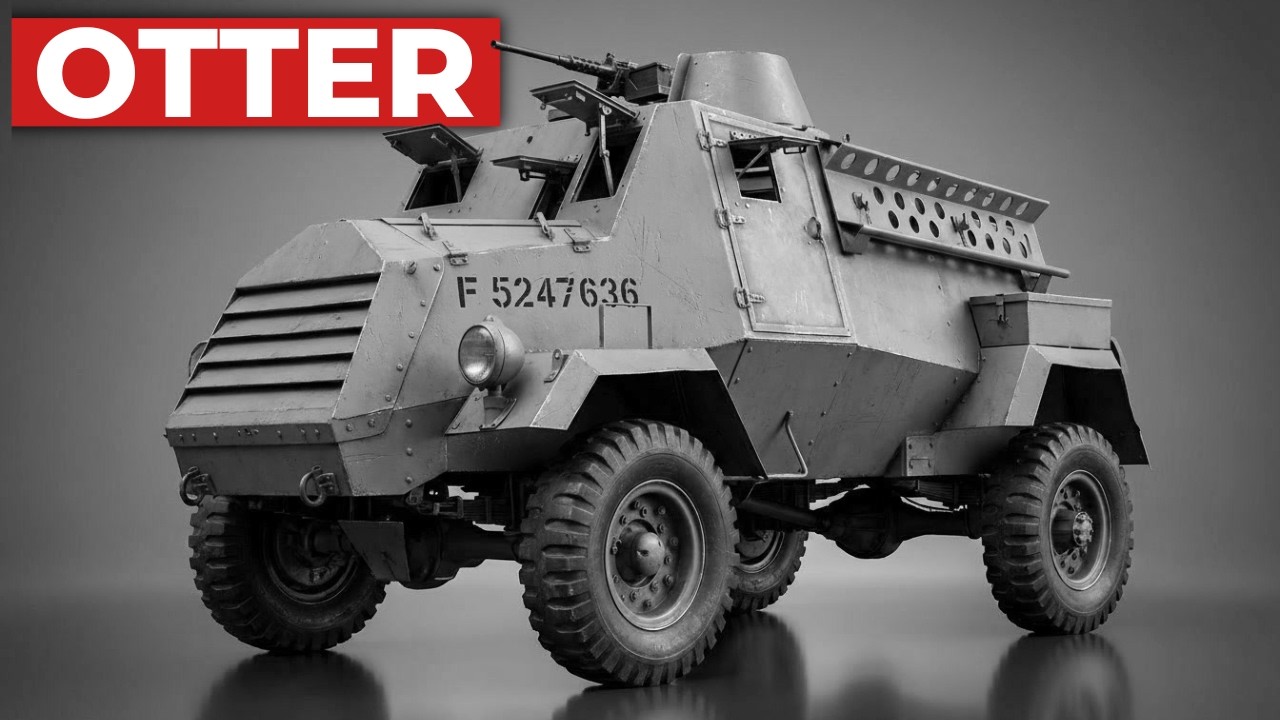
A reporter asked what his men did. Parker answered without hesitation, “We keep driving until the enemy shoots at us. Then we know he is there.” Parker was killed doing exactly that. His armored car was struck by a 75-mm shell on the Torella to Doronia road on 4 November 1943. His crew was badly wounded.
That same campaign also produced one of the war’s more improbable moments. During the Hitler Line battles of May 1944, Sergeant Hubert Ditner, a farmer from Petersburg, Ontario, bedded his section down in a roadside ditch for a few hours of sleep. He woke to discover he was sharing the ditch with Panzergrenadiers from the 44th Hoch und Deutschmeister Division.
Ditner spoke fluent German. He talked all 10 of them into surrendering without a single shot. He later wrote to his brother that he did not know who had been shaking more, the Germans or himself. Beyond the Canadians, the 12th Podolski Lancers Regiment of the Polish 2nd Corps operated Otters through Monte Cassino in May 1944, at Ancona, and into Bologna on 21 April 1945.
Italian co-belligerent forces received Otters as well. The Brigata Maiella, an Abruzzese partisan formation, received four Otters in November 1944 and used them to liberate the town of Asiago on the 1st of May, 1945. Canadian-built armored cars handed to Italian partisans who used them to free their own countrymen from the same war that had produced them.
In northwest Europe, the Otter had largely been replaced in front-line Canadian reconnaissance regiments before D-Day by heavier and better armed vehicles. What it found instead was a different kind of indispensability. Royal Canadian Engineer Field Companies used Otters for engineer reconnaissance, scouting bridges and obstacles ahead of formations that could not afford to be ambushed.
The 11th Field Company operated them at Maisy-sur-Orne in Normandy in August 1944. The 18th Field Company, which had landed on Juno Beach on D-Day itself, used them through the entire northwest Europe campaign. Photographic records place Otters with the Regina Rifles at Emmerich, Germany, on 30 March 1945 during Rhine Crossing operations, and with the 1st Canadian Infantry Division near Appeldoorn, Netherlands, on 19 April 1945.
The RAF Regiment was among the largest Otter operators on the continent. Number 2742 Squadron became an armored car unit in August 1944, moved to the continent that November, and was deployed at Ever Airfield in Belgium during Operation Bodenplatte, the Luftwaffe’s desperate mass strike against Allied Airfields on the 1st of January 1945.
Some RAF Regiment Otters were fitted with 20-mm Oerlikon or Hispano cannon adapted from aircraft armament, giving them considerably more offensive capability than the standard production model ever carried. Confirmed photographic evidence also places Otters in Tunisia in May 1943, in Greece at Katakolo Beach in September 1944, and at Perkos Airfield in Yugoslavia, where RAF Regiment ground crews serviced them far from the Canadian formations the vehicle was designed for.
On paper, the Otter compared poorly to almost every vehicle in its class. The Daimler Dingo, widely regarded as one of the finest British reconnaissance vehicles of the entire war, weighed 3,000 kg and carried 30 mm of frontal armor, two and a half times the Otter’s protection. Its transmission gave it equal speed in forward and reverse, and it could turn in 23 ft.
The Otter needed nearly double that distance. The Dingo was built for stealth. The Otter was built for availability. The Lynx Scout Car, Canada’s other answer to the Dingo, suffered the same fundamental problem. North American truck components added weight that the original British designs never carried. 3,255 Lynx were built and delivered, but crews who drove both consistently preferred the genuine Dingo.
The American M8 Greyhound was in a different category altogether. It weighed 7.4 tons, mounted a 37 mm cannon with a coaxial machine gun, and could engage fortified positions with real offensive punch. The Otter’s Boys rifle and Bren gun represented a different philosophy entirely. Observe, report, and withdraw. The Greyhound was designed to fight.
The Otter was designed to find. That distinction, more than any specification, explains what the Otter actually was. The Commonwealth needed vast numbers of reconnaissance vehicles across three continents simultaneously. Britain could not build them fast enough. Canada could, using truck parts already being manufactured, already being shipped, and already being maintained by mechanics who needed no specialist training to keep them running.
The Otter’s postwar life proved stranger than its wartime service. The Netherlands acquired approximately 300 surplus Otters from Canadian dumps at Dieren and Enschede in 1946. The Royal Marechaussee, the military police, deployed them on border patrol duty. In the late 1940s, Belgian border smugglers had started using surplus armored vehicles to crash through barricades.
On 24th February, 1948, near Mergelstel, a Marechaussee crew heard an approaching smuggler’s armored vehicle, and lacking any other option, accelerated and rammed it head-on. The smugglers were trapped in their crumpled hull and arrested. A reconnaissance car built to retreat from danger had been turned into a weapon of pursuit.
Jordan’s Arab Legion received Otters and used them in the 1948 Arab-Israeli War. Some were captured by the Haganah. Syria fitted turretless Otter hulls with 37 mm Puteaux guns, a 1914 vintage French weapon mounted on a 1942 Canadian vehicle in a Middle Eastern conflict. Dutch Otters were shipped to the Dutch East Indies and inherited by the Indonesian Army after independence in December 1949.
At least one still stands as a monument near Bandung. Return to 1942 Oshawa, Ontario. A vehicle rolls off the assembly line that is too heavy, too tall, too slow, and too lightly armed for the role it was designed to fill. It had no anti-tank capability worth the name. Its armor would not stop a determined rifle at close range.
Its silhouette was conspicuous on every ridge and road it crossed. Its top speed made escape from anything motorized a matter of luck rather than engineering. Its side doors were notorious for slamming on crew members’ fingers, and accounts confirm this was the single most common complaint raised by the men who operated it. And yet it worked.
In the mountain roads of Italy, on the beach at Katakolo, at airfields in Yugoslavia, at the Rhine crossing in March 1945, in the hands of Canadian engineers, Polish lancers, Italian partisans, RAF Regiment gunners, and Dutch military police ramming smugglers in the dark, 1,761 Otters were built. 868 reached the war.
They served because they could be produced, maintained, and delivered when nothing better could be. The Otter was not an engineering achievement. It was an industrial one. That is not luck. That is what an arsenal nation does when its allies need vehicles and need them now.