The Tragic Life Of Gloria Guinness—The Woman Who Captivated High Society D
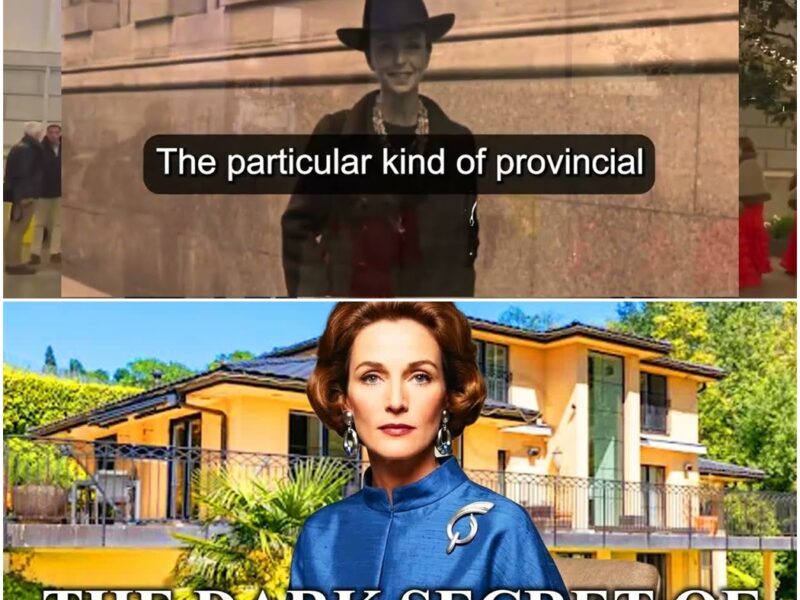
There is a photograph from the 1960s, Gloria Guinness, seated in her suite at the Waldorf Towers in New York, draped in Givenchy and Balenciaga, wearing a hat so precisely positioned it looks architectural. And if you study that face long enough, something becomes clear. Nothing in it is accidental.
Not the composure, not the stillness, not the expression that offers warmth without ever opening into vulnerability. She had been photographed by every great lens of the 20th century, and in every single image she looked exactly the same. Perfect, controlled, absolutely unreachable. The woman in that photograph was called the most elegant woman in the world by Eleanor Lambert, the woman who invented the concept.
She dined with Nazi generals and Egyptian princes and Truman Capote. She was photographed by Cecil Beaton and Richard Avedon. She wore Balenciaga for decades while the world copied what she started. She owned apartments in New York and Paris, a Swiss farmhouse with a bowling alley in the basement, a 350-ton yacht, three aircraft, and a Florida mansion bisected by a highway, its two halves connected by a soundproofed room built underneath the road.
And nobody, not one person in that glittering world, actually knew who she was because she had made absolutely certain of that. Her name at the end of her life was Gloria Guinness, but that was the fourth name she had worn. And the first one, the real one, belonged to a girl from Guadalajara that she spent 50 years pretending had never existed.
This is the story of how she did it and what it cost her and what it meant and why the world was never quite clever enough to see through her until it was too late to ask the questions that mattered. Before we go any further, we would love to know where in the world you are watching from today. Drop your city or country in the comments below.
And if you are new here, please consider subscribing. We tell stories like this one every week. Stories about extraordinary lives that history has recorded incompletely. Now, to understand Gloria Guinness, you have to start at the beginning. And the beginning is nothing like the story she told.
She was born on August 27th, 1912 in Guadalajara, Mexico to a family that was considerably more complicated than the one she would spend her life describing to anyone who asked. Her father, Jose Rafael Rubio Torres, was a liberal journalist born in the state of Michoacán in 1880. A man who had attached himself to the cause of Francisco Madero, the reformer who became Mexico’s first democratically elected president and paid for that distinction with his life.
Supporting Madero was not a safe position. The Mexican Revolution was not a single event with a clean beginning and a clean ending. It was a decade of successive upheavals, of governments collapsing into governments, of factions that were allies one year becoming enemies the next, of ordinary people being caught in the machinery of political violence they had no power to stop.
Jose Rafael found himself on the wrong side of whoever controlled the guns in any given year. And the penalty for that was exile. He left Mexico and did not come back. He died not in heroic combat, not with a rifle in his hands the way Gloria would describe him for the rest of her life, but of health complications at a clinic in San Antonio, Texas, when his youngest daughter was approximately four or five years old. Gloria grew up without him.
She grew up with the story of him. And the story, as she refined it over decades, bore less and less resemblance to the documented facts. Her mother was a different story entirely, and the gap between who her mother actually was and who Gloria claimed she was tells you more about the architecture of the persona she built than almost any other single detail.
Maria Luisa Alatorre y Díaz Ocampo came from an established land-owning family in Jalisco with roots deep in Spanish colonial aristocracy. Her family had made their fortune in sugar over generations. They were not servants. They were not seamstresses or laundry workers or any of the other humble occupations Gloria assigned her mother when the subject came up in conversation.
They were grandees, people who could trace their lineage to the conquistador Don Diego de Ochoa Garibay and through a line of relatives to Christopher Columbus himself through his eldest son, the first Duke of Veragua. This is documented. It is verifiable. And for 50 years Gloria told people her mother washed other people’s clothes for a living.
Gloria had two older siblings, Rafael and Maria Luisa. After her father’s death, the children were raised by their mother and her extended family moving between the haciendas of wealthy relatives in Jalisco, the Ochoa Garibay and Villaseñor Yasso and Sánchez de Aldana families.
People with land and horses and the particular ease that comes from having owned things for generations. It was not a childhood of poverty. It was a childhood of provincial landed privilege disrupted and reduced, but real. The kind of upbringing that leaves a person with a deep and practical understanding of how aristocratic life actually functions from the inside.
She knew what the silver looked like when it was properly polished. She knew which fork went where. She knew how to move through rooms where powerful people expected to be treated as powerful without either fawning or shrinking. She had absorbed all of that before she was old enough to understand she was absorbing it.
And then the Cristero War arrived and what remained of that world came apart. It erupted in 1926, a Catholic uprising against Mexico’s secular government that was particularly intense in Jalisco and the surrounding states. The Mexican government had declared church properties national assets, expelled priests from the country, and enforced anti-clerical laws with a violence that shocked even people who had lived through the previous decade of revolution.
Cristero fighters, mostly peasants and devout Catholics from the Mexican heartland, took up arms with the battle cry of Viva Cristo Rey, long live Christ the King, and for 3 years the conflict tore through the region where Gloria’s family had their land and their connections and their sense of who they were.
Men were publicly hanged from telephone posts, haciendas were confiscated or destroyed. Communities that had existed for generations were displaced in weeks. Over 200,000 people died before the fighting ended in 1929. Families like Gloria’s were among those driven off their land and into the cities. The family relocated to Mexico City.
They were not destitute in the theatrical sense, not starving, not entirely without resources, but they were reduced in ways that mattered. The land was gone. The position was gone. The particular kind of provincial authority that came from being among the families who owned the countryside had evaporated.
And what replaced it was the ordinary social anonymity of people who had once been important somewhere that no longer existed. At some point in those Mexico City years, the young woman who had been raised on the haciendas of Jalisco was working as a hostess in a nightclub. How she arrived there exactly, what the work entailed in its full detail, and what she made of the experience is not fully documented because Gloria never documented it and never invited anyone else to document it on her behalf.
The darker whispers that circulated for the rest of her life, the rumors about the nightclub involving more than simply hospitality, belonged to the category of things that were never proven and never definitively refuted. What is clear is that she was beautiful, that she was intelligent, that she understood the dynamics of rooms where powerful men spent money, and where women of a certain kind managed male attention with the precision of a skilled navigator managing crossing.
And she was not going to stay where she was. She knew what the life of the privileged looked like from the inside. She had lived it. She had watched it taken away. She knew the machinery. She knew how fragile it was. And she had come to a conclusion that would govern every decision she made for the next 50 years.
She had learned from the rubble of everything that had come before, a lesson that would define her. The world was not made for girls from Guadalajara. So, she would simply stop being one. In Mexico City in 1933, she found her first door. His name was Jacobus Hendrikus Franciscus Schultens. He was Dutch-born, the superintendent of a sugar refinery in Veracruz, a man embedded in the industrial commerce of a country she had decided to leave. He was 47 years old.
She was 20. The wedding took place on March 31st, 1933 in Mexico City. It was not, by any account that has survived, a love match. Both parties likely understood what it was, even if neither said so directly, because in the social and economic world that produced it, strategic marriages were not unusual and did not require the performance of romance to be considered legitimate.
What Schultens offered was not love, but exit. He had European connections, a European name, proximity to the international commercial world that lay beyond Mexico. Marriage to him gave her a legal identity that was attached to something outside the country she was trying to leave.
A way of being on paper that did not begin and end with the history she was trying to close. The marriage collapsed almost immediately. They separated shortly after the ceremony. The divorce was formalized by 1935. No children came from it. She had spent two years adjacent to the sugar industry her mother’s family had once dominated in the port city that she would later falsely claim as her birthplace.
And when the two years were over she had what she needed. Not a husband, a starting point. It is worth sitting for a moment with what it means to be 20 years old and already calculating your life in stages as deliberate as this. The haciendas were gone. Her father had died in a clinic in Texas when she was still a small child.
The revolution had taken the land. The Cristero War had taken whatever the revolution had left. She had watched a world built across generations disappear in less than a decade. And she had drawn from that experience a conclusion that most people would not have arrived at so young or with such cold clarity.
Stability was not something the world granted you. It was something you built for yourself using whatever materials were available and then maintained through intelligence and will and the ability to present whatever face the moment required. Schultens was the first material. He was necessary.
He was not the most interesting piece and the moment he was no longer necessary she set him aside with what appears to have been no particular difficulty or regret. She had learned what she needed to learn. The next door was already in view. Two years was all she needed. By 1935 she had already identified where she was going next.
And it did not lead back to Vera Cruz. It opened onto Europe. The man she married next had a name so long it required drawing a breath before you could complete it. And a title that meant something real in the world she had decided to enter. Franz Egon Maria Meinhard Engelbert Pius Aloysius Kaspar Ferdinand Dietrich III Graf von Fürstenberg-Herdrigen.
She married him on October 4th, 1935 in Kensington, London. She was 23 years old. He was 39. It was the second marriage for both of them and with that ceremony in a London register office, Gloria Rubio y Alatorre became Countess Gloria von Fürstenberg-Herdrigen. The title was not ceremonial. It was heritable, recognized across European aristocratic society, and it opened doors that money alone in that particular world at that particular moment could not have opened.
She entered the social networks of Germany and of the broader European noble class, the dinner parties and the country house weekends, and the elaborate machinery of a world that still believed, against mounting evidence, that it ran everything. She became stepmother to Betsy von Fürstenberg, the count’s daughter from his first marriage, who would later build a career as an actress.
She learned to navigate the specific protocols of German aristocratic society with the same readiness she had brought to every other social environment. And on July 31st, 1936, she gave birth to her only biological child, a daughter, Dolores. The marriage brought her into proximity with a Germany that was transforming itself into something dangerous in ways that not everyone around her was willing to acknowledge.
The count’s social world included people at the edges of the Nazi establishment. Europe was becoming a map of impossible choices. The marriage ended somewhere around 1940 to 42. The exact timing made complicated by a reportedly friendly Spanish divorce, a legal separation obtained in Spain that was intended to help secure exit visas that the Spanish government subsequently did not issue.
The paperwork of her life was becoming deliberately, perhaps strategically, unclear. And so, as the Second World War spread across the continent, the woman formerly known as Countess von Fürstenberg arrived in neutral Madrid. Neutral Madrid during the war years was one of the most extraordinary cities on Earth.
A place where every intelligence service in the Western world was operating simultaneously, where Axis and Allied agents circulated through the same ballrooms and drank at the same bars, where the aristocratic social life of a nominally neutral country under a dictator who owed his power to fascist support provided cover for activities that bore no relation to the occasion.
The city was a theater of the highest order. Everyone in it was performing. And everyone in it was watching everyone else with the concentration of people who understood that what happened in those rooms had consequences for armies and governments and the survival of nations. Into this city came the Countess von Fürstenberg, a woman with a German title, a Mexican birth, connections that reached into the highest levels of European aristocracy, and a documented social relationship with figures at the senior levels of the Nazi regime. Multiple sources place her in close proximity to Hermann Göring, the second most powerful man in Germany, and some accounts go further, placing her in direct social contact with Adolf Hitler himself during the European years, though the nature of those encounters is not verifiable from the documentary record that has survived. The primary witness to what has become known as the spy narrative is Aline
Griffith, an American woman from Pearl River, New York, who worked as an OSS operative in wartime Madrid undercover as a code clerk and later wrote a series of memoirs about her intelligence activities in Spain. Griffith encountered Gloria personally during this period and moved in the same social circles.
In her accounts, she described Gloria as an almost legendary figure in the Madrid world, glamorous, connected, operating as an intelligence asset for the Axis powers. The characterization was specific and consistent. Griffith was not writing gossip. She was a trained operative with professional reasons to understand who was working for whom.
And yet, the investigation that followed, conducted under Project Safehaven, the Allied post-war operation established to track the flow of Nazi assets out of Europe, placed Gloria under active surveillance and reached a conclusion that complicates the cleaner version of the story.
The investigators determined that they could not establish she was working for Germany. One account of the investigation states explicitly that the conclusion was that she was not a Nazi spy. The truth of those years remains genuinely unresolved, and the script that history has assembled around her wartime period is one that honest accounting has to leave open.
What is not in dispute is this. When the war ended, she carried no valid passport from any country. She had passed through Dutch legal status via the first marriage, German countess status via the second, whatever national ambiguity the divorce proceedings had introduced, and she emerged from the entire period holding no document from any nation that could establish who she was or where she belonged. She was legally stateless.
In the bureaucratic reality of post-war Europe, she did not officially exist. Whether that condition was the consequence of deliberate espionage, the accidental byproduct of too many marriages and too many countries in too short a time, or some combination of both, she never explained. She did not explain most things. That was the point.
When the war ended, she had no country, no passport, no legal identity that could be traced cleanly to any single history. She was, in the most literal and concrete bureaucratic sense, a woman who did not exist. And she was about to disappear one more time before she finally became someone the world could not look away from.
She was legally nobody, and she was invited everywhere. In the post-war years, moving through European society with the ease of someone who had not simply survived the war, but had used the experience to become considerably more interesting. She was in her mid-30s and possessed of a quality that the people around her could not quite categorize, but could not quite look away from either.
She had been through things that most of her social contemporaries had experienced only at a safe distance, and it had left her with a kind of settled authority that did not require performance to be felt. Her third marriage was to Ahmad Abu El Fotouh Fakhry Bey, a grandson of King Fuad the First of Egypt and a nephew of King Farouk, and of Queen Fawzia of Iran, who was at that time the first wife of Mohammad Reza Pahlavi, the Shah of Iran.
She married Ahmad in 1946. He was 25 years old and connected by blood to the Egyptian royal house. He was not merely wealthy, he was royal adjacent in the most literal genealogical sense, a man whose family tree intersected with the history of one of the oldest continuous civilizations on Earth. No children came from this marriage.
It ended in divorce in 1949. The sequence was becoming clear to anyone paying attention, though in the world she occupied, people were generally too carefully mannered to say so directly. Dutch sugar superintendent, German count, Egyptian prince of royal blood. Each marriage was more prestigious than the last, more deeply embedded in the world she was building toward, and each ended at the point where it had served its purpose in the larger construction.
She was not collecting husbands in any emotional sense. She was collecting the credentials and the access and the social positioning that the world she intended to inhabit required. And she was doing it with a patience and a precision that, viewed from a sufficient distance, looked less like opportunism and more like architecture.
During the third marriage, she was also conducting a relationship with Duff Cooper, the British ambassador to France, a man who was famous on both sides of the Atlantic for his complete indifference to the social expectations governing discretion about his romantic life.
Cooper was a gambler, a drinker, a politician of genuine distinction, and a womanizer of legendary consistency. He later described his relationship with Gloria in terms so frank they have been noted in nearly every account of her life since, characterizing his physical feeling for her with a directness that made clear he considered the relationship among the defining experiences of his life.
From Cooper’s side of the ledger, this was an advertisement. From Gloria’s side, it was simply another fact she neither confirmed nor denied because she never confirmed or denied anything that she did not choose to confirm or deny. After the factory divorce in 1949, she became involved with two men simultaneously, Loel Guinness and David Beatty, the second Earl Beatty.
Both were wealthy. Both were British. Both were deeply embedded in the aristocratic and financial world that was her immediate social horizon. She chose Loel. The decision was not impulsive. Very few of her decisions were. There is also the detail that belongs in the category of stories that cannot be verified, but cannot quite be dismissed, either.
Before agreeing to marry her, Loel Guinness reportedly commissioned a private investigator at a cost in the range of $1 million to compile a complete dossier on his fiance’s wartime activities. The contents of that dossier have never been disclosed. Its very existence, if the account is accurate, tells you something important about how the world understood what it was looking at when it looked at Gloria Rubio.
The world understood that the surface was not the whole story. It just could not find the proof of what the rest of the story was. They had met on a yachting trip in 1949. The setting was appropriate to a life that had been, in every meaningful sense, conducted at sea. On April 7th, 1951 in Antibes, in the warm light of the South of France, they were married.
She was 38 years old. She had been, in succession, a nightclub worker, a Dutch superintendent’s wife, a German countess, a woman of uncertain wartime history in neutral Madrid, an Egyptian princess’ wife, a stateless person carrying no valid document from any nation on Earth, and the subject of a private intelligence investigation commissioned by the man she was now standing beside.
She became Gloria Guinness, and she never looked back. What Loel Guinness gave her was not simply money. She had been adjacent to extraordinary wealth for the better part of two decades. What he gave her was permanence, and the particular kind of legitimacy that comes from being attached to a name that required no explanation in any country where it mattered.
Loel himself was a serious man in the particular way that people who have never been required to perform seriousness tend to be. He had served as a group captain in the Royal Air Force and flown in the Battle of Britain. He had been a Conservative Member of Parliament for Bath from 1931 through 1945.
His fortune came through Guinness Mahon, the banking branch of the family, and through real estate holdings that had accumulated across decades, rather than through the famous stout. Though the name carried the weight of both in any room where it was spoken. He had been born in Manhattan and raised transatlantically, educated at the Royal Military College at Sandhurst, a member of the Royal Aero Club since 1928, one of the first private citizens in England to own a personal aircraft.
He was a multimillionaire in the most straightforward sense of the word, a man for whom the word fortune was not metaphorical. His marital history was its own kind of drama. His first wife, Joan Yarde-Buller, had left him for Prince Aly Khan, the eldest son of the Aga Khan. A departure that resulted in a court case Lowell won decisively, with full custody of their son Patrick, and an order that Aly Khan pay the court costs.
His second wife, Lady Isabel Manners, was the daughter of the 9th Duke of Rutland. Gloria was the third wife, and by any measure the most spectacular acquisition of a life that had already included several spectacular acquisitions. Together they assembled a domestic world that operated at a scale requiring considerable architectural description, an apartment in the Waldorf Towers at 301 Park Avenue in New York, a seven-story townhouse at 18 Avenue Matignon in Paris, decorated by the celebrated interior designer Georges Geffroy, fitted with a roof garden, and furnished with the particular understatement that distinguished true elegance from its imitations. Villa Zanroc, an 18th century farmhouse in Epalinges, near Lausanne in Switzerland, with in the basement a bowling alley. A stud farm in Normandy called Haras de Piencourt. A mansion named Gemini in Manalapan, Florida, which sat bisected by US
Highway A1A, facing the lake on one side and the ocean on the other, its two halves connected by a soundproof living room built beneath the road itself. The subterranean passage decorated by a young French artist whose career Gloria had decided to support. A house in Acapulco, Mexico designed by the Mexican architect Marco Aldaco.
A building that sat in the hills above the Pacific with the confidence of something that knew it was beautiful. A 350-ton yacht that made its way through the Mediterranean each summer carrying its owners and their retinue from port to port with the unhurried dignity of people who had nowhere they were required to be by any particular hour.
And three aircraft maintained for different categories of travel. An Avro Commander for short hops around Europe, a small jet for longer distances, and a helicopter that Lowell used for the short transit between the Manalapan house and the Palm Beach golf course. They kept complete wardrobes at each residence.
They traveled with nothing but the clothes on their backs, arriving at each house to find everything already in order. Every closet already stocked. Every staff member already in place. She told Time magazine in 1962 that it was easier in her experience to keep five homes than one because you could not possibly spend 12 months in any single place.
It was a statement that managed to be simultaneously absurd and within the logic of the life she was describing completely rational. The fashion identity she had been developing since at least the late 1930s now found its fullest and most public expression. Balenciaga had been dressing her since 1938 by her own account and the relationship defined her public image as completely as any single element of her visible life.
The working relationship with Balenciaga was not simply a matter of buying clothes. It was a sustained creative conversation between a designer of extraordinary structural discipline and a woman whose body and bearing gave that discipline its fullest human expression. She also wore Givenchy, Schiaparelli, Chanel, Dior, under Marc Bohan, Valentino, Halston, and Roger Vivier for shoes.
Though she noted that she wore Chanel suits only in Lausanne because so many other women wore them in Paris and New York and she preferred not to match. Her aesthetic was built on precision rather than extravagance, strong clean lines, bold solid colors, particularly black and white and red, a profile that Cecil Beaton’s camera described with the vocabulary of ancient Egypt, high defined cheekbones, a long pronounced neck, bold brows, a stillness that read on film as something between composure and command.
By 1959, she was appearing on the international best-dressed list. By 1962, Time magazine ranked her the second best-dressed woman in the world, after only Jacqueline Kennedy. Eleanor Lambert, the woman who had founded the best-dressed list and New York Fashion Week, and who had spent her professional life thinking about what elegance meant and where it lived, said publicly and without qualification that Gloria Guinness was the most elegant woman in the world, not one of the most elegant, not among the most elegant, the most, without exception. The superlative was Lambert’s and she was not someone who deployed superlatives carelessly. By the late 1950s, the woman who had been born Gloria Rubio in a city she refused to name, in a family whose actual history she had spent years carefully obscuring, was the most admired, most photographed, and most deliberately mysterious woman in the international social world. And
she was just getting started. By the time Truman Capote came to understand what he was looking at, she had been the most interesting woman in any room she entered for the better part of a decade. Capote’s swans were his collection, the group of extraordinary women he gathered around himself in the 1950s and 60s and treated as a combination of confidants, creative material, social currency, and genuine friends.
The group included Babe Paley, Lee Radziwill, Marella Agnelli, Slim Aarons, C.Z. Guest, and others who moved through the same transatlantic social orbit. What distinguished a swan from the merely wealthy or the merely beautiful was, in Capote’s own formulation, that elegance required more than money and more than looks.
The woman had to be amusing in the deepest sense of that word, which meant she had to make Capote himself feel that his considerable intelligence had encountered something equal to it. Gloria was the only swan who was also genuinely funny in the way that he was funny. Most of the very rich, as he observed with the accuracy of a man who had made a study of them, tended toward literal minds and found excessive wit subtly threatening, as though cleverness directed at the wrong target might one day be directed at them. Gloria found it delightful. She refused to treat cleverness as subversive. She matched him observation for observation and she did it with the composed assurance of someone who did not need the laugh to land in order to know the shot had been accurate. He named her, alongside Babe Paley and Greta Garbo, as one of the three greatest beauties in the world. But beauty was the least of what connected them. The friendship had
texture and specificity. They went on yacht trips together, attended events together, circulated through the same parties and restaurants and gatherings that defined the international social world of the 1960s. On one particular occasion at the Fontainebleau Hotel in Miami Beach, They discovered that the hotel’s swimming pool was transparent and positioned directly above the bar, and the two of them apparently found this irresistible, spending a portion of their visit occupying themselves by watching from below what the swimmers were doing in the water above them with the satisfaction of people who understand that the world is funnier than it pretends to be, and that this knowledge is among the few genuine pleasures available at any income level. In 1963, she began writing a column for Harper’s Bazaar that would continue for 8 years. This was not a celebrity byline arrangement where a famous name is attached to prose written by someone else in an adjacent office. She wrote. She had something to say about elegance
and fashion and the way style actually functioned in the world, and she said it with the precision she brought to everything. Her most quoted statement from the July 1963 issue was that elegance lives in the brain as well as in the body and in the soul, and that Jesus Christ was the only human example she could identify of any one person having possessed all three simultaneously.
The audacity of the observation is worth considering, not its religiosity, which was unremarkable in her context, but the confidence it embodied. The certainty that she understood what elegance was and where it resided, and that most people, however well-dressed, were getting the essential point wrong.
She also said in the same column and in subsequent ones that she had never worn a piece of costume jewelry in her life on the grounds that if a woman was content with false pieces, there was no reason for a man to acquire the real thing for her. She said she wore Chanel suits only in Lausanne because too many women wore them in Paris and New York, and she preferred not to resemble anyone else.
She was not performing wit or affecting eccentricity. She was simply saying what she observed in a voice that had had refined over decades of watching other people perform and privately noting where the performance broke down. In 1964, the International Best Dressed List elevated her to its Hall of Fame, a designation that acknowledged she had moved beyond the category of fashionable and into something more durable.
She was also, in those same years, among the first women in America to wear Emilio Pucci’s Capri trousers, having appeared on Worth Avenue in Palm Beach in the early part of the decade wearing them because a dress seemed too formal for the occasion. And shorts were, in her view, appropriate only for children.
The Capri pants became a trend of considerable scale almost immediately. She later observed that the moment they became popular enough to be widespread, they had become, in her characterization, vulgar. She moved on, as she always moved on, without ceremony and without explanation. On November 28th, 1966, Truman Capote threw his Black and White Ball at the Plaza Hotel in New York, an event attended by 540 masked guests, including Andy Warhol, Frank Sinatra, the Duke and Duchess of Windsor, Gloria Vanderbilt, Lauren Bacall, Henry Ford, Henry Fonda, and the daughters of three American presidents. The event was described by every gossip columnist in the country as the social event of the century. Capote himself wore a 37-cent mask purchased from a toy store. Gloria arrived in a long white
glittering Mainbocher gown and looked exactly as she always looked, which was like someone who had not needed to try, which was itself the product of a lifetime of extremely careful effort. She was, in those years, the most fully realized version of herself that she had ever managed.
But somewhere underneath the recognition and the photographs and the pronouncements about elegance, a woman who had been studying rooms since she was old enough to understand what studying a room required, knew something about the nature of positions at the top. In a room full of elegant women, there was always someone watching you, the same way you had once been watching everyone else.
Her name was Barbara Paley, and she watched Gloria the way a person watches someone who has something they want, but cannot quite name. Babe Paley was Capote’s favorite swan by his own frequent declaration. The woman he described as having only one flaw, which was that she was perfect and otherwise perfect. She was the wife of William Paley, the founder of CBS.
She had worked as a fashion editor at American Vogue for a decade before her second marriage. She was beautiful, composed, impeccably dressed, and the defining social figure of the New York world that Gloria also occupied. The two women existed in the kind of natural competition that requires no direct because everyone in the room can feel it from the moment both of them enter.
Babe’s chosen weapon was information. For a sustained stretch of years, she made a consistent practice of telling people about Gloria’s past as a Mexican nightclub worker. In the social world they shared, where origin was a form of currency and past lives could be deliberately devalued through strategic exposure, this was not idle conversation.
It was an attempt to puncture something. The attempt did not fully land, partly because Gloria’s composure made the information impossible to use effectively against her. You cannot wound someone with a secret they have already made their peace with, and partly because Gloria had long since concluded that the nightclub story, far from damaging her, was actually more interesting than the truth, which was that she had come from a family of colonial aristocrats who had been on the wrong side of a revolution. She had chosen the nightclub story herself, in a sense. Babe’s weapon had been made for someone else. The retaliation was elegant and patient in the way that Gloria’s responses to everything tended to be. She invited the Paleys for a holiday aboard the Guinness yacht and told Babe to pack casually. She was specific about it. No jewels, no formal gowns, a relaxed trip among friends. Babe complied. The first night aboard, Gloria emerged from her cabin in full formal couture,
covered in diamonds, and announced that the group would be attending a formal dinner ashore that evening. Babe had nothing appropriate to wear. Gloria had won that round without saying a single word about it or acknowledging that anything had been orchestrated. The following year, Babe arrived for the next yacht holiday with every piece of finery she owned, packed and ready for any social occasion that might materialize.
Gloria ensured that the entire holiday was conducted aboard the yacht, that no dinner ashore was arranged, that every evening was resolutely, determinately casual, and that Babe’s elaborate preparations were entirely useless. Gloria had simply changed the rules of the game rather than playing by the original ones, and she had done it without ever raising her voice or appearing to notice that a game was being played at all.
The rivalry ran beneath the surface of the Swan years with the persistence of something that has decided to wait rather than to force its resolution. What it reveals, considered honestly, is something about both women and the world they shared. Babe Paley wielded Gloria’s origins as a weapon because she believed correctly that in their shared social universe origins mattered and exposure could damage.
But she had fundamentally miscalculated what she was dealing with. Gloria had been managing the story of her origins since before Babe Paley knew she existed. She had chosen a humbler story than the true one, had lived inside it for decades, and had made it so thoroughly her own that the nightclub revelation was not a wound, but a non-event.
Babe needed Gloria to be ashamed of it. Gloria simply was not. In 1975, Truman Capote published an excerpt from his long-announced novel Answered Prayers in Esquire magazine, a piece called La Côte Basque, 1965, named for a restaurant on East 55th Street that had been a regular gathering place for the swans and the world they inhabited.
Through characters whose identities were immediately transparent to anyone with passing knowledge of that world, he exposed the private lives of the women who had trusted him with their secrets across nearly two decades of friendship. The most devastating passages concerned Babe Paley, whose husband’s serial infidelities were rendered in detail that could only have come from the intimate confidence of a friend.
Babe was dying of lung cancer when the piece appeared. She severed all contact with Capote immediately and permanently. Most of the swans closed ranks behind her. Gloria was among those who withdrew from the friendship. When Babe died in 1978 at 63, the core of the world the swans had defined together was effectively finished as a living reality.
It would continue as a memory, as a subject of retrospective examination, as the material of future television series and documentaries, but its life as a present experience had concluded. Gloria watched it end from the composed remove that had always been her natural position.
The woman Capote had damaged most was not her. It was Babe. And Gloria had survived worse things, considerably worse things, than being talked about by someone who claimed to love her. Through all of it, through the marriages and the properties and the photographs and the columns and the rivalry and the years of being the most looked at woman in every room she entered, there was a daughter.
Dolores had been born on July 31st, 1936 to Gloria and the Count von Furstenberg in the middle of a marriage that was already less stable than it appeared and in the middle of a Europe that was already less stable than anyone around her was prepared to acknowledge. She was Gloria’s only biological child and she grew up moving between the worlds that her mother’s successive marriages created.
Ha, a childhood of considerable wealth and considerable dislocation conducted across multiple countries and multiple languages under a series of different names above the door. In October of 1955, Dolores married Patrick Benjamin Guinness, the eldest son of Loel Guinness from his first marriage, her own stepbrother. The arrangement was documented and in the social world of European aristocracy at that time was not entirely without precedent, though it was striking enough to be noted by anyone who encountered it. Gloria never offered a public comment on the union. It was, in her view and apparently in the view of everyone involved, the family’s business and the family had decided it was acceptable. Patrick and Dolores had three children together in quick succession. Maria Alexandra was born in 1956. Loel Patrick arrived in 1957. Victoria came in 1960. Three grandchildren for Gloria born
within four years growing up in the same transatlantic, multilingual, privilege-saturated world that their grandmother had spent decades building. In 1965, Patrick was killed in a car accident in Switzerland. He was 34 years old. Dolores was 28 years old and widowed with three children under nine. What this meant to Gloria is not in any document she left behind because she did not leave documents of that kind.
She did not give interviews about her private grief. She did not speak publicly about the loss in any account that has survived. She appeared at the events she was expected to appear at. She maintained the composure that was for her less a performance than a fundamental orientation toward the world.
She carried it as she had carried everything that could not be shown. The particular texture of what she was absorbing is worth considering slowly. Her own father had died in exile when she was approximately four or five years old. She had grown up in the direct aftermath of a loss that left the family displaced, reduced, and permanently altered.
She knew from the earliest layer of her own experience what it meant to watch the person who was supposed to be permanent disappear and not come back. And now, her only daughter, the one person in her life she had not acquired or constructed or managed at a strategic distance, was experiencing the same thing at 28 with three small children and the whole of a long life still ahead of her.
The grief moved between them in private, away from the cameras, and the columns, and the carefully curated image, and it was real, and it was the kind of real that no amount of Balenciaga can address. Victoria, the youngest of Dolores’s children, would eventually marry Philip Niarchos, son of the Greek shipping magnate Stavros Niarchos, extending the family’s reach into one of the great international fortunes of the second half of the century.
But that was decades away. In the mid-1960s in Switzerland, a family that appeared from every external angle to represent the absolute apex of glamour and privilege was sitting with a loss that had nothing to do with any of that. She kept showing up. That was the thing about Gloria Guinness that even careful observers sometimes missed underneath all the Balenciaga and the photographs and the pronouncements about elegance.
She had been showing up since she was 5 years old and the world she knew had been pulled apart around her. She had not stopped yet, but before the story reaches its ending, there’s something worth pausing to consider. Something that runs underneath every chapter of this life like a current you cannot always see, but can always feel if you know what you are looking for.
She lied about who she was. She did this consistently, deliberately, and with such complete internal conviction that for decades no one in her social world had any reason to question the version she was offering. She claimed she was from Veracruz rather than Guadalajara. She said her father was a revolutionary soldier killed in combat when he was a journalist who died ill in a Texas clinic when she was a small child.
She told people repeatedly and without apparent discomfort that her mother was a laundry maid or a seamstress when her mother was a woman of Spanish colonial land owning aristocracy who could trace her ancestry to the first Duke of Veragua, the eldest son of Christopher Columbus. But here is what makes these lies genuinely interesting rather than merely dishonest. She did not fabricate upward.
In a world where everyone around her was embellishing toward greater prestige, inventing longer pedigrees and more distinguished connections and grander ancestors, she was consistently insisting on a humbler origin than the one she actually had. Her mother was not the servant she described.
Her mother was the aristocrat. And she spent 50 years reversing that reality in every conversation where the subject arose. The possible explanations are multiple and not mutually exclusive. There is the social dimension, the calculation that in the world she was entering a genuine rags-to-riches story was more compelling than the truth, which was a reasonably well-connected family brought low by a revolution they had not caused and could not stop.
One narrative made her a prodigy of self-creation. The other made her a person to whom things had happened. She chose to be the prodigy. There’s also the wartime dimension. If she was involved in any form of intelligence activity during the years she spent in neutral Madrid, and the question genuinely cannot be settled with the evidence that survives, then having a documented biography that consistently failed to match the paperwork would have been an operational advantage of significant value. Multiple names, multiple nationalities, multiple divorces in multiple legal systems. A stated origin story that contradicted every document that anyone could find. You cannot effectively surveil someone whose story is architecturally designed to disintegrate under examination. Whether this was intentional or the accidental byproduct of a chaotic personal history is, like everything
else about those years, unresolvable. And there may be a third layer, which is the simplest and perhaps the most human of all. She had lost everything once. The haciendas, the land, the father, the provincial identity, the whole world she had been born expecting. Perhaps insisting that the beginning was truly nothing, genuinely nothing, was a way of protecting herself against the particular quality of grief that comes from having possessed something real and then watching it taken away.
If the original was already declared nothing in the story she told, then the loss of it did not need to exist in the story, either. She had simply started from zero and built everything herself through intelligence and will and the refusal to be limited by the category she had been assigned. That was cleaner.
That was a story she could inhabit without it hurting her. What it says about the world around her that nobody ever looked carefully enough to check is its own kind of indictment. Babe Paley knew about the nightclub and used it for years as social ammunition. But the deeper truth, the aristocratic mother and the exiled journalist father, was never weaponized by anyone.
Either no one found it or finding it did not serve any purpose that anyone in that world could use. The performance she had constructed was simply more real in the social sense than the documentary record. The creation had overtaken the original. She had told the story so many times and with such seamless composure that it is possible she had stopped distinguishing between what was built and what was found.
Or perhaps, more likely, she had decided long ago that the distinction was no longer a meaningful one. She had made a life. Whatever material she had used to make it was her own business and no one else’s. By the early 1970s, the world that had made Gloria Guinness a name on every best-dressed list and a face on every magazine cover had begun its slow and irreversible migration into a different era, one with less use for the particular kind of elegance she embodied and less patience for the social structures that had made that elegance legible as a form of achievement. The Harper’s Bazaar column ended in 1971 after 8 years of the most precise fashion observation that any working socialite had committed to print in that period. There was no farewell column, no announcement, no ceremony marking the conclusion. It simply stopped. The reasons were not stated publicly and have not been reconstructed from any private account that has survived. The
era was changing in ways that made the voice she had developed for those pages certain, authoritative, rooted in the conviction that elegance had permanent standards that the attentive person could identify and maintain, feel increasingly like a letter posted from a world that was in the process of becoming historical.
She continued to move between the houses. The properties were maintained. The wardrobes were restocked at each address. The staff traveled with the family as they had always traveled. A 1976 interview conducted by W Magazine found her at her home in Acapulco, still precisely and characteristically herself on the subject of what style required and what it meant.
Still possessed of the bone structure that great photographers have been arguing with for 30 years. Still capable of the kind of observation that made the interviewer feel they were in the presence of someone who had been thinking clearly about these things since before the interviewer was born. The Capote betrayal arrived in 1975 and when it did, it functioned less as a new event than as the conclusion of a long story that everyone involved had known was heading somewhere dark.
Gloria withdrew from the friendship with the same composure she brought to every withdrawal without public statement, without visible drama, without the appearance of having been surprised. She had less invested in the Capote friendship than Babe had and less to lose from its ending. Capote had not exposed Gloria in La Cote Basque the way he had exposed Babe.
That was either a measure of his affection or a measure of his calculation that her secrets were harder to render in fiction without triggering consequences he was not prepared to manage. When Babe died in 1978, the inner world of the swans was over as a living structure. What remained was its afterimage, which would prove in subsequent decades to be extremely durable.
What the marriage to Lowell looked like in these years is not extensively documented in any public record. She had reportedly told Noel Coward something candid and rather indiscreet about its physical dimensions. A comment that has circulated in social history ever since and that captures in its own irreverent way something about the nature of the arrangement.
Yet Lowell would, 8 years after her death, request to be buried beside her. Whatever the daily texture of the marriage was, it was also clearly something that neither of them had found elsewhere, and that neither of them wanted to give up. They had been together for nearly three decades by the time she died.
They had built and maintained a life at extraordinary scale. They had watched the world they had occupied at its height transform around them into something that belonged increasingly to the past tense, and they had remained. And so the 1970s passed, as the haciendas had passed, and the war had passed, and the marriages before this one had passed, and she remained in her villa in Switzerland, in her houses scattered across three continents, still dressed immaculately, still possessed of a face that gave nothing away, still, as she had always been, the most carefully managed mystery in any room she chose to enter. November 9th, 1980. She died of a heart attack at Villa Zanrock in Epalinges, near Lausanne, in the Swiss farmhouse with the bowling alley in the basement, and the complete wardrobe in each closet, and the staff who knew her routines. She was 67 or 68 years old, depending on which birth year the documentary record
favored on any given day. And the official cause of death is consistent across every account that has been examined. A heart attack at home in Switzerland, clean, documented, final. The rumors that followed were immediate, and among the people who actually knew her, remarkably consistent.
Friends who received the news found the heart attack difficult to accept as the whole story. She had the physical bearing and apparent constitution of a woman whose body seemed to be under a long-term contractual obligation to maintain itself. The news landed wrongly for people who had watched her in those final years.
Some among them came to believe she had chosen to end things herself, attributing the decision to the particular and quiet disillusionment that can settle over a life of extraordinary privilege once the structures that gave it meaning have dissolved around the person who built them. The era that made her famous was gone. The friends who had defined that era were gone or transformed.
The column had ended. Babe had been dead for 2 years. Capote was in his own prolonged dissolution. The swans were scattered. What remained was the machinery of the life, the houses and the staff and the wardrobes and the yacht, but not the life itself in the form that had made it worth constructing. Whether this interpretation is correct cannot be determined.
No official finding has ever contradicted the heart attack. The rumors belong to the same category as the wartime spy question and the million-dollar investigator’s dossier. Things that fit the character of the life too precisely to dismiss and that resist definitive resolution because the one person who could settle them chose in the end to leave no record.
She was buried at the Bois de Vaux Cemetery in Lausanne, Switzerland. 8 years later, on December 31st, 1988, Thomas Loel Evelyn Bulkeley Guinness died of heart disease at the Methodist Hospital in Houston, Texas. He was 82 years old. He had been a member of Parliament, a Battle of Britain veteran, a banking multimillionaire, and the man who had financed the purchase of Jacques Cousteau’s vessel, the Calypso, leasing it to Cousteau for the symbolic price of 1 franc per year.
He had done and owned and seen more than most human beings could arrange in several lifetimes. And his final request, expressed clearly before his death, was to be buried beside her. Dolores survived her mother by 32 years, dying in January of 2012 at the age of 75. Victoria, the youngest of Gloria’s grandchildren, had long since married Philip Niarchos and built her own life in the world that her grandmother’s ambition had made accessible.
The family lines continued, touching the edges of the aristocratic and financial networks of Europe and the international world that Gloria had spent her life ascending, rung by carefully chosen rung. The question of whether she was happy is one she never answered in any form that has survived.
She said she was having a marvelous time. She said it with the same absolute assurance that she said everything else. Whatever it meant, Loel chose to lie beside her for the rest of recorded time. That is all anyone knows for certain about what they actually were to each other. And perhaps for two people who had both spent their entire lives keeping their own counsel about the things that mattered most, it is sufficient.
The story that history tells about Gloria Guinness is, in the end, a partial story. What the historical record preserved is considerable. Her beauty, her elegance, and the specific form it took, understated, architectural, insistent on quality over volume. Her four marriages and the social trajectory they traced, her fashion influence across three decades, and the pieces she donated to the Victoria and Albert Museum, including the 1948 Balenciaga evening gown in organdy with flock flowers that remains among the most significant couture holdings in that collection. Her Harper’s Bazaar columns, her friendship with Truman Capote and her place in the way swan circle that he named and she inhabited on her own terms, her rivalry with Babe Paley and the way she conducted it. What the historical record missed or minimized or failed to look hard enough to find is something else entirely. The girl from Guadalajara who watched
her father disappear into exile in Texas before she was old enough to understand what exile meant. The young woman who survived the Cristero War’s systematic destruction of everything her family had built over generations, who worked in a Mexico City nightclub as a teenager to keep herself moving forward.
Who spent the years of the Second World War in neutral Madrid in circumstances that intelligence operatives on both sides found worth investigating, who married four times and used each marriage as a step toward a world she had decided she was going to reach regardless of what the world itself thought about that.
Who kept every house full of wardrobes so she never had to waste time at customs, and who told everyone for 50 years that her mother was a laundry maid when her mother was a woman of colonial aristocratic lineage descended through a documented genealogical line from the eldest son of Christopher Columbus.
In 2024, the FX anthology series Feud: Capote vs. The Swans brought the world she had inhabited back into public consciousness with the particular force that popular television commands. Hola magazine named her a Latina powerhouse, recognizing decades after her death that one of the most photographed and discussed women of the 20th century was a Mexican woman who had spent her entire adult life ensuring that no one in her social world thought of her that way first.
The irony is considerable and worth sitting with. She hid her Mexican identity, possibly for reasons of wartime operational security, possibly for reasons of social strategy, possibly because the world she was entering in 1930s Europe had no use for a Mexican woman except as an exotic curiosity, and she had not spent her adolescence working her way out of Guadalajara in order to become anyone’s curiosity.
And now, in the 21st century, that identity is the most compelling thing about her. The girl from Guadalajara who became the most elegant woman in the world is a better story than any of the versions she offered. It is the true story, and she never told it. She was not a cautionary tale. She was not a tragic figure.
She was not a victim of the world she entered because she entered it with complete awareness of its terms and navigated it better than almost anyone who has ever attempted anything comparable. What she was is harder to name and more worth the effort of naming. She was a woman who understood at an age when most people are still learning the rules of the room they are already in.
That identity is a resource, that origin is a story, and that the story you construct about yourself carries more force in the world than the story you were assigned at birth. She used that understanding to build a life of extraordinary scope and extraordinary control, and she maintained it with a discipline that the word elegance, deployed in its ordinary social sense, is entirely inadequate to describe.
Gloria Rubio Yturbide was born into a world that was already on fire in a city she refused to name to a family she spent her entire adult life redesigning for public consumption. She watched her father disappear into American exile when she was barely old enough to hold the memory. She watched the haciendas of Jalisco turn to dust and ash.
She watched the world she had been born expecting to inherit collapse before she was old enough to use it. And then she built another one. From a nightclub in Mexico City and a Dutch factory superintendent and a German count with a name that required a full breath to complete and an Egyptian prince connected by blood to the house of the pharaohs and a British banking heir who flew Spitfires and kept a bowling alley in the basement of his Swiss farmhouse.
She built it and she held it and she ran it and she maintained it with perfect composure until the last day of her life. The most elegant woman in the world. That was the verdict rendered by the woman who invented the standard. And she had earned every syllable of it. If you found this story worth your time, please like this video and subscribe to our channel.
Stories like hers deserve to be told in full.