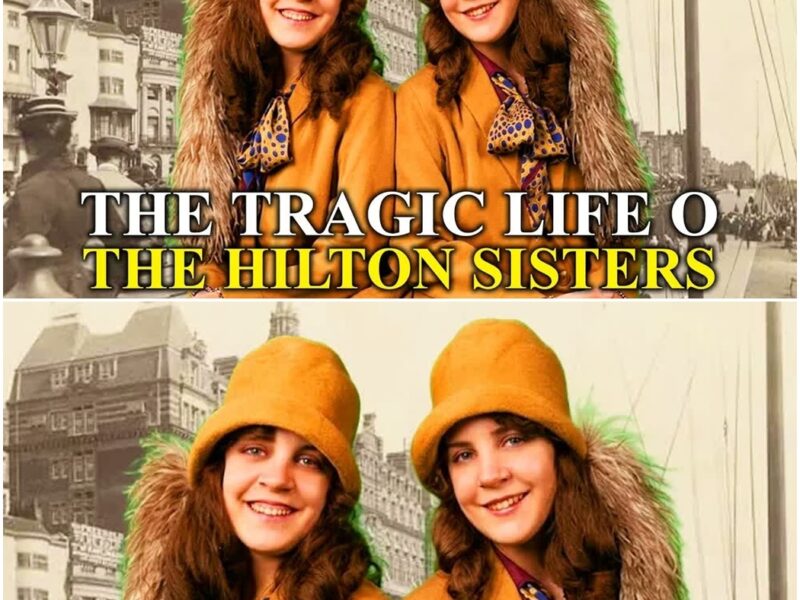
The Tragic Story Of The Hilton Sisters: Wealth, Fame, And Family Ruin D
Brighton, England. February, 1911. A young woman named Kate Skinner was 21 years old, unmarried, working as a barmaid, and she had just given birth to conjoined twins. The girls were joined at the hip and buttocks, sharing blood, sharing a body below the waist, but possessing two separate hearts, two separate minds, two entirely distinct human beings in every sense that would eventually matter.
Kate Skinner looked at what she had brought into the world and made a decision. She walked away. What happened next unfolded with a speed and efficiency that tells you everything about the era. The midwife who had delivered the girls, a woman named Mary Hilton, took them. Not out of charity, not out of pity.
Mary Hilton looked at those two small girls and saw a business, and within weeks of their birth, that is precisely what they became. By the time Daisy and Violet Hilton were old enough to understand what a stage was, they had been performing on one for years. By the time they were old enough to ask why they were living the way they were living, the answer had been built so deeply into the structure of their days that the question itself became almost impossible to form.
They had been sold, exhibited, trained, disciplined, and denied every private experience a human childhood contains, and all of it had been done with such thorough institutional logic that it barely registered as cruelty in the world that permitted it. They earned enough money in their lifetime to fill theaters in three countries.
They died in a house in Charlotte, North Carolina, found by neighbors who had noticed they had not come to work. This is the story of Daisy and Violet Hilton. It is a story about what happens when the world decides that a person is more valuable as a spectacle than as a human being, and about what it costs to spend an entire life inside that decision.
But it is also, if you look at it carefully enough, a story about two women who survived everything that was done to them with more dignity than most people manage in circumstances that are far kinder. It is a story about the entertainment industry at its most exploitative and at its most indifferent, about the legal structures that permitted the treatment of children as commercial assets for the entirety of their productive lives, about the specific and sustained cruelties that attach to a particular kind of celebrity, and about what it means to build a life from the ruins of a career that never truly belonged to you. It is not a comfortable story. It is not designed to be. The lives of Daisy and Violet Hilton were not comfortable lives, and to tell them comfortably would be to repeat the most fundamental error that the world made when they were alive, which was to prioritize its own ease over their reality. That is an error worth trying not to make. Before we go back to the
beginning, where in the world are you watching from today? Drop your location in the comments below because we love seeing how far this community reaches. And if you have not yet subscribed to this channel, now is the time. Because stories like this one, stories that have been overlooked or softened or told without their full weight, are exactly what we are here for.
Now, back to Brighton and to the world that made what happened to Daisy and Violet Hilton not only possible, but entirely ordinary. Brighton, England, February, 1911. To understand what Mary Hilton saw when she looked at those two small girls, you have to understand the world she was operating in. Because the exhibition of people with physical differences was not, in 1911, a fringe activity conducted in shadows by people who knew they were doing something wrong.
It was a mainstream entertainment industry with established circuits, standard contracts, recognized performers, and audiences who attended in their Sunday clothes and brought their children. The tradition had roots going back centuries in Europe and had been formalized in America largely through the work of P.T.
Barnum, whose American Museum in New York had been one of the most visited attractions in the country throughout the second half of the 19th century. Barnum understood something about public curiosity that his contemporaries were slower to grasp. People would pay and pay generously to see human beings who looked different from themselves, particularly when those human beings could be presented not merely as curiosities, but as performers, as entertainers, as people with skills and personalities who happened also to have bodies that deviated from the ordinary. The freak show, as it came to be called, was not purely a spectacle of difference. At its most commercially sophisticated, it was a theater of difference combined with genuine performance. And the most successful acts were those where the performer had real ability alongside the physical characteristic that drew the initial crowd. By 1911, the circuit was well-established and running smoothly across multiple continents. Traveling shows moved across
Britain, America, and Europe on regular schedules that had been refined over decades of commercial operation. Promoters knew precisely what acts commanded what fees. Audiences knew what to expect when they arrived and what they had paid for. And the legal landscape offered the people being exhibited essentially no protection whatsoever.
There were no statutes governing the exhibition of human beings with physical differences. There were no labor protections for children in performance contexts, no regulations about the conditions of travel, accommodation, or the duration and frequency of performances. No licensing requirements that would subject a promoter to any meaningful oversight about how the human beings in their care were actually being treated from day to day and year to year.
A child born with a physical difference into a family with no resources had no legal standing that would prevent an enterprising adult from taking possession of them and putting them on a stage indefinitely and keeping every dollar they earned. The other important thing to understand about this world is that it was not hidden or operating against the grain of public opinion.
It was genuinely and enthusiastically popular. The people who designed and ran these shows were responding to real sustained widespread public demand for exactly this kind of entertainment. The audiences who attended were not outliers or deviants. They were ordinary people coming to ordinary entertainment and they came because the culture told them that this kind of curiosity was natural and its satisfaction was available and acceptable.
There was no cultural framework in circulation that invited them to think critically about what they were participating in or what it cost the people being displayed. The reform of that framework was still decades away and it would require the combined efforts of disability rights activists and medical ethicists and legal reformers and a culture that had been through considerable painful education before it would fully arrive.
Mary Hilton operated in this world with the confidence of someone who knew she was doing nothing unusual. She had delivered the girls and she took them and the transaction between herself and Kate Skinner, whatever precise form it took in those first days after the birth, was one that the law of the time gave no mechanism to challenge or reverse.
Kate Skinner was 21 years old, unmarried, and working a job that paid wages insufficient to support herself alone. She had given birth to twins who would require sustained resources and sustained attention that she did not have and had no realistic prospect of obtaining. The stigma that attached to conjoined births in 1911 was not subtle or easily navigated.
These were not circumstances in which a young, unmarried, working-class woman in Brighton had many options available to her. And the decision to relinquish the girls, while brutal in its long-term consequences, was not, from where she stood in that moment, an incomprehensible one. History should not rush past Kate Skinner.
She was 21 years old, and she was out of options in a world that had given her very few to begin with. Mary Hilton gave the girls her surname. She named them Daisy and Violet, and she began the process of turning two human infants into a commercial enterprise. With the same practical focus that a farmer might apply to the acquisition of productive land, the girls would be fed, clothed, sheltered, trained, and exhibited. They would earn money.
That money would belong to Mary Hilton. The arrangement was complete and fully operational before the girls were old enough to have any view about it at all. And by the time they were old enough to form views, the arrangement had already defined the entire shape of their lives for as far back as they could remember.
Mary Hilton did not appear, by the accounts that survived her, to have been a woman without feeling. She was not a cartoon villain who took pleasure in cruelty for its own sake. She was a woman of her era operating within the entirely permissible logic of her era, who had identified an opportunity and taken it with the kind of business-like efficiency that her contemporaries would not have found unusual or particularly troubling.
The horror is not that she was a monster. The horror is that she was ordinary. The horror is that the society around her provided no framework within which what she was doing could be understood as wrong, challenged as illegal, or stopped as harmful. She did what she did because the world she lived in had decided, collectively and without much deliberation, that this was a permissible way to treat certain human beings.
That collective decision is the real subject of this story because it was not a decision that one person made. It was a decision that an entire culture made and an entire culture benefited from and an entire culture found ways not to examine too closely. By the time Daisy and Violet Hilton were old enough to understand what was happening to them, it had already been happening for years.
They had been on stages in England before they were 3 years old. Mary Hilton had moved them through the exhibition circuit in Britain with the methodical efficiency of someone managing a touring operation, which is precisely what she was doing. Audiences in the industrial cities of England, in Manchester and Birmingham and Bristol and Liverpool, paid to see the Brighton twins, as they were sometimes billed in this early period, and what they saw when they arrived was two small girls physically joined who could nonetheless sing and dance and engage an audience with the kind of cheerful performance energy that Mary Hilton had been drilling into them since before they were old enough to have any considered response to the drilling. The drilling was literal and it was sustained and it was not gentle. Mary Hilton was not an indulgent guardian and the performance standard she required was not negotiable. The accounts that Daisy and Violet gave later in their lives in interviews conducted over decades and in the legal proceedings that would eventually define the critical transition of their young
adulthood describe a childhood of structured performance and structured punishment in which the two were deeply and deliberately intertwined. When they performed well, the household ran smoothly and the day was manageable. When they did not perform to the standard Mary Hilton required, there were consequences.
Physical consequences delivered with the same practical efficiency that characterized everything else Mary Hilton did. They learned quickly what was required of them, which is to say they learned quickly that what was required of them was everything and that what was permitted to them was almost nothing and that the distance between those two facts was the entire space within which their childhood would be conducted.
They had no private life in any meaningful sense at any point during these years. They shared a room with their guardian in every city and town and accommodation they passed through. They did not attend school with other children or have friendships with children their own age or experience any of the normal social formation that most children absorb without being conscious it is happening to them.
Their education was entirely in the service of their performance. Music lessons and dance training and the specific stagecraft of engaging an audience conducted in a traveling environment that moved constantly and never settled long enough in any single place to allow anything like rootedness. By the time they were four or five years old, they had already developed the performance instincts that would eventually make them genuinely accomplished entertainers and those instincts had been developed under conditions that no employment law of the period had employment law applied to them at all would have tolerated for a single working day. The psychological texture of this childhood is something that must be inferred rather than directly known because the documentation that survives speaks mainly to the external facts rather than the internal experience of two small girls being trained and exhibited and controlled across the first years of their lives. What the interviews and legal proceedings suggest is that the girls made the adaptations
that children under sustained external control always make. They learned what pleased their guardian and they delivered it reliably. They learned what displeased her and they avoided it carefully. The compliance was not passive or defeated. It was an active and intelligent survival strategy developed by two perceptive children who grasped their situation with the particular clarity that comes from having no alternative but to understand it.
They could not leave. They could not appeal to any outside authority. They could not, for the most part, speak to anyone who was not already part of the system that controlled them. What they had, in the midst of all this, was each other, and the evidence across the entirety of their long shared life suggests they made of that companionship something genuinely sustaining, something durable enough to carry them through years that would otherwise have been simply unbearable.
Mary Hilton took them to Australia for a period, extending the circuit to a new market, and the Australian audiences responded as the English ones had. Then she brought them to America, because America was where the serious money was, and where the vaudeville circuit offered a scale of reach and income that no other market could match.
America in the 1910s was a country in the middle of a vaudeville boom that would last another decade before the new technologies of film and radio began to erode it. Theaters in every city of any meaningful size ran vaudeville bills several times a day, from the major houses in New York and Chicago and San Francisco to the smaller circuits that served every regional market of any commercial significance.
The acts that appeared on those bills ranged across every form of popular entertainment, and in the hierarchy of novelty acts, conjoined twins who could perform, who could play instruments and dance and hold an audience’s genuine attention across a full set, occupied a position of considerable and sustained commercial value that a smart promoter could exploit across many years.
Mary Hilton understood this and positioned the girls accordingly, maintaining the rigorous performance training across all the years of constant travel. By the time Daisy and Violet were six or seven years old, they were working entertainers in the full professional sense of the phrase, appearing regularly before paying audiences and delivering performances that people talked about afterward, not simply because of what they looked like, but because of what they could do.
The distinction between curiosity and genuine entertainment matters commercially. Curiosity sells one ticket, entertainment sells 10, and sells them again the next time the act comes through town. When Mary Hilton died in 1919, Daisy and Violet were 8 years old. Whatever they felt in the immediate aftermath of her death, whatever complicated mixture of grief and relief and fear and uncertainty might have attended the passing of the only guardian they had ever known, the practical consequences arrived swiftly and without sentiment. Mary Hilton had left behind, along with her other possessions, the business of exhibiting the twins. She had left it to her daughter Edith and Edith’s husband, a man named Myer Myers. She had left it to them the way you leave a property or a livestock operation or any other commercial enterprise, with the expectation that the new owners would understand what they had received and would continue to operate it as a going concern. The transfer was seamless from a business
perspective. From the perspective of two 8-year-old girls, it meant that the only adult who had ever occupied the central position of their world was gone, replaced by someone who had not watched them grow up and had no complicated feelings about what he was doing. When Mary Hilton died in 1919, she left behind a business, and the business was two 8-year-old girls.
The new regime was in some ways more brutal and in some ways more commercially polished than the one that had preceded it. Myer Myers was a man with a sharper commercial instinct than Mary Hilton and a far less personal relationship with the girls she had raised. Where Mary Hilton had at least been present throughout their entire lives and had at minimum the complicated feelings of someone who had watched children grow up in her household, Myer Myers regarded Daisy and Violet as an investment to be managed with the detached efficiency of someone who had no complicating emotions to navigate. The restrictions that had governed their lives under Mary Hilton were formalized and extended under the new arrangement. They were not permitted to go anywhere without a chaperone approved by the Myers family. They were not permitted to speak to anyone outside the approved circle without explicit permission. They could not receive mail without it being opened and read by the household first. They could not make telephone calls without supervision. They could not
handle money. They could not make any decision about their lives, their bookings, their performances, their living arrangements, or their daily schedules, however minor. They slept in the same room as their guardians in every city they traveled through, which was most cities and most of the time. This meant that two girls who were becoming young women had no physical privacy whatsoever, anywhere, at any point in their lives.
Their bodies were the business displayed on stage for paying audiences and managed and maintained with the same detached pragmatism that one might apply to any commercial asset whose condition directly determined its earning capacity. The emotional cost of this arrangement was not a consideration that the Myers household appeared to weigh in any meaningful way.
The psychological damage of growing up without privacy, without autonomy, without the ability to form any relationship that had not been vetted and controlled by your guardians was not a category that the era’s entertainment industry had language or concern for. It simply did not enter the calculation because the calculation was about revenue.
And the girls were not on the side of the ledger that required emotional consideration. Consider what this means in practice across the full span of years from 1919 to 1931. For 12 years Daisy and Violet Hilton lived inside a structure of control so complete that the word control is barely adequate to describe it.
Control implies something that could, at least in principle, be lifted. What the Myers household imposed was more like an environment, the way weather is an environment, the way gravity is an environment. Something so total and so constant that it shaped not just their behavior, but their understanding of what behavior was possible.
They did not think of themselves as imprisoned because the walls of their prison had since they were 8 years old, and 8-year-old children do not have a robust prior experience of freedom against which to measure their current circumstances. They had been born into captivity under Mary Hilton and been transferred into a different captivity under Myer Myers, and the transfer was the only significant change in the architecture of their lives.
The vaudeville circuit that they traveled during these years was itself a world, a self-contained society with its own customs and hierarchies and social codes, and within that world, the twins occupied a specific and fixed position. They were managed talent. They were the act.
The other performers on the circuit knew who they were, knew something of how they were managed, and operated around them with a specific mix of sympathy and helplessness that characterizes the response of people who can see that something is wrong, but cannot see a way to intervene. Some of them were kind. Some of them went out of their way to speak to Daisy and Violet as people rather than as a phenomenon.
Some of them offered small gestures of ordinary human connection that the twins would later describe in interviews conducted after their emancipation with a vividness that tells you how rare those gestures were in the landscape of their ordinary days. It was from exactly this circle of other performers, people who had lived in the entertainment world long enough to understand its norms, and to recognize how completely the twin situation deviated from those norms, that Daisy and Violet eventually gained the perspective they needed to understand that what was being done to them was not inevitable. That it was not simply how things were for people in their situation. That it was, in fact, a choice that other people were making and that other choices were available. Myer Myers understood entertainment with real commercial sophistication. He knew how to book an act, how to position it, how to market it to the available audiences and the available press. What he did not understand or chose not
to consider was the difference between training a performer and owning a person. In his framework, the distinction was not meaningful. Daisy and Violet were his asset. The asset would be maintained and deployed and the returns would flow accordingly. That the asset was composed of two human beings with inner lives and developing desires and the full capacity for suffering did not appear in his calculations as a variable that required his attention or his care.
What he built with Daisy and Violet over the course of the 1920s was, by purely commercial standards, genuinely impressive. The girls developed into accomplished and technically proficient musicians. Violet played the saxophone with real skill, the kind of skill that requires years of dedicated practice and a genuine musical ear, not the approximation of technique that a forced curriculum sometimes produces in reluctant students.
Daisy played the violin with comparable seriousness and polish. Both sang. Both danced. They developed a vaudeville act that went well beyond the simple exhibition of their physical difference and deep into the territory of genuine performance, comedy routines, and musical showcases, and the kind of warm audience interaction that requires real timing and real confidence and a genuine understanding of how entertainment works at the level of individual human attention.
The crowds who came initially out of curiosity found themselves genuinely entertained, and that distinction mattered enormously because curious people come once and move on, while genuinely entertained people return and bring others with them and remember the performance for years afterward. They were billed as the San Antonio Siamese Twins, a name that came from the significant time they spent in Texas and that carried the exoticizing freight that the era’s entertainment marketing applied liberally to any act that could be positioned as unusual or foreign or otherwise outside the ordinary. They toured the full American vaudeville circuit, the chains of theaters in every major city and many smaller ones, appearing on bills that sometimes included performers who would later be recognized as among the most important entertainers of their generation. They were popular in the way that only performers with genuine ability can sustain popularity over an extended period of time because popularity built purely on novelty is
fragile and self-exhausting. While popularity built on genuine craft compounds over time and generates the kind of loyal audience that returns season after season. The income the twins generated during the peak years of the 1920s is difficult to reconstruct precisely because the financial records that survive are incomplete and the Myers household had no incentive to create documentation that would later be used against them.
What can be inferred from the bookings that are known, the theaters that are documented, and the fees that comparable acts commanded during the same period is that Daisy and Violet Hilton were among the highest earning acts on the American vaudeville circuit during the mid to late 1920s. The figures are not perfectly recoverable, but the order of magnitude is not in serious dispute.
They were generating significant income on a regular basis over an extended period in a market that paid well for what they were offering. That income went entirely to Myer Myers, not a portion of it, all of it. The twins were given an allowance from it, the specific amount of which varied over time, but never reached a level that could be described as reasonable compensation for the work they were doing.
They also became American citizens during this period, a fact that grounded their legal status in a country whose laws would eventually become critical to the question of what those laws permitted to be done to them, and more importantly, what they permitted to be done for them.
By 1930, they were two of the most recognizable entertainers in America, and they had never in their adult lives spent a single night alone or made a single decision about the shape of their own days. Then something shifted, not suddenly and not in a single dramatic moment, but in the way that things shift when the weight of a situation finally becomes too much to carry without some form of action or response.
By 1930, Daisy and Violet were 19 years old. They had been performing professionally for most of their lives. They had generated income that by any reasonable estimate ran into the hundreds of thousands of dollars over the course of the 1920s alone, a period during which they were consistently among the most commercially valuable acts on the American vaudeville circuit, and they had not seen a meaningful cent of it.
Every booking fee, every performance payment, every newspaper interview arranged, and every photograph sold had generated money that went directly and entirely to Myer Myers. They lived on an allowance so modest that the purchase of a personal item required negotiation with their guardians. The money their bodies and their talent and their accumulated years of hard work had generated was not presented to them as theirs.
The subject was not discussed. They were also, by 1930, young women with enough experience of the world and enough sustained contact with other performers on the vaudeville circuit to understand with increasing clarity that the arrangement under which they lived was not the normal arrangement of professional life.
Other performers were paid for their work and received those payments directly without an intermediary who kept everything and distributed almost nothing. Other performers made decisions about their own careers, fired managers who were not serving them well, signed contracts that had been reviewed by attorneys who answered to them alone.
Other performers went home at the end of a show to spaces that belonged to them, spent their evenings as they chose, made plans for their own futures without anyone’s permission. The contrast was not invisible to two intelligent women who had spent their entire professional lives in very close proximity to people who were living in ways that were fundamentally different from their own.
The contrast had, in fact, been growing more visible and more painful with each passing year of their adult lives. They were 20 years old and they had never once decided what to have for breakfast. The legal case that followed is a matter of record. They found an attorney named Martin Arnold who was willing to make the argument that their situation constituted a form of unlawful control and that they were entitled to recognition as autonomous adults.
The specific legal mechanisms available in 1931 were limited in ways that reflected how entirely the law had failed to anticipate their circumstances. But Arnold was resourceful and determined and the case he constructed was sufficient to bring the Myers family to a negotiating table they would clearly have preferred not to visit.
The proceedings did not go to full trial. The Myers family, faced with the prospect of their arrangement being examined in detail in an open court before a press already following the story closely, chose to settle. The settlement was $100,000 in 1931 in the depths of the Great Depression when the American economy had contracted severely and unemployment had reached approximately one in four workers.
$100,000 was an amount that very few Americans would see in the course of an entire working life. It was relative to what Daisy and Violet had actually generated over the preceding decade and a half of professional performance, certainly not a full accounting of what they were owed. But it was freedom, and freedom was what mattered in that moment more than any calculation of what a complete accounting might have yielded.
The immediate aftermath of the settlement was a public event of some significance. The press covered their emancipation with enthusiasm. The story of two young women, famous since before they could walk, finally free to live as they chose. The coverage had exactly the shape the press liked, a journey from captivity to liberation with a satisfying resolution.
What it did not linger on was the harder question of what you do with freedom when you have never been taught how to use it, when every decision has been made for you since birth, and the habits of independence have never had the opportunity to form. The press wanted the triumphant version of the story. The complicated version, the one where two women in their early 20s had to learn from scratch how to be autonomous adults in a commercial world that had always taken advantage of them, was less satisfying as a narrative and less suited to the journalistic appetites of the era. They had $100,000 and an entire world to learn to navigate, and both of those facts were simultaneously and uncomplicatedly true, and neither canceled the complications the other created. 1932 was the year the world got its clearest public look at who Daisy and Violet Hilton actually were when given some degree of freedom to simply be themselves in front of a camera. The
film that provided that look was called Freaks, directed by Tod Browning for Metro-Goldwyn-Mayer, and it was unlike almost anything that had been produced by a major American studio before or since. Browning cast actual people with physical differences in the central roles of his film, rather than using conventionally built actors in costumes or makeup, a decision that was genuinely radical in its implications, even if those implications were not fully understood at the time by anyone involved in making the film. The premise was a revenge narrative set in a traveling circus, and the intent, however the result was ultimately received, was to create genuine sympathy for people who had been the objects of public curiosity their entire lives. To put the audience on the other side of the spectacle and ask them to feel what it was like to be the one being watched. Daisy and Violet appeared in Freaks as versions of themselves, and what they brought to the film was a warmth and humor and self-possession that made
every scene they were in feel different from the scenes around them. They were not performing their physical difference for the camera in the way that the exhibition economy had always required, and the spectacle logic of their public lives had always demanded. They were performing their personalities, and their personalities, shaped by decades of professional entertainment experience under every possible condition and before every possible kind of audience, were genuinely engaging.
They were funny. They were warm. They had the ease in front of an audience that only accumulates through years of practice in front of real people who have paid to be there, and the camera caught something of that ease that the stage had been displaying for decades. The film was not received as its makers had hoped.
Metro-Goldwyn-Mayer cut it significantly after disastrous preview screenings, in which audiences responded with revulsion and profound discomfort, rather than the sympathy the film was designed to generate. Several American states banned it outright. Several countries banned it.
It was considered by critics and audiences of the day to be exploitative, despite its stated intentions. A film that used the bodies and the lives of people with physical differences as a mechanism for shock and horror, even while it claimed to offer them dignity and humanity. The commercial failure was serious enough to effectively end Todd Browning’s directing career, which is a significant statement about how completely the film failed to reach the audience it was attempting to address.
It would take several decades and a significant shift in cultural sensibility for Freaks to be recognized as the complex and sympathetic work it was attempting to be. By the 1960s and ’70s, the film had been rehabilitated as a cult classic of genuine historical importance and artistic ambition. By later critical consensus, it was understood as an important document of its era, one that had tried, not always successfully, but with genuine intent, to humanize people whom the entertainment industry had spent decades exhibiting as phenomena, rather than engaging as persons. In 1932, it simply failed. And its failure was one more data point in the accumulating evidence that the world was not yet ready to engage with Daisy and Violet Hilton as anything other than a spectacle. The irony embedded in the film’s failure is one of the more painful ironies in this story. Freaks was attempting, however
imperfectly and however unsuccessfully, to do something that would have benefited Daisy and Violet Hilton enormously had it succeeded. It was attempting to shift the audience’s relationship to people with physical differences from curiosity and distance to empathy and identification. Had it achieved that shift, even partially, it might have altered the cultural landscape in ways that would have made the twin subsequent years somewhat less punishing.
A culture more capable of seeing people with physical differences as full human beings, rather than as spectacles, is a culture less likely to abandon those same people in a parking lot in 1961. The failure of Freaks in 1932 was therefore not simply a commercial disappointment.
It was in a diffuse and untrackable way a cultural failure with real consequences for real people, including the two women who had appeared in the film and whose futures would be shaped by the cultural assumptions the film had tried and failed to challenge. The 1930s also saw Daisy and Violet attempting to navigate the new landscape of American entertainment with the limited tools available to them.
They gave press interviews, they made personal appearances, they wrote or signed their names to accounts of their own lives that were published in popular magazines and newspapers with the kind of first-person intimacy that the celebrity press of the era favored. These accounts are interesting documents not only for what they say, but for the gap between what they say and what was almost certainly true.
The version of their lives that appeared in print during this period was managed, shaped to fit the requirements of the popular press and the expectations of the audiences reading it. The unmanaged version, the version that would emerge more fully in the legal proceedings of 1931 and in the more candid interviews of their later years, was considerably more complicated.
For Daisy and Violet, the film’s commercial failure was not professionally devastating in the immediate term because their celebrity existed independently of any single project and had been built through decades of personal performance before live audiences across the country. They were established in the public mind as performers of significance.
They appeared on Broadway. They gave interviews in which they spoke with genuine candor and intelligence about their lives and their work and the experience of emancipation. They hired their own managers and made decisions about their own bookings and negotiated their own fees, activities that were not remarkable for most performers but were extraordinary for two women who had been denied those activities their entire previous lives and were now learning them in their early 20s under conditions that were not always kind to inexperience. They were famous, they were free, and they were discovering that freedom for people the world had decided were different in a specific invisible way came with a particular set of constraints that no court settlement could address or remove. The question of their romantic lives had been a subject of public fascination since they were teenagers and the nature of that fascination was not innocent.
It carried within it the spectacle logic that had defined their entire public existence from infancy. The assumption that two conjoined women pursuing love was inherently a subject for external consumption, something to be watched and commented upon and judged from the outside rather than respected as a private matter of the kind that any other person’s romantic life would ordinarily be considered.
The public imagination of the era struggled genuinely to engage with the idea that Daisy and Violet might have emotional and romantic lives that were simply none of the public’s business, that the curiosity of the crowd did not constitute an entitlement to information or access. Violet wanted to be married in the way that most women in 1936 wanted to be married, quietly and permanently and to someone who genuinely loved her.
She became engaged to a musician named Maurice Lambert and the engagement became a public matter almost immediately. When they sought a marriage license in New Jersey, the state refused. The grounds offered were that such a marriage would constitute an immoral arrangement, a formal judgment made not about the character or intentions of the people involved, but about the nature of their bodies.
Other states refused similarly, each refusal generated another wave of public discussion, conducted without any apparent awareness that the people at the center of it might find it profoundly painful to have their most private desires adjudicated publicly by strangers who would never have to live with the consequences of the adjudication.
In 1936, Violet married a man named James Moore, a dancer, in a ceremony held in Dallas, Texas, that was promoted in advance as a genuine romantic event and attended by a crowd of press and public prepared for it with the thoroughness of a publicity campaign. Within approximately 1 week of the wedding, it became clear that the marriage was, at least in significant part, a publicity arrangement rather than a genuine romantic commitment.
Moore and Violet separated almost immediately. The marriage was annulled. Daisy married Harold Estep, a man who performed professionally under the name Buddy Sawyer, and that marriage also did not survive its early period. Both sisters experienced, across these years, the particular cruelty of living in an era where their desire for private romantic life was treated by the public and the press as either an entertainment proposition to be consumed or as something inherently impossible for women in their situation. What they actually felt about love and connection, the version they held privately, is something that can be inferred but never fully reconstructed. What is clear is that they were not indifferent. They were not beyond the desire for companionship and intimacy that most people carry. They simply lived those desires in a context that made privacy impossible and sincerity impossible to distinguish from performance. And they had been living in that context
so long that the distinction had become genuinely difficult to locate. What they found instead was that the public considered their desire for love to be as much a part of the show as their music had ever been. And through all of this, something was happening to the entertainment industry that would eventually erase the platform on which everything they had built was standing.
Vaudeville was dying. It had been dying since the late 1920s when film and radio had begun to compete seriously for the audiences vaudeville had previously owned. By the early 30s, the competition was decisive. By the mid-30s, the great vaudeville chains were closing or converting to other uses.
By the early 40s, the circuit that had once moved acts through hundreds of American cities on reliable schedules had shrunk to a fraction of its former reach and would not recover. Vaudeville did not die suddenly. It declined the way most things decline, gradually and then all at once with the people depending on it for their livelihood the last to fully understand what was happening because the psychological cost of understanding it clearly was too high to bear until there was no alternative. For Daisy and Violet, the decline of vaudeville was an economic catastrophe dressed as a career transition. They had been trained from before they could walk for one specific entertainment environment and that environment was ceasing to exist. Film had replaced vaudeville as the dominant mass entertainment form, but film operated by different rules with different gatekeepers who were not obviously interested in building careers around two conjoined women whose cultural moment had been defined by an
exhibition economy that was receding along with the circuit that had sustained it. The economic dimensions of the post-emancipation years are worth understanding in some detail because the financial trajectory of Daisy and Violet Hilton after 1931 is not simply a story of bad luck or poor management.
Though both of those elements played a role, It is also a story about what happens when two people who have never been permitted to make financial decisions are suddenly required to make them in an industry that was simultaneously contracting and changing in ways that made the skills they had developed over a lifetime less marketable than they had been.
The entertainment industry of the 1930s and 40s operated very differently from the vaudeville circuit that had made the twins famous. The new dominant form, film, required a specific kind of relationship between performer and studio that bore almost no resemblance to the vaudeville model.
In vaudeville, a successful act could negotiate from a position of demonstrated public appeal, touring a circuit of theaters and commanding fees that reflected their proven draw. In film, the power resided primarily with the studios, which controlled production, distribution, and exhibition in a vertically integrated system that left individual performers with considerably less leverage, particularly performers who did not fit the specific physical and cultural templates that the studio system had decided represented commercial viability. Daisy and Violet Hilton did not fit those templates. They were genuinely talented performers with a proven record of audience engagement, but the audience engagement they had demonstrated was in a medium that was disappearing, and the medium that was replacing it had already decided, at the level of institutional practice, that performers with physical differences were appropriate for roles that were limited in scope and commercial
ambition. The exception, the film Freaks, had failed badly enough to confirm rather than challenge that institutional decision. The managers who came into their lives after the emancipation settlement were operating in this context, and the ones who were not immediately incompetent were nonetheless working with a commercial proposition that was diminishing over time.
A performer’s leverage in negotiation is directly related to the size and reliability of the audience they can demonstrably deliver and as the vaudeville circuit shrank and the alternative venues became smaller and less prestigious, the leverage available to Daisy and Violet Hilton shrank accordingly. They were caught in a commercial logic that had been built around their celebrity and that was now being dismantled at the same time that their celebrity was fading and the two processes reinforced each other in ways that were very difficult to interrupt. The $100,000 from the 1931 settlement had not survived contact with the realities of professional life after emancipation. Managers took their percentages, tours had costs, living expenses for two conjoined women included specific requirements that complicated the standard calculations considerably. The financial decisions made in the 1930s were not uniformly wise partly because wisdom in financial matters is itself something that must be learned
over time and Daisy and Violet had never been given the opportunity to learn it before they urgently needed it. By the late 30s they were performing in venues that were a significant step down from their peak. The theaters were smaller, the fees were lower. The management situation was less stable.
A succession of representatives who came into their lives with varying degrees of competence and commitment and who tended to drift away when the commercial proposition became less immediately compelling. They made a second film in 1951, a low-budget production called Chained for Life. The film exists now primarily as a document of where the twins were in their careers at that point and where they were was significantly lower than where they had been.
The production values were modest and the distribution limited and the celebrity being capitalized upon was already a residue of what it had once been, the reflection of a fame that had peaked two decades earlier and had been declining steadily since. By 1950 the world that had made them famous had functionally ceased to exist.
Through the 1950s, Daisy and Violet Hilton kept performing because performing was the only thing they had ever done and the only reliable income they had ever had. The venues were smaller now, county fairs and drive-in theaters, and the lower tiers of the entertainment circuit that still operated in the spaces left behind by vaudeville’s collapse.
The fees were correspondingly modest. The crowds were nothing like the audiences that had filled theaters in New York and Chicago and San Antonio in the years when they were at the height of their celebrity and vaudeville was the dominant entertainment form in America. They were in their 40s performing at county fairs, and the distance that sentence describes from where they had started is one that requires a moment to sit with and consider seriously.
The managers who came and went through this period were not the caliber of representation a performer at their peak would command. They were working with what was available. Booking agents operating at the lower end of a market that had largely moved past them. Men with limited interest in the long-term welfare of their clients and a strong interest in the short-term extraction of whatever fees remained accessible.
It was one of these managers, unnamed in most accounts and apparently untroubled by his subsequent anonymity, who drove them to Charlotte, North Carolina in 1961 for an engagement at a drive-in theater and did not return to collect them when the engagement ended. The engagement concluded.
He collected his share of the fee. He departed. He did not arrange for their transportation to wherever they were supposed to be going next. He simply left them there standing in a city where nobody knew them with no money to get themselves anywhere else. Daisy and Violet were 50 years old. They had been performing professionally for nearly five decades.
They had been famous across three countries and had appeared in Hollywood and on Broadway. They had earned more money in a single year of peak performance than most Americans saw in a lifetime, and they were standing outside a drive-in theater in Charlotte, North Carolina, with no plan and no resources and no one to call who was both willing and able to help.
And then, in 1961, a man drove them to Charlotte, North Carolina, and did not come back. 1961. The car was gone, and it was not coming back, and Daisy and Violet Hilton were standing outside a drive-in theater in Charlotte with no money and no immediate plan. What happened in the aftermath of that moment required the same practical resourcefulness that had, in one form or another, characterized their entire adult lives, the ability to assess a situation without the luxury of extended reflection, and to find whatever was available to work with in the immediate present. They had been doing this since childhood, reading circumstances and adapting to them, finding a way to function inside conditions that were not of their choosing and could not be changed by wishing they were different. The skill had been forced on them by decades of having no alternative. It turned out, in Charlotte, to be exactly the skill they needed. What was
available in Charlotte was a grocery store owner named Charles Reid, who encountered their situation and grasped it clearly enough and offered them work. They accepted. The work was checking groceries, the straightforward and physically undemanding labor of a retail grocery store, and they were capable of doing it.
They had spent their entire professional lives interacting with the public, reading individual people and adapting their presence to what each moment required, making strangers comfortable, managing the immediate social environment of a performance space or a public appearance. A grocery store was not a vaudeville theater, but the fundamental skill of being present and capable and pleasant with strangers was one they had been practicing since before they could walk, and it turned out to transfer naturally to the context of a grocery counter. Charles Reed gave them work, and Charlotte gave them a life, which is more than anyone had given them in a very long time. They found a place to live. They established a routine. The neighborhood was not affluent, and the work was not glamorous, but it was a neighborhood where people knew them and spoke to them as people, rather than as a spectacle. And that distinction, after 50 years of being primarily a spectacle in one form or another, was not a small thing. It was possibly the most significant thing that had happened to
them in decades. More significant in its daily texture than the emancipation settlement of 1931, which had changed their legal status without changing how the world fundamentally regarded them. They had been the most famous conjoined twins in the world. Now they were checking groceries in Charlotte, North Carolina, and the remarkable thing, the thing that the story of their lives insists upon being recognized for what it is, is that they made it work, not just functionally, fully.
They built something real there, and they lived it with a completeness and dignity that the circumstances around them had never obviously predicted was possible. Charlotte turned out to be, against all reasonable expectation, given everything that had come before it, a place where two women who had spent their entire lives being looked at could find something approaching the ordinary life that had been denied them since the day they were born.
The people who knew them in Charlotte during those years describe a pair of women who were present in their community in the specific way that people who stay somewhere long enough become present, recognized at the store, known by name by neighbors, part of the texture of a particular block in a particular city in a way they had never had the opportunity to be anywhere during all the years of endless touring and endless performing and endless exhibition.
The question of what the Charlotte years felt like from the inside is one that the historical record is not fully equipped to answer. But, the accounts that survived suggest something more complex than either simple contentment or simple defeat. They had been famous. They were no longer famous. They had performed before thousands of people in the best theaters in three countries.
They were now checking groceries in a regional supermarket. The distance between those two states of being is not a trivial one. And it would require a particular kind of psychological resilience to navigate it without being broken by the comparison. What the people who knew them in Charlotte suggest is that they did navigate it, and that the navigation was not primarily a performance of contentment, but something more genuine.
Something that had to do with the specific relief of being treated as people, rather than as a phenomenon. There is something significant in the fact that the community they built in Charlotte was built on the basis of work, not performance, not exhibition. Not the presentation of their bodies and their difference and their talents for the benefit of a paying audience.
Work in the ordinary sense of the word, the kind of work that most people do without it being remarkable in any way. Showing up at a place of employment and doing what the job requires, and going home at the end of the day. For two women who had never in their lives experienced that kind of ordinary work, the ordinariness of it was not nothing.
It was, in its way, everything. It was the experience of being valued for something other than what their bodies looked like. And that experience, however modest its external form, represented a form of dignity that the most famous years of their lives had never reliably offered them. Violet still read widely, maintaining the intellectual habit she had always managed to preserve, even under the most constraining circumstances.
Daisy was still the more outwardly expressive of the two, more likely to be engaged in conversation with customers, more likely to have a direct comment about the events of the day, the one strangers tended to remember vividly in the aftermath of an encounter. The personalities that had distinguished them from each other since childhood, the personalities that had survived everything that had been done to them and everything that had been taken from them across 57 years of living inside circumstances no one would have chosen were intact. They were not diminished by what had happened. They were simply living in smaller circumstances than the ones the world had once seemed to offer, and they were living those smaller circumstances with the full engagement that had characterized everything they had ever done. There were occasional public appearances during the Charlotte years. Charlotte, aware of who they were, occasionally produced situations where their past and their present intersected briefly and publicly.
But these were exceptions to the prevailing rhythm of their days. Mostly they worked and they lived and they were, by the accounts of those who knew them in these years, people who had arrived at something that resembled peace, or at least at something that resembled the ordinary difficulty of a regular life, which is not the same as peace, but is sometimes close enough to serve the same purpose.
Their health in the final years was the health of two women in their 50s who had spent their entire lives traveling and performing under conditions that were rarely medically optimal. The specific medical realities of their conjoint condition as they aged were significant. They shared circulatory systems in ways that meant the health of one was never entirely separable from the health of the other.
When one was ill, both were affected. As they moved through their 50s, the accumulated physical weight of a life that had never been gentle made itself felt in ways that complicated the ordinary. The medical care available to them in Charlotte was the care available to people of modest means in the 1960s, which is to say it was adequate in some respects and limited in others.
And it was received by two women who had spent most of their lives having their bodies managed by others for purposes other than their own well-being. The 1968 influenza pandemic swept through the United States in the latter part of that year and into 1969. The Hong Kong influenza, as it came to be called from its geographic point of origin, killed approximately 100,000 Americans in those months and roughly 1 million people worldwide.
It moved with particular force through those whose health had been compromised or whose bodies had been taxed by hard years of hard living. It reached Charlotte, as it reached every American city of any size during those months. And it reached Daisy and Violet Hilton, January 4th, 1969. They were found in their home in Charlotte by neighbors who had noticed they had not come to work for several days, which was unlike them, which was noticed because they had been regular and reliable members of the community they had built there for eight years. The influenza had been in the house. Violet had almost certainly died first, and Daisy had died within two to four days of her sister. The shared physiology that had defined their existence from birth meant that the death of one could not be entirely separated from the death of the other. They were found together, as they had always been. They were 57 years old. The specific date of January 4th, 1969, and
the manner in which it arrived, tell their own kind of story. They were found by neighbors, not by family, because they had no family in the conventional sense of the word. The family that had claimed them, Mary Hilton and then Edith and Meyer Myers, had been a family of commerce rather than connection.
And that family had dissolved when the commercial proposition they represented dissolved. The family they might have created through the marriages of the 1930s had not survived. The extended family of the vaudeville circuit, the community of performers who had known them across the years of their peak, had dispersed as the circuit itself had dispersed.
What they had in Charlotte was neighbors, people who knew their names and their habits and who noticed in the particular way that neighbors in a stable community notice things that something was different about the silence from the house on the 4th of January 1969. That kind of neighborly attention, the attention that comes from years of ordinary proximity and ordinary interaction, is not a grand thing.
It is not the attention that filled theaters in New York and Chicago and San Antonio in the 1920s. But it is the attention that found them when they needed to be found. And in that sense, it was worth more than all the theater audiences combined. The influenza that killed them was part of a global event, one of the most significant public health crisis of the 20th century, and its arrival in Charlotte in the winter of 1968 and 1969 was not exceptional or targeted or in any way aimed at two specific women on a specific street. It moved through the city the way it moved through every city, finding the vulnerable and the unlucky and the elderly and those whose bodies had been worn by hard years. And Daisy and Violet Hilton qualified under several of those categories. They were 57 years old, which is not old, but they had lived 57 years of a life that had not been gentle. And the accumulated weight of that life was
present in their bodies in ways that made them vulnerable to what the winter of 1968 had to offer. The four days that passed between Violet’s death and Daisy’s death, the two to four days that the medical evidence suggests elapsed before both of them were gone, are a period that the historical record cannot illuminate with much precision.
What happened in that house during those days is not something that anyone who was not there can know, and there was no one there who could afterward describe it. What can be said is that Daisy Hilton spent the final days of her life in the presence of her sister, as she had spent every day of her life, and that the nature of that presence changed during those days in a way that no previous experience had prepared her for.
They had been together every moment of every day for 57 years, and then, for the last two to four days of her life, she was not. They had been performing since before they were 3 years old. They had been famous in three countries. They had appeared in a Hollywood film produced by one of the largest studios in the world, and on Broadway in the most important theatrical city in America.
They had earned enough money across the course of their performing careers to fill a significant account, if any of that money had ever been theirs to keep. They had been abandoned in a parking lot years old by a man who was never publicly identified. They had worked in a grocery store in Charlotte, North Carolina for 8 years.
They had built a life in Charlotte from nothing, and they had lived it with a completeness and dignity that the circumstances around them had never obviously predicted was possible for two women in their situation at that point in their lives. The press response to their death was modest compared to what their celebrity had once generated.
There were notices in the Charlotte newspapers and brief mentions in national outlets that maintained files on figures from the history of American entertainment, but the world had largely moved on from Daisy and Violet Hilton by 1969, and the coverage of their deaths reflected that plainly. A pair of women who had once commanded the attention of audiences from Brighton to San Antonio to New York City left the world with the quiet that accumulates around anyone who outlives the era that made them famous. The world that had once paid to see them had largely forgotten to pay attention to the end. What remains, more than five decades after their deaths, is more complicated and more important and more interesting than what the world understood itself to be looking at when it looked at Daisy and Violet Hilton across the arc of their public lives. The official version of their story, as it was told while they were alive, was a story about an extraordinary physical
circumstance and the entertainment career built around it. The spectacle was the story. The women inside the spectacle were secondary to it. Background figures in the narrative of their own lives, present mainly as the vehicle through which the public curiosity about conjoined bodies could be satisfied.
The longer view makes something different visible. What Daisy and Violet Hilton were, underneath everything that was done to them and everything that was made of them and everything that was taken from them, was two people. Two people with distinct personalities and genuine artistic gifts, with preferences and opinions and emotional lives, with the desire for love and privacy and ordinary human experience that every person carries, regardless of what their body looks like or what the world has decided to do with it. Two people who were funny and warm and who argued with each other sometimes and were inseparable always, who had opinions about their customers and the news and the weather, who were, within the particular circumstances that surrounded them at every stage of their lives, fully and irreducibly alive in the complete sense of the word. The story of what was done to them is a story about the particular cruelties that a society normalizes when it decides that certain people are more
useful as objects than as subjects. Mary Hilton and Myer Myers did not invent the freak show economy. They operated within it efficiently and profitably in ways the law permitted and the culture celebrated and the audiences rewarded with their attendance and their dollars. The audiences who attended the performances of Daisy and Violet Hilton were not primarily cruel people.
They were ordinary people participating in an entertainment form their society had decided was acceptable the same way ordinary people in other eras have participated in other forms of entertainment built on the exhibition and exploitation of those with no power to refuse. The structure of the cruelty was not unusual.
The structure of the cruelty was everywhere and everyone was participating in it and almost no one was examining what they were doing. What the rehabilitation of their story through the Broadway musical Side Show in 1997 through academic scholarship, through documentary attention, through the slow accumulation of critical consideration that takes them seriously as human beings rather than as a phenomenon has made possible is the question their lifetime rarely asked with genuine seriousness. Not what were they, but who were they? Not what did their bodies look like, but what did they think and feel and want and lose and build and hold on to when everything else was taken from them. The musical Side Show received multiple Tony Award nominations and has been revived and reconsidered in the decades since its original production. It placed that question at the center of its narrative and found in it a tragedy of genuine depth and genuine resonance. The tragedy
of two women who were seen primarily as a condition and who contained as all people contain entire worlds that the spectacle never reached and never tried to reach. The critical reassessment that has accumulated around Daisy and Violet Hilton in the decades since their deaths is not primarily a sentimental exercise.
It is an act of belated historical honesty. The kind of honesty that a culture can sometimes manage when it has enough distance from its own past practices to look at them clearly. The question of why it takes such distance, why the honesty could not have been extended to the living people it concerns, while those people could still benefit from it, is a question worth sitting with seriously.
The answer has to do with the way that spectacle functions as a barrier to empathy. The way that the act of looking at someone professionally, repeatedly, as a paying audience member in a designated entertainment context, trains the viewer to see the person being looked at as something other than a full human being. The audience for Daisy and Violet Hilton across the decades of their performing lives was not a collection of cruel people.
It was a collection of people who had been trained by the entertainment industry and by the cultural norms of their era to look in a specific way, a way that maintained the distance necessary for the spectacle to function. Empathy requires closing that distance. The spectacle depends on maintaining it.
What the rehabilitation of their story has made possible is not only a more honest account of two specific women. It is a more honest account of what the audiences who watched them were participating in, and what that participation cost the people being watched. That is not a comfortable realization. It was not meant to be.
They were found on a January morning in Charlotte by neighbors who noticed they had not come to work. They were buried in Charlotte in Forest Lawn West Cemetery, where the neighbors who had known them for eight years came to mark the end of lives that had been against all reasonable probability, given everything that had preceded those final eight years, genuinely and fully lived.
In the eight years they spent in Charlotte, the years after the abandonment and the grocery store and the decision to stay in a city that had received them with something like basic decency, when they had no power to demand anything more, the people who knew them do not describe two women in defeat.
They do not describe two women waiting for something better or mourning something lost or diminished by the distance between what their lives had been and what they had become. They describe two women who were recognizably themselves, who were present in their community, who had opinions about their customers and the news and the weather, who were alive in the full sense of the word within the particular circumstances they had been given.
Everything was taken from them. They built something anyway. The world used them for its entertainment and then moved on and they remained. They remained themselves and they remained together and they remained present in the lives of the people around them in ways that had nothing to do with spectacle and everything to do with the irreducible fact of being a person in a place where other people also live and also notice when you do not come to work.
That is not the story the world told about them when they were alive, but it is the true one. Both things, the exploitation and the survival, the fame and the poverty, the captivity and the liberation that came too late and lasted for too short a time, are real. The story of Daisy and Violet Hilton is a story that belongs simultaneously to the history of American entertainment and to the history of disability and to the history of labor and to the history of women navigating a world that had decided their value in advance without consulting them. And it is a story that none of those histories alone has fully told because none of them alone is large enough to contain it. It requires all of those frameworks at once and even then something remains that resists categorization, which is simply the fact of two specific human beings who lived specific lives and who were more than any single framework for understanding them could accommodate. Neither cancels the other.
The full truth of a life rarely cancels itself out. It simply sits in all its contradiction and complexity and waits for someone willing to look at it honestly enough to tell it without softening the parts that are hardest to hold. The willingness to do that, to hold the full weight of a story without reducing it to something more comfortable, is what separates the kind of history that merely records from the kind that actually reckons.
This story deserves the latter. Daisy and Violet Hilton, who spent their entire lives being seen without being known, deserve at least that. If this story moved you or made you think about something differently, please take a moment to like this video and subscribe to the channel. There are more stories like this one waiting.
Stories of extraordinary people whose full truth has been softened or overlooked or told only from the outside. We will keep telling them as honestly and as fully as we possibly can.