The ‘Ugly’ Australian Bushmaster That Saved More Lives in Afghanistan Than Vehicles Twice Its Price
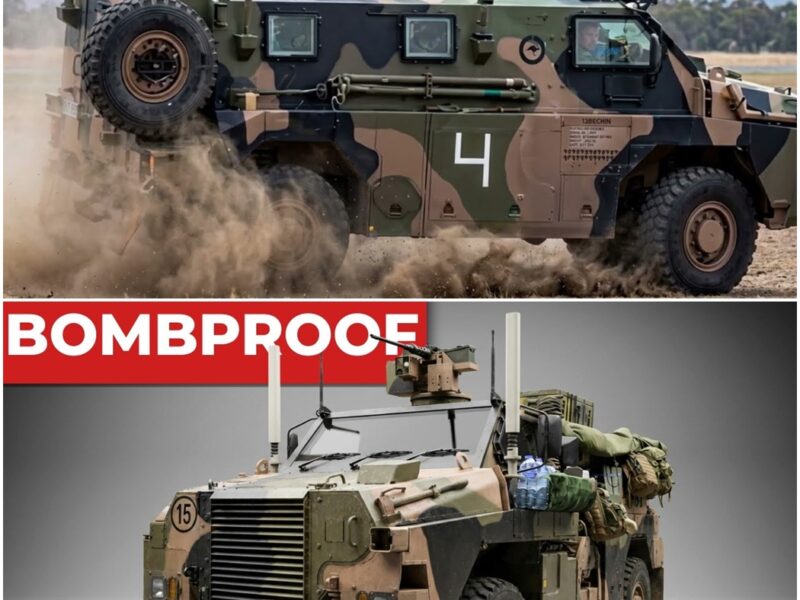
2012, a dry creek bed in the Dayrah wood district, Uruzgan province, southern Afghanistan. A 15-ton steel box rolls down a shallow embankment on four oversized wheels. It carries 10 soldiers, their weapons, their water, their ammunition, and 3 days of supplies. The hull is slab-sided, angular, and tall.
The roof bristles with antennas, hatches, and a remote weapon station. The profile is enormous. The paint is a flat desert tan, already caked in Afghan dust. There is nothing sleek about it, nothing aggressive, nothing that suggests this vehicle belongs on a battlefield alongside the armored fighting vehicles of the world’s most advanced militaries.
It looks like a shipping container bolted to a truck chassis and wrapped in steel plate. A pressure plate buried in the loose shale beneath the creek bed detonates as the front axle passes over it. The blast is a multi-stacked charge of high-grade homemade explosive packed into a yellow palm oil container and wired to a simple trigger.
The explosion lifts the vehicle off the ground, shreds the tires, buckles the front axle, shatters the windscreen into a web of fractured glass, and throws every soldier inside against their blast-attenuating harnesses. Smoke pours from beneath the hull, the engine dies, dust swallows everything. The driver, Private Matthew Clark, suffers significant leg injuries and is rapidly evacuated.
The rest of the crew are bruised, deafened, shaken to the bone. Every single one of them is alive. That vehicle, call sign Echo 2-1 Alpha, nicknamed Debbie, will be recovered, shipped home, and placed inside the Australian War Memorial in Canberra. Not as a monument to failure, but as proof of the most extraordinary survivability record of any armored vehicle in modern warfare.
Over the course of Australia’s deployment to Afghanistan, vehicles exactly like Debbie absorbed more than 120 IED strikes across Iraq, Afghanistan, and Mali. In every single incident, the crew survived. Not a single soldier seated inside one was killed by a blast. The vehicle that accomplished this was never designed for a a like Afghanistan.
It was designed for patrol duty in the red dust of the Australian Outback. Its name is the Bushmaster Protected Mobility Vehicle, and it may be the most effective troop carrier ever sent to war. To understand why the Bushmaster existed, you need to understand the problem Australia faced at the end of the Cold War.
In 1991, a Defense Full Structure Review identified a critical capability gap. The Australian Army had no dedicated infantry mobility vehicle capable of carrying a full nine-man section across the vast hostile terrain of northern Australia while providing meaningful protection against mines, ambush, and small arms fire.
What the Army had were aging M113 tracked carriers with aluminum alloy hulls and Land Rover-based patrol vehicles with no armor at all. The M113 had been designed in the 1950s. The Land Rovers offered their crews nothing but speed and fresh air. Neither was acceptable kind of expeditionary peacekeeping and counterinsurgency operations Australia was increasingly being asked to perform.
By 1994, formal specifications were drafted under what the Army called Project Bushranger. 17 manufacturers submitted proposals. Among them was a small Adelaide-based firm called Perry Engineering, which had acquired a license from an Irish company, Timoney Technology of County Meath, to build a vehicle based on Timoney’s MP44 Armored Personnel Carrier design.
That vehicle was designated the Bushmaster. By September 1995, five candidates were shortlisted, including the Bushmaster and the Taipan, a rival design derived from the South African Mamba. Grueling competitive trials lasting 44 weeks followed. Both vehicles failed to meet every specification, but the Bushmaster showed enough promise that in March 1999, ADI, the government-owned Australian Defense Industries, was awarded the production contract under strict design revision conditions.
Manufacturing would take place at ADI’s facility in Bendigo, Victoria. The vehicle that emerged from Bendigo was a masterpiece of practical engineering wrapped in a body that offended every instinct about what an armored vehicle should look like. The hull was a single-piece monocoque welded from high-hardness steel with a pronounced V-shape underneath.
That V hull was not an Australian invention. Its lineage ran directly back to the battlefields of Rhodesia and South Africa in the early 1970s. There, in a brutal counterinsurgency war defined by Soviet-supplied anti-tank mines buried on dirt roads, engineers had learned that the geometry of the underside of a vehicle determined whether the crew lived or died.
A flat-bottom hull absorbed the full force of a mine blast directly upward into the crew compartment. A V-shaped hull deflected the blast energy outward and away. South African vehicles like the Buffel and the Casspir had pioneered this principle, saving thousands of lives during the South African Border War. Australian peacekeepers serving in Namibia during the 1980s had watched these vehicles shrug off mine strikes that would have destroyed conventional carriers.
Their advocacy, carried back to Canberra, directly informed the Bushmaster’s hull geometry. Power came from a Caterpillar 3126E turbocharged six-cylinder diesel engine producing 300 horsepower at 2,400 revolutions per minute. That gave the 15-ton vehicle a power-to-weight ratio of 16 kW per ton, a governed top speed of 100 km per hour on road, and an operational range exceeding 800 km.
The double-wishbone independent suspension, designed and built by Timoney in Ireland, delivered cross-country mobility across sand, scrub, rock, and mud that tracked vehicles twice its weight could not match. The complete power pack, engine, transmission, and cooling system could be removed and replaced in the field without specialist tools.
That single feature would prove critical in Afghanistan, where maintenance infrastructure was minimal and downtime meant vulnerability. Inside the vehicle carried a driver and up to nine passengers. The cabin was fully air-conditioned with split climate zones, a detail that seemed like luxury until troops were operating in 50° heat for 12 hours at a stretch.
Ergonomic blast attenuating seats were mounted to the hull’s internal frame, isolated from the floor, designed to absorb vertical acceleration from a mine strike. The original design included a cool water drinking system. Though cost constraints initially removed it, operational complaints from Iraq and Afghanistan saw it reinstated.
The armor exceeded STANAG 4569 level one for ballistic protection as standard. Optional upgrade kits raised that to level three ballistic and level five fragment protection, but the real survivability came from that monocoque V hull, which channeled blast energy around and beneath the crew compartment rather than through it.
What surprised even the engineers was that the high hardness steel specified for the Bushmaster actually outperformed the aluminum alloys used in Australia’s heavier ASLAV reconnaissance vehicles and its M113 carriers. A vehicle classified as a lightly armored infantry mobility vehicle was quietly redesignated a protected mobility vehicle.
That redesignation was not marketing. It was a technical admission that the Bushmaster was tougher than anything else in the Australian inventory. The vehicle was air transportable in a C-130 Hercules, a C-17 Globemaster, or a Russian Mi-26 helicopter. It could be anywhere in the world within days of a crisis.
And it could sustain its crew independently for 72 hours without resupply. The vehicle no one asked for was about to become the vehicle everyone needed. Now, before we get into where the Bushmaster actually fought and how its crew survived what no other vehicle’s crew survived, if you are enjoying this deep dive into military engineering that saved lives, hit subscribe.
It takes a second, costs nothing, and helps this channel continue telling these stories. The first Bushmasters deployed operationally in April 2005, sent to Iraq with Australian Defense Force units, but it was Afghanistan that would define the vehicle’s reputation and write its legend in blast craters and shattered axles.
Australian troops operated in Uruzgan province, one of the most heavily mined regions in the entire country. IED activity dominated the area of operations. Every road, every creek bed, every culvert, every bridge crossing was a potential kill zone. The bombs were cheap to build, easy to conceal, and devastatingly effective. A typical device was packed into a 20-liter yellow palm oil container using recycled ordnance or homemade explosive compound then wired to a pressure plate, a mobile phone trigger, or something as mundane as a garage door remote. Coalition forces had no way to clear every route before every patrol. The only question was whether the vehicle carrying the soldiers could absorb the hit. The Bushmaster absorbed hit after hit after hit. According to Thales Australia, the vehicle’s manufacturer, in over several hundred significant IED and blast events involving Bushmasters used by Australian, Dutch, and British soldiers across Iraq and Afghanistan, not a single occupant was killed inside the vehicle. 50 of those incidents destroyed the Bushmasters beyond any
possibility of repair. Axles snapped, engines were blown out of their mounts, hulls cracked, wheels were found hundreds of meters from the blast site. And in every case, the crews unbuckled their harnesses, forced open the hatches, and walked out alive. On September 23, 2011, a Bushmaster commanded by a troop leader near the village of Sia Sang, roughly 50 km north of Multinational Base Tarin Kowt, struck a pressure plate IED buried in the loose shale of an old creek bed near a culvert. The blast was severe enough to knock the commander unconscious. When he came to, his driver, Trooper Rhys Kelly, told him what had happened. The words were blunt. “You have hit an IED, mate. You will be right.” The Explosive Ordnance Disposal Team, call sign Wallaby, was brought forward. The commander blacked out again. He survived. His crew survived. The vehicle had done exactly what South African engineers had proven 40 years earlier, geometry defeated chemistry. The specific vehicle known as Debbie,
Echo 2-1 Alpha, was struck on July 10, 2012, during a resupply mission in the Deh Rawod district. The recovery team assessed the bomb as a multi-stacked high-grade homemade explosive charge, most likely initiated by a pressure plate. Private Matthew Clark, the driver, was the most seriously injured and was rapidly evacuated.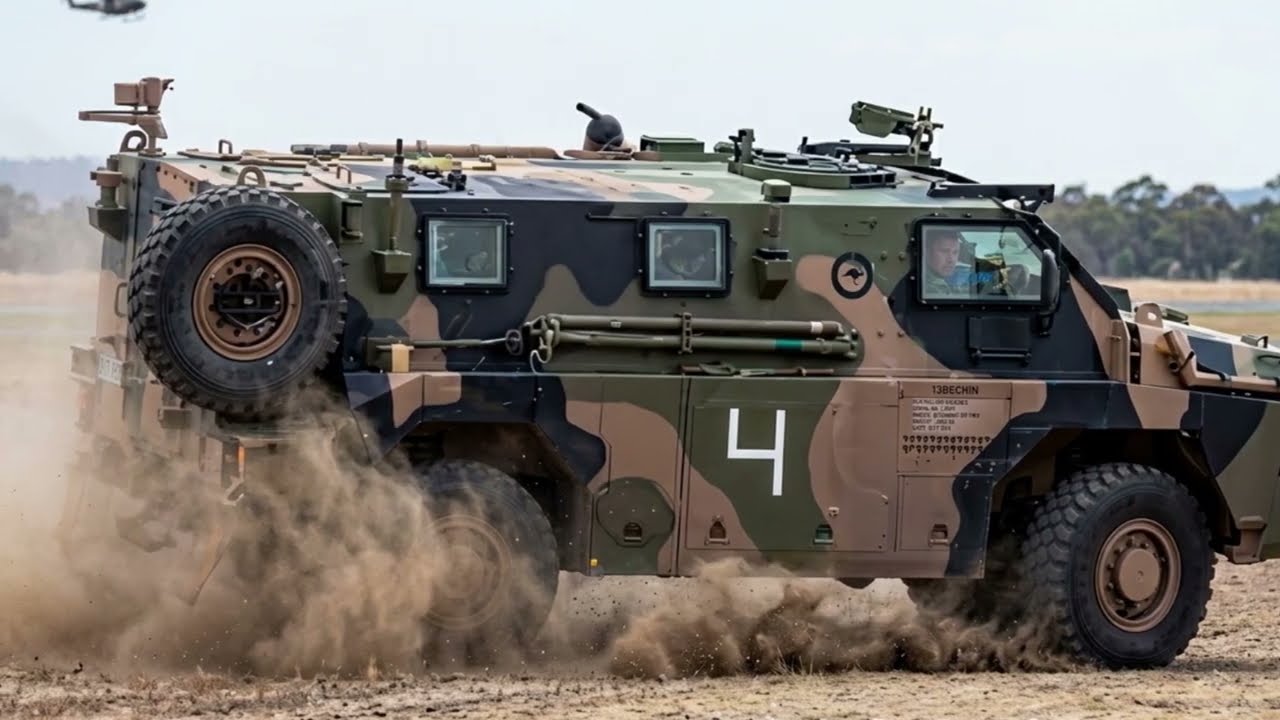
12 years later, in 2024, Clark reunited with his crew at the Australian War Memorial storage facility as the finishing touches were applied to Debbie for permanent display. Matt Anderson, the memorial’s director, called the Bushmaster a symbol of survival. The Australians were not the only coalition force that came to depend on it.
In July 2006, the Dutch government announced an emergency purchase of 25 Bushmasters for the Royal Netherlands Army deploying to Uruzgan alongside Australian forces. The need was so urgent that the vehicles were pulled directly from Australian Army stocks and flown to Afghanistan. 23 arrived in theater by late August. The Dutch had been operating 1970s vintage Patria XA-188 and YPR-765 carriers alongside unarmored Mercedes G-Class vehicles.
None offered adequate IED protection. The Bushmaster changed everything. Dutch soldiers called it the battle limousine. Air conditioning, ergonomic seating, large windows, chilled drinking water. Within 3 years, the Netherlands had ordered 98 Bushmasters, including specialist IED detection variants fitted with robotic grappler arms for remote disposal.
Six Dutch Bushmasters were destroyed by IEDs during their Uruzgan deployment. Every single crew survived. The British Army entered the story in May 2008 when the Ministry of Defense quietly procured 24 Bushmasters under a program code named Escapade. These were intended for United Kingdom special forces, specifically 22 SAS.
The Escapade variants were heavily modified. Enhanced armor packages, bull bars for breaching barricades, and wire cutters to protect personnel standing in roof hatches, mission specific BOWMAN communications, electronic countermeasures against radio-controlled IEDs, and Thales remote weapon stations mounting 12.7 mm heavy machine guns.
The vehicles deployed to Iraq and were subsequently reported operating in Syria as late as 2017. British special forces had initially favored a different vehicle, the Austrian Pandur II 6×6 as used in the American armored ground mobility system program, but the Bushmaster was selected because it was proven, available, and could be delivered within the required timeline.
In war, availability beats perfection. The Bushmaster’s most recent combat deployment has been in Ukraine. In March 2022, President Volodymyr Zelenskyy addressed the Australian Parliament by live video and requested Bushmasters by name. Within weeks, 20 vehicles from Australian Defense Force stocks were shipped.
Two further batches followed. By 2025, Australia had supplied at least 120 Bushmasters to the armed forces of Ukraine, where they have been used in active combat operations. Ukrainian soldiers have spoken positively about the vehicle’s protection and mobility. A vehicle designed for the red dirt of Australia’s Northern Territory is now fighting in the black earth of the Donbas.
The comparison that defines the Bushmaster’s legacy is not against other purpose-built protected vehicles. It is against what soldiers were actually riding in when the IED threat emerged and what their government scrambled to replace those vehicles with. When the United States invaded Iraq in 2003, its primary troop transport was the M998 Humvee, a vehicle designed for rear area logistics with minimal armor.
As the insurgency escalated, Humvees proved catastrophically vulnerable to roadside bombs. Thousands of American soldiers were killed or permanently maimed. The United States military launched an emergency MRAP program, but the first vehicles did not arrive in significant numbers until 2007, 4 years after the invasion.
Those MRAPs, vehicles like the Cougar, the MaxxPro, and the RG-31, cost between 475,000 and over 600,000 dollars per unit. They were heavier, less mobile, and arrived years too late for the soldiers who needed them most. The British experience followed a grimly similar pattern. The Snatch Land Rover, used extensively in southern Iraq and in Helmand Province, became a national scandal after soldiers died in a vehicle that offered its occupants no blast protection whatsoever.
The Mastiff Protected Patrol Vehicle, a British adapted variant of the American Cougar 6×6, was procured under urgent operational requirements beginning in 2006. The Mastiff weighed over 22 tons, offered formidable blast protection, but was so large and heavy that it struggled on Afghan terrain.
The initial batch of 108 Mastiffs cost approximately 70 million dollars. The Foxhound, which supplemented it, cost roughly 923,000 pounds per vehicle, approximately 1.5 million dollars. Both vehicles were reactive purchases born from casualties that might have been avoided. The Bushmaster, at roughly 2.45 million Australian dollars per unit in 2022 pricing, approximately 1.
6 million US dollars, was more expensive per vehicle than the early American MRAPs, but it was available before the IED crisis peaked. It was lighter and more mobile than the Mastiff. It carried a full infantry section, not four soldiers. It could be airlifted in a C-130, and it had a crew fatality rate from IED strikes of zero.
No other vehicle in its weight class at any price has matched that record. Over 1,300 Bushmasters have been produced. Nine nations now operate the vehicle. Australia, the Netherlands, the United Kingdom, Japan, New Zealand, Fiji, Jamaica, Indonesia, and Ukraine. Thales Australia continues to upgrade the platform, and the latest variant, the Bushmaster 5.
5, is currently being offered for the British Army’s Land Protected Mobility Medium requirement, a program that could see up to 2,000 vehicles replace the Mastiff fleet across British service. The Bushmaster may yet become a standard British Army vehicle, 30 years after it was first designed for a completely different war on the other side of the world.
2012, Uruzgan province, southern Afghanistan. A 15-ton steel box sits wrecked in a dry creek bed. The tires are shredded, the front axle is broken. The engine is silent. Smoke drifts from beneath the buckled hull. Glass dust coats the dashboard. By every visible measure, the vehicle is finished.
The Bushmaster was not fast. It was not sleek. It had no cannon, no missile system, no turret capable of engaging armor. It could not outrun a civilian truck. It was too tall for urban concealment, too angular for aerodynamic efficiency, too plain to grace a recruitment poster. It was over-engineered for the Outback and under-armed for conventional war.
Every officer who called it ugly was right. But in Uruzgan, in Deh Rawood, in Tarin Kowt, on Route Whale, in the green zones and the wadi crossings and the culverts where homemade bombs waited under 6 inches of Afghan dust, the Bushmaster did exactly one thing. It brought its soldiers home.
120 blasts, zero killed inside. That is not luck. That is not coincidence. That is a V-shaped hull designed by engineers who understood that in the wars soldiers actually fight, survival matters more than firepower, and geometry will always defeat explosives. Nine nations bought it.
Some are still using it in combat today. The ugliest vehicle in Afghanistan saved more lives than anything else on the road.