The ‘Ugly’ British Patrol Vehicle That Survived IED Blasts The Army Never Thought Possible D
2005, Talafar, northern Iraq. A British Army patrol moves through narrow streets baked white by summer heat. Four soldiers, one vehicle, a Land Rover. Soft-skinned, light, fast. Designed for the hedgerows of Northern Ireland, designed for a different kind of war. The bomb detonates beneath it.
The Land Rover disappears in a column of smoke and fire. The soldiers inside have no chance. No blast-attenuating seats, no armored floor, no V-shaped hull to redirect the energy of a buried charge out with and away from the crew compartment, just pressed steel, thin carpet, and nothing between them and whatever the insurgents chose to bury in the road.
This happened again, and again, and again. At least 37 British service personnel died in Snatch Land Rovers in Iraq and Afghanistan between 2003 and 2014. The families of the dead gave those vehicles a name. They called them mobile coffins. Britain was losing soldiers to a vehicle it had chosen, and the answer that emerged from that crisis looked, frankly, strange.
It sat on four enormous wheels. Its composite body was sculpted with the same techniques used to build Formula 1 racing cars. Its upper half could be unbolted and swapped in 30 minutes. It weighed less than 8 tons, and its floor was shaped like the keel of a ship. It would survive blast events that shattered heavier armored vehicles.
It would deploy to the most IED-saturated roads on Earth with a protection philosophy no other vehicle in British service shared. It would remain in service long after the war that created it had ended, and it would be upgraded to fight a generation of threats its designers never imagined. Its name was the Foxhound Light Protected Patrol Vehicle, and it was built because the British Army had already buried too many of its own people.
To understand why the Foxhound existed, you need to understand what the Snatch Land Rover was, and why it failed so catastrophically. The Snatch entered service in 1992. It was designed for Northern Ireland, a low-intensity urban environment where the threat was small arms fire and petrol bombs.
The vehicle reflected that threat. It had lightweight composite armor, a Land Rover Defender 110 chassis, and just enough protection for the environment it was designed for. That environment was not Iraq. That environment was not Afghanistan. The roadside bomb, the improvised explosive device buried in the verge or packed beneath a culvert or hidden inside a dead dog at the edge of a track, was a weapon of a fundamentally different order.
The Snatch’s armor was irrelevant. Its floor offered no protection when a charge detonated beneath its chassis. The blast energy transferred directly into the crew compartment, into the occupants, into everything and everyone inside. In 2005, the mother of Private Phillip Hewitt, killed when his Snatch hit an IED in Tal Afar, began a legal campaign that would ultimately reach the United Kingdom Supreme Court.
Susan Smith was not an angry woman making noise. She was a woman who had buried her son and wanted to understand why. The court ruled in 2013 that the family’s claims could proceed, that the Human Rights Act’s protection of the right to life extended to British soldiers serving abroad, and that the Ministry of Defense faced serious questions about the decisions it had made.
In 2016, the Chilcot Report found that the Ministry of Defense had known about the Snatch’s vulnerability and had been too slow to act. In August 2017, Defense Secretary Sir Michael Fallon wrote to Susan Smith with words that had taken 12 years to arrive. He expressed his deepest sympathies. He apologized for the delay in bringing alternative protection vehicles into service, vehicles that could have saved lives.
General Sir Mike Jackson, who served as Chief of the General Staff during the period in question, told the BBC it was a fair assumption that a more heavily armored vehicle would have offered much better protection. Susan Smith said of her son, “He did not die for nothing, and whatever came next would have to prove that was true.
” The Ministry of Defense launched the light protected patrol vehicle program in 2008. The requirement was specific, and and was difficult. The replacement for the Snatch could not simply be a heavier vehicle. The army already had heavy vehicles. The Mastiff, a Cougar derivative from the same American company, weighed around 15 tons.
It was survivable. It was also enormous. It could not navigate the narrow walled compounds of Helmand’s Green Zone. It could not be loaded into a Chinook helicopter. It could not turn in a street less than 12 m wide. What was needed was something no one had yet built, a vehicle with the protection of a heavy armored personnel carrier and the mobility of a Land Rover.
The engineers who told you that was impossible were ignored. The engineers who thought they could do it were hired. Force Protection Europe, the British subsidiary of the American company that built the Cougar and the Mastiff, partnered with Ricardo PLC, a British automotive engineering firm with roots stretching back to the 1920s.
Ricardo had built engines for everyone from Rolls-Royce to McLaren. The team they assembled was unlike anything British defense procurement had seen before. World Rally Championship engineers, Formula 1 composite specialists. Among them was Mike Coughlin, who had spent 5 years as chief designer at McLaren F1.
He applied the same composite materials philosophy used to build Formula 1 monocoques to the problem of keeping soldiers alive in Helmand. He said of the work, he had endeavored to put his skills to good use in the design of a vehicle whose purpose was to transport soldiers in safety.
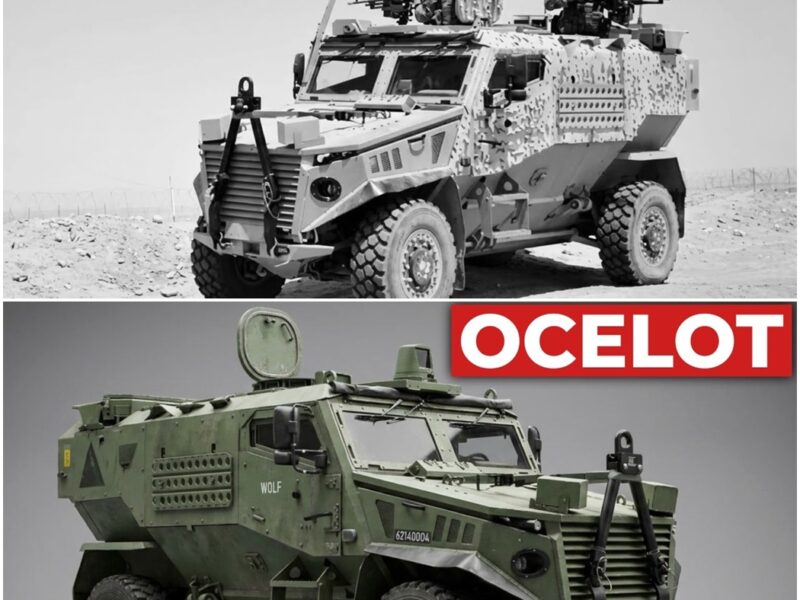
That was all he said. It was enough. The vehicle the team designed was called the Ocelot. It was built on a philosophy so distinctive it had no real predecessor in British military service. They called it the skateboard and pod concept. The skateboard was an armored V-shaped spine that ran the full length of the vehicle like the keel of a ship.
Into this spine they buried everything that would otherwise make the vehicle vulnerable. The engine, a Steyr 3.2 L 6-cylinder turbo diesel producing around 270 brake horsepower, the transmission, a 6-speed ZF automatic gearbox, the twin fuel tanks, the batteries, the generator. All of it enclosed within the armored spine, all of it sitting low, all of it outside the crew compartment.
The floor of the V-hull was not flat. It was angled sharply downward on both sides from the center line. A geometry specifically engineered so that when a mine detonated beneath it, the blast pressure was redirected outward and away from the crew, rather than upward through the floor into the people inside.
The suspension was mounted outside the armored hull. This was deliberate. When a mine struck, it was designed to shear off a wheel. The wheel was sacrificial. The crew was not. Multiple accounts from the vehicle’s operational record describe it continuing to drive on three wheels after mine strikes, returning its crew to base rather than requiring a casualty extraction.
That was the engineering intent made real. Sitting atop the skateboard spine, bolted into position in approximately 30 minutes, was the pod, a composite survival capsule. Glass-reinforced composite panels, engineered with the same manufacturing approach used to build McLaren road cars, enclosing six occupants, driver, commander up front, four dismounts in the rear.
The seats were blast attenuating, absorbing energy through controlled deformation before it reached the human body. Five-point harnesses held the occupants in position. Personal kit was stowed at the vehicle’s rear, away from the crew space. Every design choice directed toward the same outcome. The people inside would survive what the vehicle absorbed.
The pod was interchangeable. A patrol variant, a fire support variant, a utility variant, later a command post variant. The same skateboard spine underneath, the same protection philosophy, the same style engine, different missions. The entire upper structure could be raised hydraulically for maintenance.
The power pack could be changed in 30 minutes. The vehicle could be carried inside a C-17 transport aircraft, loaded into a C-130 Hercules, or carried underslung beneath a Chinook helicopter. It weighed 7,500 kg. That was the point. It was light enough to fly. Two competing designs were evaluated in April 2010, the Ocelot from Force Protection Europe and Ricardo, the SPV400 from Supacat and NP Aerospace.
On 22 September 2010, the Ministry of Defence announced its decision. The Ocelot had won. It was renamed Foxhound, continuing the canine naming convention used for the Mastiff, the Ridgeback and the Wolfhound. A 180 million pound initial contract for 200 vehicles followed in November of that year. Further orders came quickly.
By the end of 2013, the total committed order stood at 371 million pounds for a fleet of approximately 400 vehicles. Force Protection was acquired by General Dynamics in December 2011, making the Foxhound a General Dynamics Land Systems United Kingdom product. Final assembly was carried out by Ricardo, initially at their facility in Shoreham-by-Sea.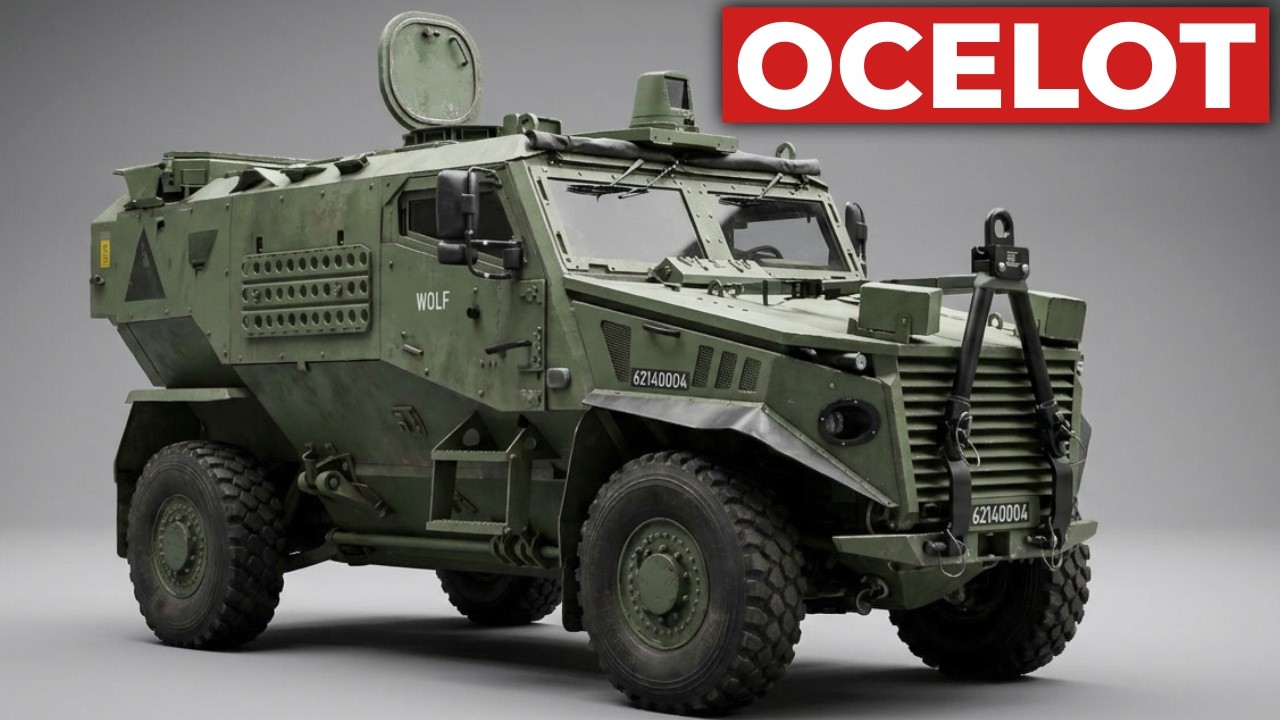
Now, if you are watching this channel for the first time and you want more stories about British engineering solving problems no one else thought were solvable, hit subscribe. It costs nothing. It helps the channel grow. It means more of this. The first Foxhounds arrived at Camp Bastion, Helmand Province on 2 June 2012.
They came aboard C-17 transport aircraft. They were unloaded into the heat of an Afghan summer and they went through in-theater hot weather trials before being cleared for operations. This timing mattered. The British drawdown from Helmand had already been announced. The peak of Operation Herrick’s combat intensity had passed.
The vehicle arrived at the edge of the window it had been built for, but it operated. Soldiers who drove the Foxhound on patrol in Helmand and later in Kabul described an immediate difference in how the vehicle felt beneath them compared with its predecessors. Three in-cab screens provided 360° situational awareness through external cameras.
Thermal imaging was standard. Counter-improvised explosive device equipment was fitted as part of the vehicle’s baseline electronic suite. The crew pod was cool, contained, and oriented towards survivability in a way that the Snatch and even the heavier Mastiff did not replicate with the same engineering precision.
Signaler Mark Lawrence of the Royal Corps of Signals, among the first British soldiers to drive the vehicle operationally, described it as brilliant. He said it was outstanding compared with its predecessors. The space, the technology, the feel of the vehicle, all of it represented something categorically different. The 4th Mechanized Brigade deployed with Foxhounds on Operation Herrick 17 from October 2012.
Second Battalion the Parachute Regiment Battalion the Yorkshire Regiment used the vehicle on force protection and advisory duties in Kabul under Operation Toral, Britain’s contribution to the NATO Resolute Support Mission following the end of combat operations. The vehicle served in a lower intensity threat environment than the buried IED saturated roads of Helmand’s Green Zone, but it served in an environment where threat remained real and where the protection philosophy built into its hull mattered every time the wheels turned on an Afghan road. In 2015, a Foxhound was photographed visibly damaged in Kabul, subsequently returned to service. The vehicle’s engineering had performed as its designers intended. The occupants were recovered. The vehicle drove again on 11 October 2015, a Taliban device detonated against a British convoy in Kabul. No British casualties were reported. The vehicle in the lead position of that patrol was a Foxhound. It was repaired. It went back on the road. That was precisely what the engineers at Ricardo and Force
Protection had designed it to do. The protection technology at the heart of the Foxhound rested on a principle that South African and Rhodesian engineers had developed decades earlier, building mine protected vehicles in Southern Africa during conflicts where the landmine was a constant and lethal presence.
They had learned that a flat floor killed people and a V-shaped floor saved them. The Casspir, the Buffalo, the Hippo, vehicles built from that hard-won knowledge had established the geometry that the entire MRAP movement eventually adopted. American manufacturers scaled it up into massive vehicles weighing 18, 20, 24 tons.
The Foxhound applied it to a 7 and 1/2 ton platform, combining the protective geometry with Formula 1 composite manufacturing and motorsport derived quick change engineering. Where the American approach built heavy and accepted the loss of strategic mobility, the Foxhound built light and preserved it. The INKAS Pro, the Cougar, the Oshkosh MATV, all of them were survivable vehicles.
None of them could be underslung from a Chinook. None of them could navigate a 12-m turning circle through a Helmand compound. The Foxhound did both. That was not a marginal improvement. It was a different philosophy expressed in steel and composite and four enormous wheels. The vehicle also incorporated four-wheel steering, giving it the tight turning circle its designers had been required to achieve.
Independent suspension units were fitted to each wheel station. The torsion bar arrangement kept the spring geometry outside the armored spine, reinforcing the principle that what could be sacrificed in a blast should be sacrificed outside the crew compartment rather than inside it. The vehicle could sustain a mine strike to any single wheel, lose that wheel entirely to the blast and continue to drive.
The remaining three wheels would bring the crew home. Baseline ballistic protection sat at broadly equivalent to STANAG 4569 level two, with applique armor kits available to raise that to level three, and to address specific shaped charge formed penetrator threats. The Ministry of Defense did not publish exact protection specifications as was standard practice for fielded vehicles, but the fundamental philosophy was clear.
The vehicle was not trying to be a tank. It was trying to ensure that a patrol of six soldiers driving through the most IED-dense environment British forces had encountered since the Second World War would get back to base alive. The engineering was built around that single outcome. By 2014, infantry battalions, including First Battalion the Royal Irish Regiment, had converted to the light protected mobility role on Foxhound as part of the Army’s restructuring under the Army 2020 program.
The vehicle had found a permanent structural role in the British order of battle, not as an emergency replacement for something that had failed, but as the platform around which an entire class of infantry capability was now organized. It was not without problems. In 2017, the BBC and The Sun reported serious overheating and reliability issues during the vehicle’s deployment to Iraq’s summer heat.
A serving sergeant with responsibility for seven Foxhounds described the vehicles breaking down repeatedly and said the engine could not handle temperatures above 50° C. The Ministry of Defense did not deny that reliability issues existed. It said the vehicle was keeping soldiers safe. Both things could be true and apparently were.
Compared with the vehicles it had replaced and the vehicles it served alongside, the Foxhound occupied a position no other British platform held. The Mastiff was heavier, slower, and could not be carried by air. The Jackal, the open-topped vehicle used for long-range reconnaissance, was fast and nimble but offered minimal blast protection.
The Foxhound sat between them carrying near MRAP underbelly protection in a package light enough to fly into theater, maneuverable enough to enter compounds the heavy vehicles could not reach, and technically sophisticated enough to carry the sensor and electronic warfare equipment the modern battlefield demanded.
No rival from any other nation offered exactly that combination. No export customer was announced in the vehicle’s service window. The Foxhound was a British solution to a British problem. The problem had cost at least 37 lives before the solution arrived. The solution came from a Formula 1 designer, a Ricardo engineering team, and a Ministry of Defense that had finally been forced by courts and by families and by 12 years of documented failure to build something that worked.
The Foxhound remained in British Army service into the mid-2020s, a longevity that spoke directly to the quality of its original engineering. Two RAF Regiment squadrons, number one and number 34, equipped with it. Units from 7th Light Mechanized Brigade deployed it to Eastern Europe as part of NATO’s Very High Readiness Joint Task Force.
Its modular pod adapting to command post roles as the threat environment shifted from buried bombs to Russian armor. In November 2023, the Ministry of Defense contracted General Dynamics for up to 50 command post conversions, approximately 32 of which were on order at a cost approaching 20 million pounds. The vehicle was not retiring, it was evolving.
General Dynamics was developing a Foxhound Mark II. Proposals included a hybrid electric drivetrain, a built-in 30 kW onboard generator, and electric braking and steering. The out-of-service date, already extended once, was under discussion for extension toward 2043. At the Defense and Security Equipment International Exhibition in 2025, General Dynamics and Moog displayed a Foxhound fitted with a reconfigurable short-range air defense system, a counter-drone capability built on the vehicle’s modular pod architecture. The skateboard concept, designed to swap pods in 30 minutes, proved as relevant against unmanned aerial systems as it had been against buried bombs. The engineers had built more than a patrol vehicle, they had built a platform. 2005, Afar, a Snatch Land Rover, four soldiers, no chance. The Foxhound was the answer to that image. It arrived two years late for the worst of what Helman produced. It was light enough to fly and tough enough to drive away from what it
could not avoid. Its hull was shaped to redirect death outward. Its pod was built by people who spent their careers keeping racing drivers alive at 300 km/h. Its wheels could be taken off by a bomb and the vehicle would still bring its crew home. It was undersized for what some wanted.
It had overheating problems in 50° heat. It served in a war that was already drawing to a close when it arrived. None of those things changed what it was built for and what it did for the people inside it. It was built because at least 37 families had been told that their sons and daughters had died in vehicles that were never meant to survive what they were asked to survive.
It was built because a court ruled that soldiers deserved better, and a government finally agreed. It was built because Mike Coughlin left Formula 1 and decided that what he knew about keeping a human being alive inside a composite shell at lethal speed translated exactly and directly to keeping a soldier alive on the roads of Helmand. That is not coincidence.
That is British engineering finding the answer in the last place the Ministry of Defense expected to look.