The ‘Underrated’ Masterpiece That Solved Britain’s Worst WWII Gun D
A British soldier drags a submachine gun through a muddy trench. He dunks it in a barrel of water, packs the barrel with sand, then he shoulders it and fires every single round. Not one jam. Not one stoppage. The officers watching didn’t say a word. They just looked at each other. Because for over a decade, they had been carrying the most embarrassing weapon in British military history.
A gun so dangerous, so unreliable, that soldiers joked the safest way to use it was to throw it at the enemy. That weapon was the Sten. And what those officers were watching was its replacement. It looked almost just as ugly. Side-mounted magazine, skeletal folding stock, rough welds. They called it the plumber’s nightmare.
They had absolutely no idea it would go on to serve for over 40 years. This is the story of the Sterling L2A3. After Dunkirk in 1940, Britain lost almost everything. Weapons, equipment, their confidence. With invasion looming and the budget shattered, they needed a cheap solution fast. American Thompson submachine guns cost over $200 each.
Britain couldn’t afford them, so they built the Sten. Designed in weeks, manufactured in about five man-hours, cost roughly $10 a unit. Over 4 million were made throughout the 1940s. And soldiers absolutely despised every single one of them. They called it the plumber’s abortion, the stench gun, the Woolworth’s wonder.
One Canadian soldier even wrote a poem about it. You wicked piece of vicious tin, call you a gun? Don’t make me grin. But the hatred wasn’t just about how it looked. The Sten’s magazine was fundamentally broken. Rounds stacked in two columns had to squeeze down into one before feeding into the chamber, creating a choke point where cartridges would catch, tip, and jam.
In mud, in sand, in the rain, in the heat of a firefight, it failed constantly. Soldiers only loaded 30 of the 32 available rounds just to reduce the pressure on the spring. And then, there was the safety. The Sten had an open-bolt design with a safety mechanism so weak that gravity could beat it.
Drop it, knock it, jostle it on a parachute jump, and it would fire. During a parachute insertion at Sukakara Airfield in late 1942, a Sten accidentally discharged mid-drop, wounding several paratroopers before they even hit the ground. More British casualties from their own weapon than from the enemy. One Korean War veteran described watching a soldier drop his Sten.
It fired, recocked itself on impact, and began spinning in a circle on the ground, emptying the full magazine while rotating faster and faster. Britain needed something better. It would take them 12 years to to get it. George William Patchett wasn’t a career weapons designer. He was a motorcycle racer.
He won the Welsh TT at Pendine in 1925, competed across Europe, designed the iconic Jawa 175 motorcycle in Czechoslovakia. When the Nazis marched Prague in March 1939, Patchett was there. He photographed the occupation. Then he got out, reportedly smuggling prototype materials through the British Embassy.
Back in England, he joined the Sterling Engineering Company in Dagenham, Essex, and he started designing a gun. On the 25th of September, 1942, he demonstrated his first prototype to the Ordnance Board, firing over 420 rounds straight. They were interested, but wanted refinements. He went back to work.
His philosophy was simple: take everything that made the Sten fail, and engineer a direct solution for each problem. By 1944, around 130 pre-production models had been built. A handful saw actual combat. The earliest confirmed use was by Lieutenant Colonel Robert Dawson of number four Commando during Operation Infatuate in November 1944.
But the road to official adoption was a nightmare in itself. If you’re locked into this story, hit subscribe right now. It costs you nothing, and it keeps content like this coming. Drop a comment below. Where in the world are you watching from? Let’s see how global this community really is. After the war ended, millions of surplus Stens sat in storage, and the budget had been slashed to zero.
Nobody wanted to spend money on a new weapon. Patchett entered his design into trial after trial. In September 1947 at Pendine, his Mark II competed against four rivals. Every single weapon had failures. The competing Royal Small Arms design overheated and burned the firer’s hand. The Australian entry fractured.
The Patchett had a trigger mechanism fault. But in the May 1951 trials, the Patchett was judged superior to everything else on the range. Even then, adoption was almost derailed when the army briefly adopted the EM-2 bullpup rifle, designed to replace everything, including submachine guns entirely.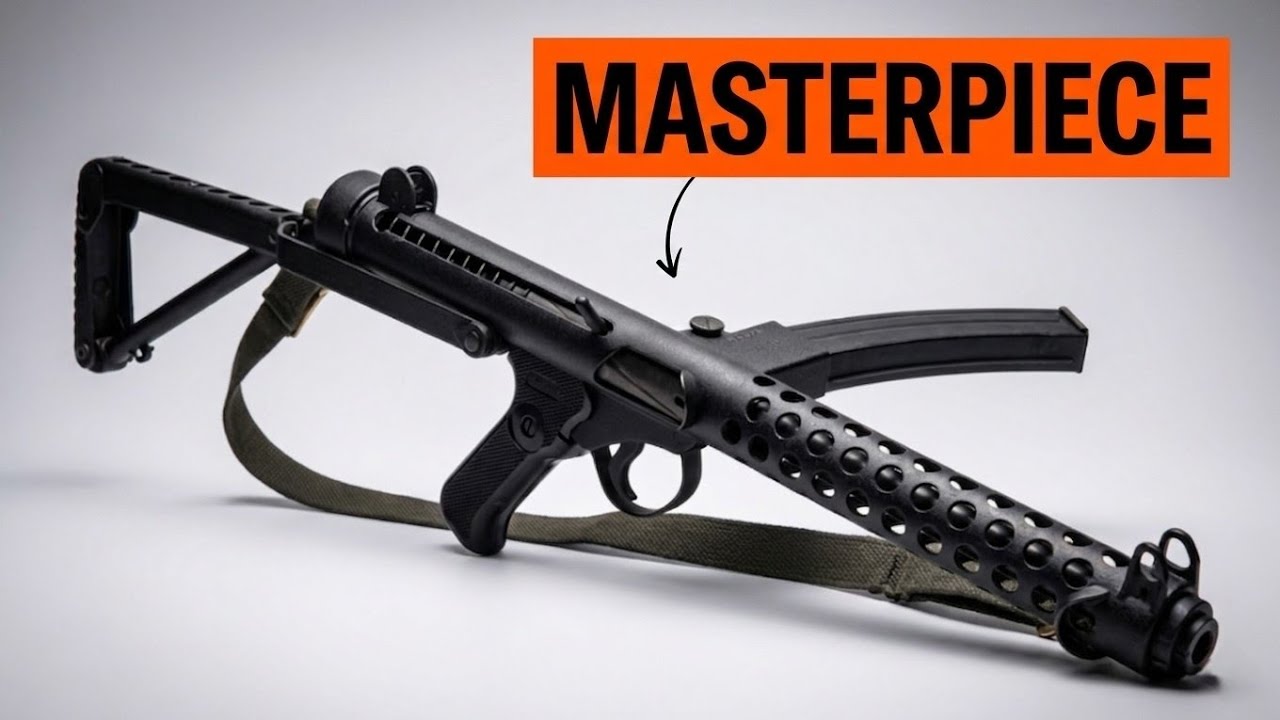
When Winston Churchill scrapped the EM-2 to satisfy NATO standardization agreements, the path finally cleared. On the 18th of September, 1953, officially adopted, the Sterling L2A1. By 1956, it had evolved into the definitive L2A3, the version that would serve for four decades. One evaluating officer summed it up perfectly.
All the advantages of the Sten, none of the disadvantages. So, what made the Sterling actually work? Four engineering decisions, each one a direct fix for a Sten failure. One, the magazine. Patchett ditched the double-stack single-feed design entirely. The Sterling used a double-stack double-feed system, rounds alternating from each side, eliminating the bottleneck completely.
A pair of rollers replaced the flat follower, turning friction into rolling contact, so grit got pushed aside instead of building up. Firearms experts have called it likely the finest submachine gun magazine ever made. Two, the self-cleaning bolt. Helical grooves machined directly into the bolt gathered dirt, sand, and fouling as it cycled.
Then channeled it straight out of the receiver. In jungle mud, in Falklands rain, in desert sand, the Sterling kept cycling. Three, dual concentric recoil springs. Two nested springs driving the bolt, reduced bounce during chambering, and ensured reliable function across different ammunition batches from different nations.
Four, advanced primer ignition. Firing the cartridge while the bolt was still moving forward, allowed a significantly lighter bolt without sacrificing controllability. The result, 2.7 kg unloaded, lighter than the MP 40, lighter than the M3 Grease Gun, lighter than the Uzi, even lighter than the Sten it replaced.
550 rounds per minute. Effective range of 200 m, 34-round curved magazine, and folded down to just 481 mm, small enough to fit almost anywhere. The Sterling went everywhere. Malaya, Kenya, Suez. Used by both sides because Britain and Egypt had both purchased it. Borneo, Aden, Northern Ireland. And then, the Falklands. 28th of May, 1982.
The Battle of Goose Green. Two Para had stalled against entrenched Argentine positions. The attack was faltering. Lieutenant Colonel Herbert Jones, commanding officer, armed with his personal L2A3 Sterling, moved to the front of his battalion. He checked his weapon and ran uphill toward the Argentine trench line.
He was hit, fell, rose, hit again. He died within meters of the position. He was posthumously awarded the Victoria Cross, Britain’s highest honor for valor. His charge broke the stalemate. Two Para took the entire trench system and captured over 1,200 Argentine prisoners. The Sterling also earned a quieter legend, literally.
The L34A1 suppressed variant used an integral suppressor built around a ported barrel. Gas bled through holes into expansion chambers, slowing and cooling propellant gases, dropping bullet velocity below the speed of sound. The only sound was the bolt cycling. Described as no louder than a staple gun, the SAS carried it in Northern Ireland and Oman.
Australian and New Zealand SAS used it in Vietnam. American SOG teams used it for prisoner snatch operations in Southeast Asia. And then there’s Hollywood. Working on the original Star Wars in 1977 on a shoestring budget, set decorator Roger Christian sourced real Sterlings from a prop house. He added rubber cooling fins, a Heckler counter on the magazine well, and an M19 tank scope, and created the E-11 Stormtrooper blaster.
Sharp-eyed viewers can spot real spent casings ejecting in certain scenes. The Sterling became one of the most recognized sci-fi weapons in cinema history, and most people never knew it was real. Over 410,000 Sterlings were manufactured in Britain between 1953 and 1988, including licensed production in Canada and India.
Total numbers likely exceeded 1 million units. Patchett himself had to sue the Ministry of Defense after the Royal Ordnance Factory produced his weapon without paying him a single pound in royalties. The case dragged on for over a decade. In June 1966, the High Court ruled in his favor. Justice Lloyd Jacob called him a distinguished inventor and valued designer, awarding him approximately 130,000 pounds, worth several million today.
The man who designed the weapon had to fight the government that issued it just to get paid. The Sterling served from 1953 until full withdrawal in 1994. 41 years. Through jungles, through deserts, through urban warfare, through the freezing South Atlantic. And when veterans talk about it today, the word that comes up most isn’t nightmare.
It’s reliable. One veteran put it simply, “Every soldier who ever used a Sterling will tell you the same thing. It never stops.” George Patchett, motorcycle racer, reluctant weapons designer, looked at the most hated gun in British military history and asked one question. “What if I fixed every single thing wrong with it?” The answer served for four decades, armed a Victoria Cross recipient in his final charge, became a Star Wars icon, and outlasted every committee, every bureaucrat, and every rival that tried to stop it. The plumber’s nightmare was the Sten. The Sterling was its redemption. If this one hit different, like, subscribe, and drop a comment below. Where in the world are you watching from?
Let’s build this community together.