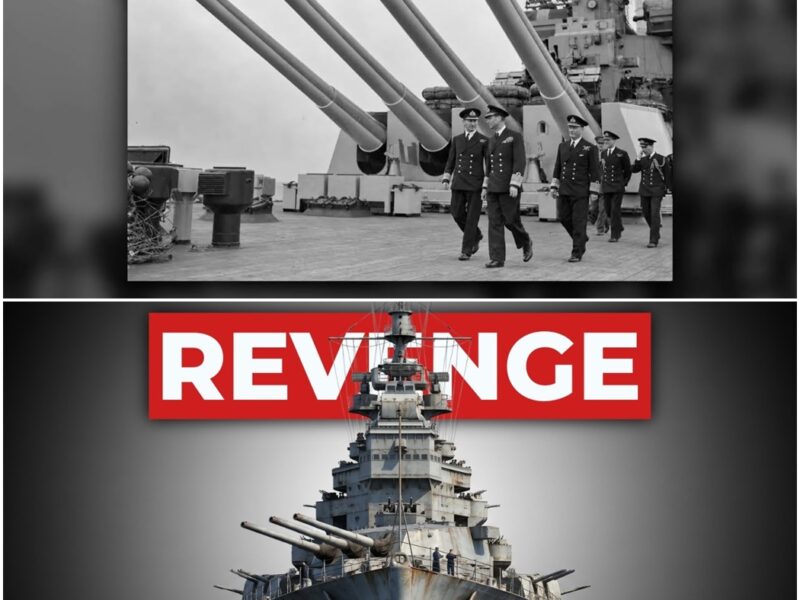
The ‘Unfinished’ British Battleship That Doomed The Bismarck With Half Her Guns Jammed D
The 24th of May, 1941. Somewhere in the freezing gray waters of the Denmark Strait, a brand new British battleship turned her bows towards the most powerful warship Germany had ever built. Her name was HMS Prince of Wales, and she was not ready. Below her decks, civilian engineers in overalls crawled through her great steel turrets, spanners in hand.
These were not sailors. They were gun fitters from the firm that had built her mountings, and they were still trying to make her main armament work. The paint was barely dry. Some of her systems had never been properly tested. Within the hour, one of her guns would fail after a single shot, and others would jam in the heat of battle.
And yet this half-finished ship, crewed by men who had barely learned their stations, was about to fire the shots that doomed the Bismarck. Few realized how close to disaster she came, or how much depended on whether her unreliable guns would fire at all. This is the story of how Britain sent an unfinished battleship into the fight of her life and changed the war at sea because of it.
Before we go further, this video is brought to you by World of Warships, and the timing could not be better. Right now, World of Warships is marking the 85th anniversary of the hunt for the Bismarck with a major in-game event. You can take command of the ships at the very heart of this story. The Bismarck in her 1941 fighting trim, the Prince of Wales herself, and a brand new ship called the Eisenach Chandler, modeled with the battle-scarred hull of Bismarck’s final sortie.
You can even sail under Ernst Lindemann, the only man ever to command the Bismarck in action. The event also adds a fresh Operation Rheinübung collection, new permanent camouflages, and a dramatic destruction effect for when a great ship finally goes down. World of Warships is a free-to-play naval game with more than 850 real warships drawn from 13 nations, everyone recreated from historical blueprints.
New players who use my link in the description with the bonus code impactforce, written as one word, get 20 days of premium time, a free cruiser, a six-skill-point commander, and a stack of rewards to start strong. Click the link, and I shall see you on the water. Now, back to the Prince of Wales.
To understand why Britain took such a gamble, you have to understand the threat. By 1941, Germany had completed the Bismarck, a battleship of more than 50,000 tons at full load, armed with eight 15-in guns. Alongside her sister ship, the Tirpitz, she threatened to break out into the Atlantic and cut the convoy routes that kept Britain alive.
The Royal Navy needed modern battleships to meet her, and it needed them at once. The Prince of Wales was one of those ships. She was the second of five King George V class battleships, designed in the 1930s under a strict set of rules. The Second London Naval Treaty had capped the main guns of new battleships at 14 in.
Britain, almost alone, honored that limit. Germany did not. So, when the Bismarck went to sea with 15-in guns, the newest British battleships carried a smaller caliber by deliberate national policy. The Prince of Wales was laid down at Birkenhead and launched in the spring of 1939.
While she was still fitting out, German bombs fell on the Merseyside dockyards, and one near miss flooded part of her hull. She was commissioned in January 1941 and declared ready for service only at the end of March. That left barely 7 weeks before she sailed against the enemy. The deepest problem was her guns.
Her new turrets were troublesome, and everyone knew it. During her workup at Scapa Flow, her main armament kept breaking down. Her captain, Captain John Leach, understood the risk completely, and he made a remarkable decision. He asked the gunfitters from Vickers-Armstrongs, the firm that built the mountings, to stay aboard and sail with the ship into battle. They agreed.
So, what exactly had Britain built? The King George V class carried 10 14-in guns in an arrangement seen on no other battleship in the world. Two of the turrets held four guns each. The third, raised above the forward turret, held only two. It was an odd, lopsided look, and there was a hard reason behind it.
The original design called for three of the big four-gun turrets, giving 12 guns in all, but the 35,000 ton treaty limit could not contain 12 guns, the engines, and the armor the Admiralty demanded. Something had to give. The designers cut the upper forward turret down from four guns to two, and they poured the saved weight into protection. And what protection it was.
The main belt reached 14.7 in of armor over the magazines. The armored deck was up to 6 in thick. The belt ran deep below the waterline to defeat shells that fell short and dived under the surface. These were among the most heavily armored warships afloat, second only to the giant Japanese battleships then being built in secret.
The gun itself was a fine weapon. The 14-in Mark 7 fired a shell weighing 1,590 lb, carrying nearly 40 lb of high explosive in its bursting charge. It could throw that shell more than 38,000 yd. Its barrels were built without wire winding, which made them lighter, straighter, and more accurate than older British designs.
On paper, the Prince of Wales was formidable. The trouble lay in the turret machinery. The four-gun mountings had been rushed into production, and they suffered from a string of flaws. The clearances between the moving and fixed parts were too tight. A maze of anti-flash safety interlocks made the whole system fragile.
Worst of all, the ring that carried shells up from the magazine did not have enough room to flex as the ship’s hull worked and bent in heavy sea. When that ring jammed, the guns above it fell silent. This is where those civilian fitters earned their place in history. The Admiralty’s own gunnery report on the action records that one of the Vickers erecting staff was present in each turret, and that their presence was, in the report’s words, of the greatest assistance.
Three men in overalls deep inside the steel, ready to fight the machinery itself while the ship fought the enemy. The naval historians Gask and Dulin record that Leach had personally requested they remain aboard and that they played an important role in the battle that followed. Now, before we see what happened when the ship met the enemy, if you are enjoying this deep dive into British naval engineering, take a second to subscribe.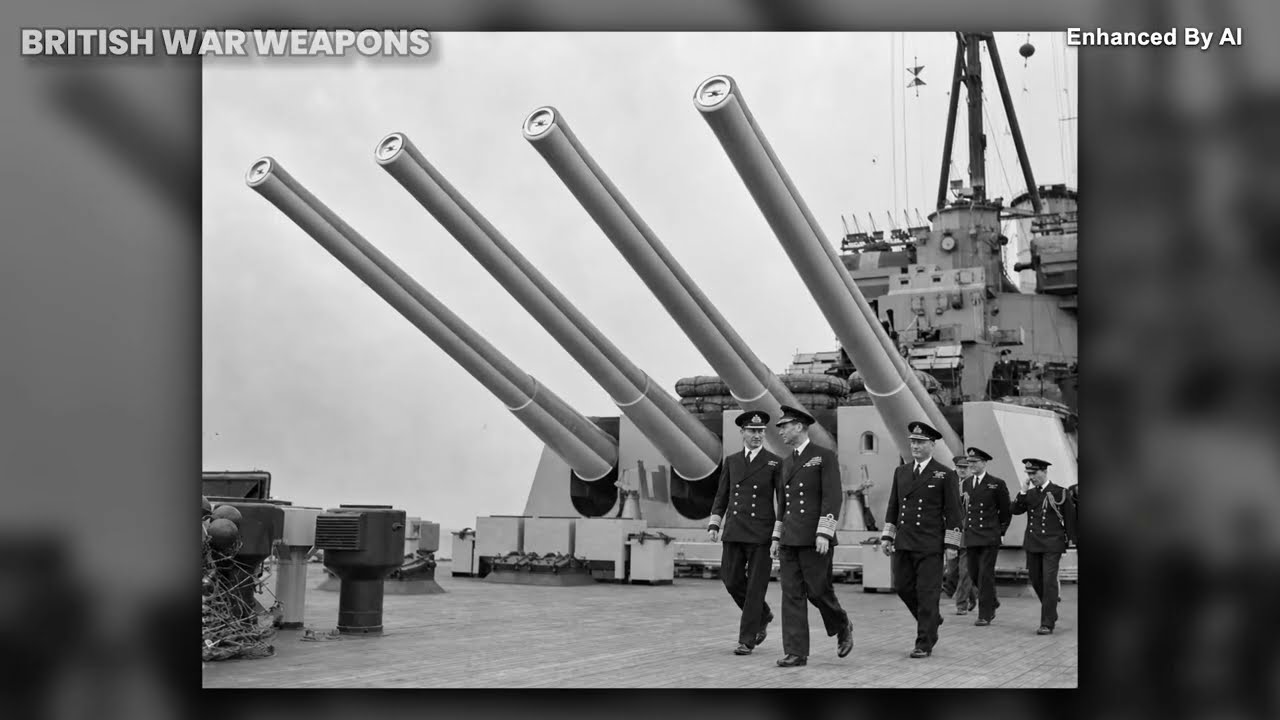
It genuinely helps the channel grow. Right. Let us get into the battle. Just before midnight on the 21st of May, the Prince of Wales slipped out to join the battlecruiser HMS Hood. The two ships steamed under Vice-Admiral Lancelot Holland, ordered to intercept the Bismarck and her companion, the cruiser Prinz Eugen, south of Iceland.
Contact came at dawn on the 24th of May. A little before 6:00 in the morning, the Hood opened fire and the Prince of Wales followed half a minute later. The range, some 25,000 yd. Spray from her own bows soaked the rangefinders in her forward turrets, forcing her gunnery officer, Lieutenant Commander Colin McMullen, to rely on the director high above the bridge.
Almost at once, the curse of the turrets struck. According to the Admiralty gunnery report, the number one gun of the forward four-gun turret went out of action after the very first salvo. A defect deep in the shell handling system had jammed it. Inside the turrets, the fitters and the ship’s own ordnance men fought back, beating seized rammers into life with heavy blows and working levers by hand at every stroke to keep the shells coming.
Then came catastrophe, though not for the British battleship. At 1 minute past 6:00, a German salvo found the Hood. A 15-in shell plunged through her thin deck armor and reached a magazine. The Hood erupted. A column of flame rose hundreds of feet. The ship broke in two and she sank in around 3 minutes.
Of her crew of over 1,400, only three men survived. Vice-Admiral Holland went down with his flagship. Now, the Prince of Wales stood alone against the Bismarck with her guns failing one by one. And here is the part the legend so often forgets. Even crippled, she was hitting. Of the 18 salvos she managed, the Prince of Wales scored three hits on the Bismarck.
One of those hits changed the war. A 14-in shell struck the Bismarck below her armor belt forward and tore open her fuel tanks. As the naval historians Garzke, Dulin, and Jurens describe it, the German ship was suddenly deprived of the use of more than 1,000 tons of fuel oil.
With forward compartments flooded by a mixture of oil and seawater, the Bismarck began to trail a long betraying slick of oil across the ocean. But the Prince of Wales paid for those hits. The Bismarck and the Prinz Eugen turned their fire on her and struck her seven times. One 15-in shell crashed through the bridge, passed clean across the compass platform, and went out the other side without exploding.
Almost every man on that bridge was killed. Captain Leach was one of only two who lived. Several other German shells that struck the ship also failed to detonate. A stroke of fortune that helped keep her afloat. With the Hood gone, his bridge a slaughterhouse, and his main armament reduced at one point to barely half its number, Leach made smoke and turned away.
Some accounts claim she was down to just two working guns, but the Admiralty report does not support so low a figure. He broke off to fight another day. It was the right call. How did the British 14-in truly compare to the German 15-in it faced that morning? Honestly, the German gun had real advantages.
The Bismarck’s 15-in fired a heavier shell at a higher velocity, giving it a flatter trajectory and better penetration of vertical armor at fighting range. German gunnery was famously precise, and the Bismarck proved it by destroying the Hood with effectively a single accurate salvo. The British gun answered with different strengths.
Its shell carried a proportionally larger bursting charge, and its accuracy and barrel life were excellent. At long range, its steeper angle of descent helped it punch through enemy decks. It was not the most powerful battleship gun of the war. In raw hitting power, the 14-in was the lightest armed of all the modern capital ships of its era, and the troublesome turrets were a genuine weakness.
The comparison with the Americans tells the real story. The first United States fast battleships were themselves designed around 14-in guns in four-gun turrets, almost identical in concept to the British ships. When Japan refused to accept the treaty limit, the Americans were free to switch to 9 16-in guns.
Britain, having already cut her steel, kept her 14-in and honored the agreement. The Prince of Wales went to war under gunned, not because British engineers could not build bigger, but because Britain kept its word when others did not. And as that battle proved, a 14-in shell in the right place was still enough to [ __ ] the pride of the German navy.
The consequences of those hits rippled out across the entire Atlantic. Starved of fuel, leaking oil, and unable to refuel safely, the German commander, Admiral Lutjens, concluded that the raiding mission was finished. He could no longer hunt convoys. He turned the Bismarck towards occupied France and the safety of a dockyard.
His own flag captain, Ernst Lindemann, had wanted to chase down and finish the wounded Prince of Wales, but Lutjens refused. That turn towards France was fatal. The Royal Navy clung to the oil trail. On the 26th of May, antiquated Fairey Swordfish biplanes from HMS Ark Royal flew into a gale and put a torpedo into the Bismarck’s stern, jamming her rudders hard over.
Unable to steer, she could only circle, waiting for the British battle fleet. On the morning of the 27th of May, HMS King George V and HMS Rodney battered her into a blazing wreck. Of more than 2,200 men aboard, only 116 were pulled alive from the sea. The Prince of Wales never sank the Bismarck. She did something arguably more important.
With faulty guns and civilians at her machinery, she landed the wound that turned a deadly commerce raider into a hunted crippled ship running for home. Think back to that gray morning and the picture of a battleship sailing to meet the enemy with her builders still aboard, mending her even as she fought.
By every reasonable measure, the Prince of Wales should not have been there. Her guns were unreliable, her crew were green, her trials were incomplete. She was in the truest sense unfinished and it did not matter. The men in those turrets, sailors and fitters together, kept just enough of her guns in action long enough to land three shells that altered the course of the war at sea.
The Bismarck, the most powerful warship in the world, was doomed by a ship that was barely ready to fight. That is the lesson British engineering wrote in steel that morning. A weapon does not have to be perfect. It only has to work when it matters most. And if this story has stirred something in you, you can live it for yourself.
Head to World of Warships using my link in the description, claim the bonus code Impact Force, and take the Bismarck, the Prince of Wales, and the new Isoroku Kancolle into battle. I shall see you out on the water.