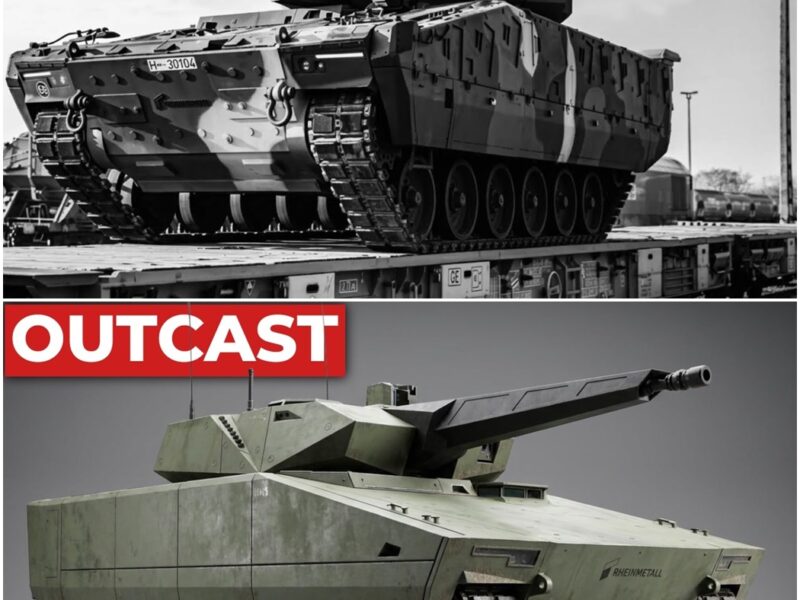
The ‘Unproven’ German IFV That Lost Australia, Then Conquered Every Other Battlefield D
June 2018, Eurosatory Exhibition Center, Paris Nord Villepinte, northern France. A tracked vehicle rolls out of the shadows and onto the exhibition floor. It moves under its own power, slow and deliberate, filling the hall with the low mechanical rumble of a 44-ton machine getting comfortable in the new space.
The people watching step back, not out of fear, out of instinct. Because the thing in front of them does not look like anything they have seen before. It is too large to be a scout, too angular to be a tank. Its turret is tall, its hull is wide, and the gun mounted above the crew compartment is angled slightly upward, as if the vehicle is already looking for something to engage.
The tracks are broad, the hull is clean. There are no visible bolt-on additions, no retrofit armor panels bolted over older plating, no evidence of a design that grew beyond its original intentions. Everything about this machine suggests it was designed for exactly this weight, exactly this configuration, from the first drawing.
The critics were already lining up before the engine cooled. No combat record, no operational history, no nation had ever fielded it, no crew had ever taken it into a real battle and brought it home. It was a clean sheet of paper, a private venture from a German arms manufacturer betting that the old way of building infantry fighting vehicles was finished, and that the armies of the world were ready for something different.
They called it unproven. They said it was a gamble. They said established platforms, vehicles with decades of service history and real combat kilometers under their tracks, would always beat a newcomer when real money was on the table. They were wrong. It lost the largest infantry fighting vehicle contract in Australian history. That part is true.
But from that single defeat, it went on to secure contracts across Europe and beyond worth more than 9 billion euros. It was chosen by Hungary, by Romania, by Italy. It entered field testing in Ukraine. It became a finalist for the United States Army’s program to replace the Bradley.
In less than eight years, a vehicle with no combat pedigree at all became one of the most commercially successful infantry fighting vehicles ever offered for sale. Its name is the Rheinmetall Lynx KF41, and it may be the most consequential tracked vehicle program of the 21st century. To understand what the Lynx actually is, you need to understand the problem Rheinmetall was trying to solve in the years leading up to 2016.
By the mid-2010s, the global infantry fighting vehicle market was dominated by platforms designed in the 1970s and 1980s. The German Marder, first fielded in 1971. The American Bradley, which entered service in 1981. The Russian BMP-3, introduced in 1987. The Swedish CV90, first delivered in 1993.
These were proven capable machines. Armies trusted them. Armies had fought and bled with them across multiple decades and multiple continents, but they were aging. Their internal volumes were constrained by the assumptions of the era in which they were designed. The growth margins, the reserve space, and weight capacity for future upgrades were largely exhausted.
Adding modern protection packages, new sensors, active protection systems, or heavier armament meant tearing out old equipment to make room. Some platforms had been upgraded so many times that the original design was barely recognizable underneath the additions. The Bradley, for instance, had grown from roughly 22 tons in its original form to close to 37 tons in its most modern configuration, and it was running out of headroom.
Rheinmetall looked at that landscape and made a deliberate decision. Instead of modernizing an existing platform, they would build a new one from the ground up. Not a replacement for the Marder, not an evolution of any existing design. A clean architecture, purpose-built to absorb the weapons, sensors, and protection levels that armies would need for the next 30 years without having to gut the vehicle every time a new threat emerged.
The lighter KF31 was shown publicly at Eurosatory in June 2016. Two years later, the KF41 followed. The designations were not arbitrary. They denoted weight class. The KF41 was designed to operate at roughly 41 tons empty and up to 44 tons in a full peer combat configuration with reserves for heavier protection if the threat demanded.
The letter stood for Kettenfahrzeug, tracked vehicle, direct, unambiguous, exactly like the machine itself. Ben Hudson, global head of Rheinmetall’s vehicle systems division, stood before the press at the 2018 unveiling and called the vehicle a veritable Swiss Army knife. He was not wrong about what the Lynx could do.
He was perhaps slightly optimistic about how quickly the world would be ready to trust something it had never seen fight. The engineering at the heart of the Lynx KF41 is built around a single principle that separates it from almost every other infantry fighting vehicle on the market, modularity.
Not as a marketing term, not as a features list, as a structural philosophy running through every major system on the vehicle. The Lynx separates into two distinct architectural layers. The first is the basic vehicle, a common drive module containing the hull, the powertrain, the baseline protection, and the crew positions.
The second is the mission kit, an interchangeable upper layer that determines what the vehicle does. Rheinmetall claimed a full role change from infantry fighting vehicle to command post, reconnaissance platform, armored ambulance, or repair and recovery variant could be completed in roughly 8 hours. They claimed that across the entire Lynx family, more than 70% of components were common between variants.
This was not merely an efficiency argument, it was a logistics argument. An army that fields Lynx in multiple variants carries one spare parts inventory, trains one maintenance workforce, and operates one common digital backbone across an entire fleet. The cost implications over a 30-year service life are significant, not in the purchase price, but in the through-life costs that procurement committees increasingly factor into their calculations.
The power plant driving the KF41 is a Liebherr six-cylinder turbocharged diesel producing 850 kW equivalent to 1,140 horsepower. That engine moves 44 tons to a road speed of 70 km/h. The operating range on a single fill of 900 L of fuel reaches approximately 500 km. The transmission, shared with the German Puma and the British Ajax, provides smooth power transfer across gradient, side slope, and obstacle.
The Lynx can climb a 60% gradient, cross a 2 and 1/2 m trench, and ford water to 1 and 1/2 m without preparation. Supashock suspension dampers, developed by a company in Adelaide, Australia, absorb the roughest terrain without compromising crew effectiveness or weapon accuracy. The weapons fit is built around the Lance 2.0 turret.
In standard configuration, the Lance mounts the Mauser MK 30-2 forward/ABM 30-mm auto cannon, a gas-operated weapon capable of controlled fire rates up to 200 rounds per minute with air burst capability against aerial and light armored targets. Flanking the turret are two configurable mission pods, each capable of carrying a pair of Rafael Spike LR 2 anti-tank guided missiles effective to ranges beyond 3,000 m.
A coaxial 7.62-mm machine gun handles close dismount protection. The elevation range of +45 to -10° allows engagement of a low-flying aircraft, helicopters, and rooftop positions in urban terrain. An alternate fit replaces the 30-mm with the Wotan 35-mm cannon firing the standard round used across NATO ground and air defense systems, creating a shared logistics chain with allied air defense assets in the field.
The protection architecture is modular in the same way as every other system on the vehicle. The baseline hull provides a protected crew cell against medium-caliber rounds and mine blast with a double floor, decoupled seats, and a full spool liner. Additional armor packages, scalable to the threat level in the mission, can be fitted and removed in the field without returning the vehicle to a depot.
The optional Strike Shield active protection system adds a third-generation hard-kill capability against rocket-propelled grenades and anti-tank guided missiles. Laser warning sensors and acoustic sniper detection systems feed into a fully networked situational awareness picture, giving the crew 360° coverage without exposing themselves to fire.
The digital backbone runs on NATO generic vehicle architecture, an open standard allowing third-party systems to be integrated without a complete software rewrite. Up to three crew and eight fully equipped dismounts can be carried. The commander and gunner can independently acquire and engage separate targets simultaneously, and the vehicle carries the electrical and physical growth margin to absorb loitering munitions, unmanned aerial vehicles, and electronic warfare systems as those capabilities mature. This is what Rheinmetall brought to Australia in 2019. Now, before moving into what happened in that competition and what came after, if you are finding this breakdown of the Lynx KF41 valuable, hit subscribe. It takes a second, costs nothing, and helps this channel keep producing content at this level. Australia’s Land 400 Phase 3 program was one of the most consequential armored vehicle competitions of the decade. The Australian Army needed to replace its aging M113AS4
armored personnel carriers, a Vietnam era fleet that had been kept alive through successive upgrades, but had reached the absolute limit of its operational relevance. The replacement would be an infantry fighting vehicle capable of operating alongside the Abrams tank in a high-intensity conflict, carrying a full infantry section into contact, and providing direct fire support in the most demanding environments Australia could anticipate.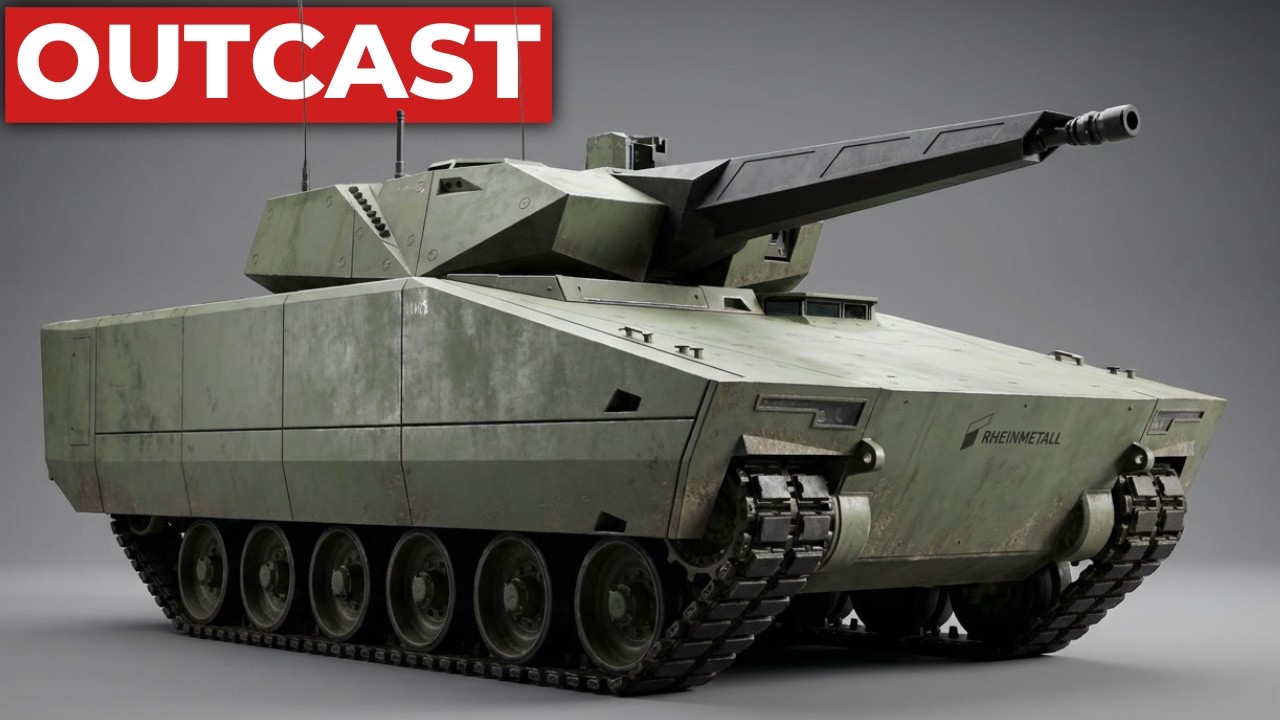
The request for tender was released in August 2018. Four vehicles entered: the Rheinmetall Lynx KF41, the Hanwha AS21 Redback, the General Dynamics Land Systems Ajax, and the BAE Systems CV90. The Ajax was assessed as not meeting requirements. The CV90 was assessed as too expensive. In September 2019, the Lynx and the Redback were shortlisted.
This was a moment of significant confidence for Rheinmetall. They had already won the Land 400 Phase 2 contract in 2018, supplying 211 Boxer combat reconnaissance vehicles to the Australian Army. They had built a factory on Australian soil, the Military Vehicle Centre of Excellence at Redbank, Queensland.
A 170 million Australian dollar facility opened in October 2020 was already producing Boxer vehicles for delivery. When the Lynx won Phase 3, the assumption in the industry was that it would roll off the same production lines, in the same facility, employing the same workforce. The risk mitigation activity contracts signed with both finalists required each company to deliver three trial vehicles for an extensive evaluation program.
Rheinmetall’s contract was worth approximately 50 million Australian dollars for 2 years, from late 2020 through 2021. Both vehicles were tested across Australia. Hot weather trials, desert mobility, jungle conditions, firepower demonstrations at Puckapunyal, Victoria, where both vehicles engaged targets from 300 m to beyond 2,000 m, blast trials, survivability trials.
One vehicle from each contender was blown up to test its crew protection under real-world detonation conditions. The results were close, genuinely close. Defence Connect reported that the Redback had performed marginally better than the Lynx, but that Defence had deferred the final decision to government because both vehicles were assessed as suitable.
Both were considered capable of meeting the requirement. The distinction between them was not a gap, it was a margin. Then the April 2023 Defence Strategic Review changed the mathematics. The original procurement of up to 450 vehicles was cut to 129, a single mechanized battalion. The financial and strategic calculus of the entire competition shifted overnight on 27th of July 2023.
Australian Minister for Defense Industry Pat Conroy announced Hanwha Defense Australia as the preferred tenderer for Land 400 Phase 3. The contract value was between 5 billion and 7 billion Australian dollars. The Redback would be built in Geelong, Victoria. The first vehicles would arrive in early 2027.
Rheinmetall Lynx had lost. There was no formal protest, no legal challenge, but the sting was real. Rheinmetall had invested years and hundreds of millions of dollars in their Australian presence. They had built the factory. They had hired the workforce. They had sourced Australian components from Adelaide, Albury, and Melbourne.
And they had lost to a Korean vehicle backed by Israeli sensors, built in an electorate represented by Deputy Prime Minister Richard Marles, who had formerly recused himself from the decision. The opposition was unconvinced. Shadow Minister for Defense Industry Philip Thompson stated publicly that the decision was not about what war fighters needed.
The 2026 report from the Australian National Audit Office found the procurement only partly effective. It found that defense had moved away from its original intent of pursuing a platform with high technical readiness. It found that very high technical risks related to the Redback’s mobility and lethality capabilities remained unresolved as of February 2026.
It warned that delivering 129 fully capable vehicles by the end of 2028 would be, in its precise language, a significant, if not impossible, challenge. The report did not vindicate the Lynx, but it cast a long shadow over the decision that had rejected it. What happened next is the part of the Lynx story the critics had not prepared for.
Hungary had already moved. In September 2020, Rheinmetall signed a contract worth more than 2 billion euros for 218 vehicles, including 209 Lynx KF, 41 infantry fighting vehicles in seven variants. The first vehicles were built in Germany. The remainder followed from a new Rheinmetall production plant in Zalaegerszeg.
Full-rate production commenced in July 2023, the same month Australia chose the Redback. The first Lynx KF41 was formally handed over to the Hungarian Defense Forces on the 31st of July 2024. The Lynx had its first customer. It was no longer unproven in the only way that mattered to a procurement committee. Romania followed after a competition that included the CV90, the Redback, and several other established European contenders.
Romania selected the Lynx KF41 in late 2025. The contract signed on 29th May 2026 under the European Union SAFE program covered 298 vehicles with an estimated program value of 5.7 billion euros. Production would be localized at Rheinmetall’s facility at Mediaș, embedding the Lynx into Romanian industrial capacity for decades.
Italy followed. The program, designated a 2CS, Army Armored Combat System, planned 1,050 infantry fighting vehicles across 16 variants at a projected cost rising to approximately 16 billion euros over the life of the program. The vehicle would be produced through a joint venture between Rheinmetall and Leonardo called Leonardo Rheinmetall Military Vehicles with approximately 60% Italian industrial work share.
The first firm contract was signed in November 2025 for 21 vehicles. Four of them were delivered to the Italian Army at Montelibretti on 27th January 2026. The Lynx had entered Italian service. It was building toward becoming one of the largest armored vehicle programs in Italian military history.
Ukraine received its first Lynx for field testing in late 2024. The vehicles delivered were Hungarian-built KF41s. Agreements for localized Ukrainian production followed. For a vehicle accused of having no operational exposure, the Lynx was now operating in the most intense conventional land warfare environment since the Second World War.
In the United States, the Army’s XM30 program to replace the Bradley was one of the most technically demanding infantry fighting vehicle competitions ever conducted. In August 2023, Rheinmetall’s Lynx-based design was selected to advance to the prototype phase, competing directly against a General Dynamics Land Systems design.
The vehicle that critics had called unproven was now a finalist to replace the most combat experienced infantry fighting vehicle in the history of the United States Army. The comparison with established rivals tells the full story of what the Lynx represents. The German Puma is arguably the most capable legacy infantry fighting vehicle in production.
But in December 2022, 18 Pumas assigned to a NATO high readiness exercise were grounded in the first week due to cascading technical failures, a public disaster for German procurement and the vehicle’s export prospects. The Puma is exceptional when it works. It is also rigid, expensive, and difficult to upgrade without substantial redesign.
The CV90 has been in service since 1993, has been combat tested in Afghanistan, and was photographed in operational use in Ukraine. That record is real and it matters, but the CV90’s growth margin is largely exhausted. The latest Mark IV is a significant upgrade, but it is working within the constraints of a hull that was designed 30 years ago for threats that have since changed fundamentally.
The Bradley’s combat record is without equal among Western infantry fighting vehicles. Iraq, Kuwait, Syria, Ukraine. No Western platform has spent more cumulative time in actual ground combat. But the Bradley’s running out of room for growth. The United States Army has spent the better part of two decades searching for its replacement, and that search led eventually to Rheinmetall’s doorstep.
The Lynx offers none of that history. What it offers instead is headroom, 6 tons of payload growth margin, a digital architecture that absorbs new systems without rebuilding from scratch, a modular turret swappable between the 30 and 35 mm cannon on the same hull, a hull that carries eight fully equipped dismounts without squeezing, a protection architecture that upgrades in the field rather than in a factory.
The argument the Lynx makes is not that it has survived the worst conditions armored warfare can produce. It makes a different argument entirely. It says that the vehicles which have survived those conditions are approaching the end of their ability to absorb what comes next. And that the armies which field a Lynx now will still be fighting effectively in 20 years time without having to start over.
June 2018, Eurosatory Exhibition Center, Paris Nord Villepinte, a tracked vehicle rolled out under its own power and the critics started counting what it lacked. No combat record, no operational miles, no proof. They were counting the wrong things. By the time the Australian National Audit Office was questioning the wisdom of the decision that rejected it, the Lynx KF41 had secured firm contracts worth more than 9 billion euros across Hungary, Romania and Italy.
It had entered field testing in an active war zone. It was a finalist to replace the Bradley. It had built manufacturing infrastructure on three continents and had anchored the industrial defense capacity of two European nations. It was not fast. It was not fortunate. It was not an accident.
Rheinmetall built a vehicle for armies thinking 30 years ahead, not 10. Hungary chose it. Romania chose it. Italy chose it. Ukraine tested it. The United States considered it seriously enough to fund prototype development. Australia chose differently. The vehicles replacing its aging fleet will be built in Geelong, not Redbank.
Whether that decision proves wise is a question the Australian National Audit Office has already begun to ask. The Lynx did not need Australia to prove anything. It proved it everywhere else.