The ‘Weird’ British Motorcycle That Dropped From The Sky To Kill NazisD
August 1942, a requisitioned mansion called the Fry, hidden in the Hertfordshire countryside about an hour north of London. Before the war, wealthy Londoners came here for weekend retreats. Now, Alsatian guard dogs patrol the perimeter, and the guests carry military ranks they earned by knowing how to solve problems that should not have solutions.
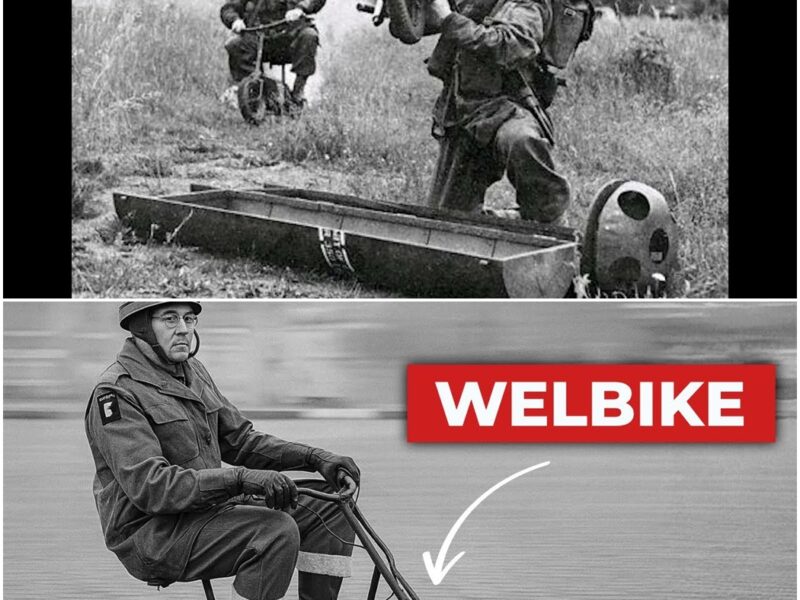
Inside, a Lieutenant Colonel named John Dolphin has just presented his superiors with what appears to be a practical joke, a motorcycle. Except this motorcycle weighs 70 lb, runs on an engine smaller than most lawnmowers, and folds up to fit inside a metal tube roughly the size of a dust bin.
The handlebars swing inward. The seat telescopes down. The whole contraption compresses into something you could shove under a bed. The officers watching the demonstration do not laugh. They have seen what comes out of this building. Silenced assassination pistols, oneman submarines designed to attach limpit mines to enemy ships, explosive coal.
The things designed at station 9 tend to look ridiculous right up until the moment they start working. Dolphin explains the concept. British paratroopers jump from aircraft, land behind enemy lines, and immediately need transportation. Every second spent walking is a second the enemy uses to organize a response.
The solution is a motorcycle that drops from bombers inside a standard parachute container, hits the ground, and becomes ridable in 11 seconds flat. The officers approve production. By wars end, 3,641 of these machines will roll off the assembly line. They will deploy at Anio, Normandy, and Arnum. They will become one of the most ingenious failures of the entire war.
A machine so perfectly designed for an impossible brief that it achieved everything asked of it and still proved nearly useless in combat. This is the Wellike, the weird British motorcycle that dropped from the sky to give paratroopers instant mobility behind enemy lines. And the reason it matters has nothing to do with how many operations it actually supported.
The problem that created the well bike started on the island of Cree in May 1941. German paratroopers launched Operation Mercury, the largest airborne assault in history up to that point. They suffered catastrophic casualties, losing over 4,000 men in a single week. But they took the island. The reason they took it came down to mobility.
German Fulsher Yaga brought lightweight motorcycles and even small tracked vehicles that could be delivered by transport aircraft and gliders. Once on the ground, German forces moved fast enough to overwhelm scattered defenders before they could consolidate. British forces on Cree had no equivalent capability.
Paratroopers landed and then walked, which meant they fought peacemeal and lost. British planners drew the obvious conclusion. Airborne forces needed instant transportation. But the solution had to fit within brutal constraints. Standard British parachute containers measured just 51 in long, 15 in in diameter, and 12 in deep. Anything dropped to paratroopers had to squeeze inside that space.
The container would fall from aircraft at around 600 ft deployed on a static line parachute and land in potentially hostile territory where every second counted. The engineering challenge seemed impossible. Design a functional motorcycle that fits inside a tube smaller than most suitcases. Make it light enough that a single soldier can carry it.
Make it simple enough that a man under fire can assemble and ride it without instructions. Make it cheap enough that losing it to enemy action does not matter. Station 9 existed precisely for impossible challenges. Officially designated the interervices research bureau, this S SOE facility operated from the Fther state under conditions of absolute secrecy.
The same workshops that created the Wellrod silenced pistol designed specifically for assassination missions in occupied Europe now turned their attention to miniature transportation. Lieutenant Colonel John Robert Vernon Dolphin conceived the original idea. Born in 1905 near Chester, Dolphin was an engineer who owned a 1,00 C aerial square 4 motorcycle, a machine that suggests he understood both the practical and emotional appeal of two wheels.
His insight was deceptively simple. Start with the exact dimensions of the container, work backwards from there. Harry Lester, described in records as a former racing bike engineer, translated Dolphin’s concept into working metal. Lester selected the Villar’s Junior Deluxe 98cc engine specifically because its horizontal cylinder configuration minimized height when the machine folded.
The engine produced 1.5 horsepower at 3,750 revolutions per minute. For comparison, a modern mobility scooter produces more power. The design eliminated everything non-essential. No suspension whatsoever, neither front nor rear, no lights, no front brake, only a rear drum. minimal saddle padding, 10-in wheels that kept the profile low, but sacrificed any pretense of off-road capability, a singlese transmission with centrifugal clutch meant no gears to shift, but also no ability to crawl up steep inclines or accelerate quickly. The fuel system presented a unique problem. The tank sat below the carburetor, making gravity feed impossible. Lester’s solution was elegant. A hand pump built into the tank pressurized the fuel system. According to training manuals, tanks could be pre-pressurized before drops to reduce setup time. Though how consistently this worked under actual combat conditions
remains unclear. Unfolded, the well bike measured 52 in long, 21 in wide, and 31 in high. Folded, it compressed to 28 in x 16 in x 12 in, just fitting inside the CLLE container at an angle with the rear wheel positioned against the base. The whole machine weighed 70 lb dry, roughly the same as a heavy suitcase.
According to training documentation, a soldier could unfold the well bike and have it running in 11 seconds. Handlebars swung outward on spring-loaded pins and locked. The saddle pulled up on a telescopic tube, footrests folded out. Though, as multiple sources note, that 11-second figure likely represents optimal training conditions rather than the fumbling reality of assembling unfamiliar equipment while under enemy fire.
Excelsia Motor Company of Tyley Birmingham won the production contracts. A fitting choice given they claimed to be Britain’s first motorcycle manufacturer. Having produced their first motorcycle in 1896, the assembly line achieved remarkable efficiency. Frame, engine, and all components were painted in a single operation while still attached.
Rubber handlebar grips were replaced with brass and canvas due to wartime material shortages. The first contract in August 1942 ordered 1,200 Mark1 machines at £2618 shillings each. That is roughly £1,400 in today’s money designed explicitly as expendable equipment. A second contract added 1,400 M2 machines with rear mud guards.
A third brought another 1,241 units with improved fuel tanks. Production peaked at 3,641 complete well bikes, plus one prototype and 12 pilot models. A fourth contract for nearly 7,800 additional machines was cancelled in June 1943. By then, larger gliders could deliver proper motorcycles like the Royal Enfield Flying Fleet, making the Wellbik’s painful compromises less necessary.
Now, before we see how this performed in combat, if you are enjoying this deep dive into British engineering, consider subscribing. It takes a second, costs nothing, and helps the channel grow. Right back to what happened when the whale bike met the enemy. The wellbike first saw combat during the Anzio landings in January 1944.
Commandos and Royal Marines brought them ashore during beach operations, notably not parachute dropped. This ground assault delivery avoided the fundamental problem that would plague the Wellike throughout its service. That problem was physics. The CLLE container with well bike inside weighed significantly more than the paratrooper jumping beside it.
Containers fell faster and landed potentially miles away from their intended users. This meant paratroopers had to search open drop zones for their motorcycles while Germans shot at them. As one contemporary assessment noted, soldiers wandering drop zones looking for motorcycle containers rather defeated the purpose and exposed themselves to enemy fire.
On D-Day, the sixth airborne division deployed well bikes during Operation Tonga on the eastern flank of the Normandy landings. Photographic evidence shows well bikes being taken ashore rather than dropped, suggesting glider or landing craft delivery proved more practical than the original parachute concept.
Royal Marines commandos also brought them for beach operations. Operation Market Garden in September. 1944 represented the largest deployment. Wellbikes went in with the British First Airborne Division and the first Polish Independent Parachute Brigade at Arnham. Photographic evidence shows Polish paratroopers with well bikes during the operation.
According to afteraction assessments, many units failed to reach their intended users due to scatter from air drops or rapid breakdowns. The terrain problem proved catastrophic. Those 10-in wheels necessary to meet the folding dimensions clogged with mud immediately. One source describes the well bike as virtually useless away from a madeup road in the shellcrated rain soaked fields of the Netherlands.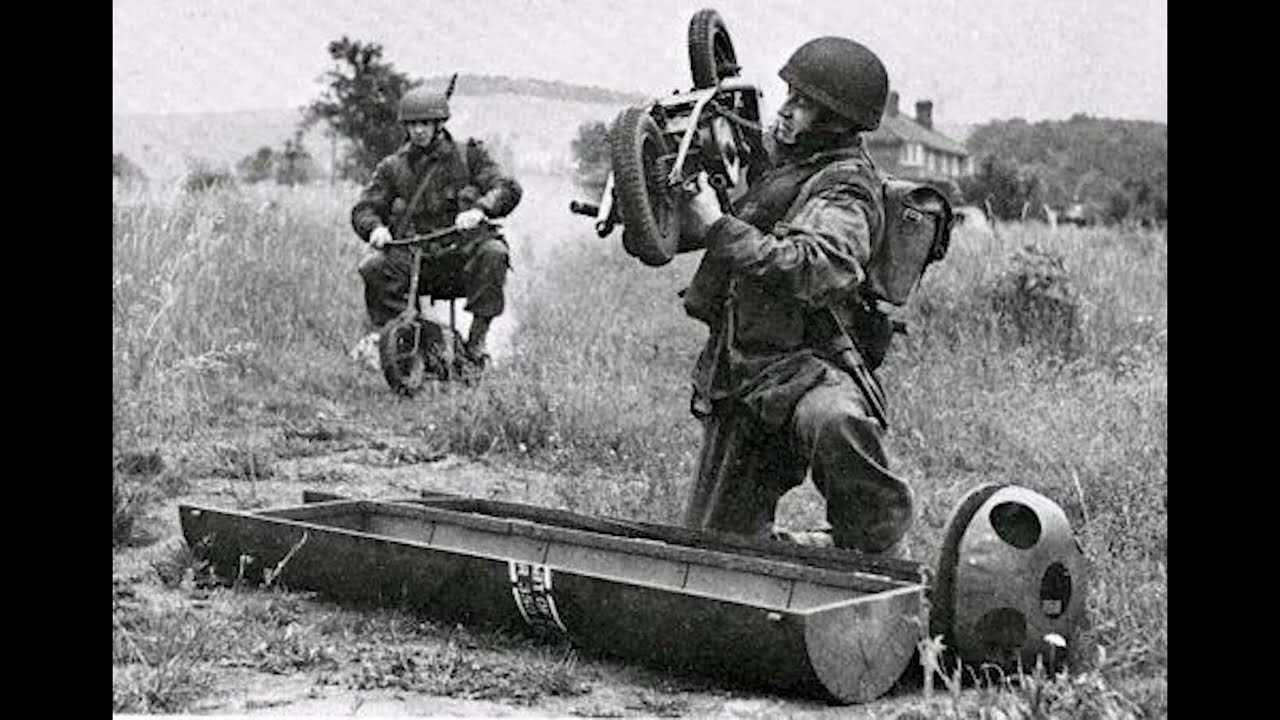
This was not a minor inconvenience. Many well bikes were abandoned by troops who found it easier to continue on foot. Here is perhaps the crulest irony of the entire wellbike program. The machine was designed at station 9 specifically for SOE covert operations behind enemy lines.
Agents would parachute into occupied Europe, retrieve their wellbike from its container, and speed away to conduct sabotage missions. The SOE barely used it. Multiple sources confirm the same assessment. The well bike proved noisy and conspicuous, used scarce petrol, and was of little use on rough ground.
For agents trying to avoid detection in occupied France or Norway, a sputtering two-stroke engine announcing their presence was exactly what they did not need. The Wellbike found its most successful role far from the front lines. RAF ground crews discovered that the machine was perfect for fing messages and personnel around large airfields.
The limited range was not a problem on bases, and the small size made storage easy. Air crew, particularly those stationed in the Far East, would stow away a well bike if they could find one. The motorcycle designed for covert operations ended up mostly shuttling paperwork between hangers. Comparing the well bike to its equivalents reveals the philosophical differences between Allied nations.
The American Kushman model 53 airborne scooter weighed 255 lb, nearly four times heavier than the well bike, but it delivered 4.6 horsepower instead of 1.5, hit 40 mph instead of 30, and featured 20in balloon tires that actually worked on rough terrain. It could tow a utility cart.
The 82nd and 101st Airborne used 4,734 of them after D-Day. A contemporary British Army evaluation described the Kushman as more purposeful than the British Wellike. The German Kettrad was not really comparable. This halftrack tractor weighed nearly 2,900 lb with a 36 horsepower Opal engine that could hit 50 mph, carry three people, and tow artillery.
Germany did not optimize for size. They optimized for capability. Around 8,345 kettra were built delivered inside Junka’s transport aircraft or by glider. Britain optimized for compactness and expendability. America optimized for capability and ruggedness. Germany optimized for multi-roll versatility. Each approach reflected national industrial capacity and tactical doctrine.
Britain had fewer resources and designed accordingly. The Wellbike was clever engineering constrained by brutal necessity. Lieutenant Colonel John Dolphin retired from military service after the war and founded the Corgi Motorcycle Company Limited in 1946. Working with Brock House Engineering of Southport, he produced a civilian version of his wartime creation.
Between 1947 and 1954, 27,050 corgis rolled off the production line. The civilian corgi featured a heavier, stronger frame since weight no longer mattered. A larger conventional fuel tank sat between the handlebars and saddle. Eventually, a Kickstarter replaced the hand pump system. The American market version called the Indian Papoose sold through department stores in dark maroon.
The Corgi succeeded initially in austerity era Britain. Fuel efficient, practical, but it ultimately failed against Italian competition. Vesper and Lamberta scooters offered better styling, performance, and reliability for similar prices. Production ceased in October 1954. Dolphin himself went on to become chief engineer at the atomic weapons research establishment from 1951 to 1957.
Quite a career progression from designing tiny folding motorcycles to engineering nuclear weapons. The wellbikes influence proved more enduring than the machine itself. The concept of ultra compact foldable personal transportation directly inspired the Honda Monkey Bike of the 1960s and the Honda Moto Compo of 1981 to 1983. A folding scooter designed to fit in a Honda City car boot.
Every modern folding electric scooter owes something to Dolphin’s original insight. Start with the space available. Design backwards from there. Today, surviving wellbikes command premium prices from collectors. The Imperial War Museum London displays one described as probably the smallest vehicle in their collection.
Examples exist at the National Motor Museum at Bolio, the Australian War Memorial in Canra, the Musea Lame in Paris, and the International Spy Museum in Washington DC. Private collectors pursue them aggressively, running documented well bikes with provenence fetch significant sums at auction, while even unrestored projects attract serious bidding.
So, what do we make of the weird British motorcycle that dropped from the sky? The well bike achieved everything asked of it. fit inside a standard parachute container, weigh under 70 pounds, deploy in seconds, cost almost nothing, be expendable. By every metric of its design brief, the well bike was a complete success.
It was also nearly useless for its intended purpose. The container separation problem meant paratroopers could not reliably retrieve their motorcycles. The tiny wheels meant mud stopped it dead. The minimal engine meant rough terrain defeated it. The noise meant covert agents could not use it.
The machine designed to give instant mobility often delivered only frustration. But here is what matters. The wellbike represents something essential about British wartime engineering. When presented with an impossible problem, British engineers did not abandon the brief. They did not demand more resources or more time. They built something that met every specified requirement, tested it, refined it, and put 3,641 of them into production in under a year.
The fact that the requirements themselves were flawed does not diminish the achievement. Station 9 gave the War Office exactly what was requested, a 70B motorcycle that fit in a tube and could theoretically let a paratrooper ride away from a drop zone in seconds. That the real world proved less cooperative than the specifications anticipated was a failure of planning, not engineering.
The wellbike did not win the war. It probably contributed little to direct combat operations. But it proved that British engineers could solve any problem put before them, even impossible ones. And sometimes that proof of concept matters more than operational results. The same workshops that produced the well bike also produced the wellrod assassination pistol, which SOE agents actually used in occupied Europe.
The same mines that miniaturaturized a motorcycle also created explosive coal that destroyed German locomotives from the inside. Station 9’s legacy is not measured by any single device, but by the relentless, often unconventional creativity that characterized British special weapons development throughout the war. The Wellbike was weird.
It was impractical. It was very nearly pointless for its intended role, and it remains one of the most fascinating examples of British engineering under pressure ever created. A machine that achieved the impossible and discovered that the impossible was not quite what anyone needed. 70 lb 98cc 1.
5 horsepower dropped from 600 ft ready in 11 seconds. That is British engineering. Not always practical, but undeniably inventive.